第6章植民地化と経済の拡大Colonization and Economic Expansion
Mechanization機械化
In the late 1700s, western European nations began to adopt mechanization, the use of machines to replace the labor of animals and humans. Mechanization set the stage for the Industrial Revolution, a transition away from societies focused on agriculture and handicraft production to socioeconomic systems dominated by the manufacture of goods, primarily with machines.
英語のヒント
1700年代後半、西ヨーロッパの国々は、人間や動物の労働を機械で置き換える「機械化」を採り入れ始めた。機械化は産業革命の舞台を整えた。産業革命とは、農業と手工業生産を中心とする社会から、主に機械による財の製造が支配的となる社会経済制度への移行である。
People in many places, including China, Egypt, India, Greece, and Rome, had made limited use of machinery in the ancient past; however, most goods were produced by skilled artisans for local consumption. Beginning in the mid-1600s, the British enjoyed an agricultural revolution that allowed smaller numbers of farmers employing fewer farm laborers to produce a surplus of food, and that in turn led to a population increase.
英語のヒント
中国、エジプト、インド、ギリシア、ローマなど多くの地域では、古代から機械が限られた形で使われていた。しかし大部分の品物は、地元で消費するために熟練職人が生産していた。1600年代半ばからイギリスでは農業革命が進み、より少数の農民が、より少数の農業労働者を雇って余剰食料を生産できるようになった。これは次に人口増加につながった。
In the 1700s, entrepreneurs in England found a way to make use of unemployed or underemployed farm laborers and their families. These entrepreneurs provided farm families with raw materials and asked them to produce finished goods in their cottages, a system that became known as cottage labor. Rural women spun wool or flax into thread, and men then wove it into woolen cloth or linen. Some farm families made bonnets from straw. Other people made nails, knit hosiery, or made lace. The entrepreneur collected their finished products, paid them for their labor, and sold the finished goods in towns and cities. Because the farm laborers were not skilled artisans, they could not command high wages, and the entrepreneurs reaped great profits.
英語のヒント
1700年代、イングランドの事業家は、失業中、あるいは十分な仕事のない農業労働者とその家族を活用する方法を見つけた。農家へ原材料を渡し、家内で完成品を作るよう依頼したのである。この仕組みは家内労働として知られるようになった。農村の女性は羊毛や亜麻を紡いで糸にし、男性はそれを毛織物や麻布に織った。わらのボンネット帽を作る家族もいた。釘を作る者、靴下類を編む者、レースを作る者もいた。事業家は完成品を集め、労働の代金を払い、町や都市で販売した。農業労働者は熟練職人ではなかったため、高い賃金を要求することができず、事業家は大きな利益を得た。
In time, entrepreneurs began to gather laborers together in one location, a factory. This decision gave them greater control over production because they could hire managers to supervise the workers’ labor. It was also easier to install machines in factories than in laborers’ cottages (although laborers might be provided with or rent relatively small machines, such as knitting frames, for their cottages). Factories came to be concentrated in towns and cities. As work moved to urban areas, so too did men and women who could not find work on farms. By the late 1700s, British business owners, supported by government policies inspired by Adam Smith, were setting up factories and hiring many of these migrant workers.
英語のヒント
やがて事業家は、労働者を工場という一つの場所へ集め始めた。管理者を雇って労働を監督できるため、この決定は生産に対する支配を強めた。労働者の家より工場のほうが、機械を設置しやすくもあった。ただし、労働者が編み機など比較的小さな機械を支給されたり、借りたりして自宅で使う場合はあった。工場は町や都市へ集中するようになった。仕事が都市部へ移ると、農場で仕事を見つけられない男女も移住した。1700年代後半までに、アダム・スミスの思想に刺激された政府政策の支援を受け、イギリスの事業主は工場を設立し、これらの移住労働者を多数雇うようになっていた。
During the Industrial Revolution, factories increasingly relied on machine power, most importantly the steam engine. A steam engine uses heat to transform water into steam, which expands and drives a piston to perform work. Hero of Alexandria, in Egypt, produced the first steam engine when he created the aeolipile, a simple turbine that powered toys, around the year 70 CE. Steam engines remained little more than curiosities until 1698 when the English inventor Thomas Savery used the world’s first commercial steam engine to pump water out of mines and to supply water for industrial water wheels. By 1776, British factories were powering some of their operations with improved steam engines designed by the Scottish engineer James Watt.
英語のヒント
産業革命の間、工場はますます機械動力に依存するようになり、その中で最も重要だったのが蒸気機関である。蒸気機関は熱で水を蒸気に変え、その膨張によってピストンを動かし、仕事をさせる。エジプトのアレクサンドリアのヘロンは、西暦70年ごろ、おもちゃを動かす簡単なタービンであるアイオロスの球を作った際、最初の蒸気機関を生み出した。蒸気機関は長く珍しい仕掛けの域を出なかったが、1698年、イングランドの発明家トマス・セイヴァリが世界初の商業用蒸気機関を使い、鉱山から水をくみ出し、工業用水車へ水を供給した。1776年までには、スコットランドの技師ジェームズ・ワットが設計した改良型蒸気機関を用い、イギリスの工場は一部の作業を動かしていた。
Locomotives and boats powered by steam engines soon delivered raw materials to the factories and transported finished goods to consumers. In 1807, American inventor Robert Fulton began operation of the first successful commercial steamboats. In 1812, Matthew Murray, an English industrialist, opened the world’s first successful steam locomotive line. Several inventors produced steam-powered vehicles that could travel on roads, but the heavy weight of steam engines and the poor conditions of most roads doomed them to failure and kept steam engines in the factories, waterways, and railroads.
英語のヒント
まもなく蒸気機関で動く機関車と船が、工場へ原材料を届け、完成品を消費者へ運ぶようになった。1807年、アメリカの発明家ロバート・フルトンは、最初の成功した商業用蒸気船の運航を始めた。1812年には、イングランドの実業家マシュー・マレーが、世界初の成功した蒸気機関車の路線を開いた。複数の発明家が道路を走れる蒸気自動車を作ったが、蒸気機関の重さと大部分の道路の悪い状態のために、失敗を免れなかった。そのため蒸気機関は、工場、水路、鉄道で使われ続けた。
Industrialization, motivated and enabled by capitalism, created tremendous wealth for business owners and middle-class professionals, but their profits often came at a high cost to workers. The production of goods shifted from the handiwork of highly skilled middle-class artisans to mechanized production done by low-paid unskilled laborers. Workers did enjoy access to new consumer goods made cheaper by industrialization, but to afford those goods they had to work long hours, in difficult and often dangerous conditions. Perhaps most importantly, workers lost control over their working conditions. Farmers and artisans, particularly those who owned their land or shops, were free to decide how and when they worked, whereas factory owners carefully regulated every aspect of their workers’ professional and even personal lives. For example, the 1848 employee handbook for the Hamilton Manufacturing Company stated that “the company will not employ any one who is habitually absent from public worship on the Sabbath, or known to be guilty of immorality.”
英語のヒント
資本主義によって動機づけられ、可能になった工業化は、事業主と中流階級の専門職に莫大な富をもたらしたが、その利益はしばしば労働者の大きな犠牲の上に成り立った。財の生産は、高度な技能を持つ中流階級の職人の手仕事から、低賃金の未熟練労働者による機械生産へ移った。労働者も、工業化で安くなった新しい消費財を手にできた。しかしそれを買うには、厳しく、しばしば危険な条件のもとで、長時間働かなければならなかった。おそらく最も重要な点は、労働者が労働条件への主導権を失ったことだった。農民や職人、特に土地や工房を所有する者は、いつ、どのように働くかを自分で決める自由があった。これに対し工場主は、労働者の仕事のあらゆる面、さらには私生活まで細かく規制した。たとえばハミルトン製造会社の1848年の従業員手引きは、「安息日の公の礼拝を習慣的に欠席する者、または不道徳な行いをしていると知られる者を、会社は雇用しない」と定めていた。
Some workers rebelled against industrialization, which threatened their status as skilled laborers. Beginning in 1811, a secretive group of British textile workers calling themselves Luddites began destroying textile machinery, rioting, and setting fires in response to the industrialization of their workplaces (Figure 6.19). They took their name from the mythical Ned Ludd, a worker who supposedly destroyed a mechanized loom rather than submit to industrialization. As the Luddite movement grew, so did the legend of Ned Ludd, until some workers claimed that King Ludd lived in Sherwood Forest and fought corrupt industrialists, much as Robin Hood had opposed corrupt authorities during the Middle Ages. The Luddites did not argue in favor of a specific ideology or a grander purpose. They were simply angry that industrialization was destroying their traditional way of life, and they fought back with every tool at their disposal.
英語のヒント
熟練労働者としての地位を脅かす工業化に、反抗する労働者もいた。1811年から、自らをラッダイトと呼ぶイギリスの繊維労働者の秘密集団が、職場の工業化に抗議して、繊維機械を破壊し、暴動を起こし、火を放ち始めた(図6.19)。彼らの名は、工業化に従う代わりに機械織機を壊したとされる、伝説上の労働者ネッド・ラッドに由来する。ラッダイト運動が広がると、ネッド・ラッドの伝説も大きくなり、ついには、ラッド王がシャーウッドの森に住んで腐敗した実業家と戦っていると主張する労働者まで現れた。中世にロビン・フッドが腐敗した権力者に抵抗したのと、よく似ていた。ラッダイトは特定の思想や、より大きな目的を掲げていたわけではない。工業化が伝統的な生き方を破壊することに怒り、自分たちが使えるあらゆる手段で反撃したのである。
Luddites Revolt.ラッダイトの反乱
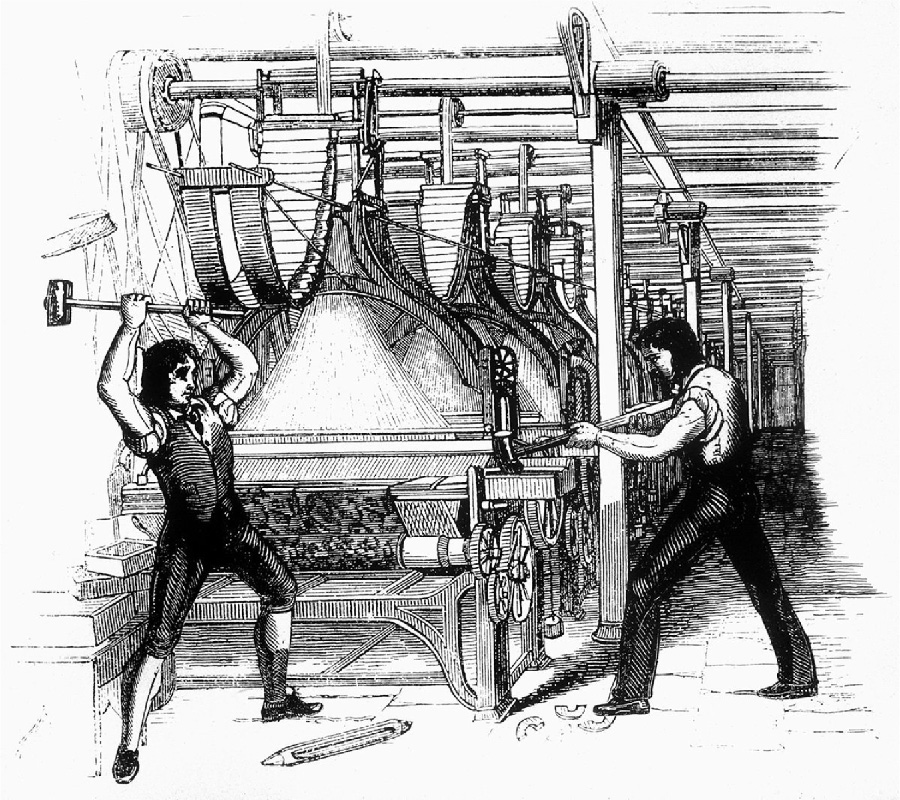
(credit: “Frame-breakers, or Luddites, smashing a loom” by Unknown/Wikimedia Commons, Public Domain) · Public Domain
Figure 6.19 Luddites were workers who opposed mechanization, primarily in the British cloth-making industry. This image depicting two Luddites breaking an industrial fabric-making frame was made in 1812. (credit: “Frame-breakers, or Luddites, smashing a loom” by Unknown/Wikimedia Commons, Public Domain)
図6.19 ラッダイトは、主にイギリスの織物産業で機械化に抵抗した労働者だった。工業用の織物製造機を壊す2人のラッダイトを描いたこの図は、1812年に制作された。(出典:作者不詳/ウィキメディア・コモンズ「織機を壊す機械打ち壊し人、ラッダイト」。パブリックドメイン)
British leaders reacted quickly to the Luddites, with some calling them a mob worthy of execution. In 1812, the poet and peer Lord Byron responded by pointing out that these same people worked the fields, produced the goods, and served in the armed forces of the British Empire. Byron argued that the mob “often speaks the sentiments of the people” and warned “it is the mob” that “enabled you to defy all the world and can also defy you when neglect and calamity have driven them to despair.” He urged the British government to respond to the protesting workers with “conciliation and firmness” rather than violence. Most British business and political leaders disagreed with Byron and worked to suppress the rebellion. Parliament made industrial sabotage a capital offense. British authorities hanged many Luddites and exiled more to prison colonies. By 1816, the industrialists had defeated the Luddites. Today, “Luddite” is often used as a generic description of anyone opposed to technological change.
英語のヒント
イギリスの指導者はラッダイトに素早く反応し、中には処刑に値する暴徒と呼ぶ者もいた。1812年、詩人で貴族でもあるバイロン卿は、それと同じ人々が畑を耕し、品物を作り、イギリス帝国の軍隊で働いていると指摘して反論した。バイロンは、暴徒は「しばしば民衆の感情を語る」と論じ、「あなたがたを世界全体に立ち向かわせた」のは「暴徒」であり、「無視と災厄が彼らを絶望へ追い込めば、あなたがたにも立ち向かえる」と警告した。抗議する労働者に対し、暴力ではなく「融和と毅然とした態度」で応じるよう、政府へ求めた。イギリスの財界・政界指導者の大半はバイロンに反対し、反乱の鎮圧を進めた。議会は産業設備の破壊を死刑に当たる犯罪とした。当局は多くのラッダイトを絞首刑にし、さらに多くを流刑植民地へ送った。1816年までに実業家側がラッダイトを打ち破った。今日「ラッダイト」は、技術の変化に反対する人を広く指す語として使われることが多い。