第14章冷戦期の紛争Cold War Conflicts
The Retreat of Communism: China共産主義の後退:中国
The excesses of the Cultural Revolution in China spelled the end of both Mao Zedong’s power and, ironically, the Chinese Revolution. By the time of Lin Biao’s death in 1971, China had suffered badly. The economy was in shambles. The government had difficulty fulfilling basic functions. As Mao retreated into depression and ill health, his role was increasingly taken over by “The Gang of Four,” consisting of Mao’s wife Jiang Qing, his chosen successor Wang Hongwen, Zhang Chunqiao, and Yao Wenyuan. However, they were primarily concerned with ensuring ideological purity and the continuation of “revolutionary” political thought. Crucial matters such as the economy were left in the hands of Premier Zhou Enlai.
英語のヒント
文化大革命の行き過ぎは、毛沢東の権力と、皮肉にも中国革命そのものの終わりを告げた。1971年の林彪の死までに、中国は深く傷ついていた。経済は混乱し、政府は基本的な機能さえ果たしにくくなっていた。毛が抑うつと病気に沈むと、妻の江青、後継者に選ばれた王洪文、張春橋、姚文元からなる「四人組」が、その役割をますます引き継いだ。しかし彼らは主に思想の純粋さと「革命的」政治思想の継続に関心を持ち、経済などの重要事項は周恩来首相に任された。
Zhou, however, was dying of cancer and needed help, so with Mao’s permission he returned Deng Xiaoping to power to assist him (Figure 14.20). Zhou and Deng managed the government and the economy, with more of the work falling to Deng as Zhou withdrew from public life. Following Zhou’s death in January 1976, the Gang of Four managed to oust Deng Xiaoping from power once more, but this time he did not remain away for long.
英語のヒント
しかし周恩来はがんで死に近づき、助けが必要だった。毛の許可を得て鄧小平を復権させ、補佐に当たらせた(図14.20)。両者は政府と経済を運営し、周が公の活動を退くにつれ、鄧が担う仕事が増えた。1976年1月の周の死後、四人組は再び鄧を失脚させたが、今回は長く権力から離れることにはならなかった。
Deng Xiaoping.鄧小平
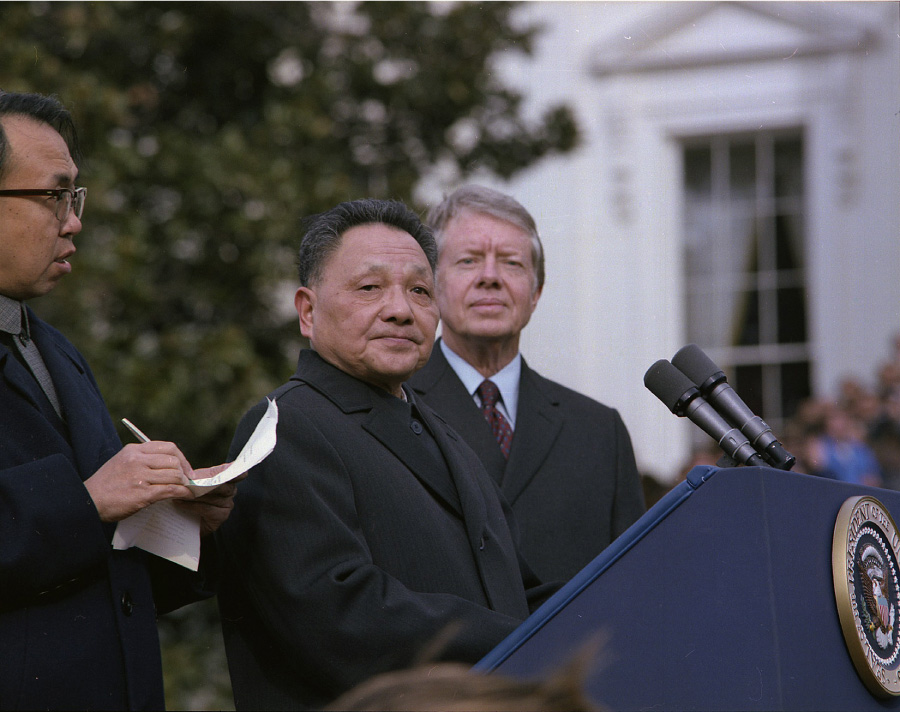
(credit: “Deng Xiaoping and Jimmy Carter at the arrival ceremony for the Vice Premier of China” by U.S. National Archives and Records Administration/Wikimedia Commons, Public Domain) · Public Domain
Figure 14.20 In 1977, Deng Xiaoping returned to a place of prominence in the Chinese government after being ousted from power during the Cultural Revolution. In this photo, President Carter welcomes him to the White House in 1979. (credit: “Deng Xiaoping and Jimmy Carter at the arrival ceremony for the Vice Premier of China” by U.S. National Archives and Records Administration/Wikimedia Commons, Public Domain)
図14.20 文化大革命で失脚した鄧小平は、1977年に中国政府の要職へ復帰した。写真は1979年、ホワイトハウスで彼を迎えるカーター大統領。(出典:米国国立公文書記録管理局「Deng Xiaoping and Jimmy Carter at the arrival ceremony for the Vice Premier of China」/Wikimedia Commons、パブリックドメイン)
Following Mao’s death on September 9, 1976, his successor Hua Guofeng had the Gang of Four arrested and Deng returned to power. Deng was made vice premier in 1977 and used his position to reverse the mistakes of the Cultural Revolution. In 1978, he replaced Hua as leader of China and argued that the country needed to focus on modernizing and building its economy instead of continuing to pursue revolution by following the teachings of Mao. He instituted a policy of Boluan Fanzheng (“correct the wrong/return to normal”), in which the reputations of those imprisoned were “rehabilitated,” and those still alive were returned to power. The Chinese system of higher education returned to normal as Deng reinstated entrance examinations, which had been suspended during the Cultural Revolution. He declared that scientists and intellectuals were deserving of respect because modernization could not proceed without their contributions.
英語のヒント
1976年9月9日の毛沢東の死後、後継者の華国鋒は四人組を逮捕させ、鄧小平が復権した。鄧は1977年に副首相となり、文化大革命の誤りを正すために地位を用いた。1978年には華に代わって中国の指導者となり、毛の教えに従って革命を続けるのではなく、近代化と経済建設へ集中すべきだと説いた。「誤りを正し正常に戻す」という撥乱反正の政策を行い、投獄された人々の名誉を回復し、生存者を復職させた。文化大革命中に停止されていた入学試験を復活させ、高等教育を正常化した。科学者や知識人の貢献なしには近代化できないため、尊重されるべきだと宣言した。
Deng also instituted a sweeping set of economic reforms based on the “Four Modernizations” of agriculture, industry, defense, and science and technology. Collective farms were broken up and entrepreneurs encouraged to start their own businesses. The country was opened to foreign investment, and foreign companies were invited to open Chinese branches. In the 1980s and 1990s, a few elements of capitalism were introduced. Private management of many state industries was allowed, and although the largest remained under government control, people’s incomes and the Chinese standard of living swiftly improved. Along with economic changes, alterations took place in foreign policy. In the 1980s, China decreased its support for revolutionary activity in other countries, with some exceptions, such as its support for anti-Soviet forces in Afghanistan and for Cambodians fighting the Vietnamese invasion. Beginning in the late 1980s, relations with the Soviet Union also began to improve, and trade between the USSR and China increased.
英語のヒント
鄧はまた、農業、工業、国防、科学技術の「四つの近代化」に基づく広範な経済改革を行った。集団農場を解体し、起業を促した。外国投資へ門戸を開き、外国企業の中国支店設立を招いた。1980〜1990年代には、資本主義のいくつかの要素を取り入れた。多くの国有事業の民間経営が認められ、最大級の事業は政府管理下に残ったものの、所得と生活水準は急速に改善した。外交も変化した。1980年代、中国は他国の革命活動への支援を減らした。ただしアフガニスタンの反ソ勢力や、ベトナムの侵攻と戦うカンボジア勢力への支援などは例外だった。1980年代末からはソ連との関係も改善し、貿易が増えた。
In 1980, Deng called for political reform as well. He criticized the cumbersome Chinese bureaucracy and called for term limits on political positions and a redrafting of the constitution. However, he had no intention of allowing opposition to the rule of the Chinese Communist Party (CCP). In 1986, university students began a series of protests in major Chinese cities. The government suppressed their actions, but in 1989 protests broke out again.
英語のヒント
1980年、鄧は政治改革も訴えた。非効率で扱いにくい官僚機構を批判し、政治的役職の任期制限と憲法の書き直しを求めた。しかし共産党支配への反対を認める意思はなかった。1986年、大学生が主要都市で相次いで抗議した。政府は抑え込んだが、1989年に再び抗議が起きた。
Beginning on April 17, students in Beijing gathered at Tiananmen Square to mourn the recent death of party official Hu Yaobang, who had supported them. Influenced by Western media, they called for democratic reform, an end to government censorship, greater rights to protest, and more money for education. They and other protesters also decried corruption in the CCP and what they perceived as mismanagement of China’s economy. Reforms had improved life for farmers, but industrial workers and urban dwellers had not benefited. In the coming weeks, some students marched through the streets in angry protest, while others refused to abandon the square. On the evening of June 3, 1989, tanks entered Beijing, and over the next several days armed troops and tanks cleared the square, killing anywhere from several hundred to several thousand people. On June 9, Deng denounced the students for attempting to overthrow the government. In other Chinese cities, the protests ended peacefully.
英語のヒント
4月17日から、北京の学生は自分たちを支持した党幹部胡耀邦の死を悼み、天安門広場へ集まった。西側メディアの影響を受け、民主改革、政府検閲の廃止、抗議する権利の拡大、教育予算の増額を求めた。学生や他の抗議者は、共産党の腐敗と、経済運営の失敗と考えるものも非難した。改革は農民の暮らしを改善したが、工業労働者や都市住民は恩恵を得ていなかった。その後数週間、怒って街を行進する学生も、広場を離れない学生もいた。1989年6月3日夜、戦車が北京へ入り、続く数日間に武装部隊と戦車が広場を排除し、数百人から数千人が殺された。6月9日、鄧は学生が政府転覆を企てたと非難した。他の都市では、抗議は平和的に終わった。
Section Summaryこの節のまとめ
In the 1980s, communism began to loosen its grip on parts of the world in which it had once been dominant. The Soviet Union found itself divided by the need to provide for its citizens at home, maintain control over its satellite states in Eastern Europe, fight a war in Afghanistan, and respond to the buildup of nuclear and conventional weapons that took place during the administrations of U.S. presidents Ronald Reagan and George H.W. Bush. Mikhail Gorbachev’s efforts to strengthen the Soviet Union through perestroika and glasnost proved unsuccessful. When the Warsaw Pact nations sought independence in the late 1980s, the Soviet Union was unable to respond as it once had, and faced with liberation movements in its own republics, the USSR disbanded in 1991. Although China did not turn its back on communism, the death of Mao allowed Deng to institute reforms that introduced elements of capitalism to the Chinese economy.
1980年代、共産主義はかつて支配的だった地域の一部で、その握力を緩め始めた。ソ連は、自国民を養うこと、東ヨーロッパの衛星国を支配すること、アフガニスタンで戦うこと、そしてレーガン、ジョージ・H・W・ブッシュ両政権の核・通常兵器増強に対応することの間で、力を分散させられた。ペレストロイカとグラスノスチによってソ連を強めようとするゴルバチョフの試みは成功しなかった。1980年代末にワルシャワ条約諸国が独立を求めても、ソ連は以前のように対応できなかった。自国内の共和国の解放運動にも直面し、1991年に解体した。中国は共産主義を捨てなかったが、毛の死によって、鄧は経済へ資本主義の要素を取り込む改革を行えるようになった。