第6章地中海の人々Mediterranean Peoples
6.5 The Age of Augustus6.5 アウグストゥスの時代
Learning Objectives学習の目標
By the end of this section, you will be able to:
この節を学ぶと、次のことができるようになる。
Identify the key events of the First and Second Triumvirate
第一次・第二次三頭政治の主要な出来事を特定する。
Analyze the personal charisma and leadership styles of Julius Caesar and Augustus
ユリウス・カエサルとアウグストゥスの個人的なカリスマ性と指導のあり方を分析する。
Explain the fall of the Roman Republic and the rise of the first emperor
ローマ共和政の崩壊と初代皇帝の登場を説明する。
The social troubles that rocked Rome following the Punic Wars led to populists like the Gracchi and military leaders like Sulla, who marched on Rome in his attempt to restore order. Such events made it clear to many that Rome’s republican institutions were no longer able to adapt to the transformed landscape produced by decades of territorial expansion. These problems also presaged the political transformations Rome was to suffer through in the following decades. Between 60 BCE and 31 BCE, a string of powerful military leaders took the stage and bent the Republic to their will. In their struggle for power, Rome descended further into civil war and disorder. By 27 BCE, only one leader remained. Under his powerful hand, the Republic became a mere façade for the emergent Roman Empire.
英語のヒント
ポエニ戦争後にローマを揺るがした社会問題から、グラックス兄弟のような民衆の支持に訴える政治家や、秩序を回復しようとローマへ進軍したスッラのような軍事指導者が登場した。こうした出来事を通じ、多くの人にとって、何十年もの領土拡大がつくり出した新たな状況に、ローマの共和政の制度はもはや適応できないことが明らかになった。これらの問題は、続く数十年間にローマが苦しむ政治的変動の前触れでもあった。前60~前31年、強力な軍事指導者が次々に登場し、共和国を自分の意のままに従わせた。彼らの権力闘争によって、ローマは内戦と混乱にいっそう深く沈んだ。前27年までに残った指導者は一人だけだった。その強力な支配のもと、共和政は、新たに生まれるローマ帝政の表向きの姿にすぎなくなった。
The First Triumvirate第一次三頭政治
Sulla was unable to crush the populares completely since some discontented groups still opposed the Senate leadership. After his retirement, new military and political leaders sought power with the support of these groups. Three men in particular eventually assumed enormous dominance. One was Pompey Magnus, who became a popular general, and thousands of landless Romans joined his client army on the promise of land. In 67 BCE, Roman armies under Pompey’s command suppressed pirates in the eastern Mediterranean who had threatened Rome’s imported grain supplies. Pompey next conclusively defeated Mithridates of Pontus, who had again gone on the attack against Rome. By 63 BCE, Pompey had subdued Asia Minor, annexed Syria, destroyed the Seleucid kingdom, and occupied Jerusalem.
英語のヒント
スッラは民衆派を完全には打ち砕けなかった。なお不満を抱く集団が、元老院の指導に反対していたからである。彼の引退後、新たな軍事・政治指導者がそうした集団の支持を得て権力を求めた。やがて、とくに3人が絶大な力を握った。その一人ポンペイウス・マグヌスは、人気のある将軍となり、土地を持たない数千人のローマ人が、土地を与えるという約束を信じて彼の私兵軍団に加わった。前67年、ポンペイウス指揮下のローマ軍は、ローマへ輸入される穀物の供給を脅かしていた東地中海の海賊を鎮圧した。続いて、再びローマへの攻撃を始めたポントスのミトリダテスを決定的に破った。前63年までに、ポンペイウスは小アジアを征服し、シリアを併合してセレウコス朝を滅ぼし、エルサレムを占領した。
Another politician and military commander of this era was Crassus. He had served under Sulla, achieved popularity in Rome by fighting against Spartacus, and used the support of disaffected wealthy Romans such as publicans to amass a huge fortune. The third influential figure was Julius Caesar, whose original source of popularity was the fact that Marius was his uncle. When Sulla took control, Caesar lost much of his influence, but by 69 BCE he was making a political comeback and winning the support of populares in Rome.
英語のヒント
この時代のもう一人の政治家・軍司令官がクラッススだった。彼はスッラのもとで軍務に就き、スパルタクスと戦うことでローマでの人気を得た。また、プブリカヌスなど、既存の政治に不満を持つ裕福なローマ人の支持を利用して、巨額の財産を築いた。3人目の有力者がユリウス・カエサルで、最初の人気の源は、マリウスが彼のおじだったことにあった。スッラが権力を握るとカエサルは影響力の多くを失ったが、前69年には政界に返り咲き、ローマの民衆派の支持を集めるようになっていた。
The optimates in the Senate distrusted all these men and cooperated to block their influence in Roman politics. In response, in 60 BCE the three decided to join forces to advance their interests though a political alliance known to history as the First Triumvirate (“rule by three men”). Together its members had the wealth and influence to run the Roman Republic, but they were all very ambitious and each greatly distrusted the others. After serving as consul in 60 BCE, Julius Caesar took command of the Roman army in Gaul (modern France). Over the next ten years, his armies conquered all Gaul and launched attacks against German tribes across the Rhine, and on the island of Britain across the English Channel. The Roman people were awed by Caesar’s military success, and Pompey and Crassus grew jealous of his popularity. In 54 BCE, Crassus invaded the Parthian Kingdom in central Asia, hoping for similar military and political triumphs. The invasion was a disaster, however, and Crassus was captured by the Parthians and executed.
英語のヒント
元老院の閥族派は、この3人全員に不信を抱き、協力してローマ政治への影響を阻もうとした。これに対して3人は前60年、自分たちの利益を進めるために手を組むことを決めた。この政治同盟は、第一次三頭政治、すなわち「3人による統治」として知られる。3人を合わせればローマ共和政を動かせる富と影響力があったが、全員が非常に野心的で、互いに強い不信を抱いていた。前60年に執政官を務めたあと、ユリウス・カエサルはガリア、現在のフランスにいるローマ軍の指揮を執った。続く10年間、彼の軍はガリア全土を征服し、ライン川の向こうのゲルマン諸部族や、英仏海峡を隔てたブリタニア島への攻撃を行った。ローマの人びとはカエサルの軍事的成功に圧倒され、ポンペイウスとクラッススはその人気をねたむようになった。同じような軍事的・政治的勝利を望んだクラッススは、前54年に中央アジアのパルティア王国へ侵攻した。しかし侵攻は大失敗に終わり、クラッススはパルティア人に捕らえられ、処刑された。
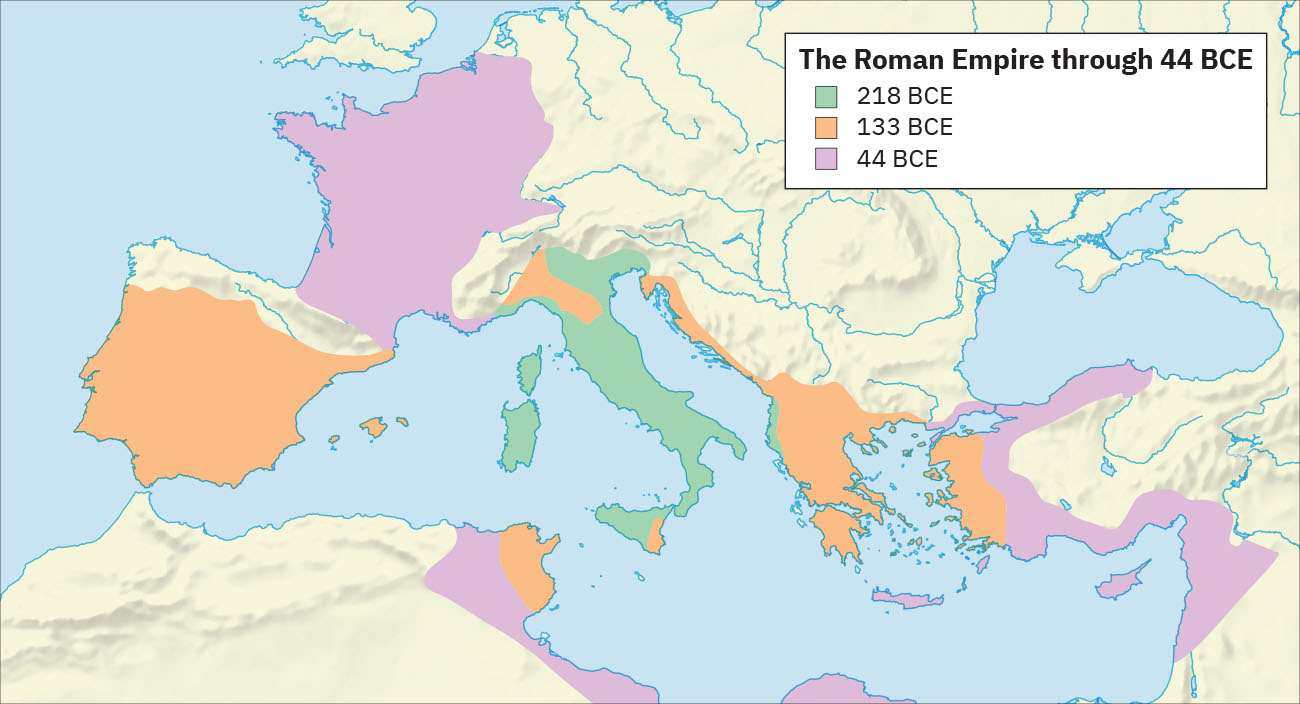
The Roman Empire had now grown large, thanks to Pompey’s and Caesar’s conquests (Figure 6.35). After Crassus’s death, Pompey decided to break with Caesar and support his old enemies the optimates. In 49 BCE, the optimates and Pompey controlled the Senate and demanded that Caesar disband his army in Gaul and return to Rome to stand trial on various charges. Instead, Caesar convinced his client army to march on Rome. In January of that year he famously led his troops across the Rubicon River, the traditional boundary between Italy and Gaul. Since Caesar knew this move would trigger war, as it was illegal to bring a private army into Rome proper, the phrase “crossing the Rubicon” continues to mean “passing the point of no return.” In 48 BCE, Caesar defeated Pompey at the Battle of Pharsalus in northern Greece. Shortly after this, Pompey fled to Egypt, where he was murdered by the Egyptian pharaoh Ptolemy XIII, who hoped to win Caesar’s favor.
英語のヒント
ポンペイウスとカエサルの征服によって、ローマの支配領域は大きく広がった(図6.35)。クラッススの死後、ポンペイウスはカエサルと決別し、かつての敵である閥族派を支持することにした。前49年、元老院を支配する閥族派とポンペイウスは、カエサルにガリアの軍を解散し、ローマへ戻ってさまざまな罪状で裁判を受けるよう要求した。しかしカエサルは、逆に私兵軍団を説得し、ローマへ進軍させた。同年1月、兵を率いて、イタリアとガリアの伝統的な境界であるルビコン川を渡った有名な出来事が起きた。私的な軍をローマの本土へ入れるのは違法だったため、カエサルはこの行動が戦争を引き起こすと知っていた。「ルビコンを渡る」という表現が今も「後戻りできない一線を越える」という意味で使われるのは、このためである。前48年、カエサルはギリシア北部のファルサロスの戦いでポンペイウスを破った。その直後、ポンペイウスはエジプトへ逃れたが、カエサルの歓心を買おうとするエジプトのファラオ、プトレマイオス13世に殺された。
The Roman Empire through 44 BCE.前44年までのローマの支配領域
(attribution: Copyright Rice University, OpenStax, under CC BY 4.0 license) · CC BY 4.0
Figure 6.35 Some of the areas marked in purple, like Gaul and Syria, were added to the Roman Empire by the victories of Julius Caesar and Pompey, respectively. (attribution: Copyright Rice University, OpenStax, under CC BY 4.0 license)
図6.35 紫色の区域のうち、ガリアやシリアなどは、それぞれユリウス・カエサルとポンペイウスの勝利によってローマの支配領域に加わった。(出典: 著作権:Rice University, OpenStax/CC BY 4.0)
To prosecute the war against Pompey, Caesar had himself appointed dictator in 48 BCE. Despite the tradition that dictatorship was to be temporary, Caesar’s position was indefinite. In 46 BCE, he was appointed dictator for a term of ten years, and in 44 BCE his dictatorship was made permanent, or for life. These appointments and other efforts to accumulate power unnerved many Romans, who had a deep and abiding distrust of autocratic rulers that stretched all the way back to the period of Etruscan rule. Caesar had hoped to win over his former enemies by inviting them to serve again in the Senate and appointing them to positions in his government. However, these former optimates viewed him as a tyrant, and in 44 BCE two of them, Brutus and Cassius, led a conspiracy that resulted in his assassination.
英語のヒント
ポンペイウスとの戦争を遂行するため、カエサルは前48年に自らを独裁官に任命させた。独裁官職は一時的なものとする伝統があったにもかかわらず、カエサルの地位に期限はなかった。前46年には任期10年の独裁官となり、前44年にはその地位が永久、すなわち終身となった。これらの任命や、権力を集めようとするほかの動きは、多くのローマ人を不安にさせた。彼らはエトルリア人の支配の時代にまでさかのぼる、独裁的な統治者への深く根強い不信を持っていた。カエサルはかつての敵を再び元老院に迎え、自分の政府の役職に任命することで、味方につけようとした。しかし元閥族派の人びとは彼を僭主とみなした。そのうちの2人、ブルトゥスとカッシウスは前44年、カエサル暗殺に至る陰謀を主導した。