第16章14世紀の気候変動とペストClimate Change and Plague in the Fourteenth Century
Introductionはじめに
The Bubonic Plague.腺ペスト。
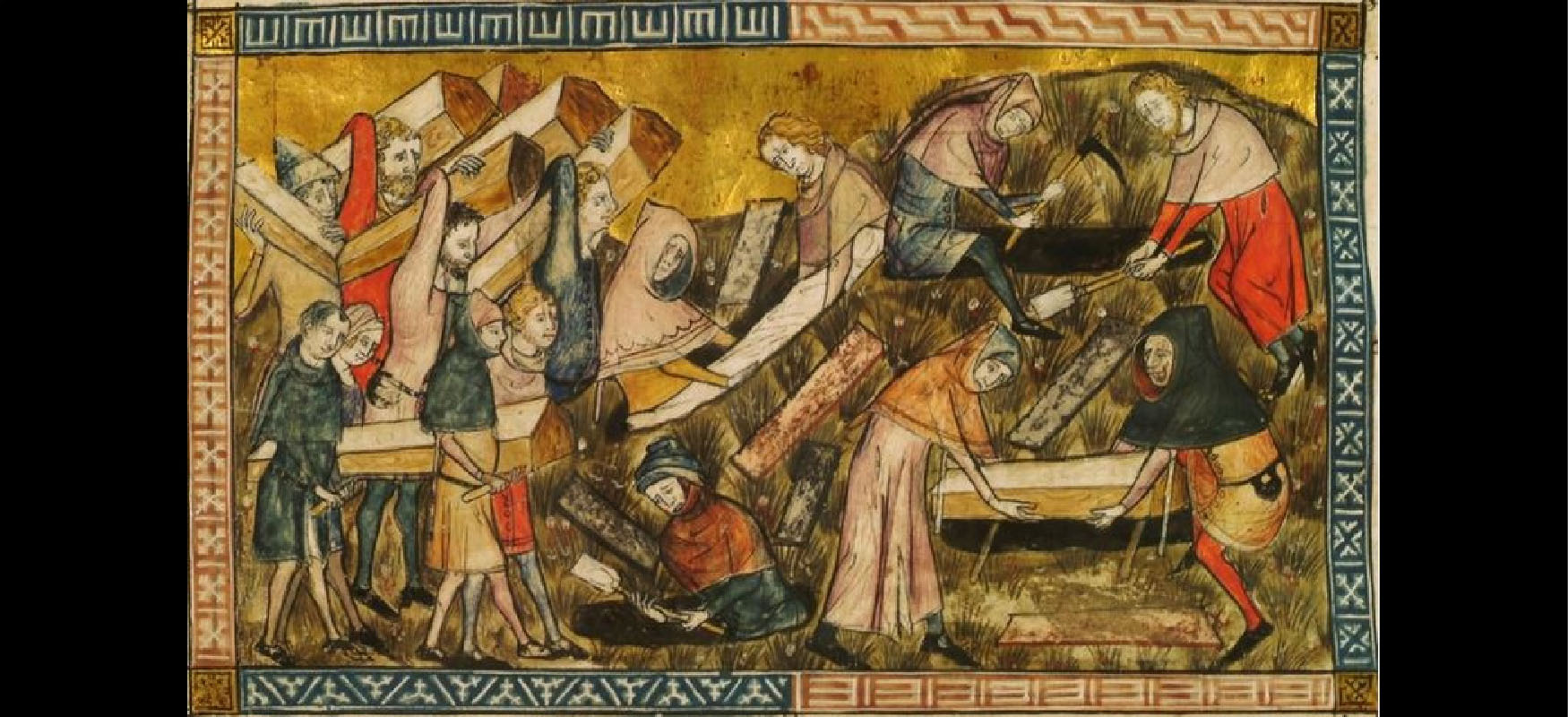
(credit: modification of work “Gilles li Muisis, Antiquitates Flandriae (Tractatus quartus)” by Belgian Art Links and Tools/Wikimedia Commons, Public Domain) · Public Domain
Figure 16.1 Thanks to modern scientific tools, the remains of fourteenth-century bubonic plague victims, such as those being buried in this image, have yielded much insight into the course and impact of historical pandemics, and their short- and long-term consequences on human society. This painting is a miniature from a manuscript of the mid-fourteenth century. (credit: modification of work “Gilles li Muisis, Antiquitates Flandriae (Tractatus quartus)” by Belgian Art Links and Tools/Wikimedia Commons, Public Domain)
図16.1 現代の科学的手法によって、この絵のように埋葬された14世紀の腺ペスト犠牲者の遺骨から、歴史上のパンデミックの経過と影響、それが人間社会にもたらした短期・長期の帰結について、多くの知見が得られている。この絵は14世紀半ばの写本の細密画である。(出典: 原作品を加工:“Gilles li Muisis, Antiquitates Flandriae (Tractatus quartus)”/Belgian Art Links and Tools/Wikimedia Commons, パブリックドメイン)
Climate change, global pandemics, and political upheaval may seem more characteristic of the modern era than of the premodern world, but the first decades of the 1300s did in fact witness a rapid succession of such crises, prompting historian Barbara Tuchman to dub the period “the calamitous fourteenth century” in her book A Distant Mirror. From the ravages of the so-called Little Ice Age to the bubonic plague (Figure 16.1) and the rapid decline of the once-mighty Mongol Empire, the 1300s were marked by an array of extraordinary challenges that not only radically altered the world’s demographic and political landscape but also showcased the strength and vigor of human resilience.
英語のヒント
気候変動、世界的な感染症の大流行、政治的混乱は、近代以前より現代を特徴づけるものに思えるかもしれない。しかし1300年代の初めの数十年間には、実際にこうした危機が相次いだ。そのため歴史家バーバラ・タックマンは、著書『遠い鏡』でこの時代を「災厄の14世紀」と呼んだ。いわゆる小氷期の猛威から腺ペスト(図16.1)、かつて強大だったモンゴル帝国の急速な衰退まで、1300年代には並外れた難局が立て続けに起きた。それらは世界の人口分布と政治情勢を根本から変えただけでなく、人間が立ち直る力の強さと活力をも示した。
Although any one of these catastrophes might have crushed the societies upon which they descended, in each case, people adapted, rebounded, and rebuilt. Due to their remarkable grit, the fourteenth century offers an unprecedented opportunity for historians to understand critical facets of the human experience, such as the impact of environmental change, infectious disease, and the ravages of military conflict.
英語のヒント
これらの大災厄は、どれ一つを取っても、見舞われた社会を打ち砕きかねなかった。それでも人々は、そのたびに適応し、立ち直り、社会を築き直した。人々が示した驚くべき粘り強さのおかげで、14世紀は歴史家にとって、人間の経験の重要な側面を理解するうえで比類のない研究対象となっている。そこには、環境変化や感染症の影響、軍事衝突がもたらす破壊などが含まれる。
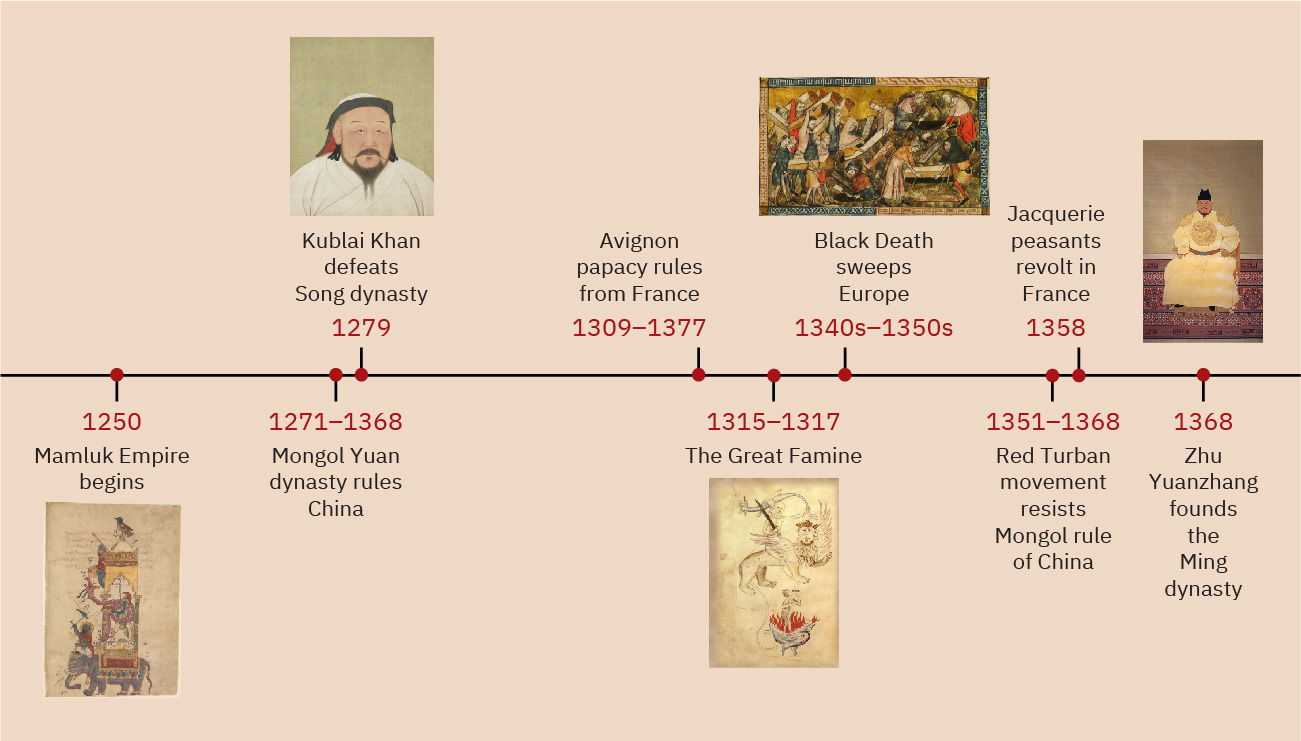
Timeline: Climate Change and Plague in the Fourteenth Century.年表:14世紀の気候変動とペスト。
(credit "1250": modification of work “"The Elephant Clock", Folio from a Book of the Knowledge of Ingenious Mechanical Devices by al-Jazari” by Bequest of Cora Timken Burnett, 1956/Metropolitan Museum of Art, Public Domain; credit "1279": modification of work "Yuan Emperor Album Khubilai Portrait" by National Palace Museum/Wikimedia Commons, Public Domain; credit "1315–1317": modification of work “Death (“Mors”) sits astride a lion whose long tail ends in a ball of flame (Hell). Famine (“Fames”) points to her hungry mouth” by “Mariule”/Wikimedia Commons, Public Domain; credit "1340s–1350s": modification of work "Gilles li Muisis, Antiquitates Flandriae (Tractatus quartus)” by Belgian Art Links and Tools/Wikimedia Commons, Public Domain; credit "1368": modification of work “Official court painting of the Hongwu Emperor” by Unknown/Wikimedia Commons, Public Domain) · Public Domain
Figure 16.2 (credit "1250": modification of work “"The Elephant Clock", Folio from a Book of the Knowledge of Ingenious Mechanical Devices by al-Jazari” by Bequest of Cora Timken Burnett, 1956/Metropolitan Museum of Art, Public Domain; credit "1279": modification of work "Yuan Emperor Album Khubilai Portrait" by National Palace Museum/Wikimedia Commons, Public Domain; credit "1315–1317": modification of work “Death (“Mors”) sits astride a lion whose long tail ends in a ball of flame (Hell). Famine (“Fames”) points to her hungry mouth” by “Mariule”/Wikimedia Commons, Public Domain; credit "1340s–1350s": modification of work "Gilles li Muisis, Antiquitates Flandriae (Tractatus quartus)” by Belgian Art Links and Tools/Wikimedia Commons, Public Domain; credit "1368": modification of work “Official court painting of the Hongwu Emperor” by Unknown/Wikimedia Commons, Public Domain)
図16.2 (出典"1250": 原作品を加工:“"The Elephant Clock", Folio from a Book of the Knowledge of Ingenious Mechanical Devices/al-Jazari”/Cora Timken Burnett の遺贈、1956年/メトロポリタン美術館, パブリックドメイン;出典 "1279": 原作品を加工:"Yuan Emperor Album Khubilai Portrait"/National Palace Museum/Wikimedia Commons, パブリックドメイン;出典 "1315–1317": 原作品を加工:“Death (“Mors”) sits astride a lion whose long tail ends in a ball of flame (Hell). Famine (“Fames”) points to her hungry mouth”/“Mariule”/Wikimedia Commons, パブリックドメイン;出典 "1340s–1350s": 原作品を加工:"Gilles li Muisis, Antiquitates Flandriae (Tractatus quartus)”/Belgian Art Links and Tools/Wikimedia Commons, パブリックドメイン;出典 "1368": 原作品を加工:“Official court painting of the Hongwu Emperor”/作者不詳/Wikimedia Commons, パブリックドメイン)