第2章初期の人類Early Humans
Introductionはじめに
The Landscape of Evolution.進化の舞台となった景観。
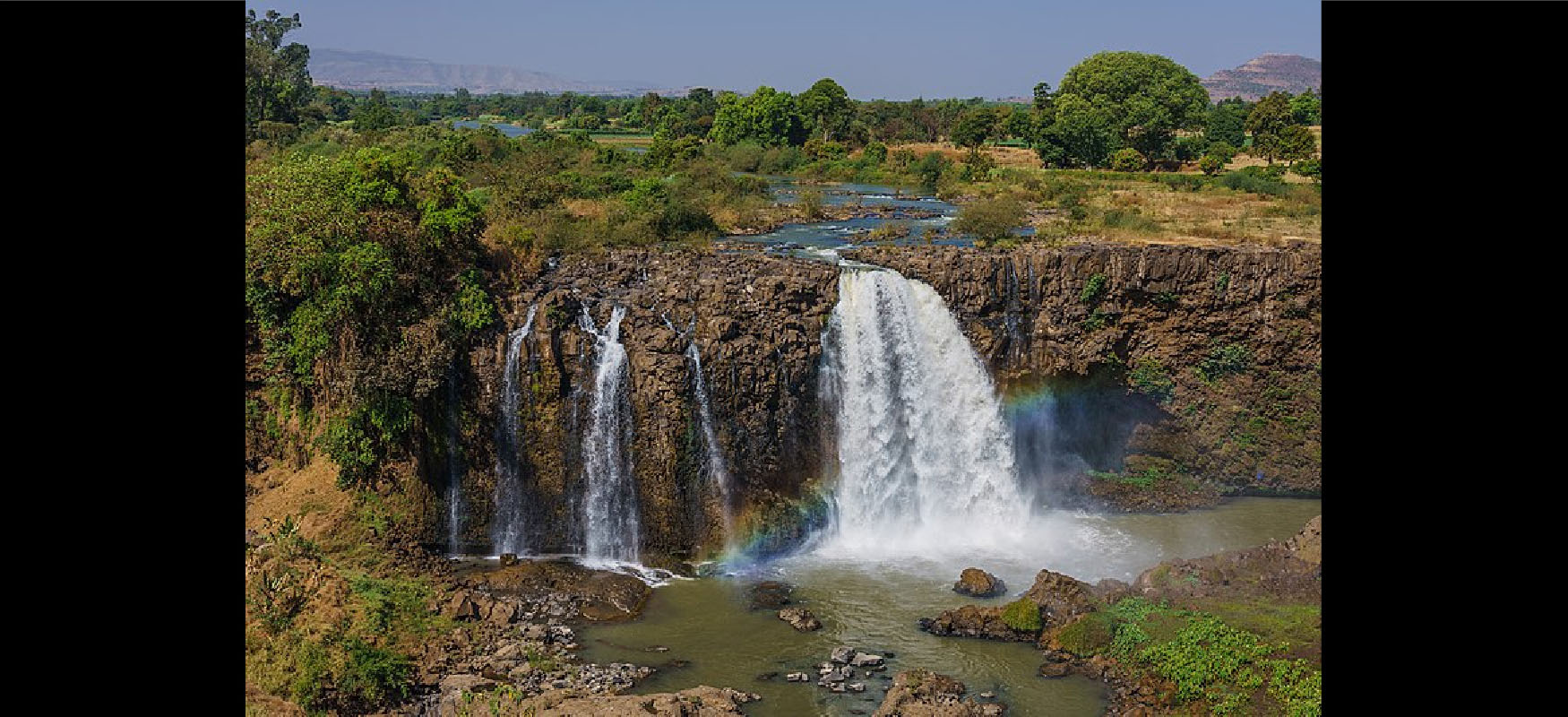
Blue Nile Falls at Tis Issat near Bahir Dar, Ethiopia — A.Savin, Wikipedia; Free Art License 1.3. Modified by OpenStax; reproduced from the pinned OpenStax source. · Free Art License 1.3
Figure 2.1 Millions of years ago, our early evolutionary ancestors roamed around today’s Ethiopia, living off the land. (credit: modification of work “Blue Nile Falls at Tis Issat near Bahir Dar, Ethiopia” by A.Savin/Wikimedia Commons, Licence Art Libre/Copyleft)
図2.1 数百万年前、人類の進化上の初期の祖先は、現在のエチオピアに当たる土地を歩き回り、自然の恵みを得て暮らしていた。(出典:A.Savin/Wikimedia Commons「Blue Nile Falls at Tis Issat near Bahir Dar, Ethiopia」を改変。Licence Art Libre/Copyleft)
In 1974, while on a mapping expedition in Ethiopia (Figure 2.2), an American paleoanthropologist named Donald Johanson and a colleague stumbled upon a skeletal forearm and skull in a gully. Upon closer inspection, they not only found more bones but also realized that all of them had belonged to some type of early human. After careful work, Johanson’s team was able to recover about 40 percent of the skeleton, which they named Lucy after the popular Beatles song, “Lucy in the Sky with Diamonds.”
英語のヒント
1974年、エチオピアで地図作成の調査をしていたアメリカの古人類学者ドナルド・ジョハンソンと同僚は、谷の中で前腕と頭蓋骨の一部を偶然発見した(図2.2)。詳しく調べると、さらに多くの骨が見つかっただけでなく、それらがすべて初期の人類の一個体に属していたことも分かった。慎重に発掘を進めた結果、ジョハンソンのチームは全身骨格のおよそ40パーセントを回収した。彼らはビートルズの人気曲「ルーシー・イン・ザ・スカイ・ウィズ・ダイアモンズ」にちなみ、この個体をルーシーと名付けた。
We now know that, though small, Lucy was an adult when she died about 3.2 million years ago. Scholars have learned a great deal since her discovery, about her but also about many of our other evolutionary ancestors. In the millions of years since Lucy walked the Earth, a number of early human species have come and gone. Some migrated out of Africa and populated portions of Asia, Europe, Australia, and the Americas. These different species developed new tools, learned to control fire, mastered language, and produced stunning works of art. Then, about twelve thousand years ago, some of our own species adopted agriculture. With this innovation, many early human groups began to end their hunting and gathering ways and establish settled communities.
英語のヒント
ルーシーは小柄だったものの、およそ320万年前に死んだときには成体だったことが、現在では分かっている。発見以来、研究者はルーシー自身についても、人類の進化上のほかの祖先についても、多くの知見を得てきた。ルーシーが地上を歩いてから数百万年の間に、初期の人類にはさまざまな種が現れ、姿を消した。その一部はアフリカを出て、アジア、ヨーロッパ、オーストラリア、南北アメリカの各地へ広がった。これらの種は新しい道具を作り、火を制御する方法を学び、言語を使いこなし、見事な美術作品を生み出した。そして約1万2000年前、私たちと同じ種の一部が農耕を始めた。この新たな営みによって、多くの初期の人類集団は狩猟採集の暮らしを終え、定住する共同体を築き始めた。
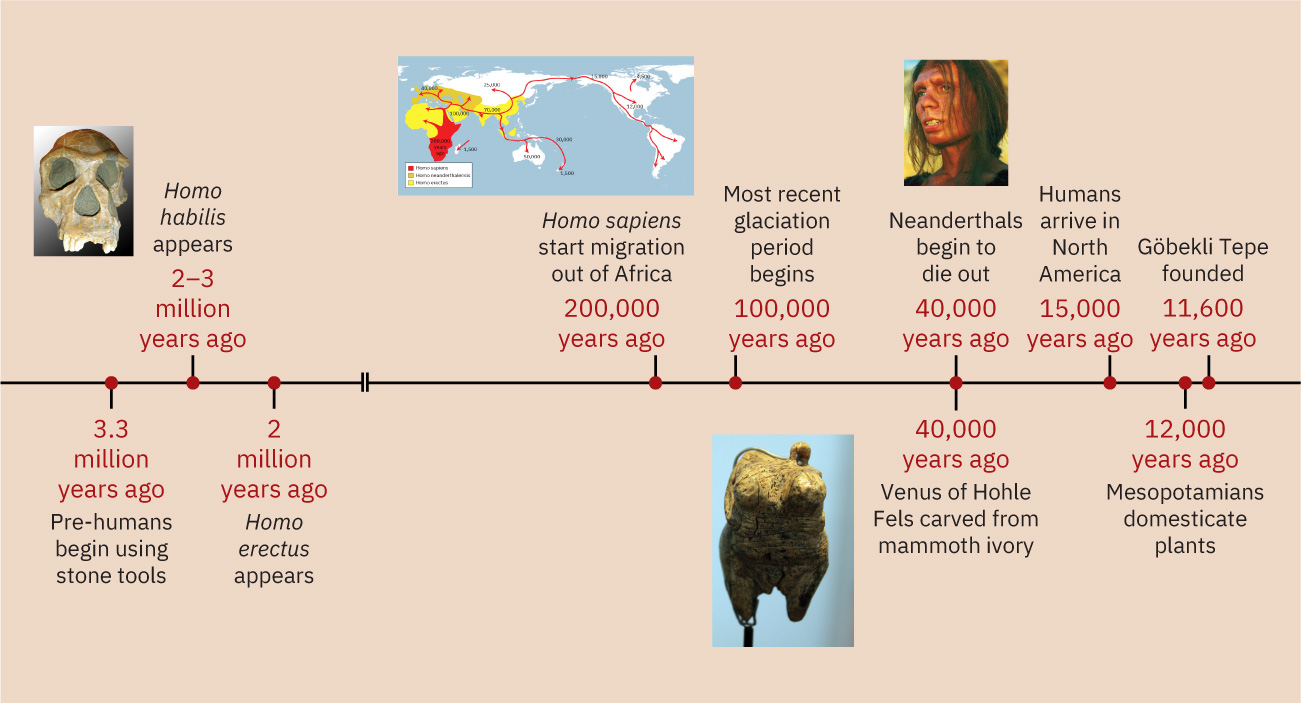
Timeline: Early Humans.年表:初期の人類。
(credit “2–3 million years ago”: modification of work “Skull of Homo Habilis (Replica)” by “Luna04”/Wikimedia Commons, CC BY 2.5; credit “200,000 years ago”: modification of work “Spreading of Homo sapiens” by “NordNordWest”/Wikimedia Commons, Public Domain; credit “40,000 years ago” top: modification of work “Reconstruction of Neanderthal woman (makeup by Morten Jacobsen)” by Public Library of Science/Wikimedia Commons, CC BY 2.5; credit “40,000 years ago” bottom: modification of work “Venus"-pendant, mammoth ivory, Alb-Donau Region, on loan from the National Archaeological Museum in Baden-Württemberg, shown at the Landesmuseum Württemberg, Stuttgart, Germany” by “Anagoria”/Wikimedia Commons, CC BY 3.0) · CC BY 2.5 + Public Domain + CC BY 3.0
Figure 2.2 (credit “2–3 million years ago”: modification of work “Skull of Homo Habilis (Replica)” by “Luna04”/Wikimedia Commons, CC BY 2.5; credit “200,000 years ago”: modification of work “Spreading of Homo sapiens” by “NordNordWest”/Wikimedia Commons, Public Domain; credit “40,000 years ago” top: modification of work “Reconstruction of Neanderthal woman (makeup by Morten Jacobsen)” by Public Library of Science/Wikimedia Commons, CC BY 2.5; credit “40,000 years ago” bottom: modification of work “Venus"-pendant, mammoth ivory, Alb-Donau Region, on loan from the National Archaeological Museum in Baden-Württemberg, shown at the Landesmuseum Württemberg, Stuttgart, Germany” by “Anagoria”/Wikimedia Commons, CC BY 3.0)
図2.2 (「200万~300万年前」の出典:「Luna04」/Wikimedia Commons「Skull of Homo Habilis (Replica)」を改変、CC BY 2.5。「20万年前」の出典:「NordNordWest」/Wikimedia Commons「Spreading of Homo sapiens」を改変、パブリックドメイン。「4万年前」上段の出典:Public Library of Science/Wikimedia Commons「Reconstruction of Neanderthal woman (makeup by Morten Jacobsen)」を改変、CC BY 2.5。「4万年前」下段の出典:「Anagoria」/Wikimedia Commons「Venus-pendant, mammoth ivory, Alb-Donau Region, on loan from the National Archaeological Museum in Baden-Württemberg, shown at the Landesmuseum Württemberg, Stuttgart, Germany」を改変、CC BY 3.0)