第2章初期の人類Early Humans
2.1 Early Human Evolution and Migration2.1 初期人類の進化と移動
Learning Objectives学習の目標
By the end of this section, you will be able to:
この節を学ぶと、次のことができるようになる。
Discuss the process of human evolution in a biological and anthropological context
人類の進化の過程を、生物学と人類学の観点から論じる。
Explain how and why Paleolithic humans migrated
旧石器時代の人々が、どのように、なぜ移動したのかを説明する。
Describe the tools and technologies used in the Paleolithic Age
旧石器時代に使われた道具と技術を説明する。
Millions of years ago, our distant ancestors descended from the trees, took to walking upright on the land, and gradually evolved into the species we are today. Their evolution was influenced by many variables, including changes in climate, diet, and survival strategies. Over time, humans developed new skills and tools to meet the challenges of endurance and sought better prospects for themselves through cooperation and migration.
英語のヒント
数百万年前、私たちの遠い祖先は木から下り、地上で直立歩行をするようになり、徐々に現在の私たちの種へと進化した。その進化は、気候、食生活、生存戦略の変化をはじめとする多くの要因の影響を受けた。時がたつにつれ、人類は生き延びる難しさに対処する新しい技能や道具を生み出し、協力や移動を通じて、よりよい生存の見通しを求めた。
Understanding these changes and the long-ago origins of our species has required careful research by archaeologists, anthropologists, genetic scientists, historians, sociologists, and many others. Through painstaking reconstructions and study, these specialists have used a relatively small number of archaeological finds and material remnants of our distant ancestors to paint a striking picture of our prehistoric past, going back millions of years. The nature of this work, however, requires using some extrapolation, educated speculation, and outright guesswork to piece together the bits of unearthed evidence into an intelligible story. This means that even as we have had to discard old theories when new information has emerged, there remain plenty of things we’ll simply never know for sure.
英語のヒント
こうした変化や、遠い昔にさかのぼる私たちの種の起源を理解するには、考古学者、人類学者、遺伝学者、歴史家、社会学者など、多くの専門家による綿密な研究が必要だった。彼らは骨の復元や研究を丹念に重ね、比較的少数の考古学的発見と遠い祖先が残した物的痕跡から、数百万年前にまでさかのぼる先史時代の姿を鮮やかに描き出してきた。しかし、この研究の性質上、掘り出された証拠の断片を筋の通った物語につなぎ合わせるには、既知の事柄からの推定や、知識に基づく推測、場合によっては純粋な憶測さえ必要になる。新しい情報が現れれば古い理論を捨てなければならない一方、結局のところ確実には分からないことも、なお数多く残っているのである。
Human Evolution人類の進化
The concept of evolution over time is one we are all likely familiar with. Consider, for example, how technology has evolved. The first true smartphones appeared on the market at the beginning of this century, but these complicated devices didn’t spring all at once from the minds of ambitious engineers. Rather, these engineers built on technology that had evolved and improved over many decades. In the mid-1800s, telegraph technology first demonstrated that electricity could be used for long-distance communication. That technology paved the way for the first telephones, which were basic and expensive but over many decades became more sophisticated, more common, and cheaper. By the early 1980s, electronics companies had begun selling telephones that used radio technology to communicate wirelessly. Over time these devices were made faster and smaller, and companies added features like cameras, microprocessors, and eventually internet access. With these evolutionary transformations, the smartphone was born.
英語のヒント
時間とともに進化するという考え方は、私たちにもなじみがあるだろう。たとえば、技術がどのように発展してきたかを考えてみよう。本格的なスマートフォンが市場に登場したのは今世紀初めだが、この複雑な機器が、意欲的な技術者の頭の中から一挙に生まれたわけではない。技術者たちはむしろ、何十年もかけて発展し、改良されてきた技術を土台にした。1800年代半ば、電信技術によって、電気を長距離通信に使えることが初めて示された。それが最初の電話への道を開いた。初期の電話は単純で高価だったが、数十年の間に性能が上がり、普及し、価格も下がった。1980年代初めには、電子機器メーカーが無線技術で通信する電話を売り始めていた。やがて機器は高速化・小型化し、カメラ、マイクロプロセッサー、さらにはインターネットへの接続機能が加わった。このような段階的な変化を通じて、スマートフォンが誕生したのである。
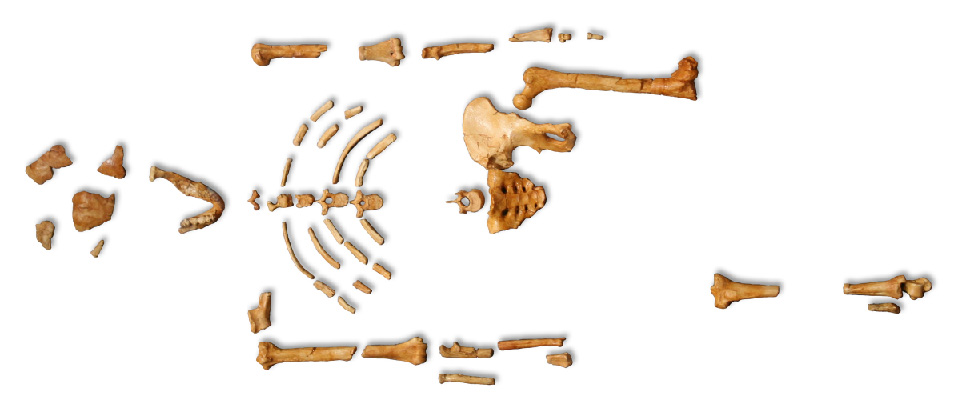
Modern humans are not smartphones, and in human history, chance biological adaptations to a changing environment drove the evolutionary process rather than the minds of inventors conceiving of technical innovations. But the evolutionary process that eventually gave birth to our species resembles the technological evolution of smartphones and other devices in some important ways. Just like we can trace the evolution of the smartphone back to the telegraph, so can we trace our own evolution back to a very distant ancestor called Australopithecus, who lived in eastern and southern Africa between 2.5 and 4 million years ago. Lucy, previously mentioned, was of the genus Australopithecus (Figure 2.3). A genus is a taxonomic rank that includes several similar and related species within it. Like us, members of Lucy’s species afarensis (named for the Afar region of East Africa where she was found) were capable of walking upright and likely used tools. Beyond that, however, they were very different from us. They had plenty of hair like chimpanzees, fingers and arms well suited for climbing trees, and brains about one-third the size of ours. Despite these differences, scholars have concluded that the genus Homo (“human”) evolved from Australopithecus somewhere around two to three million years ago.
英語のヒント
現代人はスマートフォンではない。人類史で進化を動かしたのは、発明家が技術革新を思い描く頭脳ではなく、変わる環境に対する偶発的な生物学的適応だった。それでも、最終的に私たちの種を生み出した進化の過程は、いくつかの重要な点で、スマートフォンなどの機器の技術的進化に似ている。スマートフォンの発展を電信までさかのぼれるように、私たち自身の進化も、アウストラロピテクスと呼ばれる遠い祖先までさかのぼることができる。この祖先は約400万~250万年前、アフリカ東部と南部に生きていた。先ほど登場したルーシーもアウストラロピテクス属に属する(図2.3)。「属」は、互いによく似た近縁の種をいくつか含む、生物分類の階級である。ルーシーが属するアファレンシス種は、発見地である東アフリカのアファール地方にちなんで名付けられた。私たちと同じように直立歩行ができ、おそらく道具も使っていた。しかし、それ以外の点では私たちと大きく異なっていた。チンパンジーのように毛が多く、指と腕は木登りに適し、脳の大きさは私たちの約3分の1だった。こうした違いはあるが、研究者たちは、「人間」を意味するホモ属が、およそ200万~300万年前にアウストラロピテクス属から進化したと結論している。
Lucy.ルーシー。
(credit: modification of work “Reconstruction of the fossil skeleton of "Lucy" the Australopithecus afarensis” by “120”/Wikimedia Commons, CC BY 2.5) · CC BY 2.5
Figure 2.3 Despite the incomplete state of the remains of Lucy, a member of the ancient genus Australopithecus, the similarities between her and modern humans of the genus Homo are striking. This image is a photoshopped reproduction of her skeleton. (credit: modification of work “Reconstruction of the fossil skeleton of "Lucy" the Australopithecus afarensis” by “120”/Wikimedia Commons, CC BY 2.5)
図2.3 古いアウストラロピテクス属の一員であるルーシーの遺骨は不完全だが、ホモ属の現代人との類似は際立っている。この画像は、ルーシーの骨格を画像編集で復元したもの。(出典:「120」/Wikimedia Commons「Reconstruction of the fossil skeleton of Lucy the Australopithecus afarensis」を改変、CC BY 2.5)
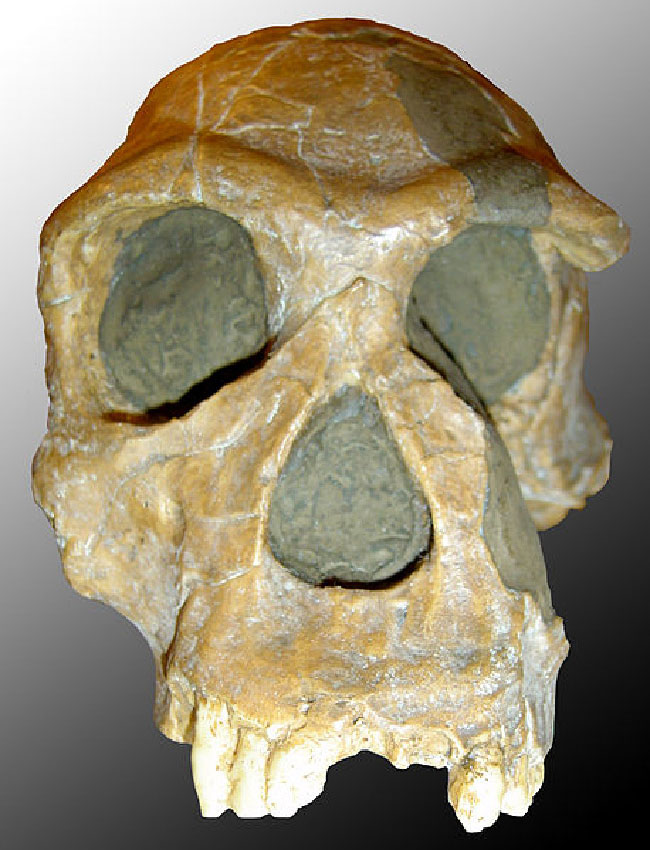
Possibly the earliest member of the genus Homo was Homo habilis (Figure 2.4). This species appears in the archaeological record about two to three million years ago. Habilis means “handy”; it was thought at one time that this was the first species to have created stone tools. We now know that stone tools predate Homo habilis, but the name has stuck. Homo habilis resembles us in many ways, with a large brain similar to ours as well as small teeth and a face we might recognize as human. But members of the species also had many ape-like characteristics, such as long arms, hairy bodies, and adult heights of only three or four feet.
英語のヒント
ホモ属の最初期の一員だった可能性があるのが、ホモ・ハビリスである(図2.4)。この種は、約200万~300万年前の考古学的記録に現れる。ハビリスは「器用な」を意味し、かつてはこの種が初めて石器を作ったと考えられていた。現在では石器がホモ・ハビリスより古いことが分かっているが、この名称はそのまま使われている。ホモ・ハビリスは多くの点で私たちに似ていた。私たちのものに似た大きな脳を持ち、歯は小さく、顔も人間らしいと感じられるものだった。しかし、長い腕、毛の多い体、成体でも3~4フィートほどの身長など、類人猿に似た特徴も数多く持っていた。
Homo Habilis.ホモ・ハビリス。
(credit: “Skull of Homo Habilis (Replica)” by “Luna04”/Wikimedia Commons, CC BY 2.5) · CC BY 2.5
Figure 2.4 Partially restored remains, like the skull represented by this replica, are some of the most important evidence we have of the human ancestor Homo habilis. (credit: “Skull of Homo Habilis (Replica)” by “Luna04”/Wikimedia Commons, CC BY 2.5)
図2.4 この複製が示す頭蓋骨のように、部分的に復元された遺骨は、人類の祖先ホモ・ハビリスについての最も重要な証拠の一つである。(出典:「Luna04」/Wikimedia Commons「Skull of Homo Habilis (Replica)」、CC BY 2.5)
Around two million years ago, a species even more similar to us, Homo erectus, emerged in East Africa. It likely evolved from Homo habilis. As the name erectus for “upright” suggests, this species lived entirely on the ground and walked—even ran—exclusively in an upright position. The consequences of this evolutionary shift were huge. Being upright meant that the body’s digestive organs were pulled down lower and into a smaller space. That in turn necessitated a change in diet, away from tough plants and toward easier-to-digest items like nuts, fruits, tubers, honey, and even meat. Living on the ground was also more dangerous because it made eluding predators more difficult. However, the upright position left Homo erectus’s hands free to use tools. This advantage likely led to further evolutions that made human hands more dexterous over time, prompting the wider adoption of ever more sophisticated tools.
英語のヒント
約200万年前、私たちにさらによく似た種、ホモ・エレクトゥスが東アフリカに現れた。おそらくホモ・ハビリスから進化したと考えられる。「直立した」を意味するエレクトゥスという名のとおり、この種は完全に地上で暮らし、歩くときも、走るときさえも、常に体を起こした姿勢を取った。この進化上の変化は大きな影響をもたらした。直立すると、消化器官が下方へ引かれ、より狭い空間に収まることになる。そのため、硬い植物を食べる食生活から、木の実、果物、塊茎、蜂蜜、さらには肉といった、より消化しやすいものを食べる食生活への変化が必要になった。地上での生活は、捕食者から逃れにくくなるため、より危険でもあった。しかし、直立姿勢はホモ・エレクトゥスの手を、道具を使うために自由にした。この利点がおそらくさらなる進化を促し、人類の手は次第に器用になって、いっそう精巧な道具が広く使われるようになった。
Members of Homo erectus shared other close similarities with modern humans. They were about the same height as we are, sometimes reaching just over six feet. They made and used relatively sophisticated stone tools and relied on fire for both warmth and cooking food. They likely constructed huts of wood and fur in which to live and worked cooperatively with each other to hunt and forage. The position of the larynx in the throat also suggests that Homo erectus may have had some capacity to communicate vocally, which would have aided in cooperative endeavors. Finally, archaeologists have uncovered strong evidence that Homo erectus cared for the sick and elderly. This evidence includes the discovery of the remains of individuals who suffered from debilitating diseases yet lived a long time, indicating that assistance was both necessary and provided by others. Together these characteristics made the species highly adaptable to changing climates and environments, helping explain why its members survived for so long. Homo erectus populations lived until as recently as about 100,000 years ago.
英語のヒント
ホモ・エレクトゥスは、ほかにも現代人によく似た特徴を持っていた。身長は私たちとほぼ同じで、6フィートを少し超えることもあった。比較的精巧な石器を作って使い、暖を取るにも調理するにも火を利用した。おそらく木や毛皮で住まいとなる小屋を作り、互いに協力して狩りや食料採集をしていた。喉の中での喉頭の位置からは、ホモ・エレクトゥスが声で意思を伝える能力をある程度持っていた可能性も示唆される。そうした能力があれば、共同作業にも役立っただろう。さらに、考古学者は、病人や高齢者を世話していたことを強く示す証拠も見いだしている。体を衰弱させる病気にかかっていながら長く生きた個体の遺骨が見つかっており、助けが必要だっただけでなく、実際に他者から与えられていたことを示している。こうした特徴を合わせ持つことで、この種は変わる気候や環境によく適応できた。それは、なぜこれほど長く生き残ったのかを説明する手がかりになる。ホモ・エレクトゥスの集団は、つい約10万年前まで生存していた。
Sometime between 1.8 and 1.5 million years ago, Homo erectus started migrating into other parts of Africa and beyond, reaching North Africa, the Near East, Europe, and East and South Asia over hundreds of thousands of years. The reasons for this extensive migration are still debated, but they likely included climate change and the desire to follow certain types of prey. Homo erectus appears to have stayed close to rivers and lakes during migration, hunting and eating animals like rhinoceroses, bears, pigs, and crocodiles, as discoveries in the Near East have confirmed. Populations evolved to adapt to the different environmental conditions into which they moved. Over time this led to a diversity of human species, including Homo heidelbergensis; Homo neanderthalensis, or Neanderthals; Denisovans; and modern humans, or Homo sapiens (sapiens means “wise”). Some of these species, like Denisovans and Neanderthals, emerged outside Africa. Others, like Homo heidelbergensis and Homo sapiens, emerged in Africa first and later migrated to other areas.
英語のヒント
約180万~150万年前のある時期、ホモ・エレクトゥスはアフリカのほかの地域や、その外へ移動し始めた。数十万年をかけて、北アフリカ、近東、ヨーロッパ、東アジア、南アジアへ到達した。この広範な移動の理由にはなお議論があるが、おそらく気候変動や、特定の獲物を追うことが含まれていた。移動の間、ホモ・エレクトゥスは川や湖の近くにとどまる傾向があったらしい。近東の発見から確認されるように、サイ、クマ、ブタ、ワニなどを狩って食べていた。各集団は、移動先の異なる環境条件に適応するよう進化した。やがてこの過程は、ホモ・ハイデルベルゲンシス、ホモ・ネアンデルターレンシス、つまりネアンデルタール人、デニソワ人、そして現代人であるホモ・サピエンスなど、人類の種の多様化をもたらした。サピエンスは「賢い」を意味する。デニソワ人やネアンデルタール人などはアフリカの外で現れた。ホモ・ハイデルベルゲンシスやホモ・サピエンスなどは、まずアフリカで現れ、その後ほかの地域へ移動した。
The extent to which these different human species interacted with each other remains unclear. DNA evidence from a bone found in Siberia has shown that a girl (who died at age thirteen) was born there of a Denisovan father and a Neanderthal mother. Another recent study demonstrated that modern European and Middle Eastern populations have between 1 and 4 percent Neanderthal DNA. This appears to suggest that mating between Homo sapiens and Neanderthals was quite common. The careful work of archaeologists and other scholars has also made clear that some species evolved from others. For example, both Neanderthals and Denisovans appear to have evolved from populations of Homo heidelbergensis.
英語のヒント
これらの異なる人類の種が、どの程度互いに関わり合っていたかは、まだはっきりしない。シベリアで見つかった骨のDNAからは、13歳で亡くなった少女が、デニソワ人の父とネアンデルタール人の母の間に生まれていたことが分かった。別の近年の研究は、現代のヨーロッパと中東の人々が1~4パーセントのネアンデルタール人由来のDNAを持つことを示した。これは、ホモ・サピエンスとネアンデルタール人の交配がかなり一般的だった可能性を示している。考古学者などの丹念な研究によって、ある種が別の種から進化したことも明らかになってきた。たとえば、ネアンデルタール人とデニソワ人はいずれも、ホモ・ハイデルベルゲンシスの集団から進化したようである。
At some point between forty thousand and fifteen thousand years ago, the diversity of human species declined and only Homo sapiens remained. Two models attempt to explain why. The first and most commonly accepted is the “out of Africa” model. This theory suggests that modern humans emerged first in Africa approximately 200,000 years ago and then, approximately 100,000 years ago, expanded out of Africa and replaced all other human species. The second model is often called the “multiregional evolution model” and proposes that Homo sapiens evolved from Homo erectus in several places around the same time. This model emerged as an explanation for the great diversity of modern human traits in different populations around the world. But it relies primarily on the study of fossils and archaeological records rather than on genetic data.
英語のヒント
4万~1万5000年前の間のある時点で、人類の種の多様性は失われ、ホモ・サピエンスだけが残った。その理由を説明しようとするモデルは二つある。第一の、最も広く受け入れられているものが「アフリカ起源説」である。この説では、現代人は約20万年前にまずアフリカで現れ、約10万年前にアフリカの外へ広がって、ほかのすべての人類種に取って代わったと考える。第二は一般に「多地域進化説」と呼ばれ、ホモ・サピエンスが、ほぼ同じ時期に複数の場所でホモ・エレクトゥスから進化したとする。このモデルは、世界各地の現代人の集団に見られる形質の大きな多様性を説明するために生まれた。ただし、その根拠は主として化石と考古学的記録の研究であり、遺伝学的データではない。
These theories about human evolution are not necessarily mutually exclusive, and the real answer to the puzzle may be a combination of the two. For example, it’s entirely possible that modern humans or a common ancestor did emerge first in Africa. Then, as this species expanded around the world, it mixed its genetic information with that of other human species. The DNA evidence collected in recent years certainly suggests a more complicated picture, and the debate has not yet been settled. The tools of both archaeology and molecular genetics continue to reveal new insights into the puzzle of human evolution and the rise of Homo sapiens. And the conclusions we can draw about our distant past will continue to change as we learn more.
英語のヒント
人類進化についてのこれらの説は、必ずしも互いを排除するものではなく、実際の答えは両者を組み合わせたものかもしれない。たとえば、現代人、あるいは共通祖先が、最初にアフリカで現れたことは十分あり得る。その後、その種が世界へ広がるにつれて、ほかの人類種との間で遺伝情報が混じり合ったのかもしれない。近年集められたDNAの証拠は、確かにもっと複雑な姿を示しており、議論はまだ決着していない。考古学と分子遺伝学の双方の手法が、人類進化とホモ・サピエンスの出現という謎に、新たな見通しを与え続けている。学びが進むにつれ、遠い過去について導ける結論も変わり続けるだろう。