第2章初期の人類Early Humans
Early Human Technologies初期人類の技術
To understand how early humans lived hundreds of thousands and even millions of years ago, scholars use the tools of archaeology to analyze the objects left behind. Many were made of materials like wood, animal skin, and earth, which rarely endure in the archaeological record. Bone items are somewhat more durable and have occasionally survived. But our window into the distant past is quite small. Stone items are the most likely to have lasted long enough for us to study them today. Beginning possibly as early as 3.3 million years ago, our distant pre-human ancestors began using stone tools for a variety of purposes. This event marks the start of the Paleolithic Age (lithos means “stone”), which lasted until nearly twelve thousand years ago.
英語のヒント
数十万年前、さらには数百万年前の初期人類の暮らしを理解するために、研究者は考古学の手法で、後に残された物を分析する。その多くは、木、獣皮、土といった、考古学的記録としては残りにくい材料で作られていた。骨製品はやや丈夫で、残ることもあった。それでも、遠い過去をのぞく窓はごく小さい。今日の私たちが研究できるまで長く残る可能性が最も高いのは、石製品である。早ければ約330万年前、人類以前の遠い祖先が、さまざまな目的で石器を使い始めた。この出来事が旧石器時代の始まりとされる。lithosは「石」を意味する。この時代は約1万2000年前まで続いた。
The earliest known human-made stone tools date from about 2.6 million years ago. They were likely first created by Homo habilis, by smashing smooth rocks together to create crudely sharpened edges. The resulting implements are often described as Oldowan tools, and their use continued until about 1.7 million years ago. While a seemingly simple adaptation from our perspective, the development of Oldowan tools in fact represents a huge leap in human engineering ability. These sharpened stones served a variety of cutting, scraping, and chopping purposes. They were highly efficient tools for killing animals, butchering meat, smashing bones to access marrow, and a host of similar tasks.
英語のヒント
現在知られている、人類が作った最古の石器は約260万年前のものである。おそらくホモ・ハビリスが、表面の滑らかな石を打ち合わせて粗く鋭い縁を作ったのが最初だった。こうしてできた道具はオルドワン石器と呼ばれ、その使用は約170万年前まで続いた。私たちから見れば単純な工夫に思えるが、オルドワン石器の開発は、実際には人類の道具を作る能力の大きな飛躍を示す。鋭くした石は、切る、こする、たたき切るといったさまざまな用途に使われた。動物を殺し、肉を解体し、骨を割って骨髄を取り出すなど、多くの作業に非常に効果的な道具だった。
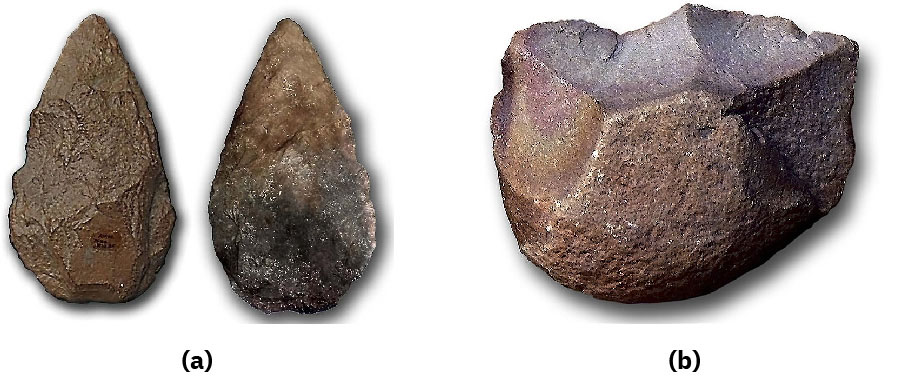
Beginning around 1.7 million years ago, some ancient humans began to develop a new and more sophisticated style of stone tool by carefully chipping away smaller flakes of the stone core to create a teardrop-shaped implement often described as a hand-axe. Far thinner and sharper than the Oldowan tools, hand-axes were even better at the cutting, scraping, and chopping tasks for which they were designed. They were such an improvement over earlier tools that archaeologists have given them their own name. They are called Acheulean tools (pronounced ah-SHOOL-ee-an), after Saint-Acheul, the site in France where they were first found in the nineteenth century CE. Since then, more Acheulean tools have been uncovered in Africa, the Middle East, and India and scattered in parts of East Asia (Figure 2.8).
英語のヒント
約170万年前になると、古代の人類の一部は、新しく、より精巧な形の石器を作り始めた。石の芯から小さな破片を慎重にはがし、一般にハンドアックスと呼ばれる、しずく形の道具を作ったのである。オルドワン石器よりずっと薄く鋭いハンドアックスは、想定された用途である切断、削り取り、たたき切りに、さらに優れていた。以前の道具からの改良があまりに大きいため、考古学者はこれらに独自の名称を与えている。アシューリアン石器と呼ばれ、名称は19世紀に初めて発見されたフランスのサン・タシュールに由来する。英語ではおよそ「アシューリアン」と発音する。その後、アフリカ、中東、インドでさらに多くが見つかり、東アジアの一部でも点在して発見されている(図2.8)。
Early Paleolithic Stone Tools.旧石器時代初期の石器。
(credit a: modification of work “Handaxe in quartzite, from the bed TG-10 of Galería in Atapuerca (Burgos, Spain)” by “Locutus Borg”/Wikimedia Commons, Public Domain; credit b: modification of work “Canto tallado de tradición Olduvayense procedente de la región del Sáhara atlántico Guelmim-Es Semara (Museo Arqueológico Nacional de Madrid)” by “Locutus Borg/Wikimedia Commons, Public Domain) · Public Domain
Figure 2.8 Acheulean hand-axes (a) were far more sophisticated and required more skill to create than the earlier Oldowan variety (b). (credit a: modification of work “Handaxe in quartzite, from the bed TG-10 of Galería in Atapuerca (Burgos, Spain)” by “Locutus Borg”/Wikimedia Commons, Public Domain; credit b: modification of work “Canto tallado de tradición Olduvayense procedente de la región del Sáhara atlántico Guelmim-Es Semara (Museo Arqueológico Nacional de Madrid)” by “Locutus Borg/Wikimedia Commons, Public Domain)
図2.8 アシューリアンのハンドアックス(a)は、それ以前のオルドワン石器(b)よりはるかに精巧で、製作には高い技能が必要だった。(aの出典:「Locutus Borg」/Wikimedia Commons「Handaxe in quartzite, from the bed TG-10 of Galería in Atapuerca (Burgos, Spain)」を改変、パブリックドメイン。bの出典:「Locutus Borg」/Wikimedia Commons「Canto tallado de tradición Olduvayense procedente de la región del Sáhara atlántico Guelmim-Es Semara (Museo Arqueológico Nacional de Madrid)」を改変、パブリックドメイン)
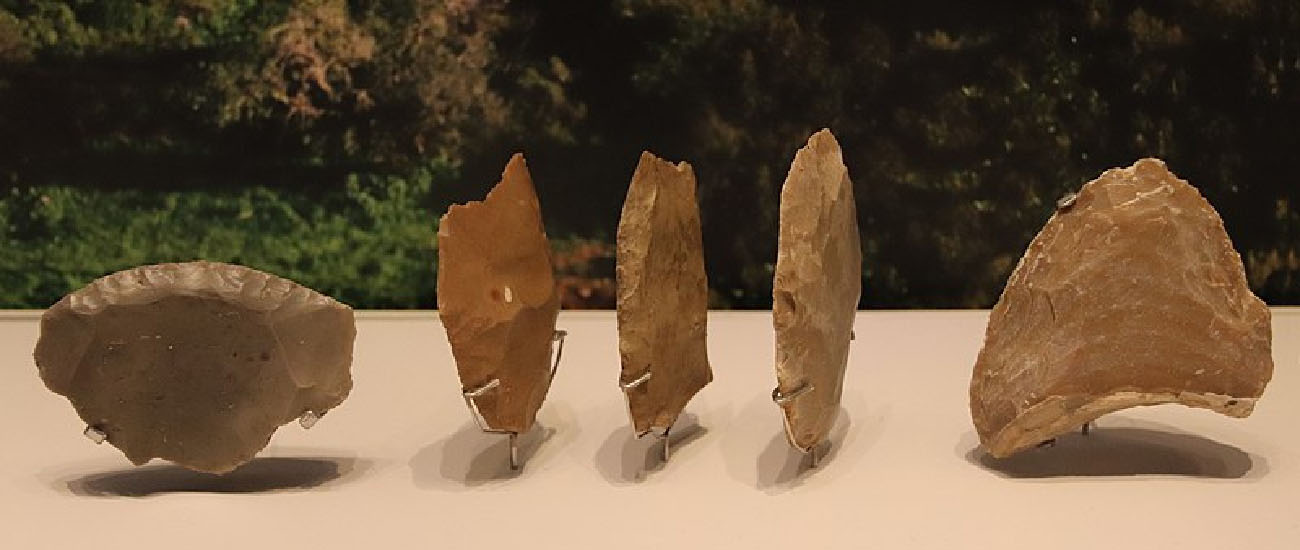
Far superior to the Oldowan variety, Acheulean tools remained the dominant style of stone tool until as recently as about 250,000 years ago. At that time a new type of utensil emerged in Europe, North Africa, and southwestern Asia. Called Mousterian tools, these implements were smaller hand-axes and tools made from stone flakes rather than cores. In older traditions, the flakes had been removed in order to shape the core as desired, such as into a hand-axe. But in the Mousterian tradition, sometimes the flakes were chipped off in such a way that they themselves could be used as small knives for cutting meat, scraping leather, and serving as spearheads attached to shafts (Figure 2.9). Advances to the Mousterian techniques later led to other tool traditions. By around forty-five thousand years ago, humans were making a great diversity of specialized tools from stone flakes. These included a variety of scrapers as well as engraving tools for carving and carefully reshaping softer materials like bone and antler into either tools or works of art.
英語のヒント
オルドワン石器よりはるかに優れたアシューリアン石器は、つい約25万年前まで、石器の主流であり続けた。その頃、ヨーロッパ、北アフリカ、南西アジアに、新しい種類の道具が現れた。ムスティエ石器と呼ばれるこれらは、より小型のハンドアックスや、石核ではなく剥片から作った道具だった。以前の技法では、ハンドアックスなど、望む形に石核を整えるために剥片を取り除いていた。しかし、ムスティエの技法では、ときに剥片自体を利用できるようにはがし取った。小さなナイフとして肉を切ったり、皮を削ったり、柄に取り付けて槍先にしたりするのである(図2.9)。ムスティエの技法の進歩から、後にはさらに別の石器製作の伝統が生まれた。約4万5000年前までには、人類は剥片から多種多様な専用道具を作っていた。さまざまな掻器に加え、骨や角といった比較的柔らかい材料を彫り、慎重に形を整えて、道具や美術品にするための彫刻具もあった。
The Next Generation of Paleolithic Tools.次の世代の旧石器。
(credit: modification of work “Stone Scrapers for Cleaning & Working Leather, Mousterian Culture” by Gary Todd/Flickr, Public Domain) · Public Domain
Figure 2.9 Mousterian stone tools, like these found in Israel, were used as scrapers for more careful butchering of animals between 250,000 and 50,000 years ago. (credit: modification of work “Stone Scrapers for Cleaning & Working Leather, Mousterian Culture” by Gary Todd/Flickr, Public Domain)
図2.9 イスラエルで見つかったこれらのようなムスティエ石器は、25万~5万年前、動物をより丁寧に解体するための掻器として使われた。(出典:Gary Todd/Flickr「Stone Scrapers for Cleaning & Working Leather, Mousterian Culture」を改変、パブリックドメイン)
Another important tool of our human ancestors was fire. When exactly humans began controlling fire remains a topic of debate. There is evidence that earlier ancestors like Homo erectus used it, but we don’t know whether they were able to start fires or merely used and perpetuated those that naturally occurred. It’s clear, however, that by at least about 125,000 years ago, if not much earlier, modern humans had learned to start and control fires.
英語のヒント
人類の祖先にとって、火も重要な道具だった。いつから火を制御し始めたのか、正確な時期にはなお議論がある。ホモ・エレクトゥスのような初期の祖先が火を利用した証拠はある。しかし、自分で火を起こせたのか、それとも自然に生じた火を使い、絶やさないようにしただけなのかは分からない。ただし、もっと早い時期でなかったとしても、少なくとも約12万5000年前までには、現代人が火を起こし、制御する方法を学んでいたことは明らかである。
Controlled fires were useful for staying warm in cold climates, scaring off predators, and cooking meat to make it easier to consume and digest. Archaeological finds also suggest that controlled fires aided in the manufacture of certain tools. Wooden spears could be hardened in the flame, making them more effective hunting implements. Some types of stone could be treated with heat to make them easier to chip and mold. Fire also played an important social function. Gathering around the heat and light likely aided in bonding and helped build the social connections vital for cooperative activities and group survival.
英語のヒント
制御された火は、寒い気候で暖を取り、捕食者を追い払い、肉を調理して食べやすく、消化しやすくするのに役立った。考古学的発見からは、ある種の道具の製作にも役立ったことがうかがえる。木製の槍は炎で硬くすることで、より効果的な狩猟具になった。種類によっては、石も熱を加えると欠き取り、形を整えやすくなった。火には重要な社会的役割もあった。暖かさと明かりの周りに集まることは、おそらく人々の絆を深め、協働や集団の生存に欠かせない社会的なつながりを築く助けになった。
Sitting around a fire may also have been an occasion for early humans to display one of their most powerful tools, the unique ability to use sounds as language. There is some speculation that earlier human ancestors like Homo erectus were able to make sound and possibly had a type of language. We’ll never know for sure. But we do know that modern humans are capable of making a great variety of different sounds. Biologists calculate that we can produce fifty different phonemes, or distinctive sounds. When strung together in a sophisticated manner, these phonemes can produce many tens of thousands of words to describe what we see, feel, do, and imagine. Beginning at least 100,000 years ago, modern humans began using language in this fashion, gaining a major advantage over competing animals. With language, they could coordinate daily tasks, work much more efficiently in groups, communicate abstract ideas, and pass important information to successive generations. Few tools aided modern humans more than their ability to communicate with complex languages.
英語のヒント
火を囲んで座ることは、初期の人類が最も強力な道具の一つを発揮する機会にもなったかもしれない。それは、音を言語として使う独特の能力である。ホモ・エレクトゥスのような初期の祖先も音声を出すことができ、ある種の言語を持っていた可能性がある、という推測はある。確かなことは今後も分からないだろう。しかし、現代人が多種多様な音を出せることは確かである。生物学者の計算によると、私たちは50種類の音素、すなわち区別される音を生み出せる。これらの音素を複雑な仕方でつなげれば、見たり、感じたり、行ったり、想像したりすることを表す、何万もの語を作ることができる。遅くとも10万年前から、現代人はこのように言語を使い始め、競争相手の動物に対して大きな優位を得た。言語によって、日々の作業を調整し、集団でより効率よく働き、抽象的な考えを伝え、重要な情報を次の世代へ受け継ぐことができた。複雑な言語で意思を伝える能力ほど、現代人を助けた道具はほとんどなかった。
While they left no record of their discussions, early humans did leave a number of impressive artistic depictions. The work that has survived includes small animal and human sculptures, usually made of carved bone or stone. The human-shaped items are often of large, possibly pregnant, women and might have served as symbols of fertility. There are also preserved hand prints, created by placing a hand on stone and blowing pigment around it to preserve the image of its shape.
英語のヒント
初期の人類は話し合いの記録こそ残さなかったが、印象的な造形表現をいくつも残した。現存する作品には、小さな動物像や人物像があり、多くは骨や石を彫って作られている。人物像は、妊娠している可能性もある、体の大きな女性をかたどったものが多く、多産の象徴として用いられたのかもしれない。また、石に手を置き、その周りへ顔料を吹き付けて手の形を残した手形も保存されている。
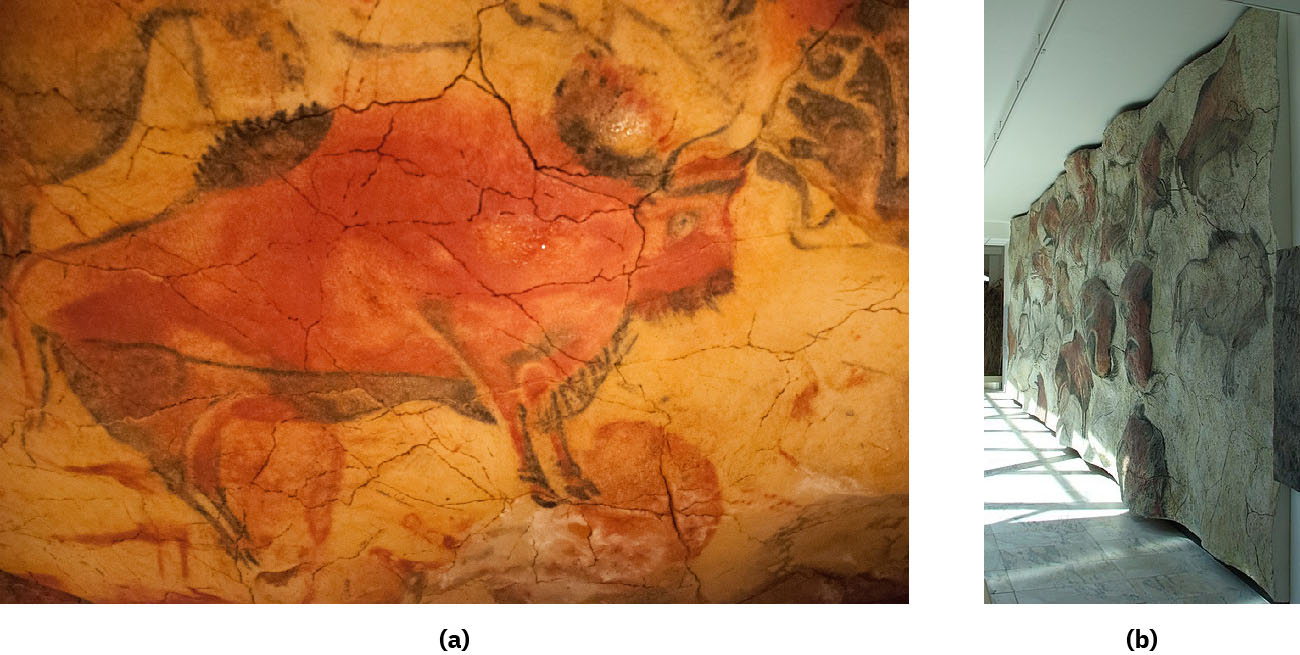
Some of the most stunning prehistoric art still in existence today consists of cave paintings dating as far back as forty thousand years. Many painted caves have been discovered in Spain and France, but there are also examples in England, Italy, Germany, Russia, and Indonesia. The paintings in the Cave of Altamira in northern Spain are prime examples of this type of art. Within the cave, and dating to about thirty-six thousand years ago, are more than two dozen large images of animals including bison, bulls, horses, deer, and boars. Each is painted in impressive detail using combinations of charcoal and ochre (a pigment made from clay) to produce bold reds, yellows, browns, and blacks. In many instances, the artists incorporated features of the cave walls as part of their designs, giving three-dimensional shape and definition to the animals they drew (Figure 2.10).
英語のヒント
現在も残る、特に見事な先史時代の美術には、4万年前にまでさかのぼる洞窟壁画がある。壁画のある洞窟はスペインとフランスで数多く見つかっているが、イングランド、イタリア、ドイツ、ロシア、インドネシアにも例がある。スペイン北部のアルタミラ洞窟の壁画は、その代表例である。洞窟内には約3万6000年前のものとされる、バイソン、雄牛、馬、シカ、イノシシなど、二十数頭を超える大きな動物像がある。一つ一つが、木炭とオーカーという粘土由来の顔料を組み合わせ、鮮やかな赤、黄、茶、黒で細部まで見事に描かれている。作者はしばしば壁面の特徴を構図に取り入れ、描く動物に立体的な形と輪郭を与えた(図2.10)。
Paleolithic Art.旧石器時代の美術。
(credit a: modification of work “Cave Paintings” by Graeme Churchard/Flickr, CC BY 2.0; credit b: modification of work “A model of the ceiling of Altamira from right, in the Brno museum Anthropos” by “HTO”/Wikimedia Commons, Public Domain) · CC BY 2.0 + Public Domain
Figure 2.10 The Paleolithic artist who painted this (a) bison in Altamira Cave (in what is now Spain) used protruding features of the cave’s surface to create a three-dimensional effect, such as at the bison’s shoulders. (b) Other examples of three-dimensionality in the art of Altamira are apparent in a Czech museum’s model of the cave’s ceiling. (credit a: modification of work “Cave Paintings” by Graeme Churchard/Flickr, CC BY 2.0; credit b: modification of work “A model of the ceiling of Altamira from right, in the Brno museum Anthropos” by “HTO”/Wikimedia Commons, Public Domain)
図2.10 現在のスペインにあるアルタミラ洞窟で(a)のバイソンを描いた旧石器時代の作者は、肩の部分などに洞窟壁面の出っ張りを利用し、立体感を生み出した。(b)チェコの博物館にある洞窟天井の模型でも、アルタミラの美術が持つ立体性の別の例を見ることができる。(aの出典:Graeme Churchard/Flickr「Cave Paintings」を改変、CC BY 2.0。bの出典:「HTO」/Wikimedia Commons「A model of the ceiling of Altamira from right, in the Brno museum Anthropos」を改変、パブリックドメイン)
The significance that cave paintings held for the people who created them may never be fully understood. It was once believed the images were designed to be popularly admired as interesting decorations, not unlike the ornaments we put in our homes today. But given that they are often deep in the dark interiors of the caves, where sunlight could not reach, this interpretation has mostly been abandoned.
英語のヒント
洞窟壁画が作り手にとって持っていた意味は、今後も完全には分からないかもしれない。かつては、今日の家に置く装飾品のように、人々が面白い飾りとして鑑賞するために描かれたと考えられていた。しかし、壁画は日光の届かない洞窟の暗い奥深くにあることが多いため、この解釈はほぼ放棄された。
With limited insight into the minds of the artists, scholars have concluded that the art likely served some unknown religious purpose. Many speculate that the caves could have been used by shamans—men and women thought to have a special knowledge of the spiritual world—who might have crawled deep into the interior to commune in ceremonies with a type of spiritual force. Such interpretations remain little more than educated guesses. What is indisputable is that the art demonstrates that even tens of thousands of years ago humans had the unique ability to reproduce the world around them in complex, symbolic fashion, through images we can immediately recognize today.
英語のヒント
作者の心の内を知る手がかりが限られるなか、研究者は、これらの美術が、詳細の分からない何らかの宗教的目的に用いられた可能性が高いと結論している。多くの研究者は、洞窟がシャーマン、すなわち霊的世界に特別な知識を持つと考えられた男女によって使われたのではないかと推測する。彼らは洞窟の奥へ這って入り、儀式を通じて何らかの霊的な力と交わったのかもしれない。こうした解釈は、知識に基づく推測の域をほとんど出ない。疑いないのは、その美術が、数万年前の人間もすでに、周囲の世界を複雑で象徴的な形に再現する独特の能力を持っていたことを示す点である。その画像は、今日の私たちにもすぐ何かが分かる。