第2章初期の人類Early Humans
Why Did Humans Move and Where Did They Go?人類はなぜ移動し、どこへ向かったのか
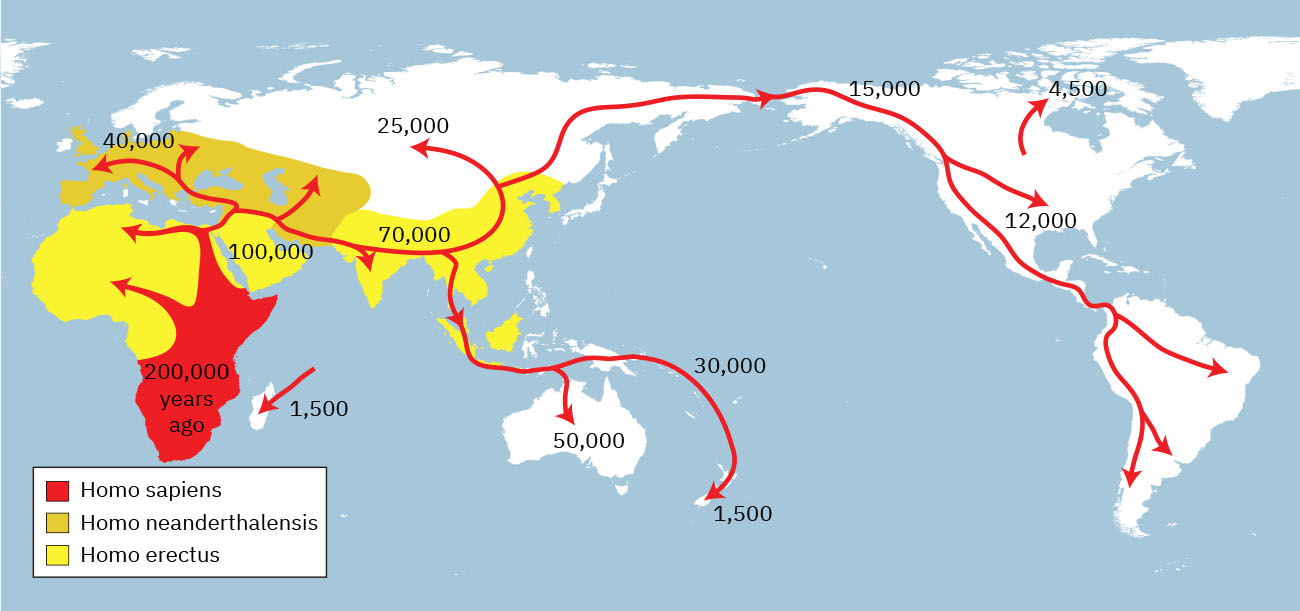
Archeological evidence indicates that Homo sapiens began migrating out of eastern and southern Africa as early as 200,000 years ago. This expansion took early humans deeper south, west, and north as far as the Mediterranean Sea. Approximately 100,000 years ago, groups of Homo sapiens left the African continent and began a global migration that lasted for tens of thousands of years (Figure 2.6). After crossing the Sinai into southwest Asia, early migrants out of Africa likely followed the coasts of Asia, and by about seventy thousand years ago, they had made their way into India and China.
英語のヒント
考古学的証拠によれば、ホモ・サピエンスは早くも20万年前に、アフリカ東部・南部から移動を始めていた。この広がりによって、初期の人類はさらに南や西へ、北は地中海まで進出した。約10万年前には、ホモ・サピエンスの集団がアフリカ大陸を離れ、数万年に及ぶ世界規模の移動を始めた(図2.6)。シナイ半島を越えて南西アジアへ入った初期の移住者は、おそらくアジアの海岸線に沿って進み、約7万年前までにはインドと中国へ到達していた。
Migration of the Earliest Humans.初期人類の移動。
(credit: modification of work “Spreading of Homo sapiens” by “NordNordWest”/Wikimedia Commons, Public Domain) · Public Domain
Figure 2.6 Homo sapiens first expanded around south and eastern Africa before embarking on migrations that eventually took them around the world. (credit: modification of work “Spreading of Homo sapiens” by “NordNordWest”/Wikimedia Commons, Public Domain)
図2.6 ホモ・サピエンスはまずアフリカ南部・東部で分布を広げ、その後、最終的に世界各地へ至る移動に乗り出した。(出典:「NordNordWest」/Wikimedia Commons「Spreading of Homo sapiens」を改変、パブリックドメイン)
Some groups continued moving south through Malaysia, into Indonesia and beyond. In places like Papua New Guinea and Australia, there is evidence of settlements at least forty-five thousand years old. Others groups making their way into southwest Asia from northern Africa entered Europe around forty thousand years ago, moving either along the Mediterranean coast or by way of Turkey into the Danube valley. By twenty-five thousand years ago, Homo sapiens had reached Siberia and other parts of northern Asia. And approximately fifteen thousand years ago, some groups in Asia crossed into North America, eventually reaching the tip of South America and settling at various locations in between.
英語のヒント
一部の集団はマレーシアを通って南へ進み、インドネシアとその先へ向かった。パプアニューギニアやオーストラリアでは、少なくとも4万5000年前の居住の証拠がある。北アフリカから南西アジアへ進んだ別の集団は、約4万年前にヨーロッパへ入った。経路は地中海沿岸、またはトルコを経由してドナウ川流域へ至るものだった。2万5000年前までには、ホモ・サピエンスはシベリアなどの北アジアに到達していた。そして約1万5000年前、アジアの一部の集団が北アメリカへ渡り、やがて南アメリカの先端にまで至るとともに、その途中のさまざまな場所に住みついた。
This timeline has been pieced together based on the analysis of several archaeological finds. But our knowledge is still limited, and new discoveries frequently require adjustments to the proposed dates and patterns of global human migration. For example, we now know that because the Earth was in its most recent ice age during this period, areas currently covered by water were then dry land. This is true for large portions of maritime Southeast Asia as well as the Bering Strait between Asia and North America. Humans were able to walk as far south as Java and from Asia into Alaska.
英語のヒント
この年代の流れは、いくつもの考古学的発見を分析して組み立てられてきた。しかし、私たちの知識はまだ限られており、新しい発見によって、人類の世界規模の移動について提案されている年代や経路は、しばしば修正を迫られる。たとえば、この時期の地球は最後の氷期にあったため、現在は水に覆われている地域が当時は陸地だったことが分かっている。東南アジアの島嶼部の広い範囲や、アジアと北アメリカの間のベーリング海峡がそうだった。人類は南はジャワ島まで、またアジアからアラスカまで、歩いて移動できたのである。
Yet they also roamed as far as Australia, which was not connected by land to Asia in this period. This means they must have used rafts of some type, probably by crossing short distances between islands. Likewise, discoveries of human habitation dating from fourteen thousand years ago in South America suggest that rafts or boats of some kind may also have been used to skirt the North and South American coasts. No crafts have been or may ever be found, but we must assume they existed.
英語のヒント
それでも、人類はこの時期にアジアと陸続きではなかったオーストラリアにまで進出した。ということは、何らかのいかだを使ったはずであり、おそらく島と島の間の短い距離を渡ったのだろう。同様に、南アメリカで1万4000年前の人類の居住跡が見つかっていることから、南北アメリカの海岸沿いを進むためにも、何らかのいかだや舟が使われた可能性がある。そうした舟はまだ見つかっておらず、今後も見つからないかもしれないが、存在したと考える必要がある。
More interesting still, analysis of the remains of the eight-thousand-year-old Kennewick Man discovered in 1996 in Washington State reveals anatomical features more consistent with Southeast Asian populations than with those traditionally assumed to have populated the Americas. This discovery complicates the version of human migration we think we know, and if anything, it suggests there is much about the process that we may never fully understand.
英語のヒント
さらに興味深いことに、1996年にワシントン州で発見された、約8000年前のケネウィック人の遺骨の分析は、従来アメリカ大陸へ住みついたと想定されていた人々よりも、東南アジアの集団に一致する解剖学的特徴を示している。この発見は、私たちが理解しているつもりの人類移動の筋書きを複雑にし、むしろその過程には、最後まで完全には分からないことが多いのかもしれないと示唆している。
But what triggered this migration in the first place? Despite the uncertainties, we can draw some speculative conclusions. We know that around the same time Homo sapiens began leaving Africa, the climate there was becoming increasingly dry. Drier conditions meant fewer of the plants and animals humans needed to survive were available. Modern humans were hunter-gatherers like their evolutionary ancestors, meaning they survived by employing the strategies of hunting animals and gathering wild plants rather than by planting crops and raising livestock. As hunter-gathering societies regularly forage over a large area, any scarcity of resources in some places or abundance in others encourages movement. In the lifetime of a single individual, a large-scale migration would have been barely perceptible, if at all. But over tens of thousands of years, human populations traversed an enormous portion of the globe. Nor did they go in a single direction or all at once. Groups likely moved back and forth over areas, responding to the climatic conditions and availability of resources. There were long periods of relative stasis punctuated by movement, creating waves of migration in various directions.
英語のヒント
では、そもそも何がこの移動を引き起こしたのだろうか。不確かな点はあるものの、推測に基づく結論をいくつか導くことはできる。ホモ・サピエンスがアフリカを離れ始めたのとほぼ同じ頃、アフリカの気候がいっそう乾燥していたことは分かっている。乾燥が進むと、生存に必要な動植物を以前ほど得られなくなった。現代人は進化上の祖先と同じく狩猟採集民だった。つまり、作物を栽培し家畜を飼うのではなく、動物を狩り、野生の植物を集めて暮らしていた。狩猟採集社会は日常的に広い地域で食料を探すので、ある場所の資源不足や、別の場所の豊富さは、移動を促す。一人の一生の間では、大規模な移動は気づかれたとしても、ほとんど分からないほどだっただろう。しかし、数万年の間に、人類の集団は地球の広大な範囲を横断した。しかも、一方向へ一斉に進んだわけでもなかった。気候条件や資源の得やすさに応じて、各地を行き来したと考えられる。長く比較的動かない時期の合間に移動が起こり、さまざまな方向へ移動の波が生まれたのである。
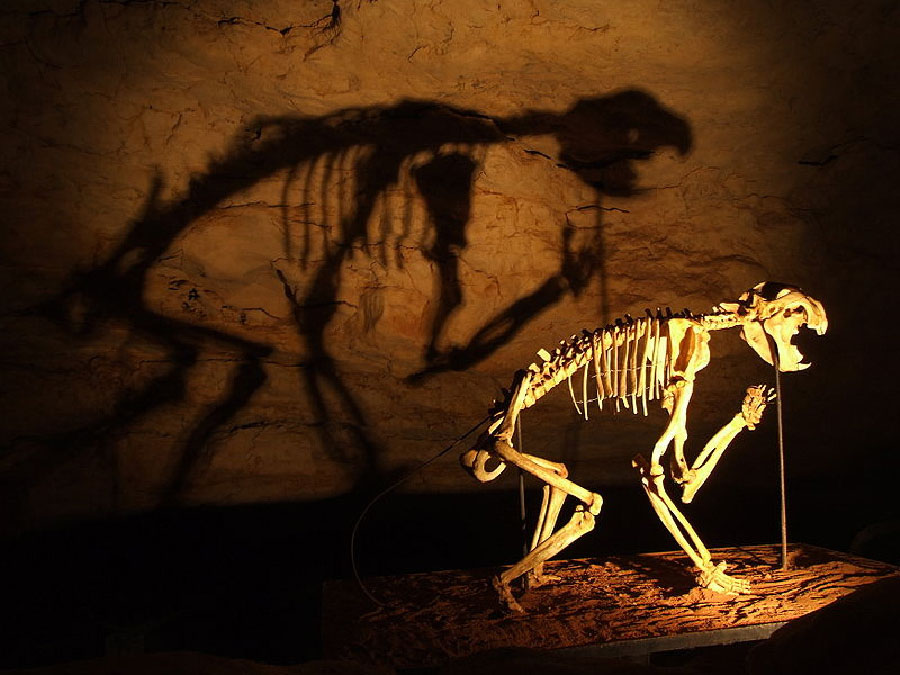
As humans moved into new environments, they adjusted their strategies to be successful under new conditions. This meant learning to gather different types of plants and hunt different types of animals they came into contact with, including mastodons, woolly mammoths and rhinos, various types of grazing animals, and giant sloths and beavers. The arrival of humans who were highly effective at survival occasionally accompanied major transformations in their new environments. Scientists who study now-extinct animals have recognized for some time that human hunting likely contributed to the decline of a number of these species. Before humans arrived approximately forty-five thousand years ago, for example, Australia was home to a number of large reptiles, a marsupial lion (which carried its young in a pouch), and huge wombats and kangaroos (Figure 2.7). These species began to vanish around the same time humans reached Australia and well before the climatic warming that led to the extinction of large animals in other places.
英語のヒント
新しい環境へ進んだ人類は、新しい条件でうまく暮らせるよう戦略を変えた。それは、新たに出会った植物を集め、動物を狩る方法を学ぶことだった。獲物にはマストドン、ケナガマンモスやケサイ、さまざまな草食動物、巨大なナマケモノやビーバーなどが含まれる。生存することに非常に長けた人類の到来は、ときに移住先の環境の大きな変化を伴った。現在は絶滅した動物を研究する科学者は、人間の狩猟がそうした種のいくつもの減少に関わった可能性を、以前から認識している。たとえば、約4万5000年前に人類が到来するまでのオーストラリアには、大型の爬虫類、子を袋で育てる有袋類のライオン、巨大なウォンバットやカンガルーが生息していた(図2.7)。これらの種は、人類が到達したのとほぼ同じ頃に姿を消し始めた。それは、ほかの地域で大型動物の絶滅をもたらした気候の温暖化より、かなり前のことだった。
A Marsupial Lion.有袋類のライオン。
(credit: “A skeleton of a Marsupial Lion (Thylacoleo carnifex) in the Victoria Fossil Cave, Naracoorte Caves National Park” by “Karora”/Wikimedia Commons, Public Domain) · Public Domain
Figure 2.7 Tens of thousands of years ago, Australia was home to many large marsupials, such as this marsupial lion. Its fossilized skeleton is shown here in the Victoria Fossil Cave where it was found. (credit: “A skeleton of a Marsupial Lion (Thylacoleo carnifex) in the Victoria Fossil Cave, Naracoorte Caves National Park” by “Karora”/Wikimedia Commons, Public Domain)
図2.7 数万年前のオーストラリアには、この有袋類のライオンをはじめとする多くの大型有袋類が生息していた。写真は、発見場所であるヴィクトリア化石洞窟に展示された化石骨格。(出典:「Karora」/Wikimedia Commons「A skeleton of a Marsupial Lion (Thylacoleo carnifex) in the Victoria Fossil Cave, Naracoorte Caves National Park」、パブリックドメイン)