第2章初期の人類Early Humans
2.2 People in the Paleolithic Age2.2 旧石器時代の人々
Learning Objectives学習の目標
By the end of this section, you will be able to:
この節を学ぶと、次のことができるようになる。
Explain how the environment shaped the way people lived in the Paleolithic Age
旧石器時代の暮らしが、環境によってどのように形作られたかを説明する。
Describe the day-to-day life of people in the Paleolithic Age
旧石器時代の人々の日常生活を説明する。
Discuss Paleolithic Age peoples and their likely attitudes toward the environment, gender, religion, and social hierarchy
旧石器時代の人々と、環境、ジェンダー、宗教、社会的序列に対して彼らが抱いていたと考えられる態度を論じる。
Living in an age when global temperatures are gradually rising, we are well equipped to recognize the impact of climate on daily life. For much of their existence, however, Earth’s early peoples lived in an ice age, when temperatures were colder and ice covered areas that are now forested or farmed. Hostile climates tend to create a scarcity of key resources and require that people spend more time securing those necessities. Early humans thus relied on one another and their communities for basic survival, forming small tight-knit groups that migrated to ensure their access to edible plants, water, and game. In regions where food was more secure, such as in lush environments with ample water supply, settlements were more permanent and people had more time for artistic and social endeavors.
英語のヒント
地球の気温が徐々に上がる時代に生きる私たちは、気候が日々の生活に及ぼす影響をよく理解できる立場にいる。しかし、初期の人類は、その存在期間の大半を氷河時代に過ごした。当時は気温が低く、今では森林や農地になっている地域が氷に覆われていた。厳しい気候は重要な資源を不足させ、人々が生活必需品の確保に、より多くの時間を割くことを要求する。そのため、初期の人類は生き延びるために互いと共同体を頼り、結び付きの強い小集団を作った。食用植物、水、獲物を確保するために移動したのである。水が豊富で緑の多い土地のように、食料を安定して得られる地域では、居住はより定着したものとなり、人々は美術や社会的な活動に時間を使う余裕があった。
But survival was generally difficult and cooperation vital. This is one reason egalitarianism was common among prehistoric hunter-gatherers, as it still is among the few remaining groups that pursue this survival strategy today. However, men and women in early human groups often had different responsibilities. For example, women tended to gather while men hunted. Across the planet, groups relied heavily on existing resources harvested from their natural surroundings, and any change or challenge could spell disaster. Yet people proved to be resilient and innovative.
英語のヒント
とはいえ、生存は一般に難しく、協力が欠かせなかった。これが、先史時代の狩猟採集民に平等主義が広く見られた理由の一つである。今日も狩猟採集で暮らす、わずかに残った集団にも、その傾向は見られる。しかし、初期の人類集団では、男女が異なる役割を担うことが多かった。たとえば、女性は採集し、男性は狩りをする傾向があった。世界各地の集団は、身の回りの自然から得られる資源に大きく依存していたため、変化や困難は破局につながりかねなかった。それでも、人々は立ち直る力と、新たな工夫を生み出す力を示した。
Ice, Ice, and More Ice氷、氷、そしてまた氷
Scientists who study the changes that have occurred on Earth over billions of years have identified at least five significant periods of cooling on the planet. These are often called ice ages, and each has included multiple glaciation periods during which glaciers grew on the land.
英語のヒント
数十億年にわたる地球の変化を研究する科学者は、地球が大きく寒冷化した時期を少なくとも五つ特定している。これらは一般に氷河時代と呼ばれ、それぞれの中には、陸上の氷河が拡大する氷期が何度も含まれていた。
A few factors can trigger an ice age, but generally such climate changes occur when insufficient sunlight is able to reach the planet’s surface. Then temperatures drop in northern latitudes, resulting in the accumulation of ice. As the glacial ice sheets grow and spread across the land, water is pulled from the oceans, causing sea levels to decline. Even areas closer to the equator, where ice is unlikely to develop, can experience dramatic climate change during these cooling periods. Otherwise-tropical areas can experience drying, causing rivers to disappear, lakes to turn into swamps, jungles into savannahs, and grasslands into deserts. These changes have a huge effect on plants and animals, leading to evolutionary adaptations in some and extinction in others. These are all natural processes, and each recorded ice age in our planet’s history has eventually come to an end when more sunlight reaches the Earth and causes the temperature to rise and ice to melt.
英語のヒント
氷河時代の引き金となる要因はいくつかあるが、一般にそのような気候変動は、地表に届く日光が不十分になると起こる。北の緯度帯で気温が下がり、氷が蓄積する。氷床が成長して陸上に広がるにつれ、海の水が取り込まれ、海面が下がる。氷の発達しにくい赤道寄りの地域でも、こうした寒冷期には劇的な気候変動が起こり得る。通常なら熱帯に当たる地域でも乾燥が進み、川が消え、湖が湿地に、密林がサバンナに、草原が砂漠に変わることがある。こうした変化は動植物に大きな影響を及ぼし、あるものには進化上の適応を、別のものには絶滅をもたらす。これらはすべて自然の過程である。地球の歴史に記録された各氷河時代は、やがて地表に届く日光が増え、気温が上がって氷が解けると、終わりを迎えてきた。
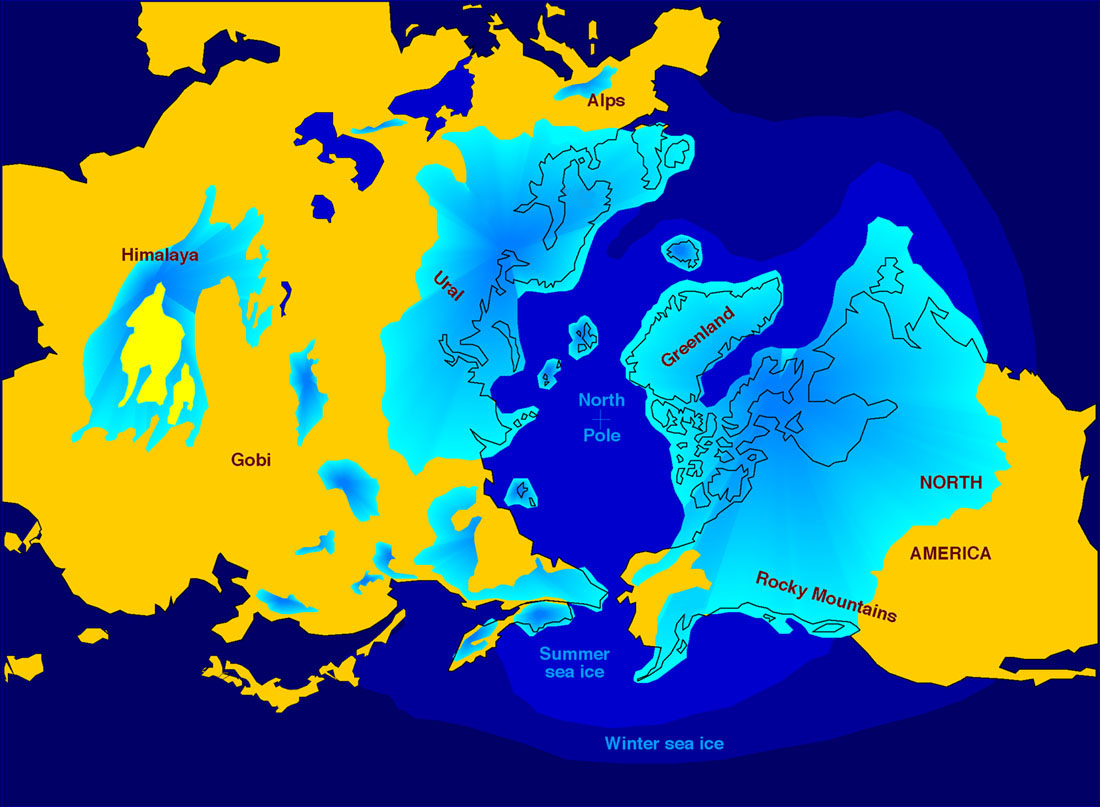
The most recent glaciation period began a little over 100,000 years ago and reached its peak about eighteen thousand years ago (Figure 2.14). The ice age of which this glaciation period was a part ended approximately twelve thousand years ago. At peak glaciation, ice sheets sometimes two miles thick covered the land around the North Pole and extended outward over much of present-day Russia, Scandinavia, the British Isles, Greenland, Canada, and the northern reaches of the United States.
英語のヒント
最後の氷期は10万年あまり前に始まり、約1万8000年前に最盛期を迎えた(図2.14)。この氷期を含む氷河時代は、約1万2000年前に終わった。最も氷河が拡大した時期には、厚さが2マイルに達する氷床が北極周辺の陸地を覆い、現在のロシア、スカンディナヴィア、ブリテン諸島、グリーンランド、カナダ、アメリカ合衆国北部の広い範囲まで伸びていた。
The Most Recent Glaciation Period.最後の氷期。
(credit: modification of work “Northern Hemisphere glaciation during the last ice ages” by “Hannes Grobe/AWI”/Wikimedia Commons, CC BY 2.5) · CC BY 2.5
Figure 2.14 During the most recent glaciation period, eighteen thousand to one million years ago, ice sheets covered large portions of the northern hemisphere, and Earth’s sea levels were far lower than they are today. (credit: modification of work “Northern Hemisphere glaciation during the last ice ages” by “Hannes Grobe/AWI”/Wikimedia Commons, CC BY 2.5)
図2.14 最後の氷期に当たる100万~1万8000年前、北半球の広い範囲を氷床が覆い、海面は現在よりはるかに低かった。(出典:「Hannes Grobe/AWI」/Wikimedia Commons「Northern Hemisphere glaciation during the last ice ages」を改変、CC BY 2.5)
The consequences of these climatic transformations for modern humans have been huge. It is probably not a coincidence that at approximately the same time Earth entered its last glaciation period, humans began their global expansion. Climate changes in Africa were likely a decisive factor in encouraging and enabling them to move into other parts of the world. Low sea levels allowed modern humans to expand into maritime Southeast Asia and Japan and reach Australia. And not long after Earth reached peak glaciation, the first human migrants entered North America from Siberia, by way of a strip of land exposed by low sea levels.
英語のヒント
こうした気候の変化は、現代人に大きな影響を与えた。地球が最後の氷期へ入ったのとほぼ同じ頃に、人類が世界への拡大を始めたのは、おそらく偶然ではない。アフリカの気候変動は、人々にほかの地域への移動を促し、それを可能にする決定的な要因だったと考えられる。低い海面は、東南アジアの島嶼部や日本への進出、オーストラリアへの到達を可能にした。そして氷河の拡大が頂点に達して間もなく、最初の移住者たちが、海面低下で露出した帯状の陸地を通って、シベリアから北アメリカへ入った。
Modern humans who moved into colder conditions had to adjust to their harsh environments. For example, they created new forms of clothing, unnecessary in warmer climates but vital now, by removing the hides from hunted animals with various types of rock tools and scraping them clean. The earliest clothing must have been simple and likely functioned as blankets draped over the body to keep warm. However, by around thirty thousand years ago, modern humans had developed the earliest known sewing needles, making them of bone, wood, and ivory. Like their modern counterparts, these needles had sharp points at one end and a hole in the other. With thread made from animal remains or wild flax, humans could now piece together bits of soft animal hide from foxes, rabbits, and deer to produce far more sophisticated and tight-fitting clothing.
英語のヒント
寒冷な土地へ移った現代人は、厳しい環境に適応する必要があった。たとえば、暖かい土地では不要だったが、今や欠かせない新しい衣服を作った。さまざまな石器で狩った動物の皮をはぎ、表面をこすってきれいにしたのである。最初期の衣服は単純なものだったはずで、おそらく体に掛けて暖を取る毛布のような役割を果たした。しかし、約3万年前までには、現代人は現在知られる最古の縫い針を、骨、木、象牙で作っていた。現代の針と同じく、一端が尖り、もう一端には穴があった。動物由来の素材や野生の亜麻から作った糸で、キツネ、ウサギ、シカの柔らかな皮の切れ端を縫い合わせれば、はるかに精巧で体に合う衣服を作ることができた。
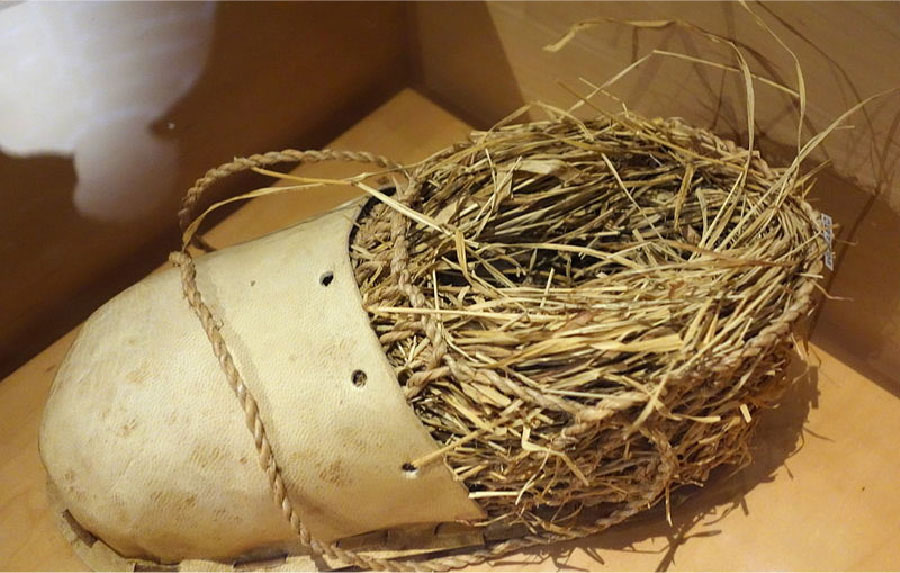
The five-thousand-year-old remains of a man discovered in the alpine region between Austria and Italy in 1991 and dubbed Ötzi provide us with some indication of the type of clothing that could be created (Figure 2.15). Ötzi was dressed in a heavy coat made of goat and sheep hides stitched together. He also wore tight-fitting leggings of similar materials, a bearskin cap with a chin strap, and shoes constructed from woven grass, tree fibers, and deer hide. This type of clothing was far more functional than earlier designs and would have allowed populations to survive in frigid areas.
英語のヒント
1991年、オーストリアとイタリアの間のアルプス地方で発見され、エッツィと名付けられた約5000年前の男性の遺体は、どのような衣服を作れたのかをうかがわせる(図2.15)。エッツィはヤギとヒツジの皮を縫い合わせた厚い上着を着ていた。同様の素材でできた体に沿う脚衣、顎ひもの付いたクマの毛皮の帽子、そして編んだ草、樹木の繊維、シカの皮で作った靴も身に着けていた。この種の衣服は以前のものよりはるかに機能的で、極寒の地域でも人々が生き延びることを可能にしただろう。
An Ancient Shoe.古代の靴。
(credit: modification of work “Ötzi shoe (replica), bearskin with deerskin upper, internal cage of twined linden bark, padded grass insulation - Bata Shoe Museum” by “Daderot”/Wikimedia Commons, CC0 1.0) · CC0 1.0
Figure 2.15 This reproduction of one of Ötzi’s shoes shows how deerskin and bearskin lined with bark and twine were fashioned to protect his feet in the cold climate in which he lived thousands of years ago. (credit: modification of work “Ötzi shoe (replica), bearskin with deerskin upper, internal cage of twined linden bark, padded grass insulation - Bata Shoe Museum” by “Daderot”/Wikimedia Commons, CC0 1.0)
図2.15 エッツィの靴の一つを再現したもの。シカ皮とクマ皮に樹皮やよりひもを組み合わせ、数千年前の寒い環境で足を守るよう仕立てた様子が分かる。(出典:「Daderot」/Wikimedia Commons「Ötzi shoe (replica), bearskin with deerskin upper, internal cage of twined linden bark, padded grass insulation - Bata Shoe Museum」を改変、CC0 1.0)
The warming of Earth and retreat of the glaciers that began around seventeen thousand years ago submerged continental shelves around the world and created new lakes and rivers. These changes in turn created opportunities for exploiting fresh- and saltwater marine life in the new waterways and the warmer shallow waters along the coasts. Many human groups were now exposed to a greater variety of animals that they could use to supplement their diets. As other animals like reindeer adapted to life in cold environments and moved north, the human populations that hunted them moved north as well. The higher water levels also helped to isolate some groups, however. Those that had migrated into maritime Southeast Asia and Australia found themselves more secluded on islands in the south Pacific. Those that had crossed into the Americas from Asia were cut off from populations in the eastern hemisphere as sea waters rose in the Bering Strait. The civilizations they created in North and South America remained largely separated from the rest of the world until the fifteenth century CE.
英語のヒント
約1万7000年前に始まった地球の温暖化と氷河の後退は、世界各地の大陸棚を水没させ、新しい湖や川を作った。その変化は、新たな水路や、暖かくなった沿岸の浅い海で、淡水・海水の生物を利用する機会をもたらした。多くの人類集団は、食生活を補う、以前より多様な動物を利用できるようになった。トナカイなど寒冷環境に適応した動物が北へ移ると、それを狩る人々も北へ移動した。しかし、水位の上昇は、一部の集団を孤立させることにもなった。東南アジアの島嶼部やオーストラリアへ移った人々は、南太平洋の島々で以前より隔てられた状態になった。アジアからアメリカ大陸へ渡った人々は、ベーリング海峡の海面が上がると、東半球の人々から切り離された。彼らが南北アメリカに築いた文明は、紀元15世紀まで、世界のほかの地域とはおおむね分離した状態にあった。