第2章初期の人類Early Humans
2.3 The Neolithic Revolution2.3 新石器革命
Learning Objectives学習の目標
By the end of this section, you will be able to:
この節を学ぶと、次のことができるようになる。
Discuss the Neolithic Age
新石器時代について論じる。
Explain the consequences of the Neolithic Revolution
新石器革命がもたらした結果を説明する。
Describe Neolithic settlements around the world and their significance
世界各地の新石器時代の集落と、その重要性を説明する。
From the time Homo sapiens emerged and for tens of thousands of years afterward, members of the species lived a life of hunting and gathering, much as their distant ancestors had. Then, about twelve thousand years ago and for reasons that remain imperfectly understood, some modern human populations adopted agriculture. This means they transitioned away from existing on merely the sustenance nature provided. Instead, they began actively promoting the growth and eventual transformation of crops, and later the domestication of animals, to provide themselves with the resources they needed. This shift in strategy inaugurated the Neolithic Age.
英語のヒント
ホモ・サピエンスは、出現してから数万年にわたり、遠い祖先とほぼ同じように狩猟採集生活を送っていた。その後、約1万2000年前に、今も十分には解明されていない理由から、一部の現代人の集団が農耕を取り入れた。それは、自然が与える食料だけで暮らす生活から離れることを意味した。必要な資源を得るために、作物の成長を積極的に促し、やがて作物そのものを変え、後には動物を家畜化し始めたのである。この戦略の転換が、新石器時代を開いた。
The birth of agriculture triggered a host of additional changes in the way humans understood land, the way they organized socially, the amount and forms of wealth they could acquire, and even the religious traditions they practiced. Not everyone made the leap to farming, however. Plenty of hunter-gatherer societies avoided transitioning into a settled agricultural life, either because the new strategy wasn’t practicable in their environment or because for them the costs outweighed the benefits. Yet those groups that did become agriculturalists experienced a degree of population growth and labor specialization that ultimately allowed for the establishment of a number of sophisticated Neolithic settlements.
英語のヒント
農耕の誕生は、土地の捉え方、社会の組織、獲得できる富の量と形、さらには宗教的伝統にまで、多くの変化を引き起こした。ただし、すべての人が農耕へ踏み出したわけではない。多くの狩猟採集社会は、その環境では新しい方法が実行できなかったり、費用が利益を上回ったりしたため、定住農耕生活へ移行しなかった。それでも、農耕を始めた集団では人口が増え、労働の専門化が進んだ。その結果、数多くの高度な新石器時代の集落を築けるようになった。
The Development of Agriculture農耕の発達
Possibly the most important transformation in the history of modern humans was the shift from hunting and gathering to a life based primarily on agriculture. We call this shift the Neolithic Revolution. But the revolution didn’t happen in just one place or at one time. Instead, it occurred independently at different times and in several different areas, including the Near East, China, sub-Saharan Africa, Mesoamerica, and South America.
英語のヒント
現代人の歴史で最も重要な変化は、狩猟採集から、主として農耕に基づく暮らしへの転換だったかもしれない。この転換を新石器革命と呼ぶ。しかし、その革命は一つの場所で一度に起こったのではない。近東、中国、サハラ以南のアフリカ、メソアメリカ、南アメリカなど、いくつもの地域で、異なる時期に独立して起こった。
Each region domesticated different types of plants. In the Near East it was grains like wheat and barley. In Mesoamerica it was squash and later maize, or corn, and in China millet and rice. These plants grew naturally in those areas and were gathered in their wild form for many thousands of years before they were cultivated deliberately. The shift to agriculture brought enormous transformations to human populations around the world. It made it possible to feed much larger groups, necessitated the abandonment of hunter-gatherer-style egalitarianism, prompted the domestication of animals, and ultimately made way for human civilization as we understand it.
英語のヒント
各地域では、それぞれ異なる植物が栽培化された。近東ではコムギやオオムギなどの穀物、メソアメリカではカボチャ類、後にはトウモロコシ、中国ではキビ類とイネだった。これらの植物はもともとその地域に自生し、意図的に栽培される前から、何千年も野生の状態で採集されていた。農耕への移行は、世界中の人類集団に大きな変化をもたらした。はるかに多くの人に食料を供給できるようになり、狩猟採集型の平等主義を放棄する必要が生じ、動物の家畜化が促され、最終的には、私たちが文明と呼ぶものへの道が開かれた。
The reason some human populations undertook this important evolution remains imperfectly understood. However, it’s likely not a coincidence that the earliest known adoptions of agriculture occurred not long after the end of the last ice age, about twelve thousand years ago. This climatic shift altered animal migration patterns and probably brought much drier conditions to places like the Near East, where we find the earliest evidence of plant domestication. Climate conditions may have put a strain on food resources and prompted a shift in survival strategy. For example, humans might have attempted to help edible plants grow by moving them to places where they didn’t grow before or had stopped growing. Populations already settled in one area might have begun to notice that seeds from the plants they were gathering would grow where they were left. Further observations likely prompted additional human interventions in order to produce more.
英語のヒント
なぜ一部の人類集団がこの大きな変化に踏み出したのかは、十分には解明されていない。しかし、知られている最初の農耕の導入が、約1万2000年前の最後の氷河時代の終わりから間もなく起こったのは、おそらく偶然ではない。気候の転換は動物の移動の仕方を変え、植物の栽培化の最初期の証拠がある近東などを、かなり乾燥させたと考えられる。気候条件が食料資源に圧力をかけ、生存戦略の転換を促したのかもしれない。たとえば、以前は生えていなかった、あるいは生えなくなった場所へ食用植物を移し、生育を助けようとした可能性がある。すでに一つの場所に住みついていた集団は、集めた植物の種が、置かれた場所で育つことに気づき始めたのかもしれない。さらに観察を重ねるうちに、生産を増やすための追加の働きかけが行われたと考えられる。
Not all regions of the world had the right conditions in place to encourage a shift from hunting and gathering to settled agriculture. Among those regions that did, and where agriculture first flourished, were Mesopotamia, southern Turkey, and Israel. On a map, these places take the shape of a large crescent bending through the Near East. For this reason, the area is often referred to as the Fertile Crescent.
英語のヒント
世界のすべての地域に、狩猟採集から定住農耕への転換を促す条件が整っていたわけではない。条件が整い、農耕が最初に栄えた地域には、メソポタミア、トルコ南部、イスラエルがあった。地図上では、これらの場所は近東を弓なりに走る、大きな三日月の形を描く。そのため、この地域は「肥沃な三日月地帯」とよく呼ばれる。
It was here that about twelve thousand years ago people began domesticating edible wild grasses to create what we know today as wheat and barley. Later, other species of plants were domesticated: peas, lentils, carrots, olives, and dates. Around ten thousand years ago, Asian peoples living on the Yangtze and Yellow Rivers began farming crops like rice, millet, and soybeans. In sub-Saharan Africa, likely around modern Sudan, people began actively cultivating sorghum, possibly as early as six thousand years ago. Over time they added crops like peanuts and sesame. Around the same time, groups living in central Mexico began cultivating maize (corn). Later they added crops like beans, squash, and peppers. Farther south, in the Andean region, around five thousand years ago people began to grow potatoes.
英語のヒント
約1万2000年前、人々が食用の野生のイネ科植物を栽培化し、今日のコムギやオオムギとなる作物を生み出し始めたのは、この地域だった。後には、エンドウ、レンズマメ、ニンジン、オリーブ、ナツメヤシなども栽培化された。約1万年前、長江・黄河流域のアジアの人々は、イネ、キビ類、ダイズなどを栽培し始めた。サハラ以南のアフリカでは、おそらく現在のスーダン周辺で、早ければ約6000年前にソルガムの積極的な栽培が始まった。やがてラッカセイやゴマなども加わった。ほぼ同じ頃、メキシコ中部の集団はトウモロコシを栽培し始め、後にマメ、カボチャ、トウガラシなどを加えた。さらに南のアンデス地方では、約5000年前にジャガイモの栽培が始まった。
Each instance of the independent emergence of agriculture was followed by the expansion of these techniques to other areas. Wheat cultivation spread from the Fertile Crescent across the Mediterranean region and into northern Europe. Rice farming was adopted across large parts of eastern Asia where the crop would grow. Maize eventually expanded across Mesoamerica; in time, it reached as far north as the modern United States and as far south as the Andean region.
英語のヒント
農耕が各地で独立に生まれると、その技術はほかの地域へ広がった。コムギ栽培は肥沃な三日月地帯から地中海地域を経て北ヨーロッパへ広がった。稲作は、イネの育つ東アジアの広い範囲で取り入れられた。トウモロコシはやがてメソアメリカ全体に広がり、時がたつと北は現在のアメリカ合衆国、南はアンデス地方にまで達した。
The key change brought by the rise of agriculture was not only that humans began to grow their own plants rather than just finding them where they grew naturally. It was also that humans, rather than their environment, became the deciding factor in determining which plants would grow. Since humans were selecting plants for their edible properties, their intervention led to gradual but important transformations in the plants themselves. For example, ancient wild varieties of wheat and barley had heavy husks around their edible seeds. These husks protected the seeds so that they could survive over the winter and sprout in the summer. But humans were primarily interested in the seeds, not the inedible husks. By selecting wheat and barley plants with thinner husks and more seeds year over year, humans transformed the plants over time into varieties of wheat and barley more suitable for their purposes. This domestication process occurred with numerous types of plants in different areas around the world.
英語のヒント
農耕の成立がもたらした重要な変化は、自然に生えた植物を探すだけでなく、自分たちで育て始めたことにとどまらない。どの植物が育つかを決める要因が、環境ではなく人間になったことも重要だった。食用としての性質を基準に植物を選んだため、人間の介入は、植物自体に緩やかだが大きな変化をもたらした。たとえば、古代の野生のコムギやオオムギは、食べられる種子の周りに厚い殻を持っていた。殻が種子を守り、冬を越して夏に芽を出せるようにしていたのである。しかし、人間の主な関心は種子であり、食べられない殻ではなかった。毎年、殻が薄く種子の多いコムギやオオムギを選ぶことで、人間は次第に、目的に合う品種へ変えていった。この栽培化の過程は、世界各地の多くの植物で起こった。
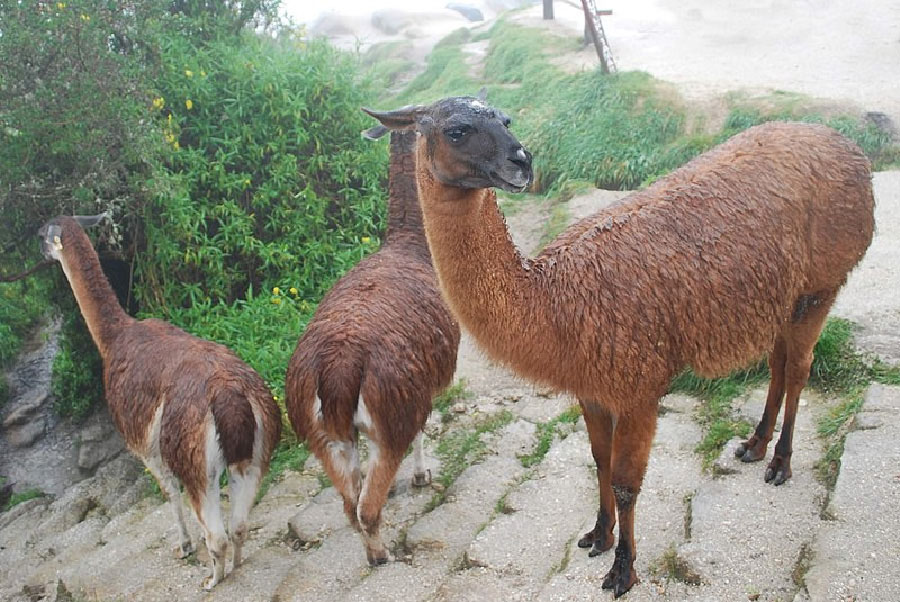
The rise of agriculture also led to the domestication of numerous types of animals, often selected for characteristics that were beneficial to humans, such as docility, strength, ability to feed on readily available foods, and rapid growth and reproduction so the animals could be slaughtered for food. Some of the many animals domesticated in the Neolithic Age were sheep and goats in the Near East around ten thousand years ago, chickens in south Asia around eight thousand years ago, horses in central Asia around six thousand years ago, and llamas in Peru about the same time (Figure 2.20).
英語のヒント
農耕の成立は、多くの動物の家畜化にもつながった。選ばれるのはしばしば、人間に役立つ特徴を備えた動物だった。たとえば、おとなしいこと、力があること、得やすい餌で育つこと、成長と繁殖が速く、食料として屠れることなどである。新石器時代に家畜化された多くの動物には、約1万年前の近東のヒツジとヤギ、約8000年前の南アジアのニワトリ、約6000年前の中央アジアのウマ、ほぼ同じ頃のペルーのリャマなどがある(図2.20)。
Peruvian Llamas.ペルーのリャマ。
(credit: “Llamas in Peru” by “NIAID”/Flickr, CC BY 2.0) · CC BY 2.0
While the advantages of plant and animal domestication seem obvious to us today, some groups either could not or simply did not adopt these practices. The Indigenous peoples of Australia, for example, lived in environments that would have supported agriculture, and some of them were in contact with groups from New Guinea that did farm crops like taro and yams. Yet the early Australians continued to practice a mostly hunter-gatherer lifestyle until Europeans arrived about two hundred and fifty years ago. They apparently consciously determined that hunting and gathering were more suitable and practical given their own needs and the environment in which they lived. This is just one example of a people choosing a means of survival apart from the Neolithic Revolution.
英語のヒント
植物の栽培化や動物の家畜化の利点は、今日の私たちには明白に思えるが、できなかった、あるいは単に取り入れなかった集団もある。たとえばオーストラリアの先住民は、農耕を支え得る環境に暮らし、その一部は、タロイモやヤムイモなどを栽培するニューギニアの集団とも接触していた。それでも、初期のオーストラリアの人々は、約250年前にヨーロッパ人が来るまで、主として狩猟採集生活を続けた。自分たちの必要と暮らす環境を考えれば、狩猟採集のほうが適切で実用的だと、意識的に判断していたらしい。これは、新石器革命とは別の生存手段を選んだ人々の一例である。