第16章14世紀の気候変動とペストClimate Change and Plague in the Fourteenth Century
16.3 The Black Death from East to West16.3 東から西へ広がった黒死病
Learning Objectives学習の目標
By the end of this section, you will be able to:
この節を学ぶと、次のことができるようになる。
Identify the origins and characteristics of the bubonic plague
腺ペストの起源と特徴を挙げる。
Describe the response to the Black Death in Asia and North Africa
アジアと北アフリカで、黒死病にどのように対応したかを説明する。
Describe the response to the Black Death in Europe
ヨーロッパで、黒死病にどのように対応したかを説明する。
Imagine a world in which medicine was utterly defenseless against a disease that could kill within hours. Vaccines and antibiotics had not yet been discovered, nor was the existence of germs and their role in contagion understood. While treatments existed, their efficacy was limited, and medical knowledge was unequally understood across regions and within class structures. At times, the defenses against illness were prayers, divination, the protective aromas of flowers and spices, and for the select few who could afford to flee heavily populated areas, retreat to the countryside. Such was the world of the Mediterranean basin and Afro-Eurasia in the middle of the fourteenth century when the bubonic plague ravaged central Asia, the Middle East, North Africa, and Europe.
英語のヒント
数時間で命を奪う病気に、医学がまったく無力な世界を想像してほしい。ワクチンも抗生物質もまだ発見されておらず、病原体の存在も、感染におけるその役割も理解されていなかった。治療法はあったが効果は限られ、医学知識の理解には、地域間でも階層間でも格差があった。病気を防ぐ手段が、祈り、占い、花や香辛料の守護的な香りでしかないこともあった。人口の密集した地域から逃れられる、ごく一部の余裕のある人々には、田舎への避難という手段もあった。14世紀半ば、腺ペストが中央アジア、中東、北アフリカ、ヨーロッパを荒らし回ったときの、地中海世界とアフロ・ユーラシアは、まさにそのような世界だった。
After the plague had run its course by the 1350s, it recurred in cyclical fashion several times during the second half of the fourteenth century. It was never fully eradicated, though subsequent waves were not as deadly as the initial outbreak, with the exception of the Great Plague of London in the 1660s and an especially virulent outbreak that began in China in 1894. Outbreaks have occurred more recently in parts of Asia, Africa, and Latin America, but surveillance, preventive measures, early diagnosis, and treatment with antibiotics remain the most effective approaches to preventing its spread.
英語のヒント
1350年代までに大流行が一段落した後も、ペストは14世紀後半に何度か周期的に再流行した。完全に根絶されることはなく、その後の流行は最初の大流行ほど致命的ではなかったものの、1660年代のロンドン大疫病と、1894年に中国で始まった特に猛威の激しい流行は例外だった。さらに近年にも、アジア、アフリカ、ラテンアメリカの一部で発生が見られる。それでも、発生動向の監視、予防措置、早期診断、抗生物質による治療が、拡大を防ぐ最も有効な方法であり続けている。
The Origins and Spread of the Bubonic Plague腺ペストの起源と拡大
The bubonic plague, the most common variant of the disease caused by the bacterium Yersinia pestis, raises egg-shaped swellings known as buboes near an afflicted person’s lymph nodes in the groin, underarm, and upper neck areas. Other symptoms include fever, nausea, vomiting, aching joints, and general malaise. For the vast majority in the Middle Ages, death generally occurred within three days. The bubonic plague pandemic, which had far-reaching economic, political, social, and cultural effects throughout Afro-Eurasia, came to be known as the Black Death. This name, inspired by the blackened tissue the disease caused on the body, also came to express the fear and awe brought by a disease with a mortality rate ranging from 30 to 80 percent. That is significantly higher than the deadliest smallpox, influenza, and polio pandemics of the modern era. Although in its bubonic form the plague could not be spread from human to human, the rat flea became a major plague vector, an organism that spreads plague from one organism to another.
英語のヒント
腺ペストは、エルシニア・ペスティスという細菌が引き起こす病気の最も一般的な病型である。患者の鼠径部、わきの下、首の上部のリンパ節付近に、ブボと呼ばれる卵形の腫れを生じさせる。他の症状には、発熱、吐き気、嘔吐、関節痛、全身の倦怠感がある。中世には、患者の大多数が通常3日以内に死亡した。アフロ・ユーラシア全域に、経済・政治・社会・文化の広範な影響を及ぼしたこの腺ペストのパンデミックは、「黒死病」と呼ばれるようになった。病気によって体の組織が黒くなることに由来するこの名は、30~80%という致死率の病気がもたらした恐怖と畏怖をも表すようになった。これは近現代で最も致命的だった天然痘、インフルエンザ、ポリオのパンデミックよりも、著しく高い率である。腺ペストという病型は、人から人へは感染しなかった。しかしネズミノミが、ある生物から別の生物へ病原体を運ぶ、主要な媒介生物となった。
The black rat was one of the most capable animal hosts for the plague-carrying fleas. It was highly susceptible to the disease itself and an especially inconspicuous stowaway on trade caravans and merchant ships. Cases of bubonic plague proliferated as rats spread through the international shipping and trades routes of the Silk Roads and the Mediterranean Sea, where they colonized crowded dwellings in towns and cities. The spread of the plague only increased owing to the increased movement of people. First it was the Mongol armies, traveling over enormous distances and unintentionally bringing small mammalian stowaways among their foodstuffs. Then, owing to the Mongols’ protection of merchants and others traveling great distances during the Pax Mongolica, the disease spread further and in new directions. Finally, those forced to leave their homes for survival amid famine and environmental change created yet another pathway for the disease to spread.
英語のヒント
ペストを運ぶノミの宿主として、クマネズミは特に適していた。クマネズミ自身もこの病気に非常にかかりやすく、交易隊商や商船に人知れず紛れ込むことも得意だった。ネズミがシルクロードと地中海の国際交易路・海運路を通じて広がり、町や都市の密集した住居に住みつくにつれて、腺ペストの患者も増えた。人の移動の増加は、ペストの広がりをいっそう速めた。まず長大な距離を移動するモンゴル軍が、食料の中に紛れた小型哺乳類を意図せず運んだ。次に、パクス・モンゴリカのもとでモンゴルが商人などの長距離旅行者を保護したため、病気はさらに遠く、新たな方向へと広がった。最後に、飢饉と環境変化のなかで生き延びるために故郷を離れた人々が、病気の広がる別の経路を作った。
Plague-bearing fleas generally preferred to feed on small rodents such as rats and marmots, but when their rodent hosts succumbed to the plague, they secured their next meal from the nearest human. Two even deadlier variants of the disease eventually emerged during the fourteenth century: pneumonic and septicemic. The pneumonic form directly infected the lungs and was spread from person to person by coughing, with a mortality rate of 95 to 100 percent. The septicemic variant, which resulted from plague bacteria circulating directly into the bloodstream, was invariably fatal and, according to contemporary observers, seemed to kill within hours of the first onset of symptoms. While historians had surmised for many decades that the plague had spread in primarily one form (bubonic) and in one direction (east to west), new evidence increasingly suggests there was a far greater diversity of spread.
英語のヒント
ペストを媒介するノミは、通常はネズミやマーモットなど小型のげっ歯類から吸血することを好んだ。しかし宿主のげっ歯類がペストで死ぬと、次の食事を最も近い人間から得た。14世紀には、さらに致命的な二つの病型、肺ペストと敗血症型ペストも現れた。肺ペストは肺を直接侵し、せきによって人から人へ広がり、致死率は95~100%だった。ペスト菌が血流へ直接入り込んで生じる敗血症型は、必ず死に至り、当時の観察者によると、症状が出始めてから数時間で命を奪うように見えた。歴史家は何十年もの間、ペストは主に一つの病型、すなわち腺ペストとして、東から西という一方向に広がったと推測してきた。しかし新しい証拠から、拡大のあり方ははるかに多様だったことが、ますます示唆されている。
Although in many regions where it struck the plague was eventually understood to be contagious, at first the means of transmission were not recognized. Some saw the epidemic as a divine punishment from God, and others speculated that it was caused by a rare conjunction of planets creating noxious atmospheric conditions on Earth. Others blamed foreign travelers, minority religious communities, or vagrants. The desperation incited by the plague’s relentless assault often led to scapegoating of marginalized populations, particularly in Europe.
英語のヒント
ペストが襲った多くの地域では、やがてその伝染性が理解されたが、当初は感染経路が認識されていなかった。神の罰だと見る人もいれば、惑星が珍しい位置関係で重なり、地球に有害な大気の状態を生んだためだと推測する人もいた。また、外国からの旅人、宗教的少数派の共同体、放浪者に責任を負わせる人もいた。ペストの容赦ない猛襲が引き起こした絶望は、特にヨーロッパで、周縁に追いやられた人々をスケープゴートにすることへ、しばしばつながった。
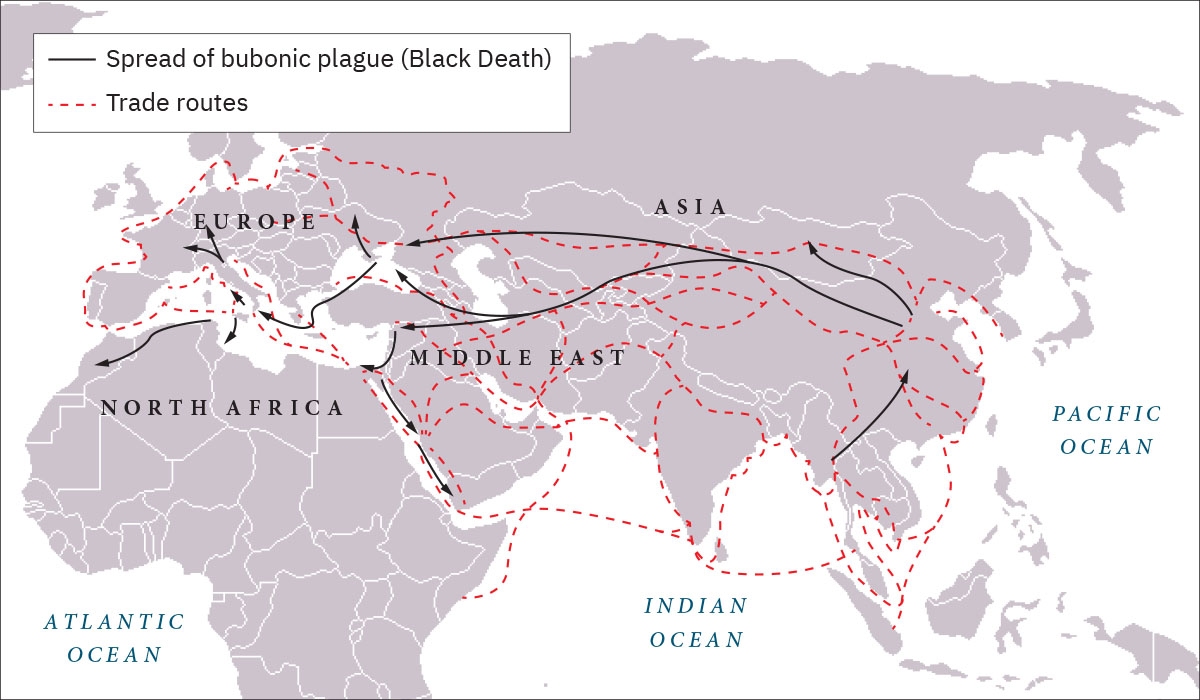
Many historians have focused almost exclusively on the Black Death’s impact on Europe, assuming that other regions were only minimally affected. The Americas and Australia were, indeed, entirely spared due to their geographic isolation. Other areas such as the Indian subcontinent experienced relatively mild outbreaks. However, we now know that the disease’s spread affected much of Asia, the Middle East, Europe, North Africa, and possibly some regions of sub-Saharan Africa in what are now Ghana, Nigeria, Burkina Faso, and Ethiopia. And new scientific techniques such as genetic testing are strongly suggesting that the plague developed far earlier than modern historians had believed. In its most well-documented form, it ultimately spread along international sea and land trade routes in the 1340s and by 1409 had reached port cities of the Indian Ocean trade network in East Africa (Figure 16.13). Wherever it went, the Black Death left a trail of demographic destruction and long-term damage to social and economic networks, compounded by the combined effects of drastic climate changes, rebellions, and crop failures that preceded it in many parts of Afro-Eurasia in the early 1300s.
英語のヒント
多くの歴史家は、他の地域の被害はごく小さかったと考え、黒死病がヨーロッパに与えた影響にほぼ専ら注目してきた。確かに、アメリカ大陸とオーストラリアは地理的に隔離されていたため、まったく被害を受けなかった。インド亜大陸などでは、比較的軽い流行にとどまった。しかし現在では、病気の広がりが、アジア、中東、ヨーロッパ、北アフリカの大部分に影響したことが分かっている。現在のガーナ、ナイジェリア、ブルキナファソ、エチオピアにあたる、サハラ以南のアフリカの一部にも及んだ可能性がある。遺伝子検査などの新しい科学技術は、近現代の歴史家が考えていたよりはるかに早く、ペストが発生していたことを強く示唆している。最もよく記録されている流行では、1340年代に国際的な海陸の交易路に沿って広がり、1409年までに東アフリカのインド洋交易網の港湾都市へ達した(図16.13)。黒死病は行く先々で人口を激減させ、社会・経済のつながりに長期的な損害を残した。アフロ・ユーラシアの多くの地域では、1300年代初頭に先行して起きた急激な気候変動、反乱、不作の影響が重なり、被害を増幅させた。
Route of the Black Death.黒死病の伝播経路。
(credit: modification of work “TNM Download (v2.0)” by National Land Cover Database (NLCD)/United States Geological Survey (USGS)/U.S. Department of the Interior, Public Domain) · Public Domain
Figure 16.13 This map compares trade routes with the spread of the Black Death across Asia, the Middle East, North Africa, and Europe. (credit: modification of work “TNM Download (v2.0)” by National Land Cover Database (NLCD)/United States Geological Survey (USGS)/U.S. Department of the Interior, Public Domain)
図16.13 アジア、中東、北アフリカ、ヨーロッパを横断する交易路と、黒死病の広がりを比較した地図。(出典: 原作品を加工:“TNM Download (v2.0)”/National Land Cover Database (NLCD)/United States Geological Survey (USGS)/U.S. Department of the Interior, パブリックドメイン)