第16章14世紀の気候変動とペストClimate Change and Plague in the Fourteenth Century
Mobility and Human Society移動と人間社会
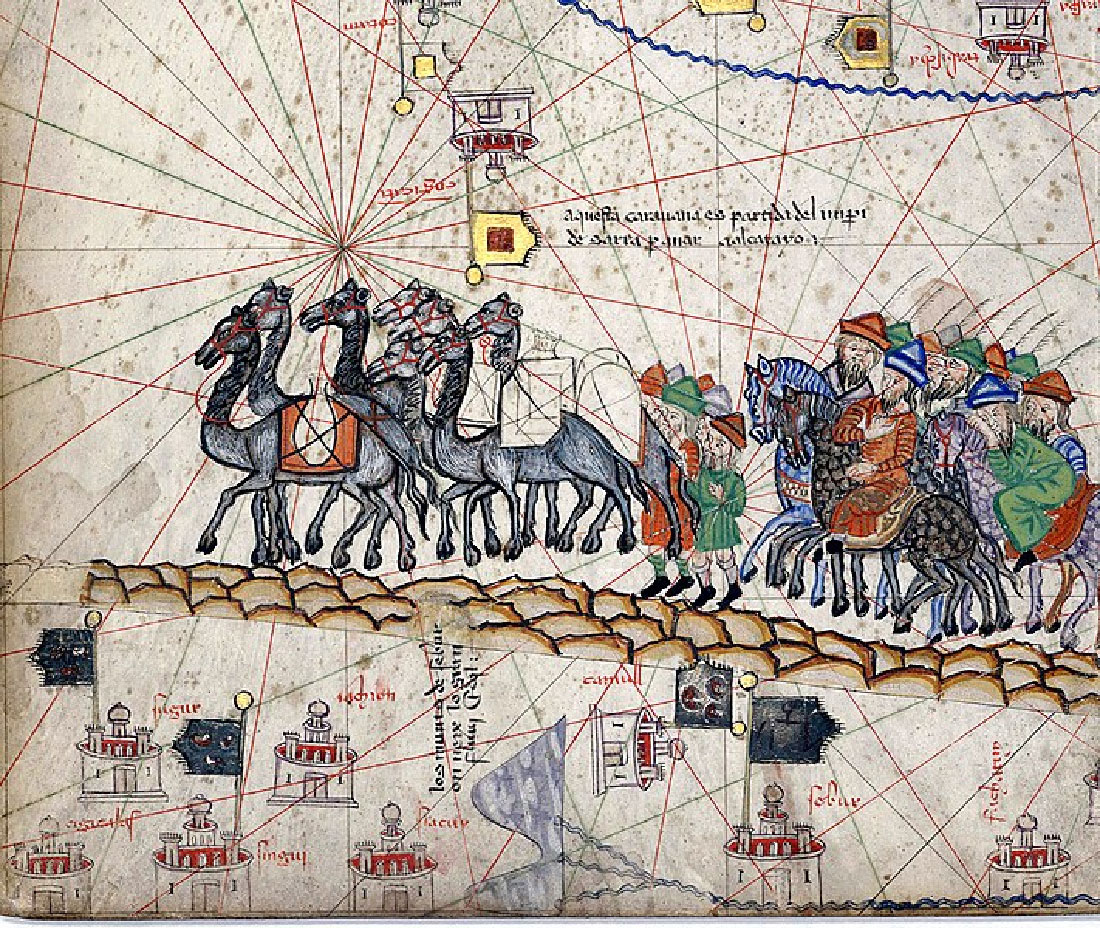
Throughout history, economic opportunity and access to new and varied resources have inspired merchants and traders to travel. In the premodern world, this was especially the case along the trade routes of North Africa and the Silk Roads, an active network of trade and commerce that attracted merchants and traders from across Afro-Eurasia (Figure 16.12).
英語のヒント
歴史を通じ、経済的な機会や、新しく多様な資源へのアクセスは、商人や交易者が旅に出る動機となってきた。近代以前の世界では、特に北アフリカの交易路とシルクロードでそうだった。これらの活発な交易・商業網は、アフロ・ユーラシア各地の商人や交易者を引き寄せた(図16.12)。
Traveling the Silk Roads.シルクロードを旅する。
(credit: “Caravan on the Silk Road” by Gallica Digital Library/Wikimedia Commons, Public Domain) · Public Domain
Figure 16.12 This detail from a page of the Mallorquin (meaning “from the island of Majorca off the coast of Spain”) Atlas of 1375 shows the type of trade caravan that traveled through various legs of the Silk Roads journey. Given the length of the route, few merchants covered it in its entirety. (credit: “Caravan on the Silk Road” by Gallica Digital Library/Wikimedia Commons, Public Domain)
図16.12 1375年のマヨルカ島の地図帳の一頁の細部。「マヨルカの」を意味する Mallorquin は、スペイン沖のマヨルカ島を指す。図は、シルクロードの旅のさまざまな区間を進んだ交易隊商の姿を示している。経路が長かったため、全行程を踏破した商人はほとんどいなかった。(出典: “Caravan on the Silk Road”/Gallica Digital Library/Wikimedia Commons, パブリックドメイン)
Travel was also a common requirement of religious devotion in the tradition of pilgrimage. Muslims desired and were even obligated, by one of the “pillars” of Islam, to complete the hajj, a visit to Mecca and Medina, the holy sites of their faith in modern Saudi Arabia. Many Christian faithful wanted to travel to sacred sites containing relics of the saints, believed to be imbued with special power, and also to the Holy City of Jerusalem, believed to be the site of Jesus’s crucifixion and resurrection. The surrounding area was the birthplace of the Christian Church. Jerusalem was also the site of the holiest of holies of Judaism, the most sacred of spaces where the Temple of Solomon had stood until its destruction by the Romans.
英語のヒント
巡礼の伝統においても、旅は宗教的献身のためにしばしば必要とされた。ムスリムは、現在のサウジアラビアにある信仰上の聖地メッカとメディナを訪ねるハッジを果たすことを望み、イスラームの「柱」の一つとして義務づけられてもいた。多くの敬虔なキリスト教徒は、特別な力が宿ると信じられた聖人の聖遺物を収める聖地や、イエスが磔刑に処され復活した場所と信じられた聖都エルサレムを訪れたがった。その周辺はキリスト教会が生まれた地でもあった。エルサレムはまた、ユダヤ教の至聖所、すなわちローマ人が破壊するまでソロモンの神殿が立っていた、最も神聖な場所でもあった。
Beyond the demands of trade and religion, however, travel was far less possible for all but a small elite who could afford the time and expense required. Travel narratives and journals written by the select few who could embark on voyages provide much of our knowledge of premodern travel. In particular, the chronicles of Ibn Battuta, a Moroccan scholar who traveled across much of the Muslim world of Asia and Africa in the fourteenth century, offer much insight into the conditions and challenges travelers faced.
英語のヒント
しかし、交易や宗教上の必要を別にすると、必要な時間と費用を負担できる少数の上層者以外にとって、旅ははるかに難しかった。近代以前の旅についての知識の多くは、旅に出られた限られた人々が書いた旅行記や日記から得られる。特に、14世紀にアジアとアフリカのイスラーム世界の大部分を旅したモロッコの学者、イブン・バットゥータの記録は、旅人が直面した状況と困難について多くの知見を与えてくれる。
At the same time, worsening environmental conditions necessitated travel by many who would rarely have ventured beyond their immediate surroundings but now migrated in search of the resources they needed to survive. Leaving behind all that was familiar in the hope of finding a more stable and hospitable environment, they faced a variety of perils, including regional disputes, adverse weather conditions, illness, and banditry. It was difficult to arrange travel between the many different political entities that existed in the fourteenth century, and crossing borders could be exceptionally risky without the security provided by the presence of established networks or patrons, especially when it came to bandits and lack of access to safe waystations to rest. Moreover, at a time when people were struggling to secure basic necessities, travel was very expensive. Horses, carts, camels, and seafaring vessels were beyond the means of most people, so walking became the most common means of transportation for those in search of new opportunities and resources. Walking eight to ten hours a day, on poor roads and at times in poor weather conditions, likely made the experience all the more grueling for migrants who were already malnourished, weak, and vulnerable to opportunistic infections.
英語のヒント
同時に、環境条件の悪化は、本来なら身近な生活圏の外へほとんど出なかったであろう多くの人々にも、移動を強いた。彼らは生存に必要な資源を求めて移住するようになったのである。より安定し暮らしやすい環境を見つける望みを抱き、慣れ親しんだすべてを残して旅立った人々は、地域間紛争、悪天候、病気、盗賊といった危険に直面した。14世紀に存在した数多くの政治体の間を移動する手はずを整えるのは難しかった。確立した人脈や保護者による安全の保障がなければ、国境越えはとりわけ危険だった。特に盗賊と、安全に休める中継宿を利用できないことが問題だった。さらに、人々が生活必需品の確保に苦闘していた時代に、旅は非常に高価だった。馬、荷車、ラクダ、航海用の船は、ほとんどの人には手が届かなかった。そのため、新しい機会や資源を求める人々の移動手段は、徒歩が最も一般的になった。劣悪な道を、ときには悪天候の中で1日8~10時間も歩くことは、すでに栄養失調で弱り、日和見感染症にもかかりやすくなっていた移住者にとって、旅をいっそう過酷にしたと考えられる。
Although some people traveled back and forth across borders, the difficulties and expense of fourteenth-century travel made round trips uncommon. Many were forced to abandon their homes knowing they would likely never return. In times of drought and food shortages, these climate refugees faced precarious situations and uncertain prospects. They could become “strangers in strange lands,” foreigners whose unique customs and cultural practices—including religious traditions, dress, and language—marked them as “other” and worthy of scorn.
英語のヒント
国境を越えて往来する人もいたが、14世紀の旅の困難さと費用を考えると、往復できるのは普通ではなかった。多くの人は、おそらく二度と戻れないと分かっていても、故郷を捨てざるを得なかった。干ばつと食料不足の時代に、こうした気候難民は、危うい立場と不確かな将来に直面した。見知らぬ土地のよそ者となり、宗教、服装、言語などの独自の習慣や文化的慣行のために、「他者」として区別され、軽蔑されてもよい存在と見なされることがあり得た。
For those participating in commerce and bringing luxury goods over long distances for sale in faraway markets, however, the experience of travel could be very different. Though merchants and traders too were often seen as “other,” the goods they carried and their need for logistic support along the way, like food and caravansaries (inns along the common trade routes), directly enriched local societies and gave these travelers a different status.
英語のヒント
しかし商業に従事し、遠方の市場で売るため長距離にわたってぜいたく品を運ぶ人々にとっては、旅の経験は大きく異なり得た。商人や交易者も「他者」と見られることは多かったが、彼らが運ぶ品々や、食事・キャラヴァンサライ(主要交易路沿いの隊商宿)など道中の補給・宿泊支援の需要は、現地社会を直接潤した。そのため、彼らには異なる地位が与えられた。
Whether they were pilgrims, refugees, merchants, or soldiers traveling great distances in the premodern world, people on the move brought with them both the goods and traditions of their homelands. In the fourteenth century, an increase in this long-distance travel by a greater swath of people across Afro-Eurasia helped bring new technologies and traditions over geographic and cultural divides, but the desperation of some travelers meant the process was not without tensions. Beyond this, however, a growing threat in the form of infectious disease traveled with them, too, and it soon had a disastrous impact on society even beyond the droughts and famine that had caused many to abandon their homes.
英語のヒント
近代以前の世界を長距離移動した人々は、巡礼者、難民、商人、兵士のいずれであっても、故郷の品物と伝統の両方を携えていた。14世紀には、アフロ・ユーラシアでより幅広い層の人々が長距離を移動するようになり、新しい技術と伝統が、地理的・文化的な隔たりを越えて伝わりやすくなった。しかし旅人の一部が切羽詰まっていたため、その過程に緊張がなかったわけではない。それに加え、感染症という形の脅威も、人々とともに移動しながら拡大していた。それはまもなく、多くの人に故郷を捨てさせた干ばつや飢饉をさえ上回る、壊滅的な影響を社会に与えることになる。
Section Summaryこの節のまとめ
The field of historical climatology has enabled historians to combine analyses of written sources with data about the ecological environment of the past. Thus, we know that at the beginning of the fourteenth century, a prolonged period of temperate climate was followed by a devastating period of lower temperatures and substantial changes in precipitation in the Northern Hemisphere that wiped out crops and led to widespread droughts and famines. Many were forced to migrate in search of the basic necessities of life.
英語のヒント
歴史気候学によって、歴史家は文字史料の分析と、過去の生態的環境に関するデータを組み合わせられるようになった。こうして、長く続いた温和な気候の後、14世紀の初めに北半球で気温が下がり、降水量が大きく変わったことが分かる。この破壊的な変化は農作物を壊滅させ、広範な干ばつと飢饉を招いた。多くの人は、生活の基本的な必需品を求めて移住を強いられた。