第16章14世紀の気候変動とペストClimate Change and Plague in the Fourteenth Century
Europe in the Early Fourteenth Century14世紀初頭のヨーロッパ
While its eastern and southern neighbors struggled to overcome the challenges of the early fourteenth century, Europe was also undergoing widespread crises of authority and shifting axes of power in the face of famine, war, and eventually pestilence. At the beginning of the century, a period of worsening weather resulted in crop failures and food shortages that left Europe vulnerable to the ravages of the bubonic plague, a deadly bacterial disease. These crises resulted in demographic changes and economic troubles that signaled profound transformations in the religious and political foundations of medieval society. Not all regions of Europe experienced the same level of upheaval and economic decline—some areas such as the Italian Peninsula and the French city of Bourges continued to prosper—but the fourteenth century was generally an era of chronic conflict and instability for most of the continent (Figure 16.8).
英語のヒント
東と南に隣接する地域が14世紀初頭の難局を乗り越えようと苦闘していた頃、ヨーロッパも、飢饉、戦争、そして後には疫病を前に、広範な権威の危機と権力の重心の移動を経験していた。世紀の初めには天候の悪化が不作と食料不足を招き、ヨーロッパは致命的な細菌感染症である腺ペストの猛威に耐えにくい状態になった。これらの危機は人口の変動と経済的困難を引き起こし、中世社会の宗教的・政治的基盤の深い変容を告げた。ヨーロッパの全地域が同じ程度の混乱や経済衰退を経験したわけではない。イタリア半島やフランスの都市ブールジュなど、繁栄を続けた地域もあった。それでも大陸の大半にとって、14世紀は全般に、対立と不安定さが慢性化した時代だった(図16.8)。
The Fourteenth Century Begins.14世紀の始まり。
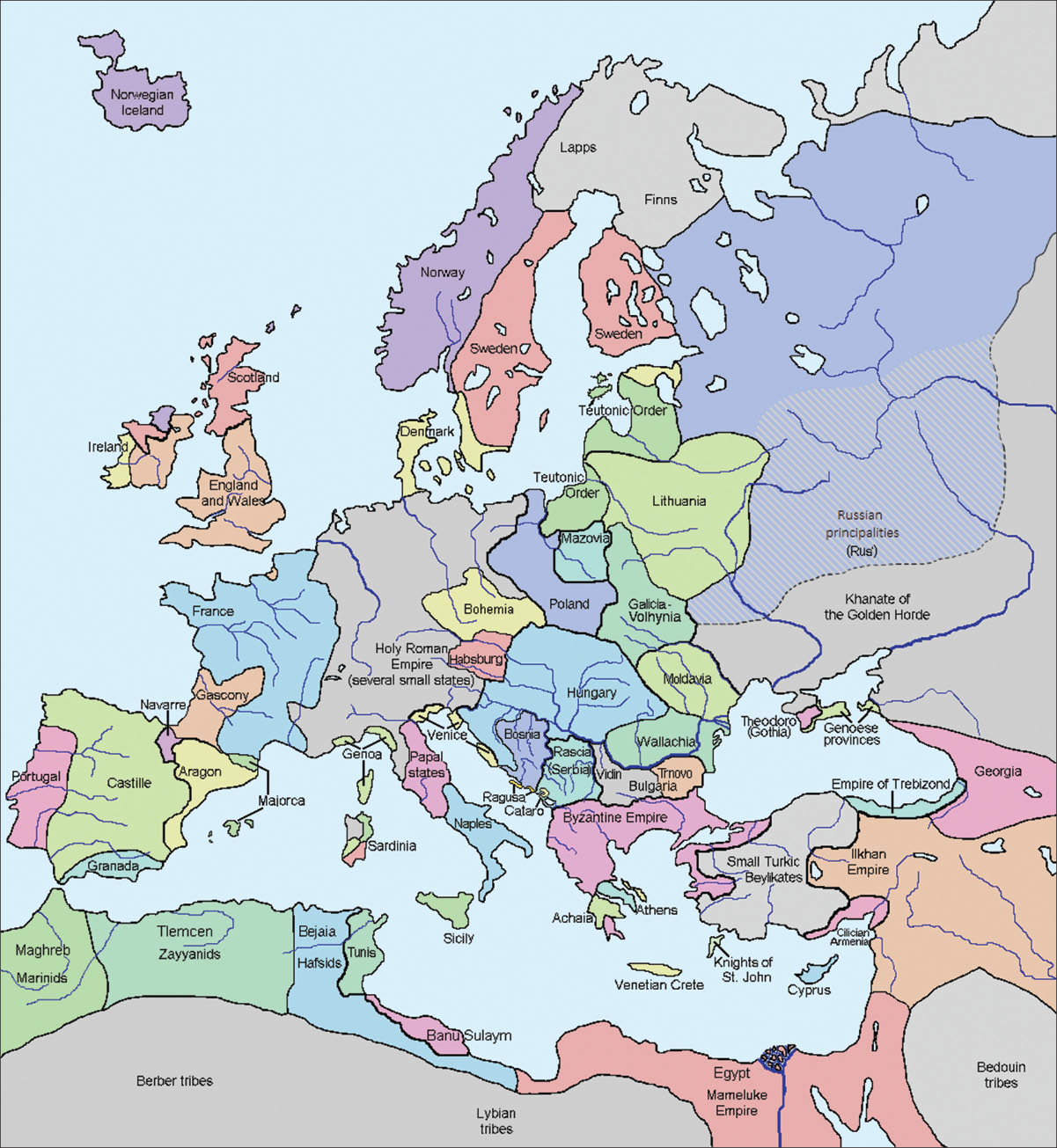
(credit: “Europe in 1328” by Lynn H. Nelson/Wikimedia Commons, Public Domain) · Public Domain
Figure 16.8 This map depicts the patchwork of kingdoms and political entities in Europe and beyond at the beginning of the fourteenth century. The many divisions ensured that political fragmentation rather than centralization defined the region throughout the medieval period, and many states depicted here still lacked a strong, centralized rule entirely. (credit: “Europe in 1328” by Lynn H. Nelson/Wikimedia Commons, Public Domain)
図16.8 14世紀初頭のヨーロッパと周辺で、王国やさまざまな政治体が入り交じっていた様子を示す地図。数多くの分割のため、中世を通じたこの地域の特徴は中央集権化ではなく政治的分裂だった。ここに描かれた国の多くには、なお強力な中央集権的支配がまったく存在していなかった。(出典: “Europe in 1328”/Lynn H. Nelson/Wikimedia Commons, パブリックドメイン)
In contrast to the stability that had defined much of the thirteenth century for the European Christian Church, it began experiencing significant destabilization in the beginning of the fourteenth century, when tensions between the pope and national monarchs led to a weakening of papal authority and division within the church. A notable conflict occurred between Pope Boniface VIII and King Philip IV of France, after Philip sought to impose taxes on the clergy in his country without papal approval. As a result, Boniface issued an edict reinforcing papal supremacy over secular rulers, to which Philip responded by attempting to kidnap the pope in 1303. Although the papacy retained its political autonomy and independent bureaucratic structures after a series of pontiffs came to settle in Avignon, France, the time they spent there tarnished the pope’s spiritual prestige and led many to question the integrity of the church’s administrative structures.
英語のヒント
ヨーロッパのキリスト教会は13世紀の大半には安定していた。しかし14世紀の初めには、教皇と各国の君主との緊張が教皇権の弱体化と教会内部の分裂を引き起こし、大きく揺らぎ始めた。際立った例が教皇ボニファティウス8世とフランス王フィリップ4世の対立である。フィリップが教皇の許可なく国内の聖職者への課税を試みると、ボニファティウスは世俗の君主に対する教皇の優越を改めて示す勅書を出した。これに対しフィリップは1303年、教皇の誘拐を企てた。その後、歴代の教皇がフランスのアヴィニョンに居を構えたが、教皇庁は政治的自立性と独立した官僚機構を維持していた。それでもアヴィニョン滞在は教皇の宗教的威信を傷つけ、多くの人が教会の行政組織の公正さに疑問を抱くようになった。
Although Pope Gregory XI brought the papal court back to Rome in 1377, continuing disagreements between church factions about papal legitimacy led to the simultaneous appointment of three popes and inaugurated a period known as the Great Western Schism (1378–1417). Although this crisis of authority was eventually resolved when the Council of Constance (1414–1418) persuaded two of the popes to resign, by then the reputation of the papacy had deteriorated significantly.
英語のヒント
1377年に教皇グレゴリウス11世は教皇庁をローマへ戻した。しかし、正統な教皇をめぐる教会諸派の対立は続き、3人の教皇が同時に立つ事態へと至った。これが大シスマ、すなわち教会大分裂(1378~1417年)と呼ばれる時代の始まりだった。コンスタンツ公会議(1414~1418年)が2人の教皇を説得して退位させたことで、この権威の危機は最終的に解決した。しかし、その頃には教皇庁の評判は著しく悪化していた。
The decline in respect for the Roman Catholic clergy can be seen in an English satirical poem known as The Land of Cockaigne. The poem calls attention to the church’s purported gluttony during a time marked by food insecurity by depicting a monastery made of mouthwatering pastries and breads. The image of a church made of food suggested the greed of the clergy: “[Quotation omitted for rights reasons.]”
英語のヒント
ローマ・カトリックの聖職者への敬意が低下したことは、『コケインの国』として知られる英語の風刺詩にも表れている。この詩は、おいしそうな菓子やパンでできた修道院を描き、食料の確保すら不安定だった時代に、教会がむさぼっているとされた飽食に注意を向けた。食べ物でできた教会というイメージは、聖職者の貪欲さを示唆していた。〔権利の関係で割愛〕
In the midst of the church’s crisis of authority and status, many areas of Europe were further racked by political and military conflict through much of the fourteenth century. The Hundred Years’ War (1337–1453) erupted between England and France over claims to French lands held by the English monarch. The tension was heightened in 1328 when King Charles IV of France died without a son. The crown was given to his nephew Philip, the Count of Valois, the son of Charles’s younger brother. However, King Edward III of England, the son of Charles’s sister and the older of the two claimants, maintained that he had the greater right to the throne of France. The conflict caused widespread political factionalism and devastation, particularly in France where most of the fighting occurred.
英語のヒント
教会の権威と地位が危機にあるさなか、ヨーロッパの多くの地域は、14世紀の大半を通じて政治・軍事紛争にも苦しめられた。百年戦争(1337~1453年)は、イングランド王が保有するフランス内の領土への権利をめぐり、イングランドとフランスの間で始まった。1328年、フランス王シャルル4世が男子を残さずに死去すると、緊張はいっそう高まった。王位はシャルルの甥で、その弟の息子にあたるヴァロワ伯フィリップに与えられた。しかしシャルルの姉妹の息子で、2人の請求者のうち年長のイングランド王エドワード3世は、フランス王位に対する自分の権利の方が強いと主張した。この紛争は、特に戦闘の大半が行われたフランスで、広範な政治的党派対立と荒廃を招いた。
Although the war lasted 116 years, its periods of conflict alternated with times of truce. The new military technologies of the late medieval period shaped much of the conflict and rendered combat especially savage. While the English longbow, prized for its ability to send arrows farther and faster than the French crossbow, dominated the first decades, later in the war the use of firearms and gunpowder became more widespread and more destructive, thanks to the ability of these weapons to dismantle the protective walls of castles and cities. Despite England’s dominance early in the conflict, the war’s conclusion in 1453 ultimately left France in control as the dominant kingdom of western Europe.
英語のヒント
戦争は116年に及んだが、戦闘期と休戦期が交互に訪れた。中世後期の新しい軍事技術が戦争の展開を大きく左右し、戦闘をとりわけ凄惨なものにした。最初の数十年には、フランスのクロスボウより遠くへ速く矢を放てるとして高く評価された、イングランドのロングボウが優勢を占めた。ところが戦争の後期には銃砲と火薬の使用が広がり、城や都市を守る城壁を破壊できるこれらの兵器によって、破壊力はさらに増した。戦争初期にはイングランドが優位だったが、1453年の終結時には、最終的にフランスが西ヨーロッパの主要な王国として支配力を確立した。
Another center of political instability during this period was the Holy Roman Empire. In the fourteenth century, the Holy Roman Empire, which had been founded by Charlemagne in 800, comprised four main entities—the Kingdom of Italy, the Kingdom of Germany (including lands that now are part of Belgium, the Netherlands, Germany, Austria, and Switzerland), the Kingdom of Burgundy (a region in southeastern France), and the Kingdom of Bohemia (what is now the Czech Republic and part of Poland) under the nominal control of an elected emperor. Each of these kingdoms, in turn, was composed of a loose coalition of independent territories with different hereditary rulers. The emperor was chosen by a handful of these rulers known as electors.
英語のヒント
この時期に政治的な不安定さが集中したもう一つの地域が、神聖ローマ帝国だった。800年にカール大帝が成立させたこの帝国は、14世紀には、選挙で選ばれる皇帝の名目上の支配のもとに、主に四つの王国から成っていた。イタリア王国、ドイツ王国(現在のベルギー、オランダ、ドイツ、オーストリア、スイスに属する地域を含む)、ブルグント王国(フランス南東部の地域)、そしてボヘミア王国(現在のチェコとポーランドの一部)である。さらに各王国は、異なる世襲君主に治められる独立した領域が緩やかに結びついた連合だった。その君主たちのうち、選帝侯と呼ばれる少数の者が皇帝を選んだ。
Competition between noble families vying for the role of emperor often created instability. In 1314, for example, one group of electors chose the ruler of Austria to be emperor, but another group gave the title to the ruler of Bavaria. Later in the century, the Golden Bull, proclaimed by the emperor Charles IV in 1356 (bull is the Latin word for “seal”), attempted to simplify and clarify the process by which the emperor was elected. The document asserted that emperors would be selected by seven specific prince-electors, the secular rulers of four principalities and the archbishops of three cities within the empire. This practice of electing emperors stood in stark contrast to the hereditary monarchies of other European kingdoms such as France and England.
英語のヒント
皇帝の地位を争う貴族家門間の競争は、しばしば不安定さを生んだ。例えば1314年には、一群の選帝侯がオーストリアの君主を皇帝に選んだのに対し、別の一群はバイエルンの君主にその称号を与えた。その後1356年、皇帝カール4世は金印勅書を発布し、皇帝選出の手続きを簡素化して明確にしようとした。英語の bull は、ここでは「印章」を表すラテン語に由来する。この文書は、帝国内の四つの領邦の世俗君主と三つの都市の大司教、計7人の特定の選帝侯が皇帝を選ぶと定めた。皇帝を選挙で選ぶこの慣行は、フランスやイングランドなど他のヨーロッパ王国の世襲王制とは、際立った対照をなしていた。
Rather than adopting a common currency, legal system, or representative assembly, the Holy Roman Empire remained a patchwork of semiautonomous principalities. Although each of these became relatively stable, the empire itself was a weak and decentralized political entity. By the end of the fourteenth century, it included more than one hundred principalities, each with varying degrees of power and autonomy. The emperor was now beholden to both the rulers who elected him and the pope, who in theory bestowed the imperial crown.
英語のヒント
神聖ローマ帝国は、共通の通貨、法制度、代表者の議会を採用せず、半ば自立した領邦の寄せ集めのままだった。個々の領邦は比較的安定するようになったものの、帝国自体は弱く分権的な政治体だった。14世紀末までには100を超える領邦を抱え、それぞれの権力と自立性の程度も異なっていた。皇帝は今や、自分を選んだ諸侯と、理論上は帝冠を授ける教皇の双方に依存する立場にあった。