第16章14世紀の気候変動とペストClimate Change and Plague in the Fourteenth Century
Religious Changes宗教上の変化
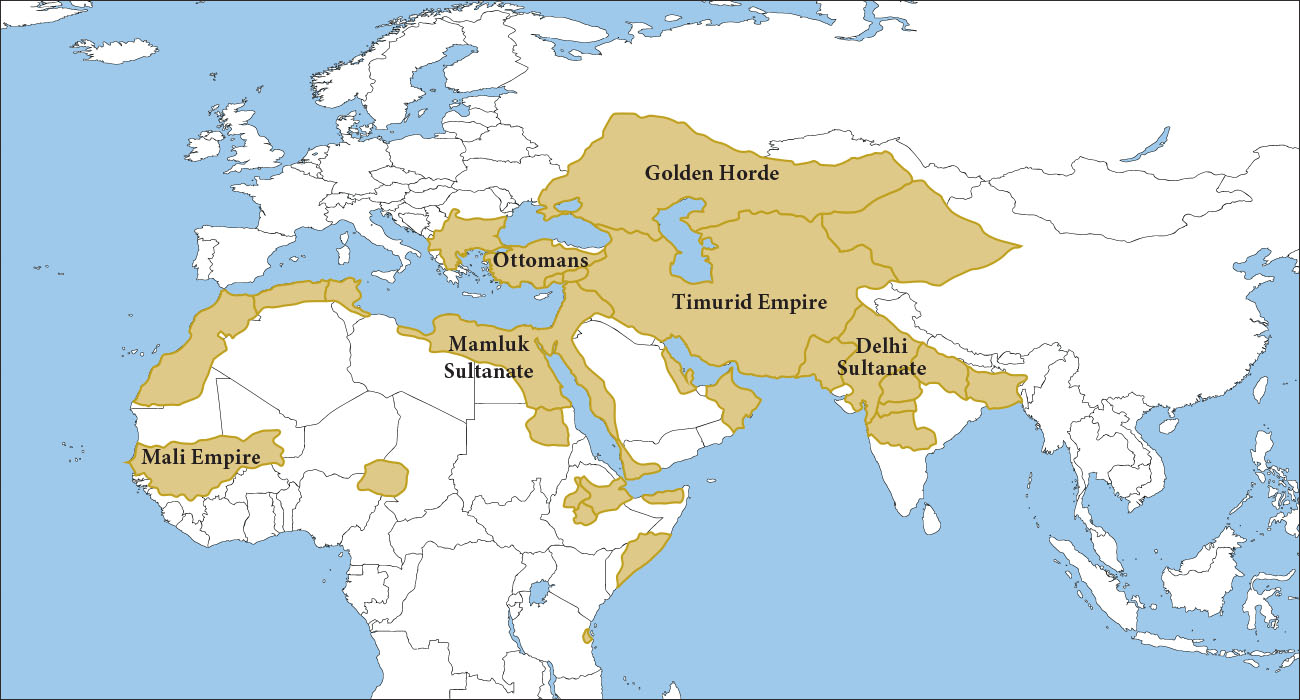
Anxieties about spiritual redemption and conflicting doctrinal interpretations generated many transformations in religious life across Afro-Eurasia in the fourteenth century. While some religions splintered into subdivisions focused on reinforcing their own doctrinal purity and conformity of belief, others expanded in the face of adversity. In the wake of the plague and the demoralizing collapse of the Mongol Empire, for example, Islamic traditions in much of North Africa and central Asia did not deteriorate but increasingly solidified into institutional forms that helped develop a sense of common identity across a broad territory (Figure 16.16). To maintain this sense of community, Muslim scholars routinely corresponded with each other and traveled to Mecca to keep up with the latest theological teachings.
英語のヒント
14世紀のアフロ・ユーラシアでは、魂の救済への不安と、教義解釈をめぐる対立が、宗教生活に多くの変容を生んだ。自らの教義の純粋性や信仰の一致を強めることに重点を置く小集団へ分かれた宗教もあれば、逆境のなかで拡大した宗教もあった。例えば、ペストと、人々の意気をくじいたモンゴル帝国の崩壊を経ても、北アフリカと中央アジアの大部分では、イスラームの伝統は衰えなかった。それどころか制度的な形に固まり、広い地域に共通の帰属意識を育てる助けになった(図16.16)。この共同体意識を保つため、ムスリムの学者は日常的に互いに書簡を交わし、メッカへ旅して最新の神学の教えを学んだ。
The Late Fourteenth-Century Islamic World.14世紀後半のイスラーム世界。
(credit: modification of work “TNM Download (v2.0)” by National Land Cover Database (NLCD)/United States Geological Survey (USGS)/U.S. Department of the Interior, Public Domain) · Public Domain
Figure 16.16 The shaded areas in this map depict the extent of the largest Islamic states at end of the fourteenth century. Despite the challenges of the Black Death and the Mongols’ conquest and decline, Islam’s scope and influence continued to expand into Africa and Asia in the fifteenth century. (credit: modification of work “TNM Download (v2.0)” by National Land Cover Database (NLCD)/United States Geological Survey (USGS)/U.S. Department of the Interior, Public Domain)
図16.16 地図の着色部分は、14世紀末の主要なイスラーム国家の領域を示す。黒死病やモンゴルの征服・衰退という難局にもかかわらず、イスラームの広がりと影響力は、15世紀にもアフリカとアジアへ拡大し続けた。(出典: 原作品を加工:“TNM Download (v2.0)”/National Land Cover Database (NLCD)/United States Geological Survey (USGS)/U.S. Department of the Interior, パブリックドメイン)
The Quran and the Hadith (the recorded actions and sayings of Muhammed) remained central components of all varieties of Islam, but different interpretations of ritual and the role of the mystical experience increasingly defined the contours of its myriad branches. In particular, Sufism, a mystical form of Islam that had first emerged in the eighth century, became increasingly integrated into everyday religious life. Although it could be expressed in a variety of ways, Sufism’s emphasis on inner personal contemplation and the believer’s connection with the divine became especially compelling during the period of instability and uncertainty following the collapse of the Il-Khanate.
英語のヒント
クルアーンとハディース(ムハンマドの言行を記録したもの)は、イスラームのあらゆる流れで中心的な要素であり続けた。しかし、儀礼の解釈や神秘体験の役割についての違いが、数多くの分派の輪郭をいっそう形づくるようになった。特に8世紀に初めて現れたイスラームの神秘主義、スーフィズムは、日常の宗教生活へますます深く組み込まれた。表現の仕方はさまざまだったが、個人の内面的な観想と、信徒が神と結びつくことを重視するスーフィズムは、イル・ハン国崩壊後の不安定で先行きの見えない時期に、特に強く人々を引きつけた。
By the end of the fourteenth century, the majority of the population from North Africa to eastern Persia was Muslim. This community of the faithful was increasingly defined by its diversity of languages and cultures. But allegiance to a shared historical tradition and set of core beliefs provided unity and coherence, as did believers’ social networks, schools, and mosques. This cohesion and continued growth enabled Islam to expand into sub-Saharan Africa and Southeast Asia, setting the stage for Muslim ascendancy in the fifteenth century.
英語のヒント
14世紀末までに、北アフリカからペルシア東部までの人口の大多数はムスリムとなった。この信徒の共同体では、言語と文化の多様性がますます大きな特徴になった。しかし共通の歴史的伝統と中核的な信仰への帰属が、一体感とまとまりをもたらした。信徒の社会的なつながり、学校、モスクも同じ役割を果たした。この結束と持続的な成長によって、イスラームはサハラ以南のアフリカと東南アジアへ拡大でき、15世紀のイスラーム勢力の隆盛を準備した。
While Islam spread across central and southern Asia, China focused on recovering its religious and philosophical traditions after years of Mongol rule. Thus, the Ming era represented a period of introspection and isolation. Zhu Di took the imperial title of Yongle emperor and ruled from 1402 to 1424 as the third emperor of the Ming dynasty. He reinstated Confucian-based rituals and learning by sponsoring the compilation of a massive encyclopedia that incorporated writing from thousands of Confucian scholars. Although Confucianism coexisted with Buddhism and Daoism in Ming China, it effectively complemented these traditions rather than competing with them.
英語のヒント
イスラームが中央アジアと南アジアに広がる一方、中国は長年のモンゴル支配の後、自国の宗教と哲学の伝統を取り戻すことに力を注いだ。そのため明代は、内省と孤立の時期として位置づけられる。朱棣は永楽帝の称号を取り、明の第3代皇帝として1402~1424年に在位した。数千人の儒学者の著述を収めた巨大な百科事典の編纂を支援し、儒教に基づく儀礼と学問を復興した。明の中国では儒教は仏教、道教と共存していたが、これらの伝統と競うというより、実質的には補い合っていた。
Meanwhile, western Europe was grappling with emerging cracks in the foundations of Christianity, its principal religious tradition. By the end of the fourteenth century, leadership crises associated with the Avignon papacy and the Great Western Schism had badly damaged the papacy’s reputation and led many to question the church’s piety and integrity. After the conclusion of the Great Schism, some attempts were made to resolve such doubts and misgivings by granting more authority to councils of clergy rather than popes through the conciliar movement. Although this movement offered some hope that the church could be reformed from within, it met with severe resistance from popes who insisted on absolute papal supremacy.
英語のヒント
その頃、西ヨーロッパは、主要な宗教的伝統であるキリスト教の基盤に生じつつあった亀裂に直面していた。14世紀末までに、アヴィニョン教皇庁と教会大分裂に関わる指導権の危機は、教皇庁の評判を大きく損ない、多くの人が教会の敬虔さと廉直さを疑うようになった。大分裂の終結後、こうした疑念や不安を解消するため、教皇より聖職者の会議に多くの権威を与えようとする公会議主義運動が起こった。教会を内側から改革できるという希望をある程度与えたが、教皇の絶対的な優越を主張する教皇たちの激しい抵抗に遭った。
Beyond their larger misgivings about the integrity of church leadership, however, many Christians who survived the trauma of the Black Death were primarily concerned with their own salvation and the church’s inability to appease God’s anger or mitigate the plague’s devastation. As a result, new forms of mystical and individualistic spiritual practices emerged that emphasized asceticism, a tradition of strict self-discipline and the denial of worldly goods, and that encouraged the rise of anticlerical groups such as the Spiritual Franciscans in Italy and the Lollards in England. Through their critiques of clerical wealth and corruption, these groups posed significant challenges to the authority of the church. Although the leaders of many anticlerical organizations were deemed heretics and suppressed by church leaders, they nevertheless laid the groundwork for the sixteenth-century religious revolution known as the Protestant Reformation. Born in central Europe, the Reformation came to emphatically divide the Christian Church.
英語のヒント
しかし、教会指導部の廉直さへの大きな疑念とは別に、黒死病の心的外傷を生き延びた多くのキリスト教徒は、何よりも自らの救済と、教会が神の怒りをなだめられず、ペストの惨禍も軽減できなかったことを気にかけていた。その結果、神秘的で個人を重視する新たな霊的実践が現れた。それは、厳しい自己規律と世俗の財物の拒否という伝統である禁欲主義を重視し、イタリアのフランシスコ会スピリトゥアル派や、イングランドのロラード派などの反聖職者的集団の台頭を促した。これらの集団は、聖職者の富と腐敗を批判し、教会の権威に重大な挑戦を突きつけた。多くの反聖職者的組織の指導者は異端者と見なされ、教会指導者によって抑圧された。それでも、16世紀の宗教的革命であるプロテスタント宗教改革の土台を築いた。中央ヨーロッパに生まれた宗教改革は、キリスト教会を決定的に分断することになった。
Section Summaryこの節のまとめ
The challenges and crises of the fourteenth century generated many social and cultural changes as the societies of Afro-Eurasia sought to recover and rebuild. The Ming dynasty represented an era of introspection during which traditional practices and beliefs such as Confucianism were reestablished to shed China of Mongol influence. Islam continued to expand across central Asia and North Africa, incorporating many new cultural traditions and regions into the community of believers. In Europe, growing anxiety about the church’s leadership led to further stirrings of reformation that crystallized in the sixteenth century. While England and France squared off in the battles of the Hundred Years’ War, peasants acquired some status and power as feudalism declined across western Europe. In each of the regions of Afro-Eurasia, the challenges of the fourteenth century created a climate of change that laid the foundations of the modern world.
英語のヒント
アフロ・ユーラシアの社会が回復と再建を図るなか、14世紀の難局と危機は多くの社会的・文化的変化を生んだ。明代は、中国からモンゴルの影響を取り除くため、儒教などの伝統的な実践と信仰を再確立する内省の時代となった。イスラームは中央アジアと北アフリカに広がり続け、多くの新しい文化的伝統と地域を信徒の共同体へ取り込んだ。ヨーロッパでは教会の指導部への不安が増し、改革の機運がいっそう高まり、16世紀に明確な形になった。イングランドとフランスが百年戦争で対峙する一方、西ヨーロッパでは封建制が衰退し、農民はある程度の地位と権力を得た。アフロ・ユーラシアの各地域で、14世紀の難局は変化の気運を生み、近代世界の土台を築いた。