第16章14世紀の気候変動とペストClimate Change and Plague in the Fourteenth Century
The Black Death in Europeヨーロッパの黒死病
As the plague began wreaking havoc in the Mamluk Sultanate, it was also making its way to the ports of Europe via Silk Roads trade caravans and merchant ships sailing the Black Sea in 1346–1347. After striking the Mongol-controlled cities of Astrakhan and Sarai (in present-day Russia), when bales of flea-infested marmot fur were unloaded, the plague then traveled down the River Don, where it reached the city of Caffa (present-day Feodosiya, Ukraine), a center of trade on the Crimean Peninsula.
英語のヒント
ペストがマムルーク朝を激しく荒らし始めた頃、1346~1347年には、シルクロードの交易隊商や黒海を航行する商船を介して、ヨーロッパの港へも近づいていた。モンゴル支配下のアストラハンとサライ(現在のロシア)では、ノミのついたマーモットの毛皮の梱包が荷揚げされると、ペストが流行した。その後、ペストはドン川を下り、クリミア半島の交易中心地カッファ(現在のウクライナのフェオドシヤ)へ到達した。
The plague’s entry point into Europe, Caffa was also the site of a Mongol siege targeting Genoese traders who had taken refuge in the city. Gabriele de Mussis, an Italian notary clerk who witnessed the siege, wrote a gruesome account of the Mongols’ efforts to launch plague-ridden corpses into the city. Although its reliability is difficult to establish, the story nevertheless demonstrates that even though the role of microbes was not yet known, dead bodies were believed to be sources of contagion. But the plague was most likely spread to Caffa by flea-infested rats independent of the Mongol siege. Caffa had long served as an important administrative center of Genoese trade, and its port was a major hub of merchant activity.
英語のヒント
ヨーロッパへのペストの入口となったカッファは、街に避難したジェノヴァ商人を標的とする、モンゴルの包囲戦の舞台でもあった。包囲を目撃したイタリアの公証人書記、ガブリエーレ・デ・ムッシは、モンゴル軍がペストに冒された死体を市内へ投げ込もうとしたという、凄惨な記録を残した。この話の信頼性は確かめにくい。それでも、微生物の役割がまだ知られていなくても、死体が感染源になると考えられていたことは示している。ただし、ペストがカッファに広がった最もありそうな経路は、モンゴルの包囲戦とは別に、ノミのついたネズミが侵入することだった。カッファは長くジェノヴァ交易の重要な行政中心地であり、その港は商業活動の主要な拠点だった。
From Caffa, the plague made its way to Italy in the summer of 1347, when plague-bearing rats boarded ships headed across the Black Sea, through the Dardanelles, and onward to the ports of Messina and Genoa. From there, the disease was carried to the port of Marseilles and spread into the European interior along rivers, paths, and roads, leaving perhaps as many as twenty-four million dead, roughly 30 percent of the continent’s population at the time.
英語のヒント
1347年の夏、ペストを運ぶネズミが、カッファから黒海を横切り、ダーダネルス海峡を通ってメッシーナとジェノヴァへ向かう船に乗り込んだ。こうしてペストはイタリアへ伝わった。そこからマルセイユ港へ運ばれ、川、小道、街道に沿ってヨーロッパ内陸へ広がった。死者は最大で2400万人、当時のヨーロッパ人口の約30%に達した可能性がある。
The plague’s arrival in Europe occurred after a period of economic contraction following a series of famines and crop failures earlier in the fourteenth century. In the early 1300s, a rising population and a relative decline in agricultural productivity had created an economic crisis and falling standards of living for all but the most privileged elites. For the vast majority of people living at the lower end of the economic spectrum, falling wages led to limited resources, poorer diets, and widespread malnourishment. Well before the plague’s arrival in the 1340s, the European population was reeling from years of economic decline and poor nutrition, which may have weakened immune systems and made some people more vulnerable to attacks of infectious disease.
英語のヒント
ペストがヨーロッパへ到達したのは、14世紀前半の一連の飢饉と不作に続く、経済縮小の時期の後だった。1300年代初めには、人口の増加と農業生産性の相対的低下が経済危機を生み、最も特権的な上層者以外の生活水準は下がっていた。経済的に下層に位置する圧倒的多数の人々にとって、賃金の低下は、使える資源の制約、食事の悪化、広範な栄養失調を意味した。ペストが1340年代に到来するずっと前から、ヨーロッパの人々は長年の経済衰退と栄養不良に揺さぶられていた。それが免疫系を弱め、一部の人々を感染症にかかりやすくしていた可能性がある。
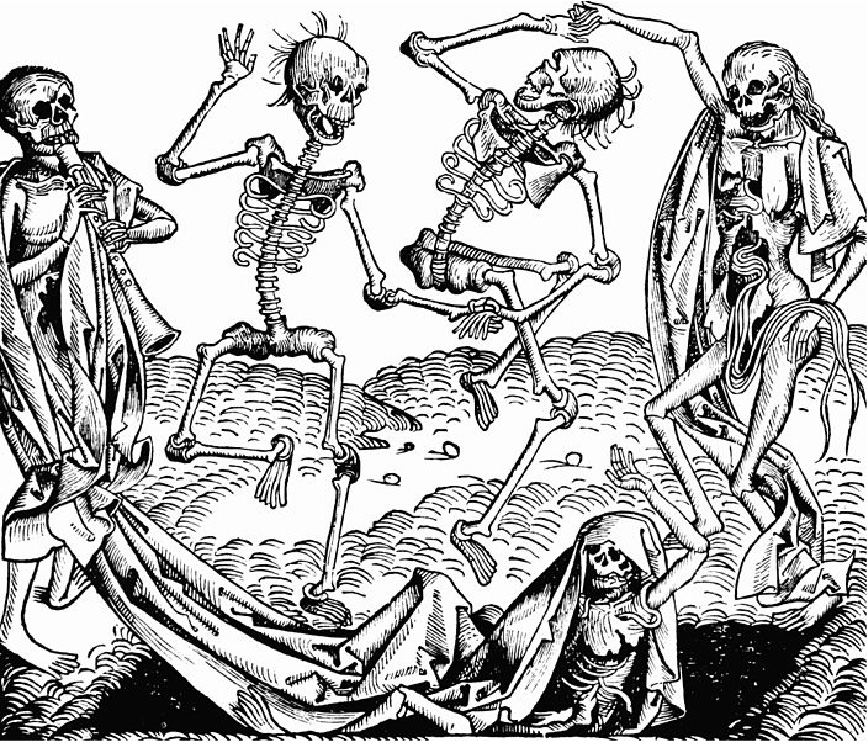
In addition to the demographic and economic impacts of the Black Death era, modes of artistic and literary expression were significantly transformed in response to the plague’s devastation. In the visual arts, the fears engendered by the omnipresence of death and decay initiated a new emphasis on realism that grappled with themes of salvation and mortality. Macabre representations of deathbed scenes and dancing skeletons became especially prominent reminders of the inevitability of death and fears of hell and damnation (Figure 16.14). Although the visual iconography of death reflected the collective cultural trauma associated with the plague, it also served as a potent reminder to celebrate life in the face of it.
英語のヒント
黒死病の時代には、人口と経済への影響に加え、芸術・文学の表現方法も、ペストの惨禍に応じて大きく変容した。視覚芸術では、至る所にある死と腐敗が生む恐怖から、救済と人間の死を主題として向き合う、新たな写実主義への傾斜が生じた。臨終の場面や踊る骸骨の不気味な描写は、死が避けられないこと、地獄や永遠の罰への恐れを思い起こさせるものとして、とりわけ目立つようになった(図16.14)。死の図像は、ペストに結びついた集団的・文化的な心の傷を映し出した。同時に、死を前にして生を喜ぶよう強く呼びかけるものでもあった。
Dance of Death.死の舞踏。
(credit: “The Dance of Death” by Michael Wolgemut, from the Nuremberg Chronicle of Hartmann Schedel/Wikimedia Commons, Public Domain) · Public Domain
Figure 16.14 This fifteenth-century woodcut image from the Nuremburg Chronicle of Hartmann Schedel depicts Death dancing and celebrating. The personification of death as a dancing skeleton became a common theme in late medieval Europe that reflects the psychological toll of the Black Death. (credit: “The Dance of Death” by Michael Wolgemut, from the Nuremberg Chronicle of Hartmann Schedel/Wikimedia Commons, Public Domain)
図16.14 ハルトマン・シェーデルの『ニュルンベルク年代記』に収められた15世紀の木版画。死が踊って祝う姿を描く。踊る骸骨として死を擬人化する表現は、中世後期ヨーロッパの一般的な主題となり、黒死病が心理面に残した傷を映している。(出典: “The Dance of Death”/Michael Wolgemut, from the Nuremberg Chronicle of Hartmann Schedel/Wikimedia Commons, パブリックドメイン)
Medieval writers also sought to make sense of the Black Death by documenting the experience of living through the pandemic and exploring themes of transience and mortality. For example, in Giovanni Boccaccio’s famous collection of novellas, The Decameron, a fictional group of young men and women taking refuge from the plague in a villa outside Florence pass the time by trading stories that reflect upon love, loss, and the vagaries of fortune. The Decameron also calls attention to larger social responses engendered by the plague’s demographic devastation, such as the growing prominence of merchants due to the continued growth of global trade and people’s loss of confidence in the European Christian Church.
英語のヒント
中世の著述家も、パンデミックを生き抜いた経験を記録し、はかなさや死を主題として探究することで、黒死病を理解しようとした。例えばジョヴァンニ・ボッカッチョの有名な短編小説集『デカメロン』では、フィレンツェ郊外の別荘へペストを避けた架空の若い男女が、愛、喪失、運命の気まぐれを考えさせる話を交わして時を過ごす。『デカメロン』はまた、ペストによる人口の激減が生んだ、より大きな社会の反応にも注意を向けている。世界貿易の成長が続いたことによる商人の地位の高まりや、ヨーロッパのキリスト教会に対する人々の信頼の喪失などである。
Although the Christian Church remained a bastion of spiritual solace for many during the Black Death, social responses to the plague in medieval Europe ranged from increased piety to hedonism to resigned acceptance of inevitable death. Those who could afford to do so fled the crowded urban centers, but most did not have this luxury. Medieval European cities remained hotbeds of infection despite the efforts of some Italian cities to impose quarantine and travel restrictions. Some cities even closed markets and prohibited gatherings for funerals; others required the removal of the infected to plague hospitals. Lacking a germ theory of contagion, however, medical practitioners were unable to fully explain or remedy the plague, although centuries of early scientific observations led many to attempt the techniques and approaches that had served in outbreaks of other diseases. Failing to fully grasp how and why the disease was spreading, however, many of the devout turned to the clergy, who were also dying in record numbers, mostly because of their efforts to care for the sick. But they too were unable to prevent the plague’s relentless toll.
英語のヒント
黒死病の間も、キリスト教会は多くの人にとって精神的な慰めの拠り所であり続けた。しかし中世ヨーロッパの社会的反応は、信仰の深化から快楽主義、避けられない死を諦めて受け入れる姿勢まで、さまざまだった。余裕のある人は混雑した都市中心部から逃れたが、大半の人にはそのような選択はできなかった。イタリアの一部都市が隔離や移動制限に取り組んだにもかかわらず、ヨーロッパの中世都市は感染の温床であり続けた。市場を閉鎖して葬儀の集まりを禁じた都市もあり、感染者をペスト病院へ移すよう命じた都市もあった。しかし病原体による感染という理論がないため、医療従事者はペストを完全には説明も治療もできなかった。何世紀にも及ぶ初期の科学的観察をもとに、他の病気の流行に役立った技法や方法を試す者は多かったが、それでも病気がどう、なぜ広がるかを十分には理解できなかった。そこで多くの敬虔な人々は聖職者を頼った。しかし聖職者自身も、主に病人を世話する努力のために、かつてない数で死亡していた。彼らにも、ペストが容赦なく積み重ねる犠牲を止めることはできなかった。
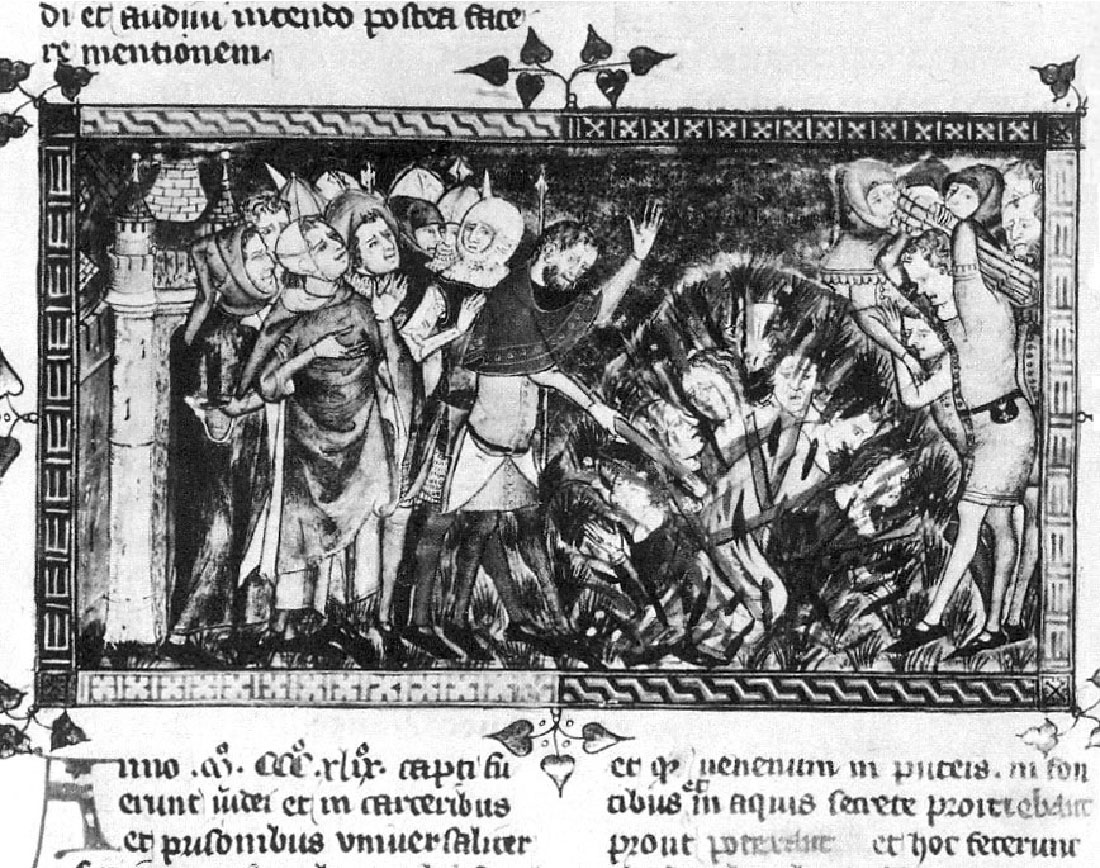
Although some blamed the plague on earthquakes, astrological forces, or poisonous fog, most people in Christian Europe agreed it was a sign of God’s displeasure. In some towns, the belief that communities had to be purged of “morally contaminating people” such as prostitutes and beggars also led to the scapegoating of Jewish people, who were falsely accused of causing the plague by poisoning wells. Regardless of the fact that their communities also suffered from the plague, Jewish people faced widespread persecution, escalating in several cities to full-blown massacres (Figure 16.15). Driven by the fire-and-brimstone dogmatism of late medieval Christianity, those who led the persecution of marginalized populations sought to placate God by building churches, developing cults to plague saints like Saint Roche, and hunting heretics and outsiders they believed had provoked divine displeasure.
英語のヒント
ペストを地震、天体の作用、有毒な霧のせいにした人々もいたが、キリスト教圏のヨーロッパでは、大半が神の不興のしるしだと考えていた。ある町々では、売春に従事する人や物乞いなど、「道徳的に人々を汚染する者」を共同体から排除すべきだという信念が、ユダヤ人への責任転嫁にもつながった。ユダヤ人は、井戸に毒を入れてペストを起こしたという、虚偽の非難を受けた。ユダヤ人の共同体自体もペストで苦しんでいたという事実は無視され、広範な迫害にさらされた。いくつかの都市では、本格的な虐殺へと激化した(図16.15)。中世後期のキリスト教の、地獄の業火を説く独断的な教えに駆られ、周縁化された人々への迫害を主導した者たちは、神をなだめようとした。教会を建て、聖ロクスのようなペストの守護聖人への崇敬を広め、神の怒りを招いたと信じた異端者やよそ者を追い詰めたのである。
Scapegoating in a Pandemic.パンデミック下のスケープゴート化。
(credit: modification of work “Burning of Jews during the Black Death epidemic, 1349” by Bibliothèque royale de Belgique from A History of the Jewish People by H.H. Ben-Sasson/Wikimedia Commons, Public Domain) · Public Domain
Figure 16.15 This image from a fourteenth-century Belgian manuscript shows Jewish people being burned alive on false accusations of spreading the plague. The anti-Semitism inflamed by the Black Death in many parts of medieval Europe sometimes had deadly consequences, and the scapegoating of Jewish and other marginalized communities led to full-blown massacres at times. (credit: modification of work “Burning of Jews during the Black Death epidemic, 1349” by Bibliothèque royale de Belgique from A History of the Jewish People by H.H. Ben-Sasson/Wikimedia Commons, Public Domain)
図16.15 14世紀のベルギーの写本に描かれた図。ペストを広めたという虚偽の非難を受け、ユダヤ人が生きたまま焼かれている。中世ヨーロッパの多くの地域では、黒死病によって反ユダヤ主義が煽られ、ときに命を奪う結果になった。ユダヤ人や他の周縁化された共同体への責任転嫁が、全面的な虐殺につながることもあった。(出典: 原作品を加工:“Burning of Jews during the Black Death epidemic, 1349”/Bibliothèque royale de Belgique from A History of the Jewish People/H.H. Ben-Sasson/Wikimedia Commons, パブリックドメイン)
The desperation and zealotry that inspired some responses to the plague in medieval Europe are perhaps best seen in the appearance of flagellants, people who believed that by publicly flogging themselves, they could atone for the sins of humanity and mitigate divine retribution. After this idea originated in Eastern Europe and took root in Germany, the flagellants traveled from town to town, reciting penitential verses and lashing themselves with leather whips until they drew blood. They were usually welcomed by townspeople who hoped they could bring an end to the plague epidemic. Occasionally, their rhetoric took an anti-Semitic turn, accusing the Jewish people of causing the plague to annihilate Christendom. The flagellants were active through much of Europe in the early years of the plague pandemic and may have even spread the disease through their contaminated blood. As a result of their increasingly radical orientation, however, by 1349 flagellants had been officially condemned by Pope Clement VI, and they ultimately faded into oblivion in the fifteenth century.
英語のヒント
中世ヨーロッパのペストへの反応の一部を駆り立てた絶望と狂信は、鞭打苦行者の出現に最もよく表れているかもしれない。彼らは、公衆の面前で自分を鞭打つことにより、人類の罪を償い、神の報いを和らげられると信じていた。この考えは東ヨーロッパで生まれ、ドイツに根づいた。鞭打苦行者は町から町へ移動し、悔悛の詩句を唱えながら、血が出るまで革の鞭で自らを打った。流行を終わらせてくれることを期待した町の人々は、たいてい彼らを歓迎した。ときにはその言説が反ユダヤ的になり、キリスト教世界を滅ぼすためにユダヤ人がペストを起こしたと非難した。パンデミック初期、鞭打苦行者はヨーロッパの大部分で活動し、汚染された血を通じて病気を広めた可能性さえある。だが次第に急進化したため、1349年までには教皇クレメンス6世から正式に非難され、15世紀には最終的に忘れ去られていった。
The plague left each region it affected with long-term economic and demographic consequences, including widespread depopulation and cyclic outbreaks of the disease in the fourteenth and fifteenth centuries. Old systems of belief came into question, and ancient social hierarchies shifted to accommodate the significant population losses that followed the plague. Peasants, laborers, and those at the lower end of the socioeconomic hierarchy tended to experience the greatest mortality, but for those who survived, pronounced labor shortages led to the demise of some industries and more favorable working conditions in others. The disadvantaged began to question whether social elites really did enjoy God’s privilege, as the social hierarchy generally preached, since they too succumbed to the plague and failed to care for those to whom they bore responsibility.
英語のヒント
ペストは、襲ったどの地域にも、経済と人口の長期的な影響を残した。広範な人口減少と、14~15世紀に繰り返される再流行もその一部だった。古い信念体系が問い直され、昔からの社会的序列も、ペスト後の大きな人口喪失に対応して変わった。死亡率が最も高かったのは、農民、労働者、社会経済的な階層の下層にいる人々である傾向があった。しかし生き残った人々にとっては、深刻な労働力不足が、一部産業の消滅をもたらす一方、他の産業では労働条件をよくする結果となった。不利な立場に置かれた人々は、社会の序列が一般に説いていたように、上層者は本当に神から特別な恩恵を受けているのかと疑い始めた。上層者もペストで死に、自らが責任を負うべき人々を世話できなかったからである。