第16章14世紀の気候変動とペストClimate Change and Plague in the Fourteenth Century
The Middle East and North Africa in the Early Fourteenth Century14世紀初頭の中東と北アフリカ
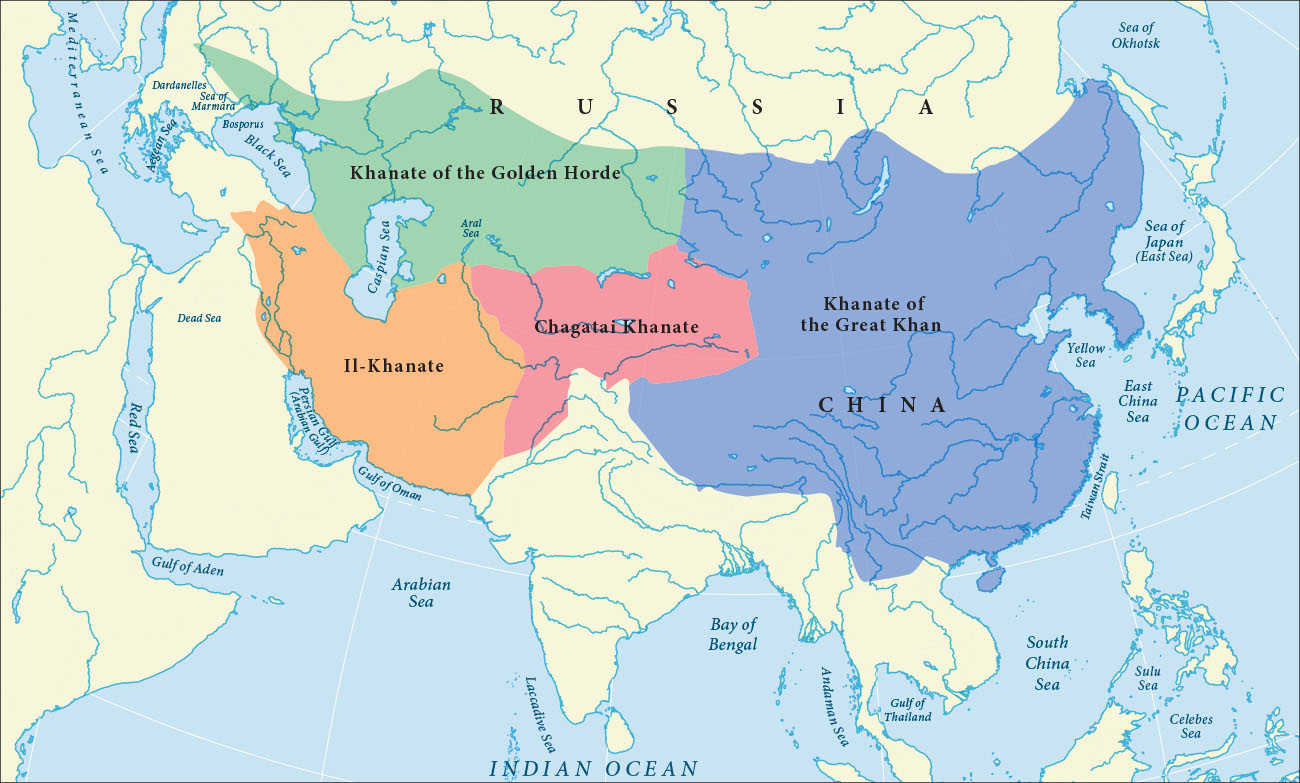
Although China served as the heart of the Mongol Empire, in the early fourteenth century, the Mongol presence also extended across the Middle East and central Asia. Political instability and shifting relationships with conquered peoples increasingly characterized the remaining khanates. For example, in the Il-Khanate, a division of the Mongol Empire that extended from the northern border of the Indian subcontinent to the eastern edge of Anatolia in modern Turkey, the nature of Mongol leadership had shifted from remote detachment to embedded assimilation by the early 1300s (Figure 16.5).
英語のヒント
中国はモンゴル帝国の中核だったが、14世紀初頭のモンゴルの勢力は中東と中央アジアにも広がっていた。他のハン国では、政治的不安定さと征服された人々との関係の変化が、ますます目立つようになった。例えばイル・ハン国は、インド亜大陸の北の境から、現在のトルコにあるアナトリアの東端まで広がるモンゴル帝国の一部だった。そこでは1300年代初頭までに、支配者のあり方が、被支配者と距離を置くものから、現地社会に根を下ろして同化するものへと変わっていた(図16.5)。
The Mongol Empire.モンゴル帝国。
(attribution: Copyright Rice University, OpenStax, under CC BY 4.0 license) · CC BY 4.0
Figure 16.5 This map depicts the four khanates that made up the Mongol Empire in 1335: the Khanate of the Golden Horde, the Il-Khanate, the Chagatai Khanate, and the Khanate of the Great Khan, or Yuan dynasty. Although each was nominally under the control of the Great Khan of the Yuan, their rulers had relative independence and autonomy; in some cases, they rivaled each other for influence. (attribution: Copyright Rice University, OpenStax, under CC BY 4.0 license)
図16.5 1335年にモンゴル帝国を構成していた四つのハン国、すなわちキプチャク・ハン国、イル・ハン国、チャガタイ・ハン国、大ハンのハン国である元を示す地図。各国は名目上は元の大ハンの支配下にあったが、その君主はかなりの独立性と自立性を持ち、ときには影響力を競い合った。(出典: 著作権:Rice University, OpenStax/CC BY 4.0)
When the Mongols occupied portions of the Middle East, their regional leader, Chinggis Khan’s grandson Hulagu, used the title il-khan (lesser khan); his realm, therefore, became known as the Il-Khanate. Founded in 1256, the Il-Khanate was primarily centered in Persia, and its rulers resurrected the ancient title of “Iran” for this core of their domain, where they sought to maintain Mongol nomadic ways and generally neglected the khanate’s economic welfare. Early on, Mongol leaders largely imposed their traditions and practices as the dominant culture, little appreciating the cultural traditions of their subjects. In addition to experiencing this cultural alienation, many peasants found the first decades of Il-Khanate rule financially disastrous as they lost their livestock and farmlands to Mongol nomads. However, after Mahmud Ghazan, the seventh ruler of the Il-Khanate, converted to Islam in 1295, the il-khans became increasingly embedded within the Muslim communities they governed.
英語のヒント
モンゴル人が中東の一部を占領したとき、現地の指導者であったチンギス・ハンの孫フレグは、「小ハン」を意味するイル・ハンという称号を用いた。そのため彼の領国はイル・ハン国と呼ばれるようになった。1256年に建国されたイル・ハン国は主にペルシアを中心とし、支配者たちはこの中核地域の古い呼称「イラン」を復活させた。そこではモンゴルの遊牧生活を維持しようとし、概してハン国の経済的な豊かさを顧みなかった。初期のモンゴルの支配者は、臣民の文化的伝統をほとんど評価せず、自分たちの伝統や慣行を優越する文化として押しつけた。農民たちは、こうした文化的疎外に加え、モンゴルの遊牧民に家畜や農地を奪われ、イル・ハン国支配の最初の数十年に深刻な経済的打撃を受けた。しかし第7代の君主マフムード・ガザンが1295年にイスラームへ改宗すると、イル・ハンたちは、自らが支配するムスリム社会にますます深く根を下ろすようになった。
Although Ghazan’s conversion may have been based solely on religious conviction, it also enabled him to appeal to the growing numbers of Mongols and members of the Persian elite who had become Muslims. Mongols living in the Il-Khanate had already begun intermarrying with their Muslim subjects, but this practice greatly increased as they gradually became less culturally distinct from them. This transformation marked a significant shift in the cultural identity of Mongols, who now increasingly became part of the sedentary societies they conquered and eventually abandoned their roles as military conquerors.
英語のヒント
ガザンの改宗は、純粋に信仰上の確信に基づくものだったかもしれない。しかし同時にそれは、ムスリムとなったモンゴル人やペルシアの有力者が増えるなかで、彼らの支持を得やすくした。イル・ハン国に暮らすモンゴル人は、すでにムスリムの臣民との通婚を始めていたが、文化的な違いが次第に薄れるにつれて、この慣行は大きく広がった。この変化はモンゴル人の文化的自己認識の大きな転換を示していた。モンゴル人は、自らが征服した定住社会の一員となることが増え、最終的には軍事的征服者という役割を捨てたのである。
Eventually the transition from foreign interlopers to fully integrated members of the community shifted Il-Khanate priorities. Although the northern regions of the khanate had been badly damaged in the early years of Mongol invasions, Ghazan and his successors focused on rebuilding the agricultural infrastructure in the southern portions of their territory, including the Iranian provinces of Fars and Khuzistan. They channeled resources into rehabilitating the empire’s economy and cosmopolitan urban life through the construction of schools, mosques, and bazaars. These policies not only enabled Islamic culture and scholarship to flourish, but they also further cemented the cultural bond between Mongol rulers and their subjects in Persia.
英語のヒント
外来の侵入者から共同体に完全に溶け込んだ一員への変化は、やがてイル・ハン国が何を重視するかも変えていった。領国北部は、モンゴル侵入の初期に甚大な被害を受けていた。それでもガザンと後継者たちは、イランのファールス州やフーゼスターン州を含む南部の農業基盤の再建に力を注いだ。学校、モスク、バザールの建設に資源を振り向け、帝国の経済と国際色豊かな都市生活の復興を進めた。こうした政策はイスラームの文化と学問を栄えさせただけでなく、モンゴルの支配者とペルシアの臣民との文化的な結びつきもいっそう強めた。
Despite the success of early attempts to rehabilitate the empire’s economy, by the middle of the fourteenth century, the Il-Khanate began to succumb to struggles for supremacy after the il-khan Abu Sa‘id died in 1335. Clashes between Mongol, Arab, Persian, and Turkic factions ultimately split the former Il-Khanate into several successor states. Although fragments of the Mongol Empire, such as the Golden Horde, persisted in name until the sixteenth century, after the overthrow of the Yuan dynasty in 1368, the Mongol Empire ceased to exist as a unified political entity.
英語のヒント
帝国の経済を立て直す初期の試みは成功した。しかし1335年にイル・ハンのアブー・サイードが死ぬと、14世紀半ばまでにイル・ハン国は覇権争いに屈し始めた。モンゴル系、アラブ系、ペルシア系、テュルク系の諸派の衝突によって、旧イル・ハン国は最終的にいくつかの後継国家に分裂した。キプチャク・ハン国などモンゴル帝国の断片は、名目上は16世紀まで存続した。それでも1368年に元が倒れると、モンゴル帝国は統一された政治的存在ではなくなった。
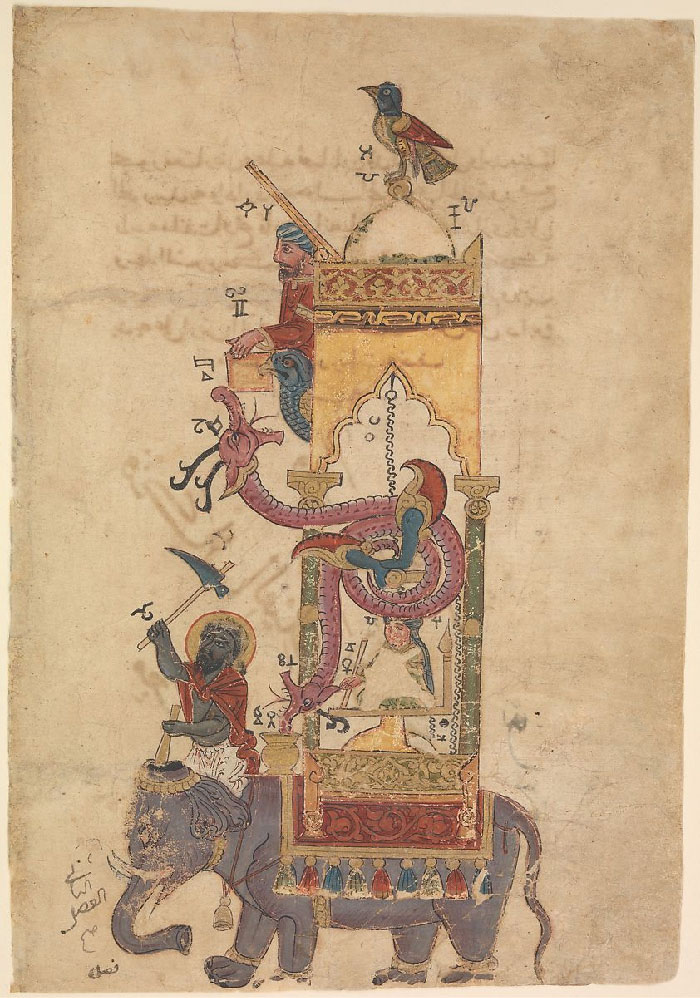
As the Il-Khanate regime began its steady decline in the fourteenth century, one of its chief rivals, the Mamluk Sultanate of Egypt, rose to a position of greater influence in the eastern Mediterranean. Founded by formerly enslaved soldiers of Turkish origin who first emerged as elite fighters in the Abbasid Caliphate, the Mamluk Sultanate eventually became the foremost center of Muslim scholarship and learning in the fourteenth century (Figure 16.7). The Mamluks’ reputation for military prowess gained them the respect of Muslims throughout North Africa and the Middle East, especially after they repelled the Mongol army at the Battle of Ain Jalut in Syria in 1260, stopping Mongol southwestern expansion. The Mamluks, under their military commander Baybars, then gained control of Egypt and Syria. In the process, they not only managed to protect their empire from subsequent Mongol attacks, but they also made significant contributions to the Islamization of Africa.
英語のヒント
14世紀にイル・ハン国が着実に衰退し始めると、その主要な競争相手の一つであったエジプトのマムルーク朝が、東地中海でより大きな影響力を持つようになった。マムルーク朝を建てたのは、奴隷の身分にあったテュルク系の兵士たちである。彼らはもともとアッバース朝の精鋭兵として頭角を現した。マムルーク朝はやがて、14世紀におけるムスリムの学問と教育の最も重要な中心地となった(図16.7)。マムルークの軍事的な武勇は、北アフリカと中東のムスリム全体から敬意を集めた。特に1260年、シリアのアイン・ジャールートの戦いでモンゴル軍を撃退し、モンゴルの南西方面への膨張を止めたことが大きかった。その後マムルークは、軍司令官バイバルスのもとでエジプトとシリアの支配を確立した。その過程で、以後のモンゴルの攻撃から帝国を守るだけでなく、アフリカのイスラーム化にも大きく貢献した。
Muslim Scholarship in the Mamluk Sultanate.マムルーク朝におけるイスラームの学問。
(credit: ““The Elephant Clock”, Folio from a Book of the Knowledge of Ingenious Mechanical Devices by al-Jazari” by Bequest of Cora Timken Burnett, 1956/Metropolitan Museum of Art, Public Domain) · Public Domain
Figure 16.7 This page from a 1315 treatise on mechanical devices by Syrian author al-Jazari depicts the high sophistication of Islamic scientific scholarship and mechanical knowledge at the height of the Mamluk Empire. The image depicts a fantastical elephant clock that was to generate a chain reaction every half hour in which the bird at the top would whistle, the man would drop a ball into the dragon’s mouth, and the driver would prod the elephant with a goad. (credit: ““The Elephant Clock”, Folio from a Book of the Knowledge of Ingenious Mechanical Devices by al-Jazari” by Bequest of Cora Timken Burnett, 1956/Metropolitan Museum of Art, Public Domain)
図16.7 シリアの著述家ジャザリーによる機械装置の論考の1315年の写本の一頁。マムルーク朝の最盛期に、イスラーム圏の科学研究と機械の知識がいかに高度であったかを示している。描かれた幻想的な象時計は、30分ごとに連鎖動作を起こす仕組みだった。頂部の鳥が鳴き、人形が竜の口へ球を落とし、象使いが突き棒で象を促すのである。(出典: ““The Elephant Clock”, Folio from a Book of the Knowledge of Ingenious Mechanical Devices/al-Jazari”/Cora Timken Burnett の遺贈、1956年/メトロポリタン美術館, パブリックドメイン)
During the period between 1260 and 1341, Cairo, the capital of the Mamluk Sultanate, became a prominent center of Muslim intellectual culture and architecture, drawing many merchants and scholars fleeing Mongol attacks in their Persian and Iraqi homelands. The age of Mamluk prosperity and prominence eventually came to an end with the death of Sultan al-Nasir Muhammad in 1341, which initiated a period of instability worsened by the onslaught of the bubonic plague in the late 1340s. While the Mamluks remained in power until their defeat by the Ottomans in the sixteenth century, a period of marked decline had begun.
英語のヒント
1260年から1341年にかけて、マムルーク朝の首都カイロは、イスラームの知的文化と建築の著名な中心地になった。モンゴルの攻撃を逃れて故郷のペルシアやイラクを離れた、多くの商人や学者が流入した。しかし1341年にスルタンのナースィル・ムハンマドが死ぬと、マムルーク朝の繁栄と隆盛の時代はついに終わった。その死が不安定な時期の始まりとなり、1340年代末の腺ペストの猛襲が状況をさらに悪化させた。マムルーク朝は16世紀にオスマン朝に敗れるまで権力を維持したが、著しい衰退はすでに始まっていた。