第16章14世紀の気候変動とペストClimate Change and Plague in the Fourteenth Century
16.1 Asia, North Africa, and Europe in the Early Fourteenth Century16.1 14世紀初頭のアジア・北アフリカ・ヨーロッパ
Learning Objectives学習の目標
By the end of this section, you will be able to:
この節を学ぶと、次のことができるようになる。
Analyze the impact of the Mongol conquest on China
モンゴルの征服が中国に与えた影響を分析する。
Describe changes that took place in Mongol rule of the Middle East in the fourteenth century
14世紀に中東のモンゴル支配がどう変化したかを説明する。
Identify the causes of instability in Europe in the fourteenth century
14世紀のヨーロッパが不安定になった原因を挙げる。
The fourteenth century was a period of great instability in Asia, North Africa, and Europe. Although much of this precariousness was caused by climate change, famine, and epidemic disease, these natural phenomena might not have been so devastating if strong political and social institutions had existed to provide support for the people affected by these events. However, in China, the Middle East, North Africa, and Europe, war and conquest, conflicts among rulers, and the weakness of political and religious institutions affected the ability of kingdoms and empires to respond effectively to these challenges.
英語のヒント
14世紀のアジア、北アフリカ、ヨーロッパは、きわめて不安定な時代を迎えていた。この不安定さの多くは気候変動、飢饉、感染症の流行によって生じた。しかし、被害を受けた人々を支える強固な政治・社会制度があったなら、こうした自然現象の打撃はそこまで甚大にはならなかったかもしれない。ところが中国、中東、北アフリカ、ヨーロッパでは、戦争と征服、支配者どうしの対立、政治・宗教制度の弱体さが、王国や帝国の効果的な対応力を損なっていた。
China in the Early Fourteenth Century14世紀初頭の中国
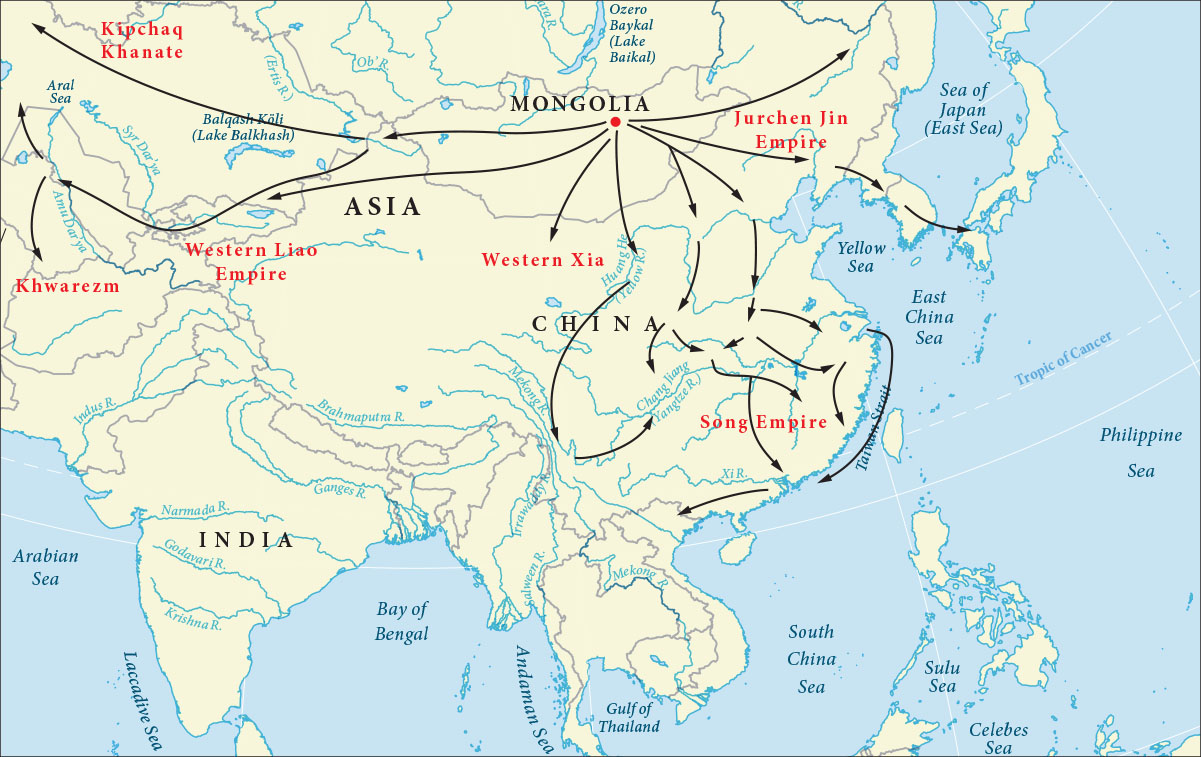
By the beginning of the fourteenth century, the Mongol realm had expanded its reach through a broad swath of Eurasia, effectively becoming the largest land-based empire in history. First uniting the Mongol tribes into a common fighting force with a goal of expanding their control beyond their homeland, the Mongols extended their conquest into China across the North China plain in 1212–1213, leaving many cities in ruin. It was not until Chinggis Khan’s grandson Kublai Khan came to power, however, that the Mongol invasion of southern China was complete (Figure 16.3).
英語のヒント
14世紀の初めまでに、モンゴルの勢力圏はユーラシアの広大な地域に広がり、事実上、史上最大の陸上帝国となっていた。モンゴル人はまず、故郷の外へ支配を広げるため、諸部族を共通の軍事力へとまとめた。そして1212~1213年には華北平原を横断して中国への征服を進め、多くの都市を廃墟に変えた。しかし中国南部への侵攻が完了したのは、チンギス・ハンの孫フビライ・ハンが権力を握ってからのことだった(図16.3)。
Mongol China and Beyond.モンゴル支配下の中国とその周辺。
(attribution: Copyright Rice University, OpenStax, under CC BY 4.0 license) · CC BY 4.0
Figure 16.3 This map depicts the Mongol conquest of Chinese regimes over the course of the thirteenth century, as well as the movement of Mongol armies westward toward the Middle East and beyond. Notice how the movement of the Mongol conquests varies, owing to both the geographic size of China and the resistance within each region. (attribution: Copyright Rice University, OpenStax, under CC BY 4.0 license)
図16.3 13世紀を通じたモンゴルによる中国諸政権の征服と、中東およびその先へ西進したモンゴル軍の動きを示す地図。中国の地理的な広さと各地域の抵抗によって、征服の進み方がどう異なるかに注目しよう。(出典: 著作権:Rice University, OpenStax/CC BY 4.0)
Having transferred his capital from Karakorum in Mongolia to what is now Beijing in 1264, Kublai Khan began his conquest of China by adopting the Chinese name Yuan for his empire in 1271. Meaning “origin,” the term Yuan cemented the Mongols’ political legitimacy in China by reinforcing their connection to the Mandate of Heaven, an ancient political philosophy that emphasized the divine source of governmental authority. After fully conquering the Song dynasty in 1279, Kublai Khan became the first ruler over all of China who was not of Chinese origin. In addition to his role as Yuan emperor, he claimed the title of “great khan,” asserting his claims to supremacy over the entire Mongol Empire, even though the Mongols had regional khans responsible for their own territories.
英語のヒント
フビライ・ハンは1264年、モンゴルのカラコルムから現在の北京へ都を移した。その後1271年、帝国の国号に中国語の「元」を採用して、中国征服を進めた。「始まり」を意味する「元」という名は、統治権の源泉を天に求める古来の政治思想、天命との結びつきを強め、モンゴルによる中国支配の正統性を確かなものにした。1279年に宋を完全に征服すると、フビライは中国全土を支配する初の非中国系の君主となった。元の皇帝であると同時に「大ハン」の称号も名乗り、モンゴル帝国全体に対する最高権力を主張した。各地のハンが、それぞれの領土を統治していたにもかかわらず、である。
The Yuan dynasty not only incorporated China into the vast Mongol domain, but it also made it a nominal capital of the empire. China had long been a target of Mongol conquest. Its combination of strategic placement at the terminus of the interconnected Eurasian trade routes known as the Silk Roads, its abundant croplands, and a sophisticated bureaucracy provided a ready-made foundation for Mongol governance. The Mongols’ traditional nomadic ways had given them little experience in managing sedentary agriculture, so they began by absorbing many Chinese practices of taxation and administration into their government, which they staffed mainly with foreigners rather than with their Chinese subjects. Although some Chinese officials maintained their positions at the local level, the most lucrative and prestigious jobs were primarily held by Mongols and non-Chinese outsiders. Mongol leaders favored those of Mongolian descent, but they also exhibited tolerance for those they considered outsiders and supported the ethnic and religious diversity of Yuan China, particularly in urban areas. By developing policies favorable to trade, adopting the practice of Buddhism, and expanding the circulation of paper money, Mongol leadership fostered economic expansion and a cosmopolitan spirit that attracted many foreign traders to China (Figure 16.4).
英語のヒント
元は中国をモンゴルの広大な領土に組み込んだだけでなく、名目上は中国を帝国の中心地とした。中国は以前からモンゴルの征服目標だった。シルクロードと呼ばれるユーラシアの交易路網の終点という戦略的な位置、豊かな農地、発達した官僚制度を併せ持つ中国には、モンゴルが統治するための土台がすでにそろっていた。伝統的に遊牧生活を送っていたモンゴル人には、定住農業を管理する経験が乏しかった。そのため、まず中国の徴税・行政慣行を数多く取り入れて統治を始めた。ただし政府の人員には、支配下の中国人よりも外国人を多く採用した。地方で地位を保った中国人官吏もいたが、収入も威信も高い役職は、主にモンゴル人や中国人以外の外来者が占めた。モンゴルの指導者はモンゴル系の人々を優遇した一方、外部の人々と見なした者にも寛容さを示し、元の中国、特に都市部における民族と宗教の多様性を支えた。交易に有利な政策を立て、仏教を受け入れ、紙幣の流通を拡大することで、経済の成長と国際色豊かな気風を育て、多くの外国商人を中国へ引き寄せた(図16.4)。
An Early Passport.初期の旅券。
(credit: “Safe Conduct Pass (Paiza) with Inscription in Phakpa Script” by Purchase, Bequest of Dorothy Graham Bennett, 1993/Metropolitan Museum of Art, Public Domain) · Public Domain
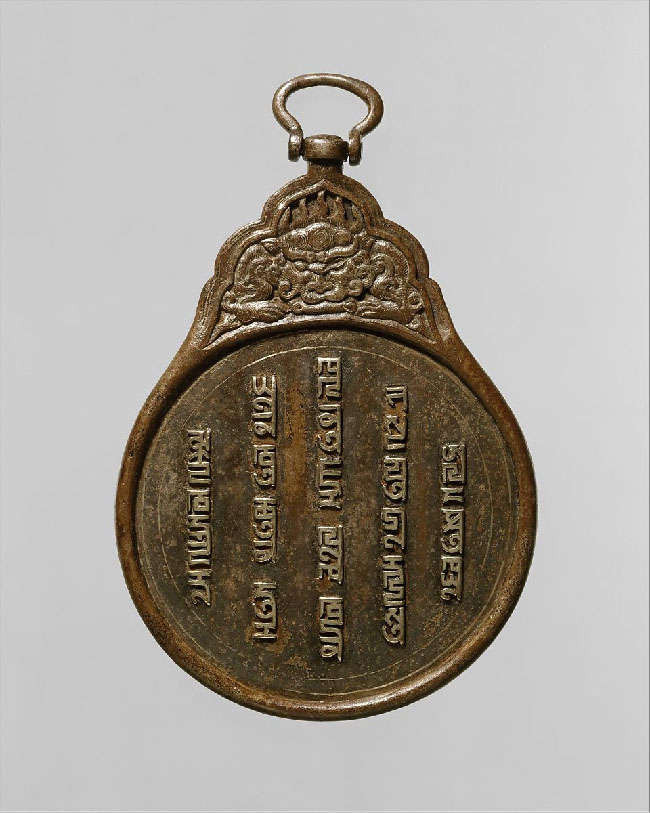
Figure 16.4 This late-thirteenth-century iron and silver plaque, known as a paiza, served as one of the world’s first passports. The inscription uses Phakpa script, devised by the Tibetan monk Phakpa, who served as imperial preceptor at the court of Khubilai Khan. Paizi such as this were carried by Mongol diplomats or officials to permit them safe passage and access to supplies wherever they traveled in the Mongol realm. (credit: “Safe Conduct Pass (Paiza) with Inscription in Phakpa Script” by Purchase, Bequest of Dorothy Graham Bennett, 1993/Metropolitan Museum of Art, Public Domain)
図16.4 パイザと呼ばれるこの13世紀後半の鉄と銀の牌は、世界で最も初期の旅券の一つとして使われた。刻文は、フビライ・ハンの宮廷で帝師を務めたチベット人僧パクパが考案したパスパ文字で記されている。モンゴルの外交使節や官吏は、このような牌符を携帯し、領内のどこを旅しても安全な通行と物資の供給を受けられるようにした。(出典:メトロポリタン美術館「Safe Conduct Pass (Paiza) with Inscription in Phakpa Script」、Dorothy Graham Bennett遺贈資金による購入、1993年、パブリックドメイン)
Although Yuan rulers incorporated some elements of Chinese political culture into their governmental organization, such as the Confucian emphasis on filial piety and the veneration of ancestors, they also sought to maintain cultural distance from their Chinese subjects by forbidding them to adopt Mongol dress or learn the Mongol language. They enforced rigid hierarchies based on ethnicity and capitulation to their rule. Their four-tiered social structure placed Mongols at the top, followed by non-Mongol foreigners known as Semu ren. Their ethnic Chinese subjects were relegated to the bottom two categories; those who had submitted to Mongol rule earlier, the Han Chinese in the north, were ranked higher than those in the south who held out longer.
英語のヒント
元の支配者は、孝や祖先への崇敬を重視する儒教思想など、中国の政治文化の一部を統治機構に取り入れた。しかし、中国人の臣民がモンゴルの服装をまねたりモンゴル語を学んだりすることを禁じ、文化的な隔たりも維持しようとした。元は民族と服属の時期に基づく厳格な身分秩序を敷いた。四層の社会構造では、最上位がモンゴル人、次が「色目人」と呼ばれた非モンゴル系の外国人だった。中国系の臣民は下位の二層に置かれた。より早くモンゴルに服属した北部の漢人が、長く抵抗を続けた南部の人々より上に位置づけられた。
Although the social policy of the Mongols generated a great deal of resentment from their ethnic Chinese subjects, in other respects, the Yuan rulers instituted more benevolent policies. By creating granaries that provided food in times of famine, forgiving the tax burden for villages hit by natural disasters, and reducing the number of crimes that had traditionally resulted in the death penalty, for example, Mongol rulers likely alleviated the hardships faced by many of their subjects. By reducing banditry and making trade safer, particularly along the Silk Roads, they also boosted commerce and improved the lives and fortunes of merchants.
英語のヒント
モンゴルの社会政策は中国系の臣民に強い反感を抱かせたが、元の支配者は別の面では、より慈恵的な政策も導入した。例えば飢饉の際に食料を供給する穀倉を設け、自然災害に遭った村々の税を免除し、それまで死刑とされていた犯罪の種類を減らした。こうした政策は、多くの臣民の苦難をおそらく軽くしただろう。また、盗賊を減らして交易の安全を高め、特にシルクロードの治安を改善することで商業を活発にし、商人たちの生活と財産状況を好転させた。
Despite Kublai Khan’s dominance in China, his attempts to hold a unified Mongol Empire together were largely in vain. The realm had already begun to unravel by the time he took the reins of power in China. Not only had a sharp divide occurred when some Mongols converted to Islam, but the empire itself had splintered into four separate sections known as khanates, each governed by a military ruler or governor known as a khan and who linked his ancestry to the sons of Chinggis. Yuan rulers also faced unrest from their Chinese subjects, particularly when a string of weak emperors after Kublai Khan’s death in 1294 resulted in a succession crisis that left Yuan leadership vulnerable to revolt.
英語のヒント
中国で優位を確立したフビライ・ハンも、モンゴル帝国全体の統一を維持しようとした努力は、ほぼ実を結ばなかった。彼が中国で権力の手綱を握る頃には、帝国はすでにほころび始めていた。一部のモンゴル人がイスラームへ改宗して深い亀裂が生じただけでなく、帝国そのものが四つのハン国に分裂していた。各ハン国は、チンギスの息子たちの血統につながるとする軍事的支配者、すなわちハンによって治められていた。元の支配者は中国人の臣民による不穏な動きにも直面した。特に1294年にフビライが死ぬと、弱い皇帝が相次いで皇位継承の危機を招き、元の指導部は反乱に対して脆弱になった。
Mongol taxation practices and the expropriation of agrarian land had proved financially ruinous for many Chinese peasants and farmers, though taxation benefited merchants and artisans. Despite modest efforts to shore up roads, bolster the postal service, and rebuild the Grand Canal, which provided a means of trade and transportation between northern and southern regions of China, Mongol attempts to bolster infrastructure did not reduce the resentment of their Chinese subjects. Aside from the implementation of some favorable economic and social policies, the notion of foreign rule was an affront to Chinese subjects, who were also offended by Mongols’ dietary and bathing practices. Many Chinese people likely felt affronted by their subjugation to a people they would have viewed as lesser for having such different cultural practices.
英語のヒント
モンゴルによる徴税と農地の収用は、中国の多くの農民・耕作者を経済的破綻に追い込んだ。一方、その税制は商人や職人には利益をもたらした。道路を整え、郵便・駅伝制度を強化し、中国の南北を結ぶ交易と交通の手段であった大運河を再建するなど、ささやかな努力も行われた。しかし、社会基盤を強化するこうした試みは、中国人臣民の反感を鎮めなかった。有益な経済・社会政策がいくつか実施されていても、外国人に支配されること自体が中国人臣民にとって屈辱だった。モンゴル人の食事や入浴の習慣にも嫌悪感を抱いていた。多くの中国人は、文化的慣行がこれほど違うため自分たちより劣ると見なしたであろう人々に服従することを、侮辱だと感じたものと思われる。
By the middle of the fourteenth century, aversion to Mongol rule had led to widespread local rebellions that ultimately hastened the collapse of the Yuan dynasty. Rapid inflation, the devastating impact of the bubonic plague, and intensifying Mongol factionalism all contributed as well. In 1368, the Yuan dynasty officially came to an end when rebel forces triumphed over the Mongol leaders and established the Ming dynasty in its stead.
英語のヒント
14世紀半ばまでには、モンゴル支配への嫌悪が各地の反乱を広範囲に引き起こし、ついには元の崩壊を早めた。急激な物価上昇、腺ペストの壊滅的な影響、激化するモンゴル内部の派閥争いも、いずれも崩壊を促した。1368年、反乱勢力はモンゴルの支配者を破り、代わって明を樹立した。こうして元は正式に終わりを迎えた。