第6章地中海の人々Mediterranean Peoples
6.4 The Roman Republic6.4 ローマ共和政
Learning Objectives学習の目標
By the end of this section, you will be able to:
この節を学ぶと、次のことができるようになる。
Identify the key institutions of the Roman Republic
ローマ共和政の主要な制度を特定する。
Discuss class differences and conflict in the Roman Republic
ローマ共和政の階級の違いと対立を論じる。
Analyze the challenges that strained democratic institutions in the Roman Republic, including the Punic Wars
ポエニ戦争を含め、ローマ共和政の民主的な制度に負担をかけた課題を分析する。
Many elements of early Roman culture and society resulted from Greek influence on the Italian peninsula. Later, when the Roman state expanded and built an empire, its people transmitted their culture—heavily indebted to Ancient Greece—to the Celtic and Germanic tribes of central and western Europe. They also transmitted their language, which is why French, Portuguese, Italian, and Spanish are known as “Romance” languages: They are descended from the Latin language spoken by the Romans. The classical civilizations of Ancient Greece and Rome were therefore the foundation for what became known as Western civilization.
英語のヒント
初期ローマの文化と社会を構成する多くの要素は、イタリア半島に及んだギリシアの影響から生まれた。のちにローマ国家が領土を拡大して帝国を築くと、ローマ人は古代ギリシアに大きく負う自分たちの文化を、中央・西ヨーロッパのケルト系・ゲルマン系諸部族へ伝えた。言語も伝えた。フランス語、ポルトガル語、イタリア語、スペイン語が「ロマンス諸語」と呼ばれるのはこのためで、いずれもローマ人の話したラテン語に由来する。こうして古代ギリシアとローマの古典文明は、のちに西洋文明と呼ばれるものの基盤となった。
The Foundation and Function of the Roman Republicローマ共和政の成立と仕組み
During the Archaic period, Greeks established colonies on Sicily and in southern Italy that went on to influence the culture of Italy. By around 500 BCE, the inhabitants of central Italy, who spoke Latin, had adopted much of Greek culture as their own, including the idea that citizens should have a voice in the governance of the state. For example, the people of the small city-state of Rome referred to their state as res publica, meaning “public thing” (to distinguish it from the res privata, or “private thing,” that had characterized oligarchical and monarchical rule under the Etruscans). Res publica—from which the word “republic” derives—signified that government happens in the open, for everyone to see. Early Romans also adopted Greek gods and myths as well as other elements of Greek culture.
英語のヒント
アルカイック期、ギリシア人はシチリア島とイタリア南部に植民市を建設し、それらはやがてイタリアの文化に影響を与えた。前500年ごろまでに、ラテン語を話すイタリア中部の住民は、ギリシア文化の多くを自分たちのものとして取り入れていた。そのなかには、市民は国の統治について発言権を持つべきだという考えもあった。たとえば小さな都市国家ローマの人びとは、自分たちの国家を「公共のもの」を意味するレス・プブリカと呼んだ。これは、エトルリア人のもとでの寡頭政や君主政を特徴づけたレス・プリウァタ、つまり「私的なもの」と区別するためだった。「共和国」を意味する英語 republic の語源となったレス・プブリカは、政治が誰の目にも見える公の場で行われることを意味した。初期のローマ人は、ギリシアの神々や神話をはじめ、ギリシア文化のほかの要素も取り入れた。
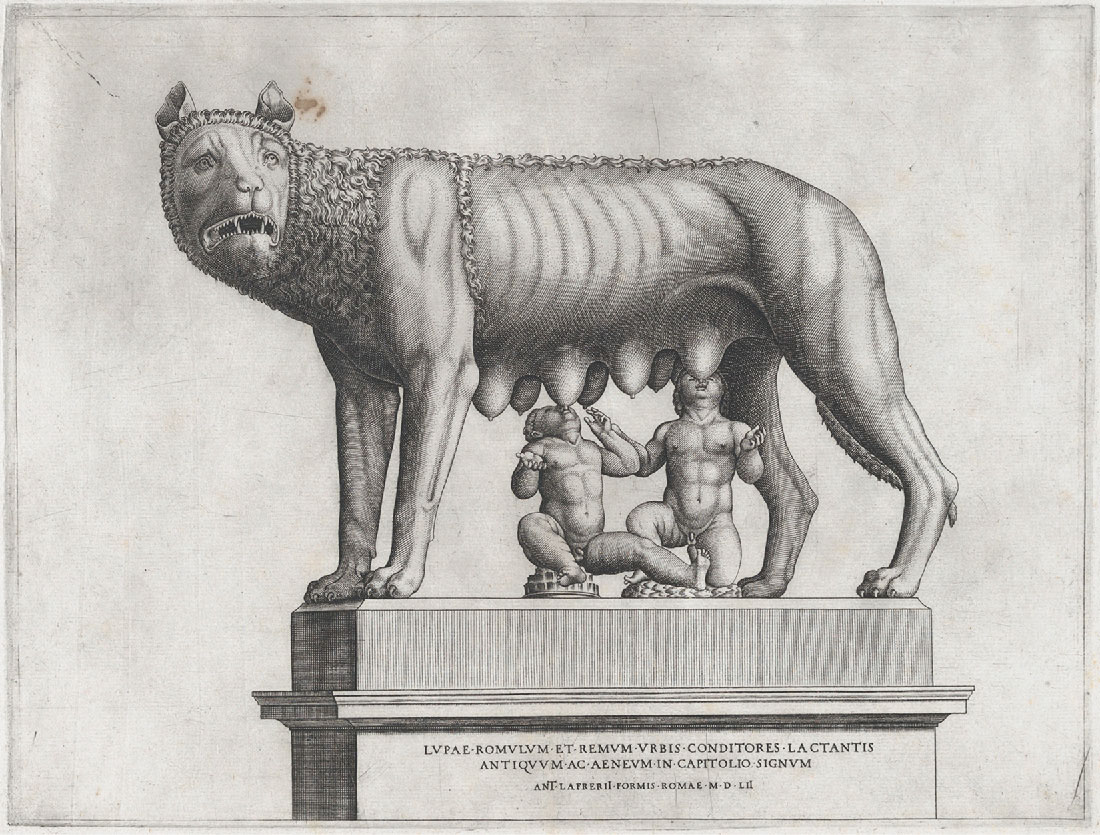
The Romans passed down many traditions about the early history of their republic, recorded by historians such as Livy in the first century BCE. These stories often reflected the values that the Romans revered. According to Roman tradition, the city was founded in 753 BCE by the twin brothers Romulus and Remus, sons of Mars, the god of war (Figure 6.28). It was said that Romulus killed his brother when Remus mocked his construction of a wall around the new city and jumped over it. This story brought into focus for Romans their respect for boundaries and private property.
英語のヒント
ローマ人は共和国の初期の歴史について多くの伝承を受け継いだ。それらは前1世紀のリウィウスら歴史家によって記録された。こうした物語には、ローマ人が尊んだ価値観がしばしば表れている。ローマの伝承によれば、都市を建設したのは軍神マルスの息子である双子のロムルスとレムスで、前753年のことだった(図6.28)。ロムルスが新しい都市を囲む城壁を築くと、レムスがそれをあざ笑って飛び越えたため、ロムルスは弟を殺したとされる。この物語は、境界と私有財産を重んじるローマ人の考えを鮮明に示していた。
Romulus and Remus.ロムルスとレムス
(credit: modification of work “Speculum Romanae Magnificentiae: Romulus and Remus” by Metropolitan Museum of Art, Rogers Fund, Transferred from the Library, 1941/Wikimedia Commons, CC0 1.0) · CC0 1.0
Figure 6.28 This sixteenth-century engraving illustrates the legend that the infants Romulus and Remus, later the founders of Rome, were suckled by a she-wolf after a jealous king ordered them abandoned to die. (credit: modification of work “Speculum Romanae Magnificentiae: Romulus and Remus” by Metropolitan Museum of Art, Rogers Fund, Transferred from the Library, 1941/Wikimedia Commons, CC0 1.0)
図6.28 この16世紀の版画は、のちにローマを建設する幼いロムルスとレムスが、嫉妬深い王に命じられて死ぬように捨てられたあと、雌狼に乳を与えられたという伝説を描く。(出典: 原作品を加工:“Speculum Romanae Magnificentiae: Romulus and Remus”/メトロポリタン美術館、Rogers 基金、図書館から移管、1941年/Wikimedia Commons, CC0 1.0)
Romulus assembled a group of criminals and debtors to inhabit his city, and, to secure wives for them, he invited the neighboring Sabines to attend a festival with their unmarried daughters and sisters. The Romans seized the women, and when the Sabines returned with an army to recover them, the women, now Roman wives, said they had been treated with respect and wished to remain. The Sabines and the Romans then joined together in a single city-state. This story showed that a person did not have to be born a Roman to receive the rights of citizenship. It also reflected women’s social status in Rome, which was higher than their status in other ancient cultures. They couldn’t vote or hold public office, but they could own property and freely participate in public events such as banquets.
英語のヒント
ロムルスは犯罪者や債務者を集め、自分の都市に住まわせた。そして彼らの妻を確保するため、近隣のサビニ人に、未婚の娘や姉妹を連れて祭りに来るよう招いた。ローマ人はその女性たちを奪った。サビニ人が女性たちを取り戻そうと軍を率いて戻ってくると、すでにローマ人の妻となっていた女性たちは、大切に扱われており、そのままとどまりたいと述べた。そこでサビニ人とローマ人は一つの都市国家にまとまった。この物語は、ローマ人として生まれなくても市民権を得られることを示していた。また、ほかの古代文化に比べて高かったローマ女性の社会的地位も反映している。女性は投票したり公職に就いたりできなかったが、財産を所有し、宴会のような公の催しに自由に参加できた。
These stories also include details of Roman ideas about government. For example, they note that in its early centuries, Rome was a monarchy, with the first king being Romulus. After the passing of the fourth king, the throne was assumed by Lucius Tarquinius Priscus, an Etruscan. The next two kings were also Etruscan. The last of these, Tarquin the Proud, was the final king of Rome, whose son raped a young Roman woman named Lucretia. This act triggered a rebellion against the monarchy, which ultimately ousted the Etruscan king. In 509 BCE, the victorious Romans declared their government to be a republic and vowed never to be subject to tyranny again. This story emphasized the Roman respect for the rule of law. No one, no matter how powerful, was above it.
英語のヒント
これらの物語には、統治に関するローマ人の考えも具体的に描かれている。たとえばローマは最初の数世紀には王政で、初代の王はロムルスだったとされる。4代目の王が死ぬと、エトルリア人ルキウス・タルクィニウス・プリスクスが王位に就いた。続く2人の王もエトルリア人だった。最後の王は「傲慢王」タルクィニウスで、その息子がルクレティアという若いローマ人女性を強姦した。この行為が王政への反乱を引き起こし、ついにエトルリア人の王は追放された。勝利したローマ人は前509年、自分たちの政体を共和政と宣言し、二度と専制に服従しないと誓った。この物語が強調するのは、法の支配を尊重するローマ人の姿勢である。どれほど権力があっても、法を超越する者はいなかった。
Archaeological evidence seems to indicate at least some historical basis for these accounts of Rome's founding. In 1988, a wall was discovered around the Palatine Hill where Romulus reportedly built his fortification. Archaeologists also found Greek pottery from this period at the same location, suggesting trade took place. The city of Rome is located along the Tiber River where it was no longer navigable to sea-going vessels. Greek merchants would have sailed up the Tiber from the Mediterranean Sea and traded with the native peoples there. Greek merchants and colonists arriving in Italy at this time influenced the Iron Age culture in northern and central Italy, which then evolved though Greek influence into the Latin and Etruscan cultures. Around 600 BCE, the Etruscans colonized Rome, which became an Etruscan city-state. The story of the Tarquin dynasty reflects this Etruscan period of Roman history. Modern historians maintain that the story of the expulsion of the Tarquins is loosely based on historical events, which saw the Roman city-state free itself from Etruscan domination and establish an independent republic around 500 BCE.
英語のヒント
考古学的証拠は、ローマ建国をめぐるこれらの物語に、少なくともある程度の史実の裏づけがあることを示しているように見える。1988年、ロムルスが防壁を築いたとされるパラティヌスの丘の周囲で、壁が発見された。同じ場所から同時期のギリシア陶器も見つかり、交易があったことがうかがえる。ローマの都市はテヴェレ川沿いの、海を航行する船がそれ以上は進めなくなる地点にある。ギリシア商人は地中海からテヴェレ川をさかのぼり、そこに住む人びとと交易したのだろう。この時期にイタリアへ来たギリシア商人や植民者は、北部・中部イタリアの鉄器時代の文化に影響を与えた。それがギリシアの影響を通して発展し、ラテン人とエトルリア人の文化となった。前600年ごろ、エトルリア人はローマに入植し、ローマはエトルリア人の都市国家になった。タルクィニウス王朝の物語は、ローマ史のこのエトルリア時代を反映している。現代の歴史家は、タルクィニウス一族の追放の物語は、ローマがエトルリア人の支配を脱して前500年ごろに独立した共和国を樹立したという史実を、大まかな下敷きにしていると考える。
In the early republic, Rome was ruled by elected magistrates instead of kings, and by a Council of Elders or Senate. Roman society was divided into two classes or orders, patricians and plebeians. The patricians were the aristocratic elite, who alone could hold public office and sit in the Senate. From the beginning of the republic through the third century BCE, the plebeians, or common people, worked to achieve equality before the law in Roman society. The political conflict between these two classes is known as the Struggle of the Orders.
英語のヒント
共和政初期のローマを統治したのは、王に代わって選挙で選ばれる政務官と、長老会議、すなわち元老院だった。ローマ社会は、パトリキとプレブスという2つの階級、あるいは身分に分かれていた。パトリキは貴族の支配層で、公職に就き元老院の議員になれるのは彼らだけだった。共和政の始まりから前3世紀まで、平民であるプレブスは、ローマ社会で法の前の平等を獲得しようと努めた。この2つの階級の政治的対立は「身分闘争」と呼ばれる。
Rome was located on a coastal plain known as Latium. East of it were the foothills of the Apennine Mountains, inhabited by warlike tribes that made periodic raids. When Rome was under threat, the plebeians could gain leverage with the patricians by refusing to fight until their demands were met. In 450 BCE, the plebeians went on strike for the first time. They feared that patrician judges were interpreting Rome’s unwritten laws to take advantage of ignorant plebeians, so they demanded the laws be written down. The patricians agreed. In the Twelve Tables, published in the Forum, Rome’s laws were written for the first time and were then accessible to all citizens.
英語のヒント
ローマはラティウムと呼ばれる海岸平野にあった。東方にはアペニン山脈の山麓があり、好戦的な諸部族が住んで定期的に襲撃した。ローマが脅かされると、プレブスは要求が認められるまで戦いを拒むことで、パトリキに対する交渉力を得られた。前450年、プレブスは初めてストライキに踏み切った。パトリキの裁判官が、不文法であるローマの法を解釈する際、法律に詳しくないプレブスにつけ込んでいるのではないかと恐れたため、法を成文化するよう要求した。パトリキはこれを認めた。フォルムに掲示された十二表法によって、ローマの法は初めて文字で書かれ、すべての市民が知ることのできるものとなった。
After 450 BCE, the plebeians met in a Plebeian Assembly that annually elected ten officials known as tribunes. These tribunes attended meetings of Rome’s assemblies, the Senate, and the law courts. If they saw any public body or official taking action that would bring harm to plebeians, they could say “Veto” or “I forbid” and stop that action. This power to veto gave plebeians a way to protect themselves and put a check on the power of patrician officials.
英語のヒント
前450年以降、プレブスは平民会に集まり、毎年、護民官と呼ばれる10人の役人を選んだ。護民官はローマの民会、元老院、法廷の会合に出席した。公的な機関や役人がプレブスに害を与える行動を取ろうとしているのを見れば、「ウェトー」、つまり「私は禁ずる」と言って、その行動を止めることができた。この拒否権によって、プレブスは自分たちを守り、パトリキの役人の権力に歯止めをかけられるようになった。
In the fourth and third centuries BCE, plebeians won more concessions by again seceding from the patrician state. After 367 BCE, one of the two consuls, the highest officials in the republic, had to be a plebeian. After 287 BCE, the Plebeian Assembly could pass laws for the republic that were introduced to it by the tribunes, and their laws applied to all Roman citizens. By the third century BCE, the Struggle of the Orders had effectively concluded, since it was now possible for plebeians to pass laws, serve as elected officials, and sit in the Senate, equals of the patricians under Roman law. The Struggle of the Orders did not bring equality to everyone in Rome, however. Rather, it gave well-off plebeians access to positions of power.
英語のヒント
前4~前3世紀、プレブスはパトリキの国家から再び離脱することで、さらに譲歩を勝ち取った。前367年以降は、共和国最高の政務官である2人のコンスル、すなわち執政官のうち、1人をプレブスから選ばなければならなくなった。前287年以降、平民会は護民官が提出した法案を共和国の法律として可決できるようになり、その法律はローマのすべての市民に適用された。前3世紀までに、身分闘争は事実上終結した。プレブスも法律を可決し、選挙による公職に就き、元老院の議員になれるようになり、ローマ法のもとでパトリキと平等になったからである。だが、身分闘争がローマのすべての人に平等をもたらしたわけではない。実際に権力の座への道が開かれたのは、裕福なプレブスだった。
Romans were a very conservative people who greatly venerated the mos maiorum or “way of the ancestors.” Their political system was a combination of written laws and political traditions and customs that had evolved since the birth of the Republic. By the third century BCE, this system was being administrated by a combination of public assemblies, elected officials, and the Senate.
英語のヒント
ローマ人はとても保守的で、モス・マイオールム、すなわち「祖先の慣習」を深く尊重した。彼らの政治体制は、共和国の成立以来発展してきた成文法と、政治上の伝統・慣習を組み合わせたものだった。前3世紀までに、この体制は複数の民会、選挙で選ばれる役人、元老院の組み合わせによって運営されるようになった。
The Roman Republic had three main public assemblies—the Plebeian Assembly, the Tribal Assembly, and the Centuriate Assembly—that elected various officials every year. Only plebeians could attend the Plebeian Assembly, organized into thirty-five regional tribes with a single vote each. It was this assembly that annually elected the ten tribunes, who possessed veto power and could present laws to the assembly for approval. The Tribal Assembly was likewise divided into thirty-five tribes based on place of residence, with each tribe casting one vote, but both plebeians and patricians could attend. Every year, the Tribal Assembly elected the Quaestors, treasurers in charge of public money.
英語のヒント
ローマ共和政には、平民会、トリブス民会、ケントゥリア民会という3つの主要な民会があり、毎年さまざまな役人を選んだ。平民会に参加できるのはプレブスだけで、地域ごとの35のトリブスに分かれ、各トリブスが1票を持っていた。この民会が毎年10人の護民官を選んだ。護民官には拒否権があり、法案を平民会に提出して承認を求めることもできた。トリブス民会も居住地に基づく35のトリブスに分かれ、それぞれが1票を投じたが、こちらにはプレブスもパトリキも参加できた。トリブス民会は毎年、公金を扱う財務担当官クァエストルを選んだ。
Only the Centuriate Assembly could declare war, though the Senate remained in control of foreign policy. Both plebeians and patricians could attend this assembly, which was organized into blocs. The number of votes assigned to each bloc was based on the number of centuries—meaning a group of one hundred men in a military unit—that bloc could afford to equip with weapons and armor. Wealthier citizens had more votes because they could pay more to support the military. This assembly also elected military commanders, judges, and the censor, whose main task was to conduct the census to assess the wealth of Rome’s citizens.
英語のヒント
宣戦布告ができるのはケントゥリア民会だけだったが、外交政策を統制する権限は元老院が保持していた。この民会にもプレブスとパトリキの両方が参加でき、いくつかの集団に編成されていた。各集団に割り当てられる票数は、その集団が何個のケントゥリアに武器や防具をそろえられるかによって決まった。ケントゥリアとは、軍の編成で100人の兵士からなる単位を意味する。富裕な市民は軍を支えるために多くの金を出せたので、票数も多かった。この民会は軍の指揮官、裁判官、ケンソルも選出した。ケンソルの主な仕事は、ローマ市民の資産を評価するために戸口調査を行うことだった。
All elected officials joined the Roman Senate as members for life after their term in office. By far the most powerful institution in the Roman state, the Senate decided how public money was to be spent and advised elected officials on their course of action. Elected officials rarely ignored the Senate’s advice since many of them would be senators themselves after leaving office.
英語のヒント
選挙で選ばれた役人は、任期を終えると全員が終身の元老院議員になった。元老院はローマ国家で群を抜いて強力な機関であり、公金の使途を決め、選ばれた役人に行動方針を助言した。役人が元老院の助言を無視することはまれだった。自分たちの多くも退任後には元老院議員となるからである。
The patron-client system was another important element in the Roman political system. A patron was usually a wealthy citizen who provided legal and financial assistance to his clients, who were normally less affluent citizens. In return, clients in the Roman assemblies voted as directed by their patrons. Patrons could inherit clients, and those with many wielded great influence in Rome.
英語のヒント
パトロヌスとクリエンテスの関係も、ローマの政治制度の重要な要素だった。保護者であるパトロヌスは通常裕福な市民で、被保護者のクリエンテスに法的・経済的な援助を与えた。クリエンテスは一般に、それより資産の少ない市民だった。その見返りに、クリエンテスはローマの民会で、パトロヌスの指示どおりに投票した。パトロヌスはクリエンテスを相続することもでき、大勢のクリエンテスを持つ人はローマで強い影響力を振るった。