第6章地中海の人々Mediterranean Peoples
Sparta and Athensスパルタとアテネ
In the Archaic period, Athens and Sparta emerged as two of the most important of the many Greek city-states. Not only did their governments and cultures dominate the Greek world in the subsequent Classical period; they also fired the imaginations of Western cultures for centuries to come. Athens was the birthplace of democracy, whereas Sparta was an oligarchy headed by two kings.
英語のヒント
アルカイック期、ギリシアの多くの都市国家のなかでも、アテネとスパルタがとくに重要な二つの国として台頭した。その政治と文化は、続く古典期のギリシア世界を主導しただけでなく、後世の西洋文化の想像力を何世紀にもわたってかき立てた。アテネは民主政の発祥地であり、スパルタは2人の王を頂点とする寡頭政だった。
The Rise and Organization of Spartaスパルタの台頭と組織
Sparta in the eighth century BCE was a collection of five villages in Laconia, a mountain valley in the Peloponnese in southern Greece. Due to the shortage of farmland, the citizens (adult males) of these villages, the Spartiates, all served in the military and waged war on neighboring towns, forcing them to pay tribute. The Spartiates also appropriated farmland for themselves and enslaved the inhabitants of these lands, most famously the Messenians, who became known as the helots. Just as Greek colonists at this time divided land among themselves into equal lots, the Spartiates likewise divided the conquered land equally and assigned to each landowner a certain number of helot families to work it. Helots, unlike enslaved people in other parts of Greece, could not be bought or sold but remained on the land as forced laborers from generation to generation. In the seventh century BCE, Sparta conquered the land of Messene to its west and divided its farmland equally among the Spartiates.
英語のヒント
前8世紀のスパルタは、ギリシア南部のペロポネソス半島の山あいにあるラコニア地方の、五つの村の集まりだった。農地が不足していたため、これらの村の市民、つまりスパルティアタイと呼ばれる成人男性は全員軍に参加し、近隣の町と戦って貢納を強制した。スパルティアタイは自分たちのために農地を奪い、その土地の住民を奴隷化した。もっともよく知られるのがメッセニア人で、彼らはヘイロータイと呼ばれた。当時のギリシア植民者が土地を等しい区画に分けたように、スパルティアタイも征服地を平等に分け、各土地所有者に、その土地を耕す一定数のヘイロータイの家族を割り当てた。ギリシアのほかの地域の奴隷とは違い、ヘイロータイは売買されず、世代を超えてその土地にとどまり、強制労働に従事した。前7世紀、スパルタは西隣のメッセネ地方を征服し、その農地をスパルティアタイに等しく分けた。
By the late sixth century BCE, the wealth from the rich agricultural land that Sparta then controlled had made it the most powerful state in the Peloponnese. Sparta also organized the city-states of this region and parts beyond into a system of alliances that historians refer to as the Peloponnesian League. Its members still had self-government and paid no tribute to Sparta, but all were expected to have the same friends and enemies as Sparta, which maintained its dominance in the league. Sparta also used its army to overthrow tyrants in the Peloponnesian city-states and restore political power to the aristoi.
英語のヒント
前6世紀末までには、スパルタは支配下の豊かな農地から得た富によって、ペロポネソス最強の国になっていた。また、この地域とその周辺の都市国家を、歴史家がペロポネソス同盟と呼ぶ同盟関係に組み入れた。加盟国には自治があり、スパルタに貢納することもなかったが、友と敵をスパルタと同じにするよう求められた。こうしてスパルタは同盟内の優位を保った。スパルタは軍を使ってペロポネソスの都市国家の僭主を倒し、アリストイに政治権力を戻すことも行った。
The Spartans were proud of their unique system of government, or constitution, which was a set of laws and traditional political practices rather than a single document. It was said to have been created by a great lawgiver named Lycurgus around 800 BCE, but modern historians view its development as an evolutionary process during the Archaic period rather than the work of a single person.
英語のヒント
スパルタ人は、独自の政治制度、すなわち国制を誇りにしていた。それは1枚の文書ではなく、法律と伝統的な政治慣行のまとまりだった。前800年ごろ、リュクルゴスという偉大な立法者が作ったと伝えられるが、現代の歴史家は、1人の人物の仕事ではなく、アルカイック期を通じた漸進的な発展の成果とみている。
Sparta had two hereditary kings drawn from rival royal families. Their powers were very limited, though both sat as permanent members of the Council of Elders and were priests in the state religion. On occasion, the Spartan kings also led armies into battle. The Assembly of Spartiates passed all laws and approved all treaties with the advice of the Council of Elders. This Assembly also elected five judges every year who administered the affairs of state, as well as the members of the Council of Elders.
英語のヒント
スパルタには、対立する二つの王家から出る世襲の王が2人いた。権限はごく限られていたが、2人とも長老会の終身の構成員であり、国家の宗教の祭司でもあった。王はときに軍を率いて戦いに赴いた。スパルティアタイの民会は、長老会の助言を受け、あらゆる法律を制定し、すべての条約を承認した。この民会は、国家の事務を運営する5人の監督官を毎年選び、長老会の構成員も選出した。
The unique element of Spartan culture was the agoge, its educational system. At the age of seven, boys were separated from their families and raised by the state. To teach them to live by their wits and courage, they were fed very little so they had to learn how to steal food to survive. At the age of twelve they began an even more severe regimen. They were not allowed clothes except a cloak in the wintertime, and they bathed just once a year (Figure 6.12). They also underwent ritual beatings intended to make them physically strong and hardened warriors. At the age of eighteen, young men began two years of intense military training. At the age of twenty, a young Spartan man’s education was complete.
英語のヒント
スパルタ文化に独特だったのが、アゴゲという教育制度だった。男子は7歳になると家族から引き離され、国家によって育てられた。機転と勇気で生き抜くことを教えるため、与えられる食べ物はごくわずかで、生きるために食料を盗む方法を学ばなければならなかった。12歳になると、さらに厳しい生活が始まった。冬の外套以外に衣服は許されず、入浴は年に1度だけだった(図6.12)。肉体を強くし、鍛え上げられた戦士にするための儀礼的な鞭打ちも受けた。18歳になると、若者は2年間の厳しい軍事訓練に入った。20歳で、スパルタの青年の教育は終了した。
Spartan Youth.スパルタの若者
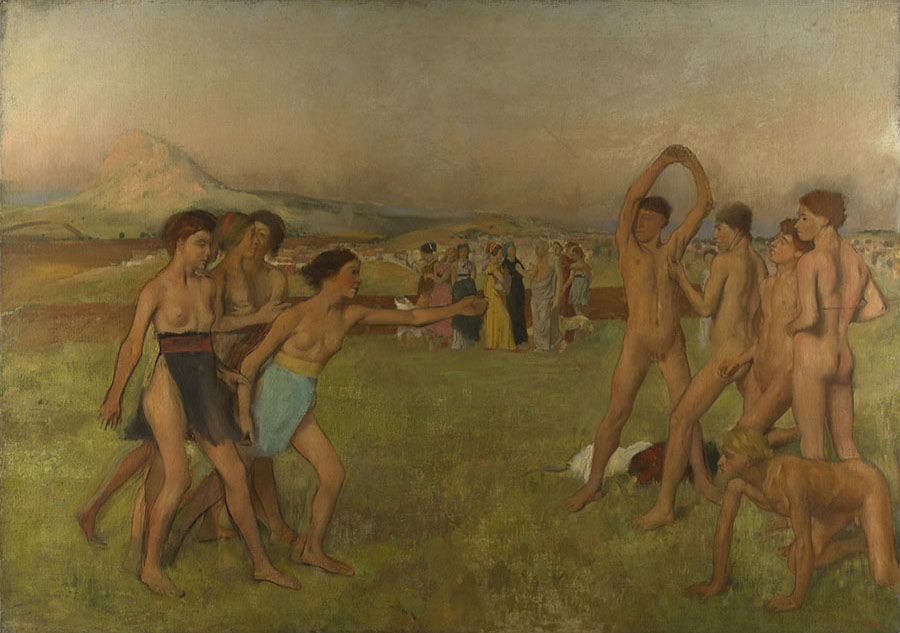
(credit: “Young Spartans exercising” by National Gallery, 1924: purchased from Courtauld Fund/Wikimedia Commons, Public Domain) · Public Domain
Figure 6.12 The design of this nineteenth-century painting by French impressionist Edgar Degas was based on a passage from Plutarch’s Life of Lycurgus and depicts Spartan girls encouraging and challenging Spartan boys. Here the boys prepare to compete in running and wrestling exercises. (credit: “Young Spartans exercising” by National Gallery, 1924: purchased from Courtauld Fund/Wikimedia Commons, Public Domain)
図6.12 フランスの印象派画家エドガー・ドガによるこの19世紀の絵は、プルタルコスの『リュクルゴス伝』の一節に基づいて構想され、スパルタの少女たちが少年たちを励まし、挑戦する様子を描く。少年たちは、走競技やレスリングで競う準備をしている。(出典: “Young Spartans exercising”/ナショナル・ギャラリー、Courtauld 基金による購入、1924年/Wikimedia Commons, パブリックドメイン)
Women of the Spartiate class, before marrying in their mid-teens, also practiced a strict physical regimen, since they were expected to be as strong as their male relatives and husbands and even participate in defending the homeland. Spartan women enjoyed a reputation for independence, since they managed the farms while men were constantly training for or at war and often ran their family estates alone due to the early deaths of their soldier husbands. The state organized unmarried women into teams known as chorai (from which the term chorus is derived) that danced and sang at religious festivals.
英語のヒント
スパルティアタイの階層の女性も、10代半ばで結婚する前には厳しい身体訓練を受けた。男性の親族や夫と同じくらい強くなり、ときには国土の防衛にも参加することを期待されたからである。スパルタの女性は自立しているとの評判を得ていた。男性が絶えず戦争の訓練や実戦に出るあいだ、女性が農場を管理し、兵士である夫が早くに亡くなると、家の所領を1人で経営することも多かったためである。国家は未婚の女性を、コライと呼ばれる組に分け、宗教祭礼で踊りや歌を披露させた。「コーラス」という語はこれに由来する。
When a Spartiate man reached the age of thirty, he could marry, vote in the Assembly, and serve as a judge. Each Spartiate remained in the army reserve until the age of sixty, when he could finally retire from military service and became eligible for election to the Council of Elders. Spartan citizens were proud to devote their time to the service of the state in the military and government; they did not have to work the land or learn a trade since this work was done for them by commoners and helot subjects.
英語のヒント
スパルティアタイの男性は30歳になると、結婚し、民会で投票し、監督官を務めることができた。全員が60歳まで予備役にとどまり、その年齢でようやく軍務から退くことができ、長老会への被選挙資格も得た。スパルタ市民は軍務と政治に時間を捧げて国家に奉仕することを誇りとし、農地を耕したり手仕事を習ったりする必要はなかった。それらの仕事は平民や従属身分のヘイロータイが代わりに行った。