第6章地中海の人々Mediterranean Peoples
The Classical “Golden Age”古典期の「黄金時代」
Many historians view the Greek Classical period and the cultural achievements in Athens in particular as a “Golden Age” of art, literature, and philosophy. Some scholars argue that this period saw the birth of science and philosophy because for the first time people critically examined the natural world and subjected religious beliefs to reason. (Other modern historians argue that this position discounts the accomplishments in medicine and mathematics of ancient Egypt and Mesopotamia.) For example, around 480 BCE, Empedocles speculated that the universe was not created by gods but instead was the result of the four material “elements”—air, water, fire, earth—being subjected to the forces of attraction and repulsion. Another philosopher and scientist of the era, Democritus, maintained that the universe consisted of tiny particles he called “atoms” that came together randomly in a vortex to form the universe.
英語のヒント
多くの歴史家は、ギリシアの古典期、とくにアテネの文化的達成を、美術・文学・哲学の「黄金時代」とみる。この時代に、人びとが初めて自然界を批判的に調べ、宗教的信念を理性によって吟味したため、科学と哲学が誕生したと主張する研究者もいる。(これに対して、そうした見方は古代エジプトやメソポタミアの医学・数学の業績を過小評価すると論じる現代の歴史家もいる。)例えば前480年ごろ、エンペドクレスは、宇宙は神々が作ったものではなく、空気・水・火・土という四つの物質的な「元素」が引力と斥力を受けた結果だと考えた。この時代のもう1人の哲学者・科学者デモクリトスは、宇宙は「原子」と呼ぶ微小な粒子からなり、それらが渦のなかで偶然集まって宇宙を形成したと主張した。
Philosophers questioned not only the traditional views of the gods but also traditional values. Some of this questioning came from the sophists (“wise ones”) of Athens, those with a reputation for learning, wisdom, and skillful deployment of rhetoric. Sophists emerged as an important presence in the democratic world of Athens beginning in the mid-fourth century BCE. They claimed to be able to teach anyone rhetoric, or the art of persuasion, for a fee, as a means to achieve success as a lawyer or a politician. While many ambitious men sought the services of sophists, others worried that speakers thus trained could lead the people to act against their own self-interest.
英語のヒント
哲学者は神々についての伝統的な見方だけでなく、伝統的な価値観も問い直した。その一部を担ったのは、学識・知恵・巧みな弁論術で知られるアテネのソフィスト、すなわち「知者」たちだった。ソフィストは前4世紀半ば以降、民主政のアテネで重要な存在となった。彼らは、法律家や政治家として成功する手段として、報酬を受け取れば誰にでも修辞学、つまり説得の技術を教えられると主張した。野心ある多くの男性がソフィストの指導を求めたが、こうして訓練された弁論家が、民衆を自分たち自身の利益に反する行動へ導くのではないかと心配する人もいた。
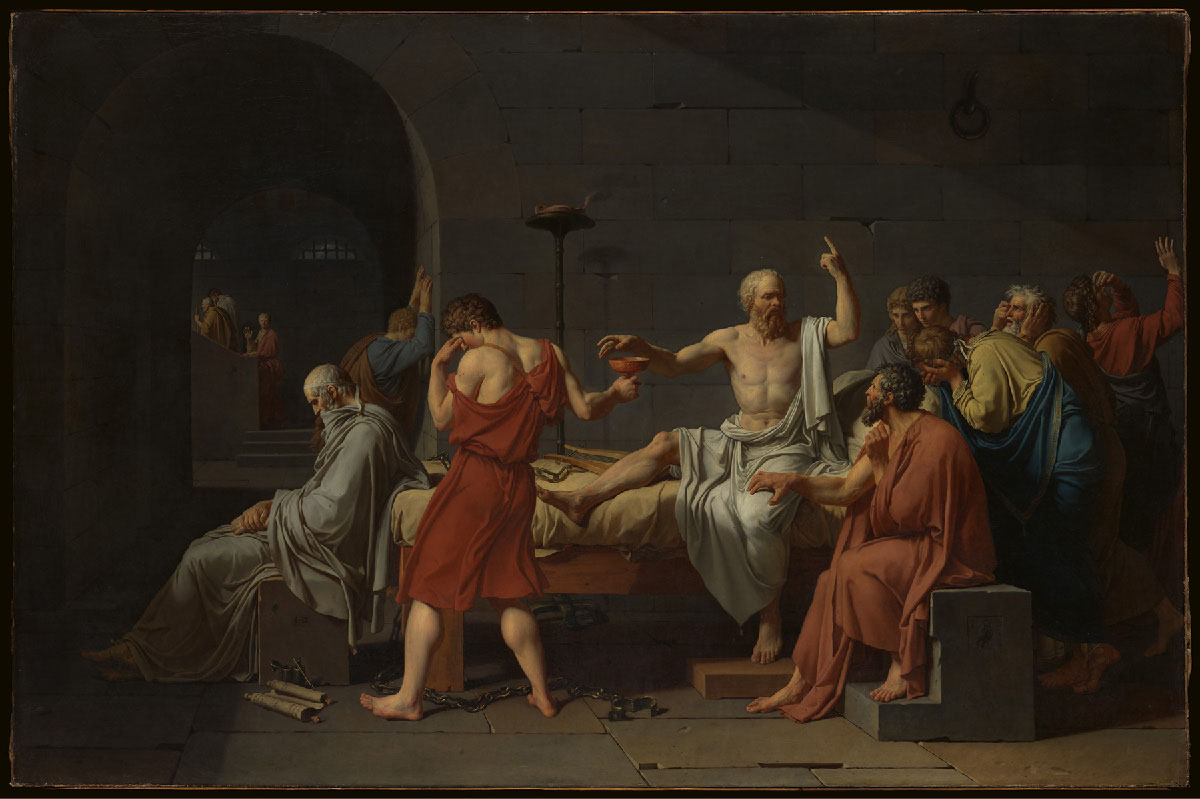
Many thought Socrates was one of the sophists. A stonecutter by trade, Socrates publicly questioned sophists and politicians about good and evil, right and wrong. He wanted to base values on reason instead of on unchallenged traditional beliefs. His questioning often embarrassed powerful people in Athens and made enemies, while his disciples included the politician Alcibiades and even some who had opposed Athenian democracy. In 399 BCE, an Athenian jury court found Socrates guilty of impiety and corrupting the youth, and he was sentenced to death (Figure 6.17).
英語のヒント
多くの人はソクラテスもソフィストの1人と考えた。石工を職としたソクラテスは、善悪や正邪について、ソフィストや政治家に人前で問いを投げかけた。疑われずに受け入れられてきた伝統的信念ではなく、理性を価値観の根拠にしたいと考えたのである。彼の問いは、しばしばアテネの有力者に恥をかかせ、敵を作った。また弟子には、政治家アルキビアデスや、アテネ民主政に反対した人物さえいた。前399年、アテネの陪審法廷はソクラテスを、神々への不敬と青少年を堕落させた罪で有罪とし、死刑が宣告された(図6.17)。
The Death of Socrates.ソクラテスの死
(credit: “The Death of Socrates” by Metropolitan Museum of Art, Catharine Lorillard Wolfe Collection, Wolfe Fund, 1931/Wikimedia Commons, CC0 1.0) · CC0 1.0
Figure 6.17 Socrates (center with upraised arm) was forced to drink hemlock, a poison. His last moments were imagined to great dramatic effect in this large oil painting of 1787 by the French artist Jacques-Louis David. (credit: “The Death of Socrates” by Metropolitan Museum of Art, Catharine Lorillard Wolfe Collection, Wolfe Fund, 1931/Wikimedia Commons, CC0 1.0)
図6.17 中央で腕を上げるソクラテスは、毒のドクニンジンを飲むことを強いられた。フランスの画家ジャック=ルイ・ダヴィッドは、1787年のこの大きな油彩画で、彼の最期を想像し、強い劇的効果を生み出した。(出典: “The Death of Socrates”/メトロポリタン美術館、Catharine Lorillard Wolfe コレクション、Wolfe 基金、1931年/Wikimedia Commons, CC0 1.0)
Socrates left behind no writings of his own, but some of his disciples wrote about him. One of these was Plato, who wrote dialogues from 399 BCE to his death in 347 BCE that featured Socrates in conversation with others. Through these dialogues, Plato constructed a philosophical system that included the study of nature (physics), of the human mind (psychology and epistemology, the theory of knowledge), and ethics. He maintained that the material world we perceive is an illusion, a mere shadow of the real world of ideas and forms that underlie the universe. According to Plato, the true philosopher uses reason to comprehend these ideas and forms.
英語のヒント
ソクラテス自身の著作は残されなかったが、弟子の何人かが彼について書いた。その1人プラトンは、前399年から前347年に死ぬまで、ソクラテスがほかの人と語り合う対話篇を書いた。これらを通じて、プラトンは自然の研究(自然学)、人間の心の研究(心理学と、知識についての理論である認識論)、倫理学を含む哲学体系を築いた。私たちが知覚する物質世界は幻影であり、宇宙の根底にある観念や形相の真実の世界の、単なる影にすぎないと彼は考えた。プラトンによれば、真の哲学者は理性を用いて、これらの観念や形相を理解する。
Plato established a school at the Academy, which was a gymnasium or public park near Athens where people went to relax and exercise. One of his most famous pupils was Aristotle, who came to disagree with his teacher and believed that ideas and forms could not exist independently of the material universe. In 334 BCE, Aristotle founded his own school at a different gymnasium in Athens, the Lyceum, where his students focused on the reasoned study of the natural world. Modern historians view Plato and Aristotle as the founders of Western (European) philosophy because of the powerful influence of their ideas through the centuries.
英語のヒント
プラトンは、アテネ近郊のアカデメイアに学園を開いた。そこは人びとがくつろぎ、運動するために訪れる体育施設、または公共の公園だった。もっとも有名な弟子の1人がアリストテレスで、やがて師とは意見を異にし、観念や形相は物質的な宇宙から独立しては存在できないと考えた。前334年、アリストテレスはアテネの別の体育施設リュケイオンに自らの学園を開いた。そこで弟子たちは、理性的に自然界を研究することに力を注いだ。その思想が何世紀にもわたり強く影響したため、現代の歴史家は、プラトンとアリストテレスを西洋(ヨーロッパ)哲学の創始者とみなしている。
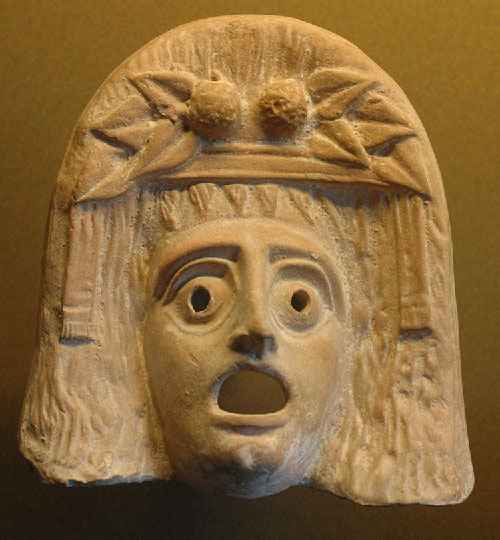
Athens in the Golden Age was also the birthplace of theater. Playwrights of the fifth century BCE such as Sophocles and Euripides composed tragedies that featured music and dance, like operas and musicals today (Figure 6.18). The plots were based on traditional myths about gods and heroes, but through their characters the playwrights pondered philosophical questions of the day that have remained influential over time. In Sophocles’s Antigone, for example, Antigone, the daughter of Oedipus, must decide whether to obey the laws or follow her religious beliefs.
英語のヒント
黄金時代のアテネは、演劇の誕生の地でもあった。ソフォクレスやエウリピデスなど前5世紀の劇作家は、今日のオペラやミュージカルのように、音楽と踊りを伴う悲劇を作った(図6.18)。筋立ては神々や英雄についての伝統的な神話に基づくが、劇作家は登場人物を通じて、その時代の哲学的な問いを考察した。それらの問いは、後世にも影響を保ち続けた。例えばソフォクレスの『アンティゴネ』では、オイディプスの娘アンティゴネが、法律に従うべきか、宗教的な信念に従うべきかを決めなければならない。
Dionysus.ディオニュソス
(credit: “Terracotta figurine of a theatrical mask representing Dionysos” by Marie-Lan Nguyen/Wikimedia Commons, Public Domain) · Public Domain
Figure 6.18 This terracotta representation of a theatrical mask a Greek actor might have worn dates from the first or second century BCE and portrays Dionysus, Zeus’s son and the god of wine. (credit: “Terracotta figurine of a theatrical mask representing Dionysos” by Marie-Lan Nguyen/Wikimedia Commons, Public Domain)
図6.18 ギリシアの俳優が着けたような演劇用の仮面を表す、このテラコッタ作品は、前1~前2世紀のものである。ゼウスの息子でワインの神、ディオニュソスを表している。(出典: “Terracotta figurine of a theatrical mask representing Dionysos”/Marie-Lan Nguyen/Wikimedia Commons, パブリックドメイン)
The study of history also evolved during the Golden Age. Herodotus and Thucydides are considered the first true historians because they examined the past to rationally explain the causes and effects of human actions. Herodotus wrote a sweeping history of wide geographic scope, called Histories (“inquiries”), to explore the deep origins of the tension between the Persian and Greek worlds. In History of the Peloponnesian War, Thucydides employed objectivity to explain the politics, events, and brutality of the conflict in a way that is similar in some respects to the approach of modern historians.
英語のヒント
歴史の研究も黄金時代に発達した。ヘロドトスとトゥキュディデスは、人間の行動の原因と結果を理性的に説明するために過去を調べたので、最初の本格的な歴史家と考えられている。ヘロドトスは、ペルシア世界とギリシア世界の緊張の深い起源を探るため、広い地理的範囲を扱う壮大な歴史『ヒストリアイ』(「探究」の意)を書いた。トゥキュディデスは『戦史』で、ペロポネソス戦争の政治、出来事、残酷さを説明するために客観性を重視した。その方法は、いくつかの点で現代の歴史家の取り組みに似ている。
Finally, this period saw masterpieces of sculpture, vase painting, and architecture. Classical Age Greek artists broke free of the heavily stylized and two-dimensional art of Egypt and the Levant, which had inspired Greek geometric forms, and produced their own uniquely realistic styles that aimed to capture in art the ideal human form. Centuries later, and especially during the European Renaissance, artists modeled their own works on these classical models.
英語のヒント
最後に、この時期には彫刻、壺絵、建築の傑作も生まれた。古典期のギリシアの美術家は、かつてギリシアの幾何学的な形の表現に影響した、エジプトやレヴァントの、様式化が強く平面的な美術から離れた。そして理想的な人体を美術のなかに捉えようとする、独自の写実的な様式を生み出した。数世紀後、とくにヨーロッパのルネサンス期の芸術家は、これら古典期の作品を手本にした。