第6章地中海の人々Mediterranean Peoples
The Expansion of the Roman Republicローマ共和国の拡大
The early Romans did not plan on building an immense empire. They were surrounded by hostile city-states and tribes, and in the process of defeating them they made new enemies even as they expanded their network of allies. Thus they were constantly sending armies farther afield to crush these threats until Rome emerged in the second century BCE as the most powerful state in all the lands bordering the Mediterranean Sea.
英語のヒント
初期のローマ人は、巨大な帝国を築こうと計画していたわけではなかった。敵対的な都市国家や諸部族に囲まれていたため、それらを倒す過程で、同盟国の網を広げるのと同時に新たな敵もつくった。こうして脅威を打ち砕くため、絶えずさらに遠くへ軍を送り出し続けた。その結果、前2世紀にはローマが、地中海に面するすべての地域のなかでもっとも強大な国家として現れた。
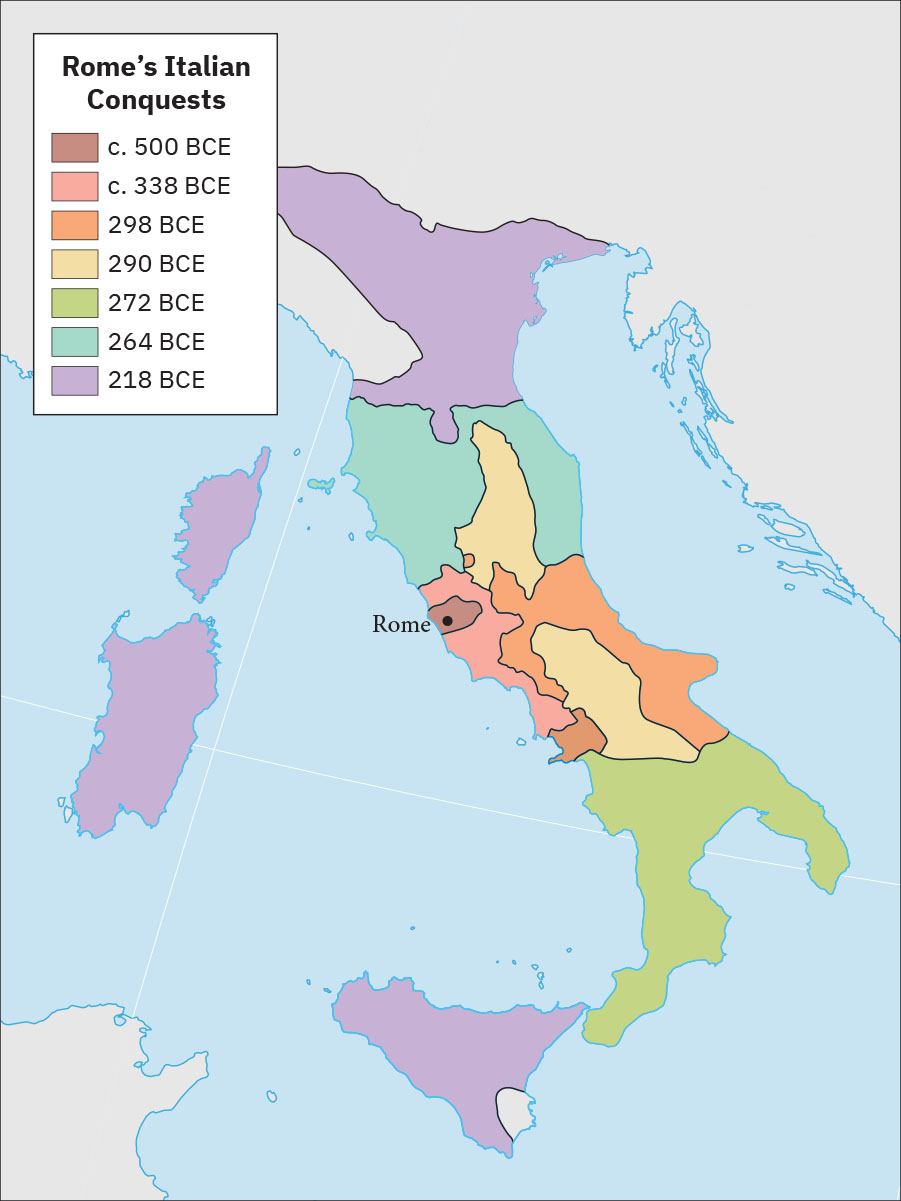
The Roman Senate developed certain policies in conducting wars that proved quite successful (Figure 6.29). One was to divide and conquer. The Romans always tried to defeat one enemy at a time and avoid waging war against a coalition. Thus they often attempted to turn their enemies against each other. Another tactic was to negotiate from strength. Even after suffering enormous defeats in battle, Rome would continue a war until it won a major engagement and reach a position from which to negotiate for peace with momentum on its side. Yet another successful strategy was to establish colonies in recently conquered lands to serve as the first line of defense if a region revolted against Rome. Well-constructed roads were also built to link Rome to these colonies, so armies could arrive quickly in a region that rebelled. Thanks to these networks across Italy, the language and culture of Rome eventually spread throughout its empire as well. Romans also transformed former enemies into loyal allies who could enjoy self-government as long as they honored Rome’s other alliances and provided troops in times of war. Some even received Roman citizenship.
英語のヒント
ローマ元老院は、戦争を行うにあたって、成果を上げるいくつかの方針を発展させた(図6.29)。その一つが、敵を分断して征服することだった。ローマ人はつねに一度に一つの敵を倒そうとし、敵の連合との戦争を避けた。そのため敵同士を争わせようとすることが多かった。別の方策は、優位に立って交渉することだった。戦闘で大敗しても、大きな会戦に勝ち、勢いを自分の側に引き寄せて和平交渉のできる立場を得るまで、ローマは戦争を続けた。さらに有効だったのが、征服して間もない土地に植民市を置き、その地域が反乱を起こしたときの最前線の防衛拠点にすることだった。これらの植民市とローマを結ぶ堅固な道路も建設され、反乱の起きた地域に軍がすぐ到着できるようになった。イタリア各地に延びるこの網のおかげで、ローマの言語と文化も、やがて帝国全体へ広がった。ローマ人はまた、かつての敵を忠実な同盟国へ変えた。同盟国は、ローマのほかの同盟関係を尊重し、戦時に兵士を提供すれば、自治を認められた。ローマ市民権を与えられた者もいた。
Rome’s Conquests in Italy.ローマによるイタリア征服
(credit: modification of work “Map of the Roman conquest of Italy” by “Javierfv1212”/Wikimedia Commons, Public Domain) · Public Domain
Figure 6.29 This map shows the expansion of Rome across Italy over time and its addition of new allies. (credit: modification of work “Map of the Roman conquest of Italy” by “Javierfv1212”/Wikimedia Commons, Public Domain)
図6.29 この地図は、ローマが時代とともにイタリア各地へ拡大し、新たな同盟国を加えていった様子を示す。(出典: 原作品を加工:“Map of the Roman conquest of Italy”/“Javierfv1212”/Wikimedia Commons, パブリックドメイン)
The Roman Conquest of the Mediterraneanローマによる地中海征服
After conquering most of the Italian peninsula, Rome came to challenge the other major power in the region, Carthage. A series of wars ensued, called the Punic Wars, in which Rome and Carthage vied for dominance. During the First Punic War (264–241 BCE), Rome and Carthage battled for control of the island of Sicily. Although Carthage had the largest fleet at the time, the Romans won by dropping a hooked plank on the deck of an opposing ship and using it as a causeway to cross over, transforming a sea battle in which they were at a disadvantage into a land battle where they could dominate. After the destruction of its fleet, Carthage sued for peace, and the war ended with Rome annexing Sicily.
英語のヒント
イタリア半島の大部分を征服したローマは、この地域のもう一つの大国、カルタゴに挑むようになった。続いて起きた一連の戦争がポエニ戦争であり、ローマとカルタゴは覇権を争った。第一次ポエニ戦争(前264~前241年)では、両国はシチリア島の支配をめぐって戦った。当時最大の艦隊を持っていたのはカルタゴだったが、ローマ人は鉤のついた板を敵船の甲板に落とし、橋として渡って勝利した。自分たちに不利な海戦を、優位に立てる陸戦へ変えたのである。艦隊を破壊されたカルタゴは和平を求め、ローマがシチリア島を併合して戦争は終わった。
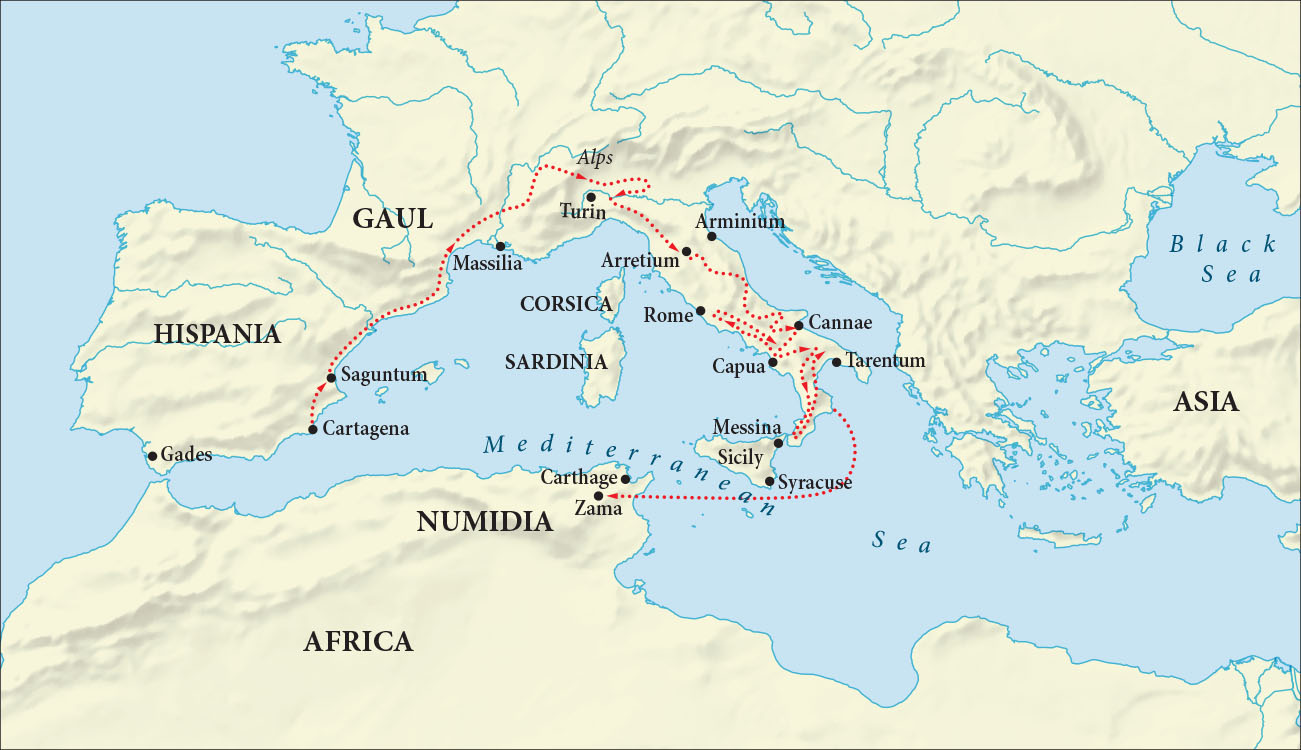
Carthage desired revenge. In the Second Punic War (218–201 BCE), the Carthaginian general Hannibal marched his army, along with dozens of war elephants, from Hispania (modern-day Portugal and Spain), across southern Gaul, and then over the Alps into Italy. Hannibal hoped Rome’s allies would abandon it and leave the city at his mercy. Most of Rome’s Italian allies remained loyal, however, even after Hannibal repeatedly defeated Roman armies, and after his decisive victory at the Battle of Cannae. As Hannibal’s army was rampaging through Italy, Rome sent an army across the Mediterranean to Africa to attack Carthage, which summoned Hannibal back to defend his homeland (Figure 6.30).
英語のヒント
カルタゴは復讐を望んだ。第二次ポエニ戦争(前218~前201年)では、カルタゴの将軍ハンニバルが、数十頭の戦象を含む軍をヒスパニア、現在のポルトガルとスペインから進め、ガリア南部を横切り、アルプス山脈を越えてイタリアに入った。ハンニバルは、ローマの同盟国がローマを見捨て、ローマが自分のなすがままになることを期待した。しかしハンニバルがローマ軍を何度も破り、カンナエの戦いで決定的な勝利を収めたあとも、イタリアの同盟国の大部分はローマへの忠誠を保った。ハンニバル軍がイタリアを荒らし回るなか、ローマは地中海を越えてアフリカへ軍を送り、カルタゴを攻撃した。カルタゴは祖国を守らせるため、ハンニバルを呼び戻した(図6.30)。
Hannibal’s Invasion of Rome.ハンニバルのローマ侵攻
(attribution: Copyright Rice University, OpenStax, under CC BY 4.0 license) · CC BY 4.0
Figure 6.30 This map shows the route Hannibal followed from Hispania over the Alps to attack Italy before finally returning to defend Carthage in the Second Punic War. (attribution: Copyright Rice University, OpenStax, under CC BY 4.0 license)
図6.30 この地図は、第二次ポエニ戦争でハンニバルがヒスパニアからアルプスを越えてイタリアを攻撃し、最後にカルタゴ防衛のため帰還するまでの経路を示す。(出典: 著作権:Rice University, OpenStax/CC BY 4.0)
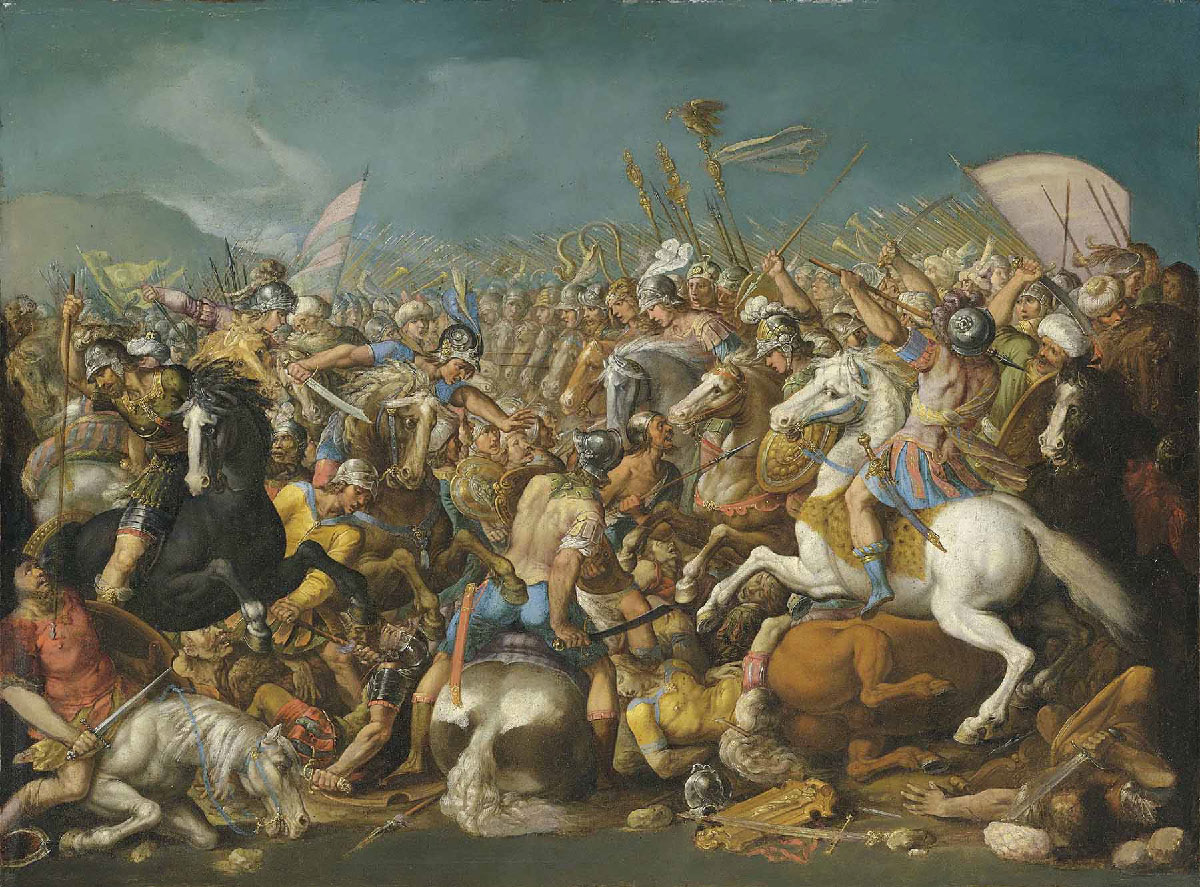
At the Battle of Zama in 202 BCE, the Roman army defeated Hannibal, and the Roman commander Scipio earned the nickname “Africanus” (Figure 6.31). Carthage sued for peace and was stripped of all its overseas territory. Rome thus acquired Carthage’s lands in Hispania.
英語のヒント
前202年のザマの戦いで、ローマ軍はハンニバルを破り、ローマの指揮官スキピオは「アフリカヌス」という添え名を得た(図6.31)。カルタゴは和平を求め、海外領土をすべて奪われた。こうしてローマは、ヒスパニアにあったカルタゴの領土を獲得した。
Hannibal and Scipio.ハンニバルとスキピオ
(credit: “Hannibal and Scipio Africanus” by Bernardino Cesari/Wikimedia Commons, Public Domain) · Public Domain
Figure 6.31 This classical battle scene, painted by the Italian artist Bernardino Cesari in the early 1600s, is believed to represent Hannibal’s defeat by the Roman commander Scipio in 202 BCE. (credit: “Hannibal and Scipio Africanus” by Bernardino Cesari/Wikimedia Commons, Public Domain)
図6.31 イタリアの画家ベルナルディーノ・チェザーリが1600年代初めに描いたこの古代の戦闘場面は、前202年、ローマの指揮官スキピオがハンニバルを破った戦いを表すと考えられる。(出典: “Hannibal and Scipio Africanus”/Bernardino Cesari/Wikimedia Commons, パブリックドメイン)
During the war, King Philip V of Macedon, concerned by the growth of Rome just across the Adriatic Sea from his own kingdom, made an alliance with Carthage. After Rome’s victory against Carthage, Rome declared war against this new enemy. Philip’s Macedonian troops won numerous victories over Roman armies, but in 196 BCE at the Battle of Cynoscephalae in northern Greece, Philip suffered a defeat and lacked the resources to continue. Consequently, he agreed to become an ally of Rome. Rome also liberated all regions in Greece formerly under Macedonian control.
英語のヒント
この戦争の最中、マケドニア王フィリッポス5世は、自国からアドリア海を隔てた対岸でローマが強大化することを懸念し、カルタゴと同盟を結んだ。カルタゴに勝利したローマは、この新たな敵に宣戦布告した。フィリッポスのマケドニア軍はローマ軍に何度も勝利したが、前196年、ギリシア北部のキュノスケファライの戦いで敗れ、戦争を続けるための資源も尽きた。そのためフィリッポスはローマの同盟国となることに同意した。ローマはまた、それまでマケドニアの支配下にあったギリシアの全地域を解放した。
Philip’s defeat emboldened the king of the Seleucid Empire, Antiochus III, to advance his army into Greece, hoping to obtain the territory Philip had vacated. Rome feared that Antiochus’s occupation of Greece posed a threat to Italy, just as Philip had. In 190 BCE, Roman armies smashed the forces of Antiochus III at the Battle of Magnesia in western Asia Minor. Antiochus then agreed to withdraw from Asia Minor.
英語のヒント
フィリッポスの敗北に力を得たセレウコス朝の王アンティオコス3世は、フィリッポスが退いた領土を獲得しようと、軍をギリシアへ進めた。ローマは、アンティオコスによるギリシア占領が、以前のフィリッポスと同じくイタリアへの脅威になると恐れた。前190年、小アジア西部のマグネシアの戦いで、ローマ軍はアンティオコス3世の軍を打ち破った。アンティオコスは小アジアから撤退することに同意した。
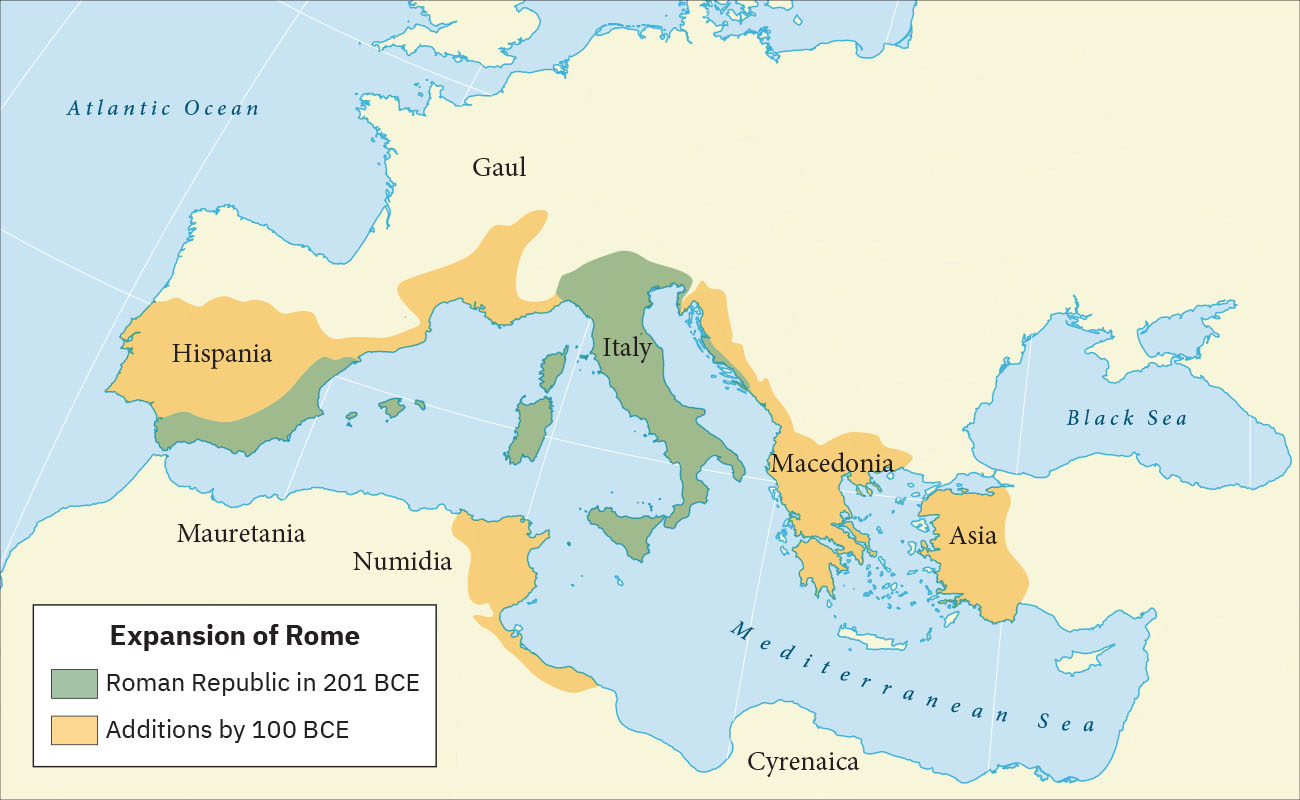
Rome discovered in the second century BCE that there was no end to the threats from hostile powers. Perseus, the son of Philip V, renounced the alliance with Rome. When he made alliances with Balkan tribes that threatened to invade Italy, Roman armies invaded Macedon and defeated his army at the Battle of Pydna in 168 BCE. Rome then dissolved the monarchy in Macedon, which soon afterward became a Roman province, and Perseus died of starvation as a prisoner in Rome. When the Achaean League in the Peloponnese in Greece challenged Roman control of Greece and Macedon, Rome declared war and sacked Corinth, the League’s largest city, in 146 BCE. In that same year, Roman armies also destroyed the city of Carthage in the Third Punic War, fearing the city’s revival as an economic and military power. After 146 BCE, no power remained in the Mediterranean that could challenge Rome (Figure 6.32).
英語のヒント
前2世紀、ローマは敵対勢力からの脅威に終わりがないことを知った。フィリッポス5世の息子ペルセウスはローマとの同盟を破棄した。彼が、イタリア侵攻の脅威となるバルカン諸部族と同盟を結ぶと、ローマ軍はマケドニアに侵攻し、前168年のピュドナの戦いでその軍を破った。ローマはマケドニアの王政を廃止し、ほどなくマケドニアはローマの属州になった。ペルセウスはローマの捕虜として餓死した。ギリシアのペロポネソス半島を拠点とするアカイア同盟が、ギリシアとマケドニアに対するローマの支配に挑むと、ローマは宣戦し、前146年に同盟最大の都市コリントを略奪した。同じ年、ローマ軍は、経済的・軍事的な大国としての再興を恐れたカルタゴも、第三次ポエニ戦争で破壊した。前146年以降、地中海にはローマに対抗できる勢力が残っていなかった(図6.32)。
The Expansion of Rome.ローマの拡大
(credit: modification of work “Expansion of Rome, 2nd century BC” by The Department of History, United States Military Academy/Wikimedia Commons, Public Domain) · Public Domain
Figure 6.32 This map shows Rome’s expansion in the second century BCE as it responded to perceived threats to its power from neighboring kingdoms. (credit: modification of work “Expansion of Rome, 2nd century BC” by The Department of History, United States Military Academy/Wikimedia Commons, Public Domain)
図6.32 この地図は前2世紀のローマの拡大を示す。ローマは、近隣の諸王国が自分の権力を脅かしていると受け止め、それに対応した。(出典: 原作品を加工:“Expansion of Rome, 2nd century BC”/The Department of History, United States Military Academy/Wikimedia Commons, パブリックドメイン)