第6章地中海の人々Mediterranean Peoples
The Collapse of the Bronze Age World青銅器時代世界の崩壊
The last century of the Late Bronze Age, after 1200 BCE, was a period of wars and invasions that witnessed the collapse of many powerful states. The palaces of Mycenaean Greece were destroyed, perhaps following revolts by the lower class and natural disasters like climate change and earthquakes. In the centuries that followed, the population declined drastically, writing and literacy disappeared, and Greece entered a “Dark Age.”
英語のヒント
前1200年以降、後期青銅器時代の最後の1世紀は戦争と侵入の時代となり、多くの強国が崩壊した。ミケーネ・ギリシアの宮殿は破壊された。その背景には、下層の人びとの反乱や、気候変動・地震などの自然災害があったのかもしれない。その後数世紀のあいだに人口は激減し、文字と読み書きの能力は失われ、ギリシアは「暗黒時代」に入った。
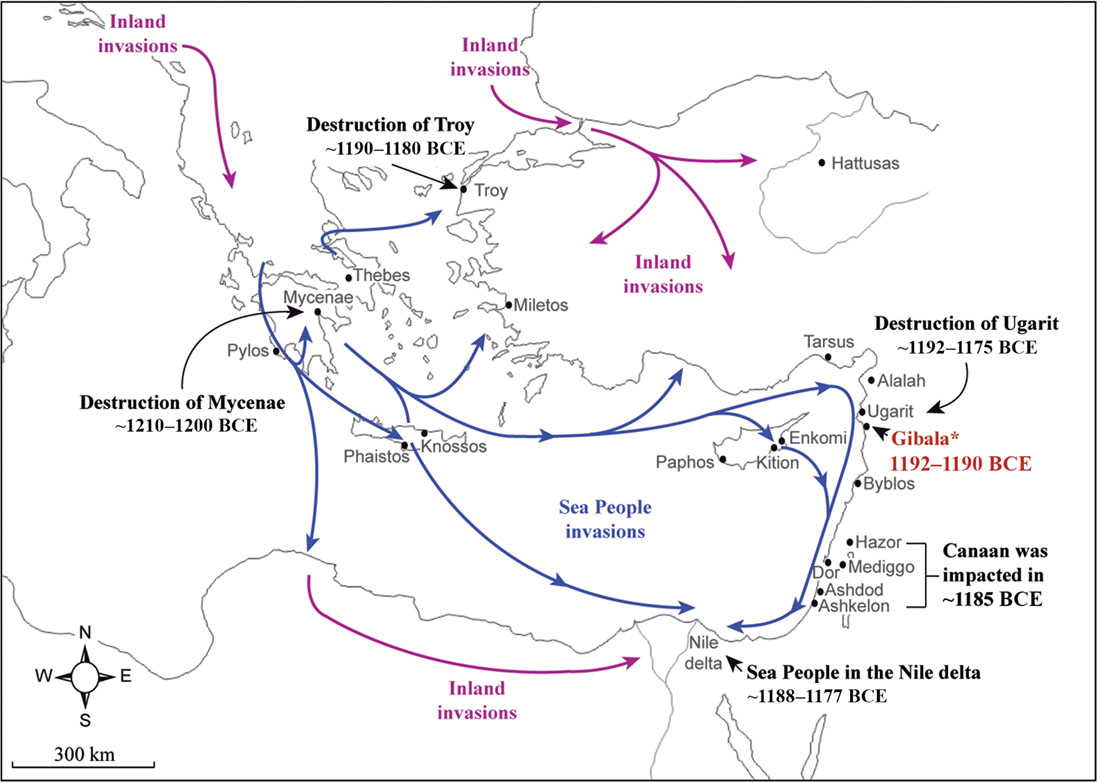
Later ancient Greek historians reported that Greek-speaking tribes known as the Dorians migrated from northwest Greece to the south after the Trojan War. The instability in Greece and the Aegean resulted in much migration by people in search of new homes. For instance, ancient Egyptian inscriptions tell us that the “Sea Peoples” destroyed the Hittite Empire and numerous kingdoms in the Levant to the north of Egypt. One particular group known as the Philistines (Peleset), who attacked Egypt, eventually settled just north of Egypt along the coast of the southern Levant. But there were many others, including the Akawasha, Lukka, Shardana, Tursha, and more who washed across the eastern Mediterranean during the Late Bronze Age Collapse (Figure 6.6).
英語のヒント
後世の古代ギリシアの歴史家は、ドーリア人と呼ばれるギリシア語を話す諸部族が、トロイア戦争後にギリシア北西部から南へ移動したと伝えている。ギリシアとエーゲ海の不安定化によって、多くの人びとが新しい住みかを求めて移動した。例えば古代エジプトの碑文には、「海の民」がヒッタイト帝国と、エジプト北方のレヴァントの多くの王国を破壊したとある。エジプトを攻撃した集団のうち、ペリシテ人(ペレセト)と呼ばれる人びとは、最終的にエジプトのすぐ北、レヴァント南部の海岸に定住した。しかし、ほかにもアカワシャ、ルッカ、シャルダナ、トゥルシャなど多数の集団が、後期青銅器時代の崩壊期に東地中海へ波のように押し寄せた(図6.6)。
The Path of the Sea Peoples.海の民の進路
(credit: modification of work “Map of the Sea People invasions in the Aegean Sea and Eastern Mediterranean at the end of the Late Bronze Age” by David Kaniewski, Elise Van Campo, Karel Van Lerberghe, Tom Boiy, Klaas Vansteenhuyse, Greta Jans, Karin Nys, Harvey Weiss/”The Sea Peoples, from Cuneiform Tablets to Carbon Dating”/Wikimedia Commons, CC BY 2.5) · CC BY 2.5
Figure 6.6 The “Sea Peoples,” as they were called in Egyptian records, came largely from the Aegean region. By studying the remains of pottery and other archaeological traces, scholars have concluded that these groups moved through Greece and Crete and into North Africa, Cyprus, and the Levant (as shown by the blue arrows) at the close of the Late Bronze Age. (credit: modification of work “Map of the Sea People invasions in the Aegean Sea and Eastern Mediterranean at the end of the Late Bronze Age” by David Kaniewski, Elise Van Campo, Karel Van Lerberghe, Tom Boiy, Klaas Vansteenhuyse, Greta Jans, Karin Nys, Harvey Weiss/”The Sea Peoples, from Cuneiform Tablets to Carbon Dating”/Wikimedia Commons, CC BY 2.5)
図6.6 エジプトの記録で「海の民」と呼ばれた集団の多くは、エーゲ海地域から来た。陶器の遺物など考古学的な痕跡を調べた研究者は、後期青銅器時代の終わりに、これらの集団がギリシアとクレタ島を通って北アフリカ、キプロス島、レヴァントへ移動したと結論づけている。青い矢印がその動きを示す。(出典: 原作品を加工:“Map of the Sea People invasions in the Aegean Sea and Eastern Mediterranean at the end of the Late Bronze Age”/David Kaniewski, Elise Van Campo, Karel Van Lerberghe, Tom Boiy, Klaas Vansteenhuyse, Greta Jans, Karin Nys, Harvey Weiss/”The Sea Peoples, from Cuneiform Tablets to Carbon Dating”/Wikimedia Commons, CC BY 2.5)
Other groups were also on the move. Libyans, who inhabited the North African coastal region west of Egypt, invaded the northern Nile River valley and settled there. The attacks of the Sea Peoples and Libyans contributed to the later collapse of Egypt’s central governments after 1100 BCE, ending the New Kingdom period. Phrygians, who inhabited the Balkans in southeast Europe, migrated into Asia Minor (Turkey). The Aramaeans, nomadic tribes who spoke a Semitic language and inhabited the Arabian Desert, migrated into Syria and Mesopotamia.
英語のヒント
ほかの集団も移動していた。エジプト西方の北アフリカ沿岸地域に住んでいたリビア人は、ナイル川北部の流域へ侵入して定住した。海の民とリビア人の攻撃は、前1100年以降にエジプトの中央政権が崩れ、新王国時代が終わる一因となった。ヨーロッパ南東部のバルカン半島に住んでいたフリュギア人は、小アジア(トルコ)へ移住した。アラビア砂漠に住み、セム系言語を話す遊牧部族であったアラム人は、シリアとメソポタミアへ移動した。
These wars and invasions coincided with an important technological innovation, the birth of sophisticated iron-making technology. For thousands of years, bronze had been the metal of choice in the ancient world. But the disruptions caused by the Late Bronze Age Collapse made it difficult for metal workers to access tin, a crucial ingredient in bronze. Without a sufficient supply of tin, artisans experimented for centuries with iron ore. In the process, they developed the techniques of steeling (adding carbon to the iron to make it stronger), quenching (rapidly cooling hot iron with water), and tempering (heat treating) to produce a metal far superior in strength to bronze. By around 900 BCE, the Iron Age had begun in the eastern Mediterranean.
英語のヒント
こうした戦争や侵入と時期を同じくして、重要な技術革新、すなわち高度な製鉄技術が生まれた。何千年ものあいだ、古代世界でよく選ばれる金属は青銅だった。しかし、後期青銅器時代の崩壊に伴う混乱のため、金属加工の職人は青銅の重要な原料であるスズを手に入れにくくなった。十分なスズの供給が得られないなか、職人たちは何世紀にもわたって鉄鉱石を用いた試みを重ねた。その過程で、鋼化(鉄に炭素を加えて強くする)、焼入れ(熱した鉄を水で急冷する)、焼戻し(熱処理)の技術を発達させ、青銅よりはるかに強い金属を作った。前900年ごろまでには、東地中海で鉄器時代が始まっていた。
Phoenicians, Greeks, and Etruscansフェニキア人、ギリシア人、エトルリア人
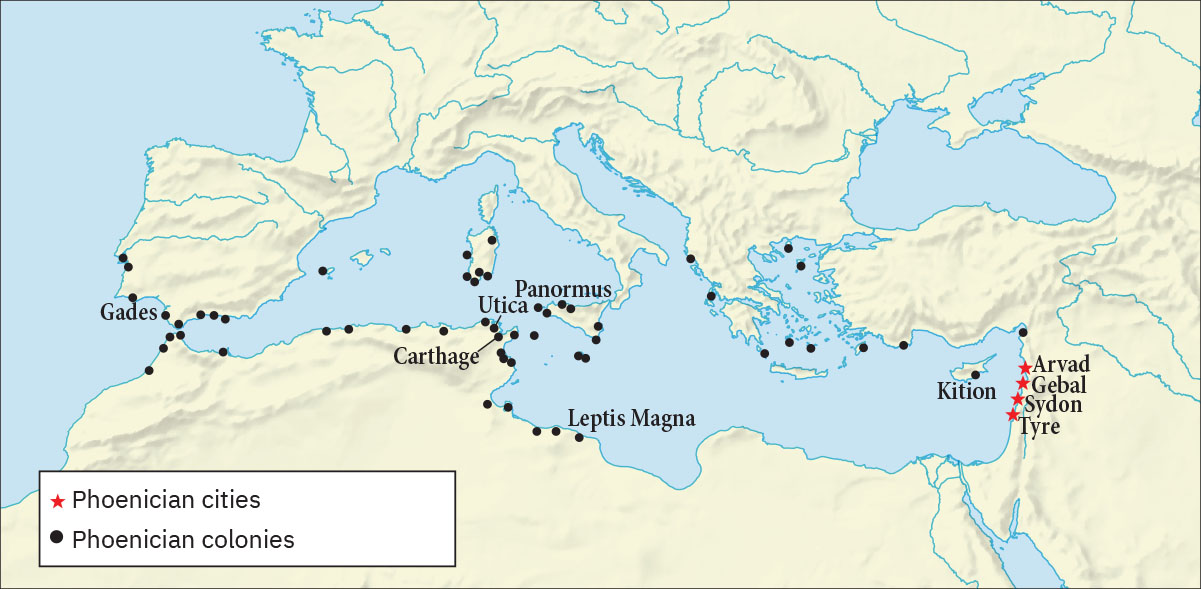
The Phoenicians were descended from the Bronze Age Canaanites and lived in cities like Sidon and Tyre (in today’s Lebanon), each ruled by a king. They were great sailors, explorers, and traders who established trading posts in Cyprus, North Africa, Sicily, Sardinia, and Spain. They sailed along the west coast of Africa and to the British Isles in search of new markets and goods such as tin (See Figure 6.7).
英語のヒント
フェニキア人は青銅器時代のカナン人の子孫で、現在のレバノンにあるシドンやティルスなど、それぞれ王が治める都市に住んでいた。優れた船乗り・探検者・交易者であった彼らは、キプロス、北アフリカ、シチリア、サルデーニャ、スペインに交易拠点を設けた。新しい市場やスズなどの品物を求めて、アフリカ西岸沿いを航海し、ブリテン諸島にも向かった(図6.7参照)。
Phoenician Cities and Colonies.フェニキアの都市と植民市
(credit: modification of work “Mediterranean at 218 BC” by “Megistias”/Wikimedia Commons, Public Domain) · Public Domain
Figure 6.7 The Phoenicians were great mariners and explorers. This map shows the many cities and colonies they founded across the Mediterranean Sea. (credit: modification of work “Mediterranean at 218 BC” by “Megistias”/Wikimedia Commons, Public Domain)
図6.7 フェニキア人は優れた船乗りであり探検家だった。この地図は、彼らが地中海の各地に建設した多数の都市と植民市を示している。(出典: 原作品を加工:“Mediterranean at 218 BC”/“Megistias”/Wikimedia Commons, パブリックドメイン)
Around 1100 BCE, the Phoenicians also invented the world’s first known alphabet, using symbols that represented consonant sounds. Strung together, these consonants created words in which vowel sounds were interpreted by the order of the consonants. Because the Phoenician alphabet simplified the earlier script of the Canaanites, more people could now become literate, not just a small, specialized group of scribes. The Phoenicians’ commercial success was undoubtedly partly a result of their better, more efficient record-keeping system that a larger population could learn and employ. Other cultures like the Aramaean peoples and the Israelites quickly adapted the new script to their own languages. By the eighth century BCE, the Greeks had also adopted and later adapted the Phoenician alphabet to write their language.
英語のヒント
前1100年ごろ、フェニキア人は子音を表す記号を使った、知られている限り世界最初のアルファベットも発明した。子音をつなげると語になり、その並びから母音の音が読み取られた。フェニキア文字は、それ以前のカナン人の文字を簡略化したため、少数の専門的な書記だけでなく、もっと多くの人が読み書きを身につけられるようになった。フェニキア人の商業的成功は、より多くの人が学び、使える、優れた効率的な記録法に部分的に支えられていたことは間違いない。アラム人やイスラエル人など、ほかの文化を持つ人びとは、新しい文字をすぐに自分たちの言語に合わせて取り入れた。前8世紀までにはギリシア人もフェニキア文字を採用し、その後、自分たちの言語を書くために改変した。
Beginning with the Assyrian Empire’s expansion in the eighth century BCE, the Phoenician kingdoms became subjects of the successive Iron Age empires of western Asia: the Assyrians, the Chaldeans (Neo-Babylonian), and the Persians. The Phoenicians continued to flourish, however. The Assyrians valued Phoenician artists, and finely crafted Phoenician wares such as jewelry and furniture became popular among the ruling elites. The Persians relied largely on Phoenician sailors and ships to serve as the naval forces, especially in their campaigns to conquer Greece in the early fifth century BCE. When Phoenician city-states such as Sidon and Tyre became subject to foreign rule, many Phoenicians immigrated to the city of Carthage (in modern-day Tunisia), founded by Phoenician merchants around 700 BCE as a stopping place on the long but profitable voyage to Spain. Given this influx of immigrants, Carthage grew large and wealthy, and by the fifth century BCE the southern Italian peninsula was the dominant power in the western Mediterranean.
英語のヒント
前8世紀のアッシリア帝国の拡大を皮切りに、フェニキアの諸王国は、西アジアの鉄器時代の帝国に次々と従属した。アッシリア、カルデア(新バビロニア)、そしてペルシアである。それでもフェニキア人は繁栄を続けた。アッシリア人はフェニキアの美術工芸家を高く評価し、精巧に作られた宝飾品や家具などが支配層のあいだで人気を博した。ペルシア人は、とくに前5世紀初めのギリシア征服戦争で、海軍を担う船乗りや船舶の多くをフェニキア人に頼った。シドンやティルスなどのフェニキア都市国家が外国の支配下に入ると、多くのフェニキア人が、現在のチュニジアにあるカルタゴへ移住した。この都市は、スペインへの長いながらも利益の大きい航海の寄港地として、前700年ごろにフェニキア商人が建設したものだった。移民の流入でカルタゴは大きく豊かになり、前5世紀までにイタリア半島南部が西地中海の覇権を握った。
The Phoenicians were not the only people establishing colonial outposts around the wider Mediterranean world. Beginning in the eighth century, Greeks began founding colonies in North Africa, in coastal Spain and France, on the shores of the Black Sea, and on the Italian peninsula. Many of these colonies were built in resource-rich areas and commonly produced grain, tin, or timber for export back to Greece. Others served more mercantile interests, trading with major and minor powers across the Mediterranean. It was through these colonial ventures that Greeks and Phoenicians came into contact with the Etruscans of the northern Italian peninsula.
英語のヒント
地中海の広い世界に植民拠点を築いたのは、フェニキア人だけではなかった。前8世紀以降、ギリシア人は北アフリカ、スペインやフランスの沿岸、黒海沿岸、イタリア半島に植民市を建設し始めた。多くは資源の豊かな場所に築かれ、ギリシアへの輸出用に穀物・スズ・木材を生産した。ほかには、地中海全域の大小の勢力と交易する、より商業的な目的を持つ植民市もあった。こうした植民活動を通じて、ギリシア人とフェニキア人はイタリア半島北部のエトルリア人と接触した。
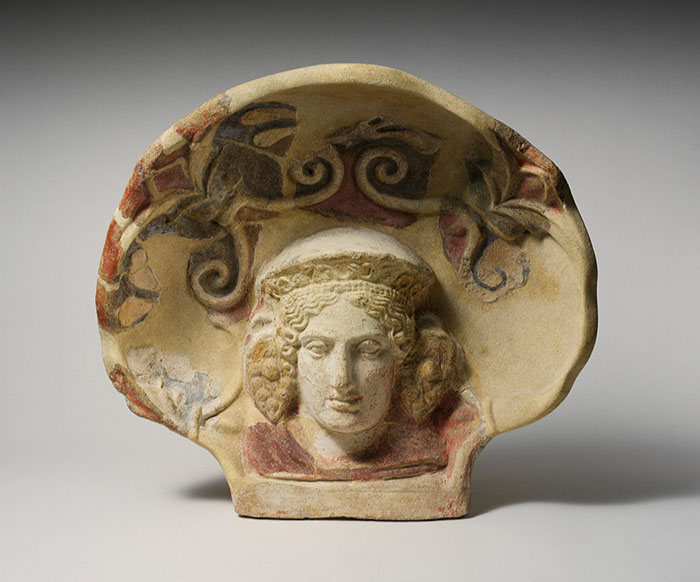
The Etruscans were organized into independent city-states such as Veii and Vulci, much like the Greeks were, and each city was ruled by its own king and council of elders. In their art and architecture, the Etruscans followed Greek models (Figure 6.8). They modified the alphabet the Greeks had acquired from the Phoenicians to write their language, which scholars have not yet fully deciphered. By 600 BCE, they had expanded beyond their base in modern Tuscany and colonized Rome, which became an Etruscan city. They also founded new colonies in northern and southern Italy. The Etruscan states remained the dominant power in the Italian peninsula until 474 BCE. In that year, at the Battle of Cumae off the coast of southern Italy, the naval forces of the Greek city-state of Syracuse won a decisive victory over the Etruscan fleet and emerged as the chief power in the region, along with Carthage.
英語のヒント
エトルリア人はギリシア人とよく似て、ウェイイやウルキなどの独立した都市国家を形成し、それぞれの都市は王と長老会によって治められた。美術や建築ではギリシアを手本とした(図6.8)。ギリシア人がフェニキア人から取り入れたアルファベットを改変し、自分たちの言語を書くために使ったが、その言語は研究者によってまだ完全には解明されていない。前600年までには、エトルリア人は現在のトスカーナに当たる拠点から勢力を広げ、ローマを植民してエトルリアの都市とした。イタリア北部と南部にも新しい植民地を築いた。エトルリア諸国は前474年まで、イタリア半島の有力な勢力であり続けた。この年、南イタリア沖のクマエの海戦で、ギリシア都市国家シュラクサイの海軍がエトルリア艦隊に決定的な勝利を収め、カルタゴと並ぶ地域の主要勢力となった。
Greek Influence in Etruria.エトルリアへのギリシアの影響
(credit: “Terracotta antefix (roof tile) with head of a maenad” by Purchase by subscription, 1896/Metropolitan Museum of Art, Public Domain) · Public Domain
Figure 6.8 This Etruscan antefix (roof tile) was created in the fourth century BCE and found in the Italian city of Cerveteri, northwest of Rome. The almost twenty-inch-tall piece of terracotta art depicts a maenad, a Greek mythological figure associated with the Greek god Dionysus. In its style and symbolism, it reflects the cultural exchange between the Etruscans and the Greeks. (credit: “Terracotta antefix (roof tile) with head of a maenad” by Purchase by subscription, 1896/Metropolitan Museum of Art, Public Domain)
図6.8 このエトルリアのアンテフィクス(屋根端を飾る瓦)は前4世紀に制作され、ローマの北西にあるイタリアの都市チェルヴェテリで見つかった。高さ約50センチメートルのテラコッタ作品で、ギリシア神話の神ディオニュソスに従うマイナスが表される。その様式と象徴には、エトルリア人とギリシア人の文化交流が反映されている。(出典: “Terracotta antefix (roof tile) with head of a maenad”/募金による購入、1896年/メトロポリタン美術館, パブリックドメイン)
Since ancient Rome began as an Etruscan city-state, the Etruscans strongly influenced the development of Roman culture. For example, Roman priests divined the will of the gods by examining a sacrificed animal’s entrails, a custom adopted from the Etruscans. The Etruscans honored their dead with elaborate tombs, and the Romans did the same, maintaining that the spirits of their ancestors watched over them. Gladiatorial contests in Rome had origins among the Etruscans, who at funerals forced prisoners of war to fight to the death as human sacrifices to their dead. The fasces, a bundle of rods and an ax that symbolized the authority of Roman magistrates, originally denoted the authority of Etruscan kings. Finally, the Roman alphabet, still used in western and central Europe today, was based on Etruscan modifications to the Greek alphabet.
英語のヒント
古代ローマはエトルリアの都市国家として始まったため、エトルリア人はローマ文化の発展に強い影響を与えた。例えばローマの祭司は、生け贄にした動物の内臓を調べて神々の意思を占ったが、これはエトルリア人から取り入れた習慣だった。エトルリア人は手の込んだ墓を造って死者を敬い、ローマ人も同様に、祖先の霊が自分たちを見守ると考えた。ローマの剣闘士競技もエトルリア人に起源を持つ。彼らは葬儀の際、死者への人身供犠として戦争捕虜に死ぬまで戦わせた。ローマの政務官の権威を象徴するファスケス、すなわち棒を束ねて斧を添えたものも、もとはエトルリア王の権威を表していた。そして、今日もヨーロッパ西部・中部で用いられるローマ字は、エトルリア人が改変したギリシア文字をもとにしていた。