第6章地中海の人々Mediterranean Peoples
6.1 Early Mediterranean Peoples6.1 初期の地中海の諸民族
Learning Objectives学習の目標
By the end of this section, you will be able to:
この節を学ぶと、次のことができるようになる。
Identify the regional peoples of the Mediterranean before 500 BCE
前500年以前の地中海各地の諸民族を特定する。
Discuss the technological achievements of the early Mediterranean peoples
初期の地中海諸民族の技術的な成果を論じる。
Describe the interconnectedness of the early Mediterranean peoples
初期の地中海諸民族が相互にどう結びついていたかを説明する。
During the Bronze Age (c. 3300–1200 BCE), trade connected the peoples and cultures of Greece and the Aegean islands such as Crete. By the third millennium BCE, the inhabitants of these lands were already producing wine and olive oil, products in high demand in ancient Egypt and the Near East. The Aegean Minoan and Mycenaean civilizations of the Late Bronze Age (c. 1600–1100 BCE) thus shared in the economic prosperity and cultural interaction that linked the eastern Mediterranean with the ancient cultures of western Asia.
英語のヒント
青銅器時代(前3300~前1200年ごろ)には、交易がギリシアと、クレタ島などのエーゲ海の島々の人びとや文化を結び付けていた。前3千年紀までには、これらの土地の住民はすでにワインとオリーブ油を生産しており、それらは古代エジプトや近東で強く求められる商品だった。こうして、後期青銅器時代(前1600~前1100年ごろ)のエーゲ海のミノア文明とミケーネ文明は、東地中海と西アジアの古代文化を結ぶ経済的繁栄と文化交流の一翼を担った。
The eventual collapse of the Late Bronze Age world coincided with the development of new technology that allowed people to devise iron tools and weapons. During the new Iron Age, the Phoenicians not only preserved Bronze Age cultural traditions but they also developed a revolutionary new communication tool, the alphabet, that vastly expanded literacy. They established trading posts across the Mediterranean as far as Spain, often in search of new sources of iron ore and other metals such as tin. The arrival of the Phoenicians and Greek traders in the western Mediterranean brought them into contact with the Etruscans in the Italian peninsula. Thus, the period from the Bronze Age through the Iron Age witnessed the development of numerous cultures across the Mediterranean.
英語のヒント
後期青銅器時代の世界がやがて崩壊した時期には、鉄製の道具や武器を作れるようにする新たな技術も発達した。新しい鉄器時代になると、フェニキア人は青銅器時代の文化的伝統を保っただけでなく、文字を読み書きできる人を大幅に増やす、アルファベットという画期的な意思伝達の手段も発達させた。彼らはしばしば鉄鉱石やスズなどの金属の新しい供給源を求め、スペインにまで及ぶ地中海各地に交易拠点を設けた。フェニキア人とギリシアの商人が西地中海へ進出したことで、彼らはイタリア半島のエトルリア人と接触した。このように、青銅器時代から鉄器時代にかけて、地中海全域で多くの文化が発展した。
The Late Bronze Age World後期青銅器時代の世界
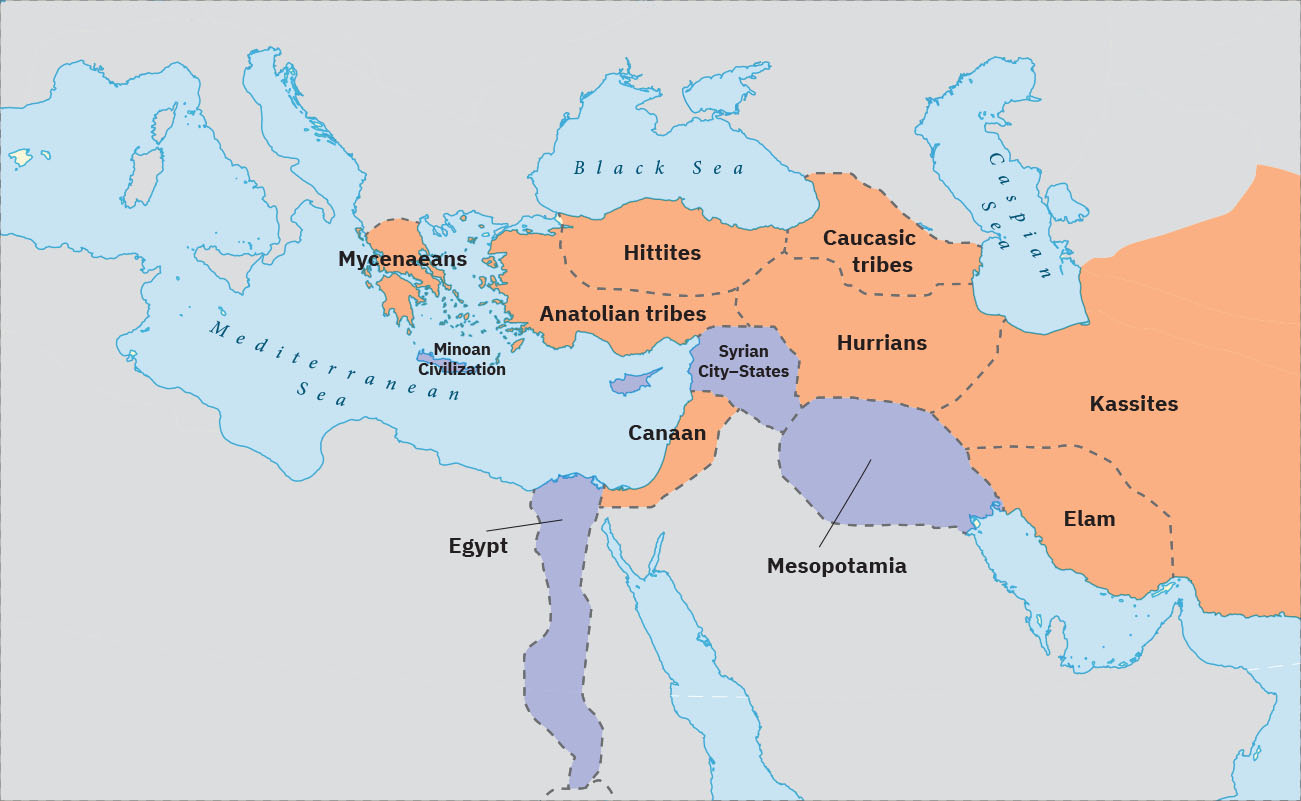
Egypt was the dominant economic and military power of the Late Bronze Age, for the most part a time of economic prosperity and political stability. Other powerful kingdoms included Minoan Crete, Mycenaean Greece, the Hittites of Asia Minor (modern Turkey), the Mitanni and Assyrians in northern Mesopotamia, and the Kassites and Elamites in southern Mesopotamia and western Iran (Figure 6.4). While each maintained its own unique culture, their interactions created a shared Late Bronze Age culture.
英語のヒント
後期青銅器時代は、おおむね経済的繁栄と政治的安定の時代であり、エジプトが経済・軍事の両面で優勢を誇った。このほかの有力な王国には、クレタ島のミノア文明、ミケーネ・ギリシア、小アジア(現在のトルコ)のヒッタイト、北部メソポタミアのミタンニとアッシリア、南部メソポタミアやイラン西部のカッシートとエラムがあった(図6.4)。それぞれが独自の文化を保ちながらも、その交流によって後期青銅器時代に共通する文化が生まれた。
The Bronze Age World.青銅器時代の世界
(credit: modification of work “Near East and Mediterranean in 2000 BCE” by “Briangotts”/Wikimedia Commons, CC BY 2.5) · CC BY 2.5
Figure 6.4 While Egypt was the dominant power in the relatively peaceful Late Bronze Age, many other cultures thrived during this time. (credit: modification of work “Near East and Mediterranean in 2000 BCE” by “Briangotts”/Wikimedia Commons, CC BY 2.5)
図6.4 比較的平穏だった後期青銅器時代にはエジプトが優勢だったが、この時代には多くのほかの文化も栄えた。(出典: 原作品を加工:“Near East and Mediterranean in 2000 BCE”/“Briangotts”/Wikimedia Commons, CC BY 2.5)
For instance, they all used a redistributive economic system in which agricultural goods were collected from local farmers as taxes, stored in the palace or temple, and redistributed to urban artisans, merchants, and officials who could not grow food. They all possessed military forces of elite warriors trained to fight from horse-drawn chariots. They interacted using a common set of diplomatic practices: Official correspondence was often written in Akkadian cuneiform, military alliances were sealed by arranged marriages between the royal families of allied states, and vassal states paid tribute to dominant states to avoid military assault.
英語のヒント
例えば、どの国でも、地域の農民から農産物を税として集め、宮殿や神殿に保管し、食料を自分では生産できない都市の職人・商人・役人に分配する、再分配型の経済が行われていた。また、どの国も、馬に引かせた戦車に乗って戦う訓練を受けた精鋭の戦士を擁していた。外交にも共通の慣行があった。公式の書簡はアッカド語の楔形文字で書かれることが多く、軍事同盟は同盟国の王家同士が決めた婚姻によって固められた。従属国は軍事攻撃を避けるため、有力な国に貢納を行った。
These civilizations also exchanged prized goods, such as wine and oil from Greece, cedar logs from the Levant (modern Israel, Jordan, Lebanon, Palestine, and Syria), and copper from the island of Cyprus. Great cultural achievements resulted from their interaction. For example, in the small maritime kingdom of Ugarit (now Syria), scribes modified their writing methods to suit their local Semitic language. They used this script to record traditional epic poetry featuring myths of their main deity, the storm god Baal.
英語のヒント
これらの文明は、ギリシアのワインや油、レヴァント(現在のイスラエル、ヨルダン、レバノン、パレスチナ、シリア)のスギ材、キプロス島の銅など、価値の高い品物も交換した。交流からは大きな文化的成果も生まれた。例えば、現在のシリアにあった小さな海洋王国ウガリトでは、書記が自分たちのセム系言語に合うよう文字の記し方を改めた。彼らはこの文字を使い、主神である嵐の神バアルの神話を題材にした伝統的な叙事詩を書き留めた。
Minoan Crete and Mycenaean Greeceミノア文明のクレタ島とミケーネ文明のギリシア
By 2000 BCE, a unique culture had developed on the Aegean island of Crete, reaching the height of its power at the beginning of the Late Bronze Age around 1600 BCE. The later Classical Greeks told the myth of King Minos of Crete, who built a giant maze known as the Labyrinth and imprisoned there a half-man, half-bull called the Minotaur (the “Bull of Minos”). To avenge his own son’s death, Minos forced young men and women from Athens in Greece to enter the Labyrinth and be eaten by the monster. Historians see in the myth a distant memory of the earlier civilization on Crete and use the term Minoan, derived from Minos, to describe it.
英語のヒント
前2000年までに、エーゲ海のクレタ島では独自の文化が発達し、後期青銅器時代が始まる前1600年ごろに最盛期を迎えた。後の古典期ギリシア人は、クレタ王ミノスの神話を語った。ミノスはラビュリントスと呼ばれる巨大な迷宮を造り、ミノタウロス(「ミノスの雄牛」)という半人半牛の怪物をそこに閉じ込めた。自分の息子の死への復讐として、ギリシアのアテネから来た若い男女を迷宮に入れ、怪物に食べられるようにしたのである。歴史家はこの神話に、それ以前のクレタ文明の遠い記憶を見いだし、ミノスの名に由来する「ミノア」という語で、この文明を呼んでいる。
The Minoans built spacious palaces on Crete, the largest at Knossos. Since these were usually unfortified, historians believe Crete was generally peaceful and united under a single government with Knossos as the capital. The Minoans also established settlements and trading posts on other Aegean islands such as Thera and along the Anatolian coast. Their palaces were huge complexes that served as economic and administrative centers. To keep records for these centers the Minoans developed their own script, written on clay tablets and known to scholars as Linear A. It has not yet been deciphered.
英語のヒント
ミノア人はクレタ島に広大な宮殿を建て、その最大のものがクノッソスにあった。通常、宮殿には防御施設がなかったため、歴史家は、クレタ島がおおむね平和で、クノッソスを首都とする単一の政権のもとに統一されていたと考えている。ミノア人はテラ島などエーゲ海のほかの島々や、アナトリア沿岸にも居住地や交易拠点を設けた。宮殿は経済と行政の中心として機能する巨大な複合施設だった。その記録を残すため、ミノア人は粘土板に書く独自の文字を発達させた。研究者が「線文字A」と呼ぶこの文字は、まだ解読されていない。
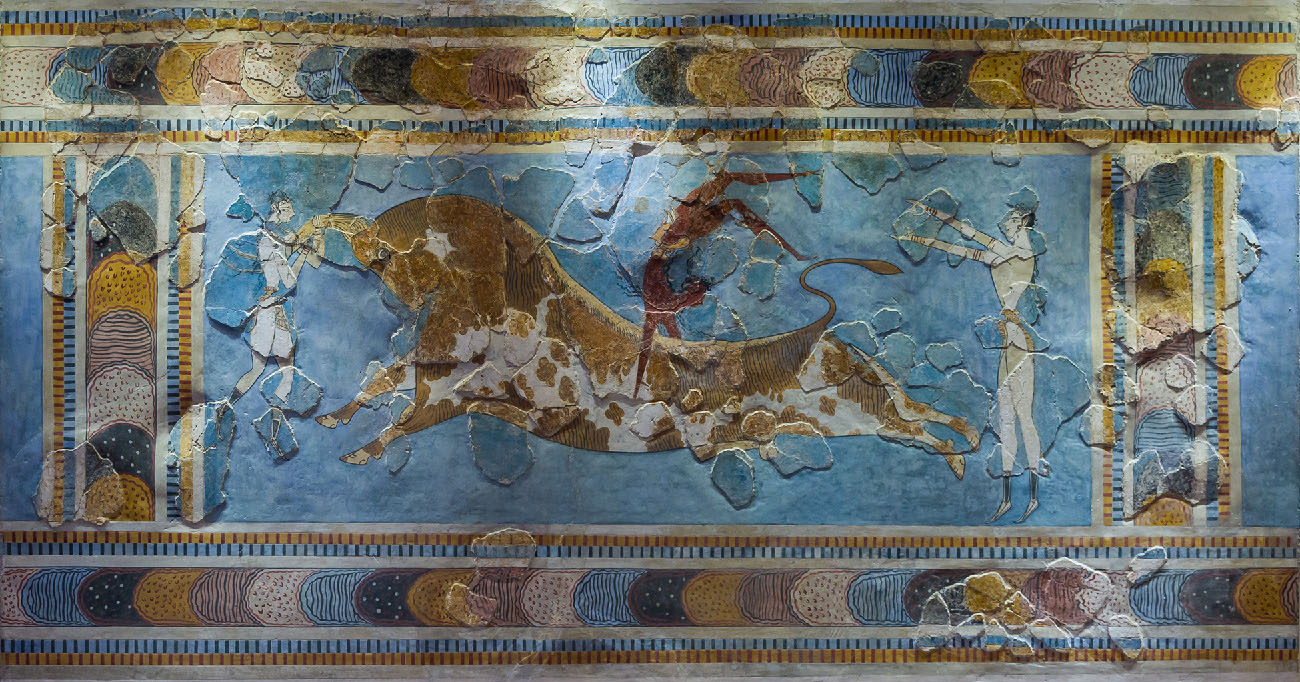
A common weapon and symbol in these palaces was the labrys, or double ax, from which the word “labyrinth” arose. In the courtyards, young men and women participated in bullfights that may be the basis for the myth of the Minotaur. Frescoes on the palace walls depict these fights as well as sea creatures and scenes from nature (Figure 6.5). The Minoan religion revered bulls and a goddess associated with snakes, nature, and fertility. The abundance of figurines of this snake-wielding female deity and other artistic depictions of women may mean that at least some women enjoyed high social status in Minoan society. Religious rituals were practiced in small shrines as well as on mountain tops and in caves and sacred forests.
英語のヒント
これらの宮殿でよく見られる武器であり象徴でもあったのが、ラブリュスという両刃斧だった。「ラビュリントス」という語はこれに由来する。中庭では若い男女が牛と向き合う競技に参加しており、これがミノタウロス神話のもとになった可能性がある。宮殿の壁のフレスコ画には、その競技だけでなく、海の生き物や自然の光景も描かれている(図6.5)。ミノアの宗教は、雄牛と、ヘビ・自然・豊穣に結び付く女神を崇めていた。ヘビを手にするこの女神の小像や、女性を表したほかの美術作品が数多くあることは、少なくとも一部の女性がミノア社会で高い地位を持っていたことを示すのかもしれない。宗教儀礼は小さな祠のほか、山頂、洞窟、聖なる森でも行われた。
A Leaping Bull.跳躍する雄牛
(credit: “Toreador Fresco (Bull-Leaping Fresco)” by “Jebulon”/Wikimedia Commons, CC0 1.0) · CC0 1.0
Figure 6.5 This small Minoan fresco (c. 1600–1450 BCE) shows a leaping bull with one acrobat on its back and two others alongside. It is one of five discovered in the Knossos palace on Crete. (credit: “Toreador Fresco (Bull-Leaping Fresco)” by “Jebulon”/Wikimedia Commons, CC0 1.0)
図6.5 この小さなミノアのフレスコ画(前1600~前1450年ごろ)には、跳躍する雄牛と、その背の上の1人、両脇の2人の曲芸師が描かれる。クレタ島のクノッソス宮殿で発見された5点のうちの一つである。(出典: “Toreador Fresco (Bull-Leaping Fresco)”/“Jebulon”/Wikimedia Commons, CC0 1.0)
Sometime around 1500 BCE, the palaces on Crete were destroyed. Knossos was rebuilt, and scribes there began employing a new script scholars call Linear B, apparently derived from Linear A and found to be an early form of Greek. Linear B clay tablets discovered on the Greek mainland led historians to conclude that Greeks from the mainland conquered Crete and rebuilt Knossos.
英語のヒント
前1500年ごろのある時点で、クレタ島の宮殿は破壊された。クノッソスは再建され、そこの書記は、研究者が「線文字B」と呼ぶ新しい文字を使い始めた。この文字は線文字Aから派生したらしく、初期のギリシア語を書き表していたことがわかっている。ギリシア本土からも線文字Bの粘土板が発見されたため、歴史家は、本土のギリシア人がクレタ島を征服し、クノッソスを再建したと結論づけた。
The Bronze Age culture that produced Linear B is called Mycenaean since the largest Bronze Age city in Greece was at Mycenae. Bronze Age Greeks appear to have migrated from the Balkans into mainland Greece around 2000 BCE and adopted Minoan civilization around the beginning of the Late Bronze Age, in 1600 BCE. Unlike the Minoans, the Mycenaean Greeks were divided into a number of separate kingdoms. Immense palace complexes like those at Knossos have been found at Mycenae, Tiryns, Thebes, Pylos, and Sparta, sometimes surrounded by monumental fortifications. These locations correspond to the powerful kingdoms described in the later Greek epic poem the Iliad, attributed to the poet Homer. This poem tells the story of the Trojan War, in which the Greek kingdoms, led by King Agamemnon of Mycenae, waged war against the city of Troy. Archaeologists have also uncovered the Bronze Age city of Troy in western Turkey, which suggests the Iliad was loosely based on oral traditions that preserved the memory of these ancient Bronze Age kingdoms. The Linear B tablets indicate that the ruler of these palaces was known as the Wanax or “lord,” the same word used to describe the heroic kings of the Iliad.
英語のヒント
線文字Bを生んだ青銅器時代の文化は、ギリシア最大の青銅器時代都市がミケーネにあったことから、ミケーネ文明と呼ばれる。青銅器時代のギリシア人は、前2000年ごろにバルカン半島からギリシア本土へ移住し、後期青銅器時代の始まる前1600年ごろにミノア文明を取り入れたと考えられる。ミノア人とは異なり、ミケーネのギリシア人はいくつもの別々の王国に分かれていた。クノッソスに似た巨大な宮殿施設が、ミケーネ、ティリンス、テーバイ、ピュロス、スパルタで見つかっており、大規模な防御施設に囲まれたものもある。これらの場所は、詩人ホメロスの作とされる後世のギリシア叙事詩『イリアス』に登場する有力な王国に対応している。この詩は、ミケーネ王アガメムノンの率いるギリシアの諸王国がトロイアと戦った、トロイア戦争の物語を伝える。考古学者はトルコ西部で青銅器時代のトロイアの都市も発掘している。このことは、『イリアス』が古代青銅器時代の王国の記憶をとどめる口承伝統に、大まかに基づいていたことを示唆する。線文字Bの粘土板によれば、宮殿の支配者はワナクス、つまり「主」と呼ばれていた。これは『イリアス』で英雄的な王たちを指すのと同じ言葉である。