第6章積分の応用
6.9 Calculus of the Hyperbolic Functions6.9 双曲線関数の微積分
Learning Objectives学習目標
- Apply the formulas for derivatives and integrals of the hyperbolic functions.双曲線関数の微分・積分の公式を使う。
- Apply the formulas for the derivatives of the inverse hyperbolic functions and their associated integrals.逆双曲線関数の微分公式と、関連する積分公式を使う。
- Describe the common applied conditions of a catenary curve.懸垂線が現れる代表的な状況を説明する。
We were introduced to hyperbolic functions in Introduction to Functions and Graphs, along with some of their basic properties. In this section, we look at differentiation and integration formulas for the hyperbolic functions and their inverses.
「関数とグラフの入門」で、双曲線関数とその基本的な性質を学んだ。この節では、双曲線関数と逆双曲線関数の微分・積分の公式を調べる。
Derivatives and Integrals of the Hyperbolic Functions双曲線関数の微分と積分
Recall that the hyperbolic sine and hyperbolic cosine are defined as
双曲線正弦と双曲線余弦は、次のように定義されていた。
The other hyperbolic functions are then defined in terms of and The graphs of the hyperbolic functions are shown in the following figure.
その他の双曲線関数は、とを使って定義される。各関数のグラフを次の図に示す。
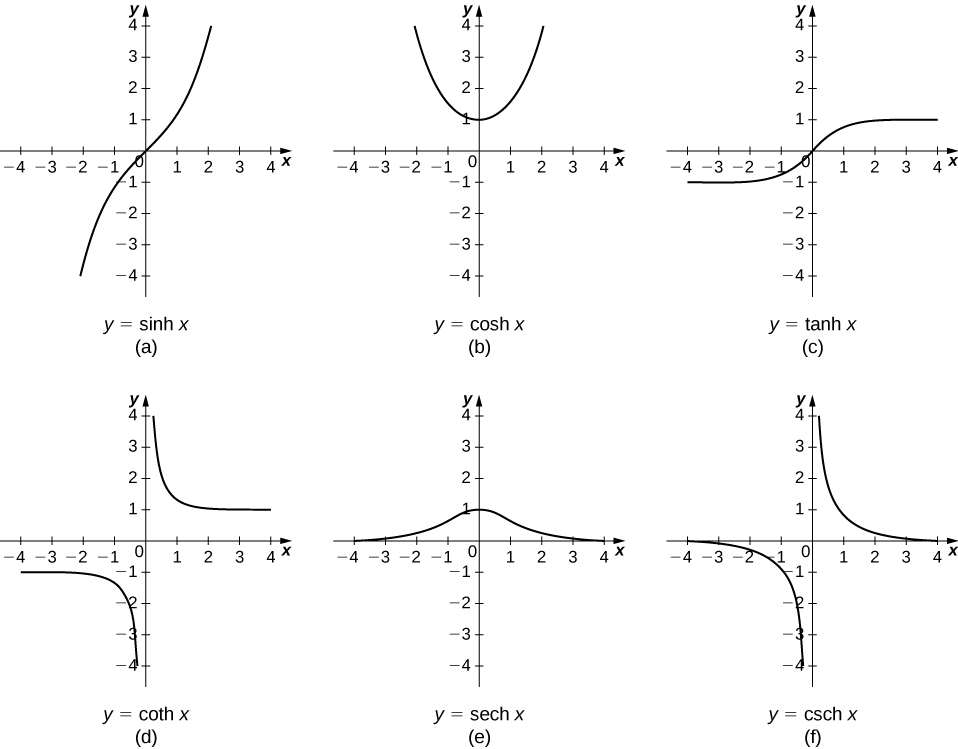
OpenStax, Rice University; Calculus Volume 1. · CC BY-NC-SA 4.0
Figure 6.81図 6.81
Graphs of the hyperbolic functions.
双曲線関数のグラフ。
It is easy to develop differentiation formulas for the hyperbolic functions. For example, looking at we have
双曲線関数の微分公式は、定義から簡単に導ける。たとえばでは、次のようになる。
Similarly, We summarize the differentiation formulas for the hyperbolic functions in the following table.
同様にとなる。双曲線関数の微分公式を次の表にまとめる。
Let’s take a moment to compare the derivatives of the hyperbolic functions with the derivatives of the standard trigonometric functions. There are a lot of similarities, but differences as well. For example, the derivatives of the sine functions match: and The derivatives of the cosine functions, however, differ in sign: but As we continue our examination of the hyperbolic functions, we must be mindful of their similarities and differences to the standard trigonometric functions.
英語のヒント
双曲線関数の導関数を、通常の三角関数と比べてみよう。よく似ているが、違いもある。正弦については、とで同じ形になる。一方、余弦ではに対してであり、符号が異なる。双曲線関数を扱うときは、三角関数との共通点だけでなく、このような違いにも注意する必要がある。
These differentiation formulas for the hyperbolic functions lead directly to the following integral formulas.
これらの微分公式から、次の積分公式が直ちに得られる。
Example 6.47例題 6.47
Example 6.48例題 6.48
Integrals Involving Hyperbolic Functions双曲線関数を含む積分
Evaluate the following integrals:
次の積分を求めよ。
Solution解き方
We can use u-substitution in both cases.
どちらも u による置換積分を使える。
- Let Then, andとおく。すると となり、さらに、
- Let Then, andとおく。すると となり、さらに、
Note that for all so we can eliminate the absolute value signs and obtainすべてのについてなので、絶対値記号を外して次式を得る。
Calculus of Inverse Hyperbolic Functions逆双曲線関数の微積分
Looking at the graphs of the hyperbolic functions, we see that with appropriate range restrictions, they all have inverses. Most of the necessary range restrictions can be discerned by close examination of the graphs. The domains and ranges of the inverse hyperbolic functions are summarized in the following table.
英語のヒント
双曲線関数のグラフを見ると、必要に応じて定義域を制限すれば、どれも逆関数をもつことが分かる。必要な制限の大半は、グラフから読み取れる。逆双曲線関数の定義域と値域を次の表にまとめる。
Function 関数 |
Domain 定義域 |
Range 値域 |
|---|---|---|
The graphs of the inverse hyperbolic functions are shown in the following figure.
逆双曲線関数のグラフを次の図に示す。
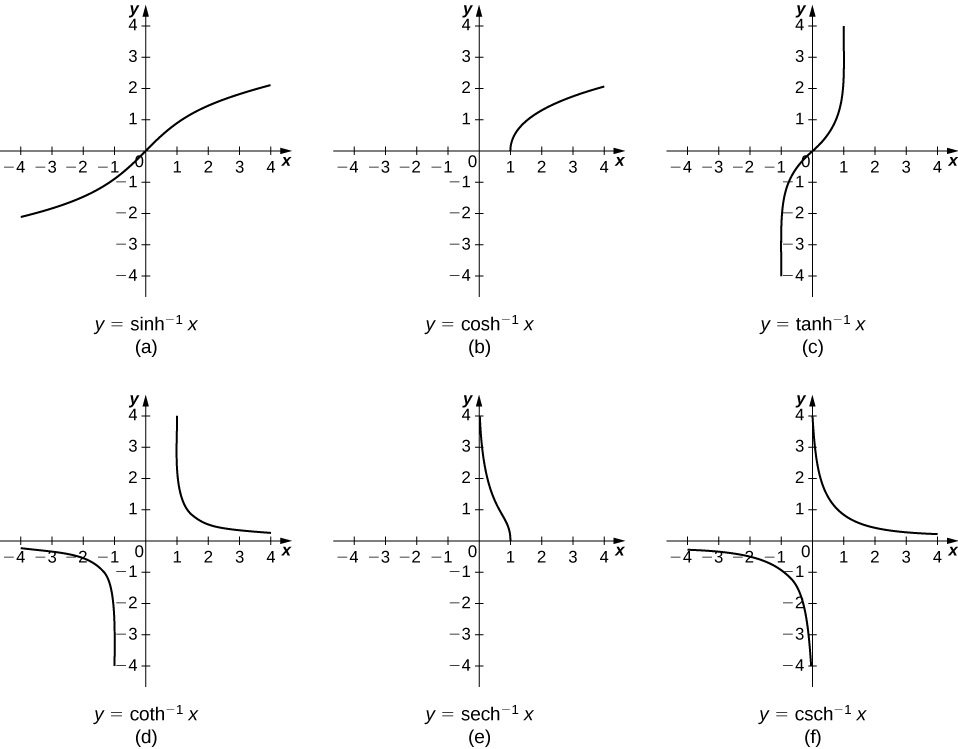
OpenStax, Rice University; Calculus Volume 1. · CC BY-NC-SA 4.0
Figure 6.82図 6.82
Graphs of the inverse hyperbolic functions.
逆双曲線関数のグラフ。
To find the derivatives of the inverse functions, we use implicit differentiation. We have
逆関数の導関数は、陰関数微分を使って求める。
Recall that so Then,
なので、である。したがって、次のようになる。
We can derive differentiation formulas for the other inverse hyperbolic functions in a similar fashion. These differentiation formulas are summarized in the following table.
英語のヒント
その他の逆双曲線関数も、同じ方法で微分公式を導ける。結果を次の表にまとめる。
Note that the derivatives of and are the same. Thus, when we integrate we need to select the proper antiderivative based on the domain of the functions and the values of Integration formulas involving the inverse hyperbolic functions are summarized as follows.
英語のヒント
との導関数は、同じ形の式になる。ただし定義域が異なるので、を積分するときは、の範囲に合う原始関数を選ぶ必要がある。逆双曲線関数に関する積分公式を次にまとめる。
Example 6.49例題 6.49
Example 6.50例題 6.50
Integrals Involving Inverse Hyperbolic Functions逆双曲線関数を用いる積分
Evaluate the following integrals:
次の積分を求めよ。
Solution解き方
We can use in both cases.
どちらもを使える。
- Let Then, and we haveと置くと、なので、次式を得る。
- Let Then, and we obtainと置くと、なので、次式を得る。