第6章積分の応用
Work Done in Pumping水をくみ上げる仕事
Consider the work done to pump water (or some other liquid) out of a tank. Pumping problems are a little more complicated than spring problems because many of the calculations depend on the shape and size of the tank. In addition, instead of being concerned about the work done to move a single mass, we are looking at the work done to move a volume of water, and it takes more work to move the water from the bottom of the tank than it does to move the water from the top of the tank.
英語のヒント
タンクから水などの液体をくみ出す仕事を考えよう。タンクの形や大きさによって計算が変わるため、ばねの問題より少し複雑になる。また、1つの物体を動かすのではなく、広がりをもつ水を動かす。タンクの底の水は、上の方の水より長い距離を持ち上げるため、多くの仕事が必要になる。
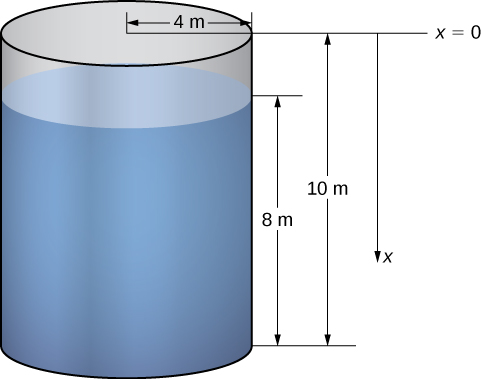
We examine the process in the context of a cylindrical tank, then look at a couple of examples using tanks of different shapes. Assume a cylindrical tank of radius m and height m is filled to a depth of 8 m. How much work does it take to pump all the water over the top edge of the tank?
まず円柱形のタンクで手順を調べ、その後で別の形も考える。半径 m、高さ m の円柱形タンクに、深さ8 m まで水が入っている。水をすべてタンクの上縁までくみ上げるには、どれだけの仕事が必要か。
The first thing we need to do is define a frame of reference. We let represent the vertical distance below the top of the tank. That is, we orient the vertically, with the origin at the top of the tank and the downward direction being positive (see the following figure).
英語のヒント
まず座標を決める。タンクの上端から下向きに測った鉛直距離をとする。つまり、図のようにを鉛直にとり、原点をタンクの上端、正の向きを下向きにする。
OpenStax, Rice University; Calculus Volume 1. · CC BY-NC-SA 4.0
Figure 6.52図 6.52
How much work is needed to empty a tank partially filled with water?
途中まで水が入ったタンクを空にするには、どれだけの仕事が必要か。
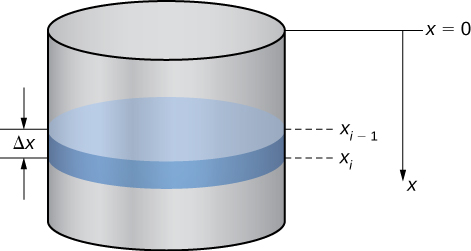
Using this coordinate system, the water extends from to Therefore, we partition the interval and look at the work required to lift each individual “layer” of water. So, for let be a regular partition of the interval and for choose an arbitrary point Figure 6.53 shows a representative layer.
この座標系では、水はからまでの範囲にある。区間を分割し、薄い水の層をそれぞれ持ち上げる仕事を考える。として、を区間の等分割とし、について任意の点を選ぶ。代表的な層を図6.53に示す。
OpenStax, Rice University; Calculus Volume 1. · CC BY-NC-SA 4.0
Figure 6.53図 6.53
A representative layer of water.
代表的な水の層。
In pumping problems, the force required to lift the water to the top of the tank is the force required to overcome gravity, so it is equal to the weight of the water. Given that the weight-density of water is N/m3, or lb/ft3, calculating the volume of each layer gives us the weight. In this case, we have
英語のヒント
水をくみ上げるとき、重力に逆らって持ち上げるのに必要な力は、その水の重さに等しい。水の単位体積あたりの重さ、すなわち重量密度は N/m3、または lb/ft3である。したがって各層の体積を求めれば、重さも求められる。ここでは次のようになる。
Then, the force needed to lift each layer is
よって、各層を持ち上げるのに必要な力は、次式となる。
Note that this step becomes a little more difficult if we have a noncylindrical tank. We look at a noncylindrical tank in the next example.
英語のヒント
円柱以外の形のタンクでは、この段階の計算が少し複雑になる。その場合は次の例題で扱う。
We also need to know the distance the water must be lifted. Based on our choice of coordinate systems, we can use as an approximation of the distance the layer must be lifted. Then the work to lift the layer of water is approximately
水を持ち上げる距離も必要である。今回の座標の取り方では、その距離をで近似できる。したがって、の層を持ち上げる仕事は、近似的に次式となる。
Adding the work for each layer, we see the approximate work to empty the tank is given by
すべての層の仕事を足すと、タンクを空にする仕事の近似値を得る。
This is a Riemann sum, so taking the limit as we get
これはリーマン和なので、の極限をとると、次式となる。
The work required to empty the tank is approximately 23,650,000 J.
タンクを空にするために必要な仕事は、約23,650,000 J である。
For pumping problems, the calculations vary depending on the shape of the tank or container. The following problem-solving strategy lays out a step-by-step process for solving pumping problems.
英語のヒント
くみ上げの問題では、タンクや容器の形によって計算が変わる。解法の手順を次にまとめる。
We now apply this problem-solving strategy in an example with a noncylindrical tank.
この手順を、円柱ではないタンクに使ってみよう。
Example 6.26例題 6.26
A Pumping Problem with a Noncylindrical Tank円柱ではないタンクから水をくみ上げる
Assume a tank in the shape of an inverted cone, with height ft and base radius ft. The tank is full to start with, and water is pumped over the upper edge of the tank until the height of the water remaining in the tank is ft. How much work is required to pump out that amount of water?
英語のヒント
高さフィート、底面の半径フィートの円錐を、頂点が下になるように置いたタンクを考える。初めは満水であり、水面の高さが底の頂点からフィートになるまで、上縁を越えて水をくみ出す。必要な仕事はいくらか。
Solution解き方
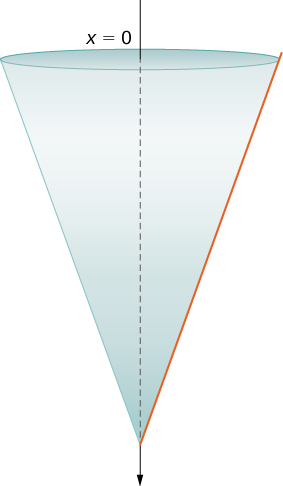
The tank is depicted in Figure 6.54. As we did in the example with the cylindrical tank, we orient the vertically, with the origin at the top of the tank and the downward direction being positive (step 1).
タンクを図6.54に示す。円柱形の場合と同じように、を鉛直にとり、原点を上端、正の向きを下向きにする(手順1)。
OpenStax, Rice University; Calculus Volume 1. · CC BY-NC-SA 4.0
Figure 6.54図 6.54
A water tank in the shape of an inverted cone.
頂点を下に向けた円錐形の水槽。
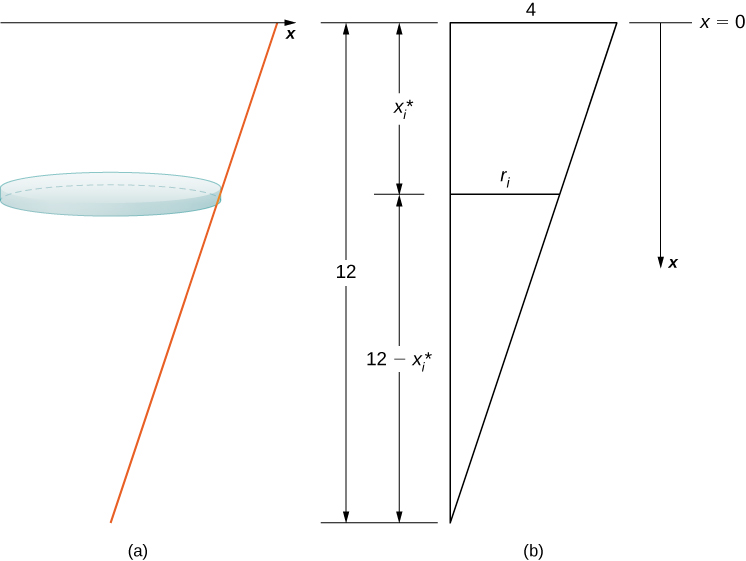
The tank starts out full and ends with ft of water left, so, based on our chosen frame of reference, we need to partition the interval Then, for let be a regular partition of the interval and for choose an arbitrary point We can approximate the volume of a layer by using a disk, then use similar triangles to find the radius of the disk (see the following figure).
初めは満水で、最後には深さフィートの水が残る。今回の座標系では、くみ出す水がある区間を分割すればよい。として、を区間の等分割とし、について任意の点を選ぶ。各層は薄い円板として近似できる。その半径は、次の図の相似な三角形から求められる。
OpenStax, Rice University; Calculus Volume 1. · CC BY-NC-SA 4.0
Figure 6.55図 6.55
Using similar triangles to express the radius of a disk of water.
相似な三角形を使って、水の円板の半径を表す。
From properties of similar triangles, we have
三角形の相似より、次式が成り立つ。
Then the volume of the disk is
したがって、円板の体積は次のようになる。
The weight-density of water is lb/ft3, so the force needed to lift each layer is approximately
水の重量密度は lb/ft3なので、各層を持ち上げるのに必要な力は、近似的に次式となる。
Based on the diagram, the distance the water must be lifted is approximately feet (step 4), so the approximate work needed to lift the layer is
図より、水を持ち上げる距離は約フィートである(手順4)。したがって、その層を持ち上げる仕事は、近似的に次式となる。
Summing the work required to lift all the layers, we get an approximate value of the total work:
すべての層を持ち上げる仕事を足すと、仕事の合計の近似値を得る。
Taking the limit as we obtain
の極限をとると、次式となる。
It takes approximately ft-lb of work to empty the tank to the desired level.
指定された水位までくみ出すには、約フィート・ポンドの仕事が必要である。