第6章積分の応用
Solids of Revolution回転体
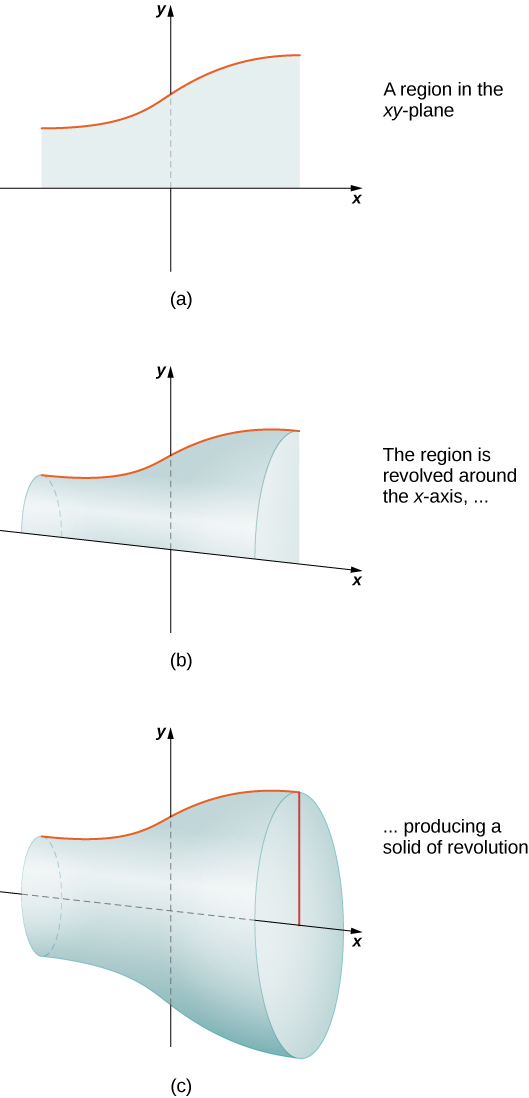
If a region in a plane is revolved around a line in that plane, the resulting solid is called a solid of revolution, as shown in the following figure.
平面上の領域を、その平面内の直線のまわりに回転させてできる立体を、回転体という。次の図に示す。
OpenStax, Rice University; Calculus Volume 1. · CC BY-NC-SA 4.0
Figure 6.15図 6.15
(a) This is the region that is revolved around the x-axis. (b) As the region begins to revolve around the axis, it sweeps out a solid of revolution. (c) This is the solid that results when the revolution is complete.
(a) x 軸のまわりに回す領域。(b) 回転を始めると立体が掃き出される。(c) 一回転を終えてできる回転体。
Solids of revolution are common in mechanical applications, such as machine parts produced by a lathe. We spend the rest of this section looking at solids of this type. The next example uses the slicing method to calculate the volume of a solid of revolution.
英語のヒント
旋盤で加工する機械部品など、回転体は機械の分野でよく使われる。この節の残りでは、この種類の立体を調べる。次の例題では、断面を使って回転体の体積を計算する。
Example 6.7例題 6.7
Using the Slicing Method to find the Volume of a Solid of Revolution断面を使って回転体の体積を求める
Use the slicing method to find the volume of the solid of revolution bounded by the graphs of and rotated about the
と横軸で囲まれる領域を のまわりに回してできる回転体の体積を、断面を使って求めよ。
Solution解き方
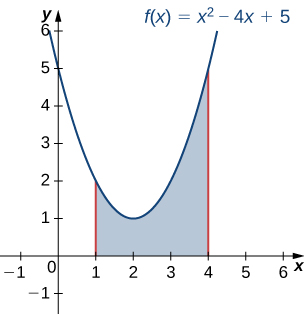
Using the problem-solving strategy, we first sketch the graph of the quadratic function over the interval as shown in the following figure.
解法の手順に従い、まず区間 上で二次関数のグラフを描く。次の図のようになる。
OpenStax, Rice University; Calculus Volume 1. · CC BY-NC-SA 4.0
Figure 6.16図 6.16
A region used to produce a solid of revolution.
回転体を作るための平面領域。
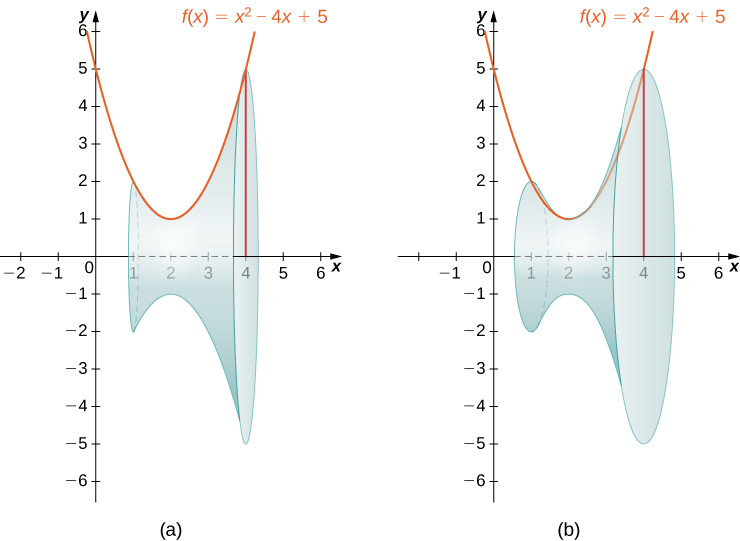
Next, revolve the region around the x-axis, as shown in the following figure.
次に、この領域を x 軸のまわりに回す。
OpenStax, Rice University; Calculus Volume 1. · CC BY-NC-SA 4.0
Figure 6.17図 6.17
Two views, (a) and (b), of the solid of revolution produced by revolving the region in Figure 6.16 about the
図6.16の領域を のまわりに回転してできた立体の、二つの見方(a)、(b)。
Since the solid was formed by revolving the region around the the cross-sections are circles (step 1). The area of the cross-section, then, is the area of a circle, and the radius of the circle is given by Use the formula for the area of the circle:
のまわりに回して作った立体なので、断面は円になる(手順1)。半径は であり、断面積には円の面積公式を使える。
The volume, then, is (step 3)
したがって、体積は次のようになる(手順3)。
The volume is
体積は である。
The Disk Method円板法
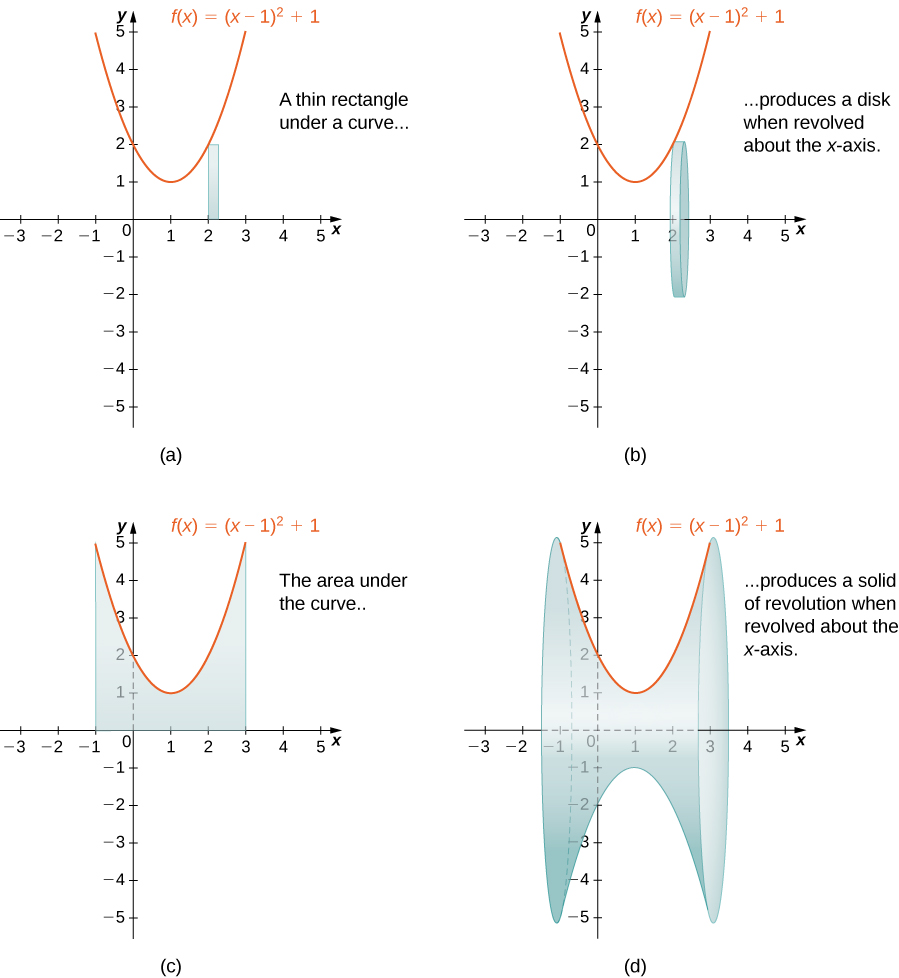
When we use the slicing method with solids of revolution, it is often called the disk method because, for solids of revolution, the slices used to over approximate the volume of the solid are disks. To see this, consider the solid of revolution generated by revolving the region between the graph of the function and the over the interval around the The graph of the function and a representative disk are shown in Figure 6.18(a) and (b). The region of revolution and the resulting solid are shown in Figure 6.18(c) and (d).
OpenStax, Rice University; Calculus Volume 1. · CC BY-NC-SA 4.0
Figure 6.18図 6.18
(a) A thin rectangle for approximating the area under a curve. (b) A representative disk formed by revolving the rectangle about the (c) The region under the curve is revolved about the resulting in (d) the solid of revolution.
(a) 曲線の下の面積を近似する細い長方形。(b) 長方形を のまわりに回してできる円板。(c) 曲線の下の領域を のまわりに回すと、(d)の回転体ができる。
We already used the formal Riemann sum development of the volume formula when we developed the slicing method. We know that
断面の方法を導く際に、リーマン和によって体積公式をすでに導いた。それによれば、
The only difference with the disk method is that we know the formula for the cross-sectional area ahead of time; it is the area of a circle. This gives the following rule.
円板法では、断面積が円の面積だと初めからわかっている点だけが異なる。これにより、次の公式が得られる。
The volume of the solid we have been studying (Figure 6.18) is given by
いま調べている立体(図6.18)の体積は、
Let’s look at some examples.
いくつかの例を見よう。
Example 6.8例題 6.8
Using the Disk Method to Find the Volume of a Solid of Revolution 1円板法で回転体の体積を求める(1)
Use the disk method to find the volume of the solid of revolution generated by rotating the region between the graph of and the over the interval around the
区間 上で のグラフと の間にある領域を、 のまわりに回転させる。できる回転体の体積を円板法で求めよ。
Solution解き方
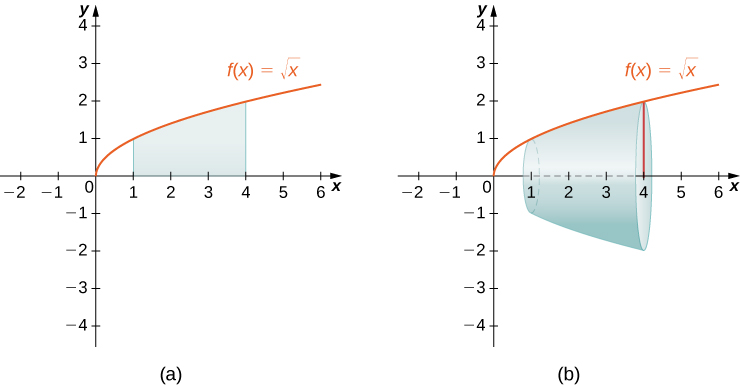
The graphs of the function and the solid of revolution are shown in the following figure.
関数のグラフと回転体を、次の図に示す。
OpenStax, Rice University; Calculus Volume 1. · CC BY-NC-SA 4.0
Figure 6.19図 6.19
(a) The function over the interval (b) The solid of revolution obtained by revolving the region under the graph of about the
(a) 区間 上の関数 。(b) のグラフの下の領域を のまわりに回した立体。
We have
次の式が得られる。
The volume is units3.
体積は 単位3である。
So far, our examples have all concerned regions revolved around the but we can generate a solid of revolution by revolving a plane region around any horizontal or vertical line. In the next example, we look at a solid of revolution that has been generated by revolving a region around the The mechanics of the disk method are nearly the same as when the is the axis of revolution, but we express the function in terms of and we integrate with respect to y as well. This is summarized in the following rule.
英語のヒント
これまでの例はすべて のまわりに回すものだったが、回転軸には任意の水平線や鉛直線を選べる。次の例では のまわりに回す。手順は を軸にする場合とほぼ同じだが、関数を で表し、y について積分する。次の公式にまとめよう。
The next example shows how this rule works in practice.
この公式の使い方を、次の例で示す。
Example 6.9例題 6.9
Using the Disk Method to Find the Volume of a Solid of Revolution 2円板法で回転体の体積を求める(2)
Let be the region bounded by the graph of and the over the interval Use the disk method to find the volume of the solid of revolution generated by rotating around the
上の区間 で、 のグラフと に囲まれる領域を とする。 を のまわりに回してできる回転体の体積を、円板法で求めよ。
Solution解き方
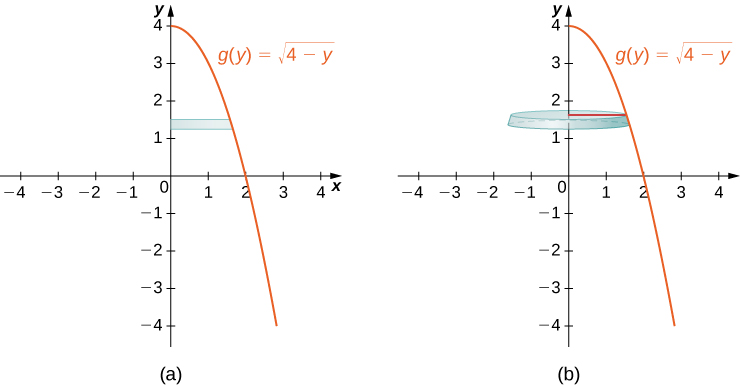
Figure 6.20 shows the function and a representative disk that can be used to estimate the volume. Notice that since we are revolving the function around the the disks are horizontal, rather than vertical.
図6.20に、関数と、体積を近似するための代表的な円板を示す。 のまわりに回すので、円板は縦ではなく横向きになる。
OpenStax, Rice University; Calculus Volume 1. · CC BY-NC-SA 4.0
Figure 6.20図 6.20
(a) Shown is a thin rectangle between the curve of the function and the (b) The rectangle forms a representative disk after revolution around the
(a) 関数 の曲線と の間の細い長方形。(b) のまわりに回すと円板になる。
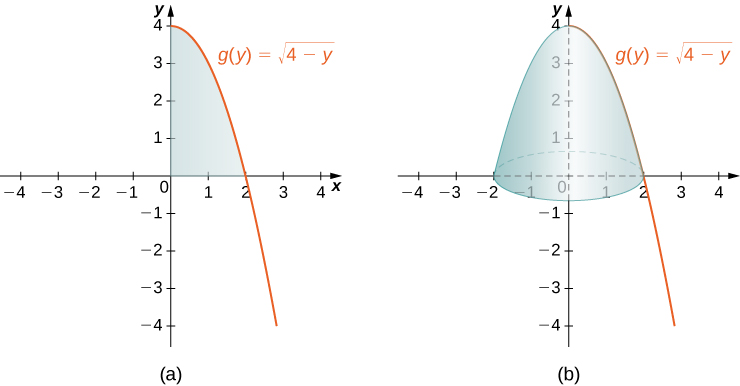
The region to be revolved and the full solid of revolution are depicted in the following figure.
回す領域と、できあがる回転体全体を次の図に示す。
OpenStax, Rice University; Calculus Volume 1. · CC BY-NC-SA 4.0
Figure 6.21図 6.21
(a) The region to the left of the function over the interval (b) The solid of revolution formed by revolving the region about the
(a) 上の区間 で、関数 の左側にある領域。(b) その領域を のまわりに回した立体。
To find the volume, we integrate with respect to We obtain
体積を求めるため、 について積分すると、
The volume is units3.
体積は 単位3である。