第6章積分の応用
Defining the Number e数 e の定義
Now that we have the natural logarithm defined, we can use that function to define the number
英語のヒント
自然対数が定義できたので、これを使って数を定義しよう。
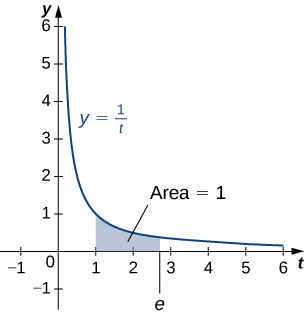
To put it another way, the area under the curve between and is (Figure 6.77). The proof that such a number exists and is unique is left to you. (Hint: Use the Intermediate Value Theorem to prove existence and the fact that is increasing to prove uniqueness.)
英語のヒント
言い換えると、曲線の下の、からまでの面積がとなる(図6.77)。このような数がただ1つ存在することは、各自で証明してみよう。ヒント:存在は中間値の定理で示し、一意性はが増加することを使って示す。
OpenStax, Rice University; Calculus Volume 1. · CC BY-NC-SA 4.0
Figure 6.77図 6.77
The area under the curve from to is equal to one.
からまでの曲線下の面積は1に等しい。
The number can be shown to be irrational, although we won’t do so here (see the Student Project in Taylor and Maclaurin Series). Its approximate value is given by
数が無理数であることも証明できるが、ここでは扱わない。「テイラー級数とマクローリン級数」の課題を参照してほしい。近似値は次のとおりである。
The Exponential Function指数関数
We now turn our attention to the function Note that the natural logarithm is one-to-one and therefore has an inverse function. For now, we denote this inverse function by Then,
次に、関数を考える。自然対数は1対1の関数なので、逆関数をもつ。その逆関数を、ひとまずと書く。このとき、次式が成り立つ。
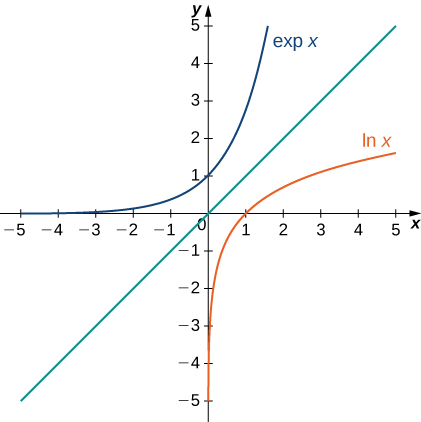
The following figure shows the graphs of and
とのグラフを次の図に示す。
OpenStax, Rice University; Calculus Volume 1. · CC BY-NC-SA 4.0
Figure 6.78図 6.78
The graphs of and
とのグラフ。
We hypothesize that For rational values of this is easy to show. If is rational, then we have Thus, when is rational, For irrational values of we simply define as the inverse function of
英語のヒント
と予想される。が有理数なら、簡単に示せる。が有理数のときなので、が有理数ならである。が無理数の場合には、をの逆関数によって定義することにする。
Then we have for all and thus
こうすると、すべてのに対してとなる。したがって、次式が成り立つ。
for all
これは、すべてのについて成り立つ。
Properties of the Exponential Function指数関数の性質
Since the exponential function was defined in terms of an inverse function, and not in terms of a power of we must verify that the usual laws of exponents hold for the function
指数関数を、のべき乗ではなく逆関数として定義したので、通常の指数法則がでも成り立つことを確かめる必要がある。
Proof証明
Note that if and are rational, the properties hold. However, if or are irrational, we must apply the inverse function definition of and verify the properties. Only the first property is verified here; the other two are left to you. We have
とが有理数なら、これらの性質は成り立つ。しかし、またはが無理数の場合は、を逆関数として定義したことに戻って確認する必要がある。ここでは最初の性質だけを証明し、残る2つは各自の課題とする。まず、次式を得る。
Since is one-to-one, then
は1対1の関数なので、次のようになる。
□
□
As with part iv. of the logarithm properties, we can extend property iii. to irrational values of and we do so by the end of the section.
対数の性質 iv と同じく、性質 iii も、が無理数の場合まで広げられる。この節の最後で扱う。
We also want to verify the differentiation formula for the function To do this, we need to use implicit differentiation. Let Then
関数の微分公式も確かめたい。そのために陰関数微分を使う。と置くと、次式が成り立つ。
Thus, we see
したがって、次式を得る。
as desired, which leads immediately to the integration formula
これで目的の微分公式が示された。積分公式も直ちに得られる。
We apply these formulas in the following examples.
次の例題で、これらの公式を使ってみよう。
Example 6.38例題 6.38
Using Properties of Exponential Functions指数関数の性質を使う
Evaluate the following derivatives:
次の導関数を求めよ。
Solution解き方
We apply the chain rule as necessary.
必要に応じて連鎖律を使う。
Example 6.39例題 6.39
Using Properties of Exponential Functions指数関数の性質を使う
Evaluate the following integral:
次の積分を求めよ:。
Solution解き方
Using -substitution, let Then and we have
による置換を用い、 とおく。すると となり、次のようになる。
General Logarithmic and Exponential Functions一般の対数関数と指数関数
We close this section by looking at exponential functions and logarithms with bases other than Exponential functions are functions of the form Note that unless we still do not have a mathematically rigorous definition of these functions for irrational exponents. Let’s rectify that here by defining the function in terms of the exponential function We then examine logarithms with bases other than as inverse functions of exponential functions.
英語のヒント
この節の最後に、以外を底とする指数関数と対数を考える。指数関数はという形の関数である。以外の場合、無理数の指数については、まだ厳密な定義を与えていない。そこで、を指数関数によって定義する。さらに、その逆関数として、以外を底とする対数を調べる。
Now is defined rigorously for all values of x. This definition also allows us to generalize property iv. of logarithms and property iii. of exponential functions to apply to both rational and irrational values of It is straightforward to show that properties of exponents hold for general exponential functions defined in this way.
これで、すべての実数 x についてが厳密に定義できた。この定義を使うと、対数の性質 iv と指数関数の性質 iii を、が有理数でも無理数でも成り立つように拡張できる。この方法で定義した一般の指数関数にも指数法則が成り立つことは、直接確かめられる。
Let’s now apply this definition to calculate a differentiation formula for We have
この定義を使って、の微分公式を求めよう。
The corresponding integration formula follows immediately.
対応する積分公式も直ちに得られる。
If then the function is one-to-one and has a well-defined inverse. Its inverse is denoted by Then,
底が正でなら、関数は1対1で、逆関数が定まる。その逆関数をと書く。このとき、次式が成り立つ。
Note that general logarithm functions can be written in terms of the natural logarithm. Let Then, Taking the natural logarithm of both sides of this second equation, we get
一般の対数も、自然対数で表せる。と置くとである。後者の両辺の自然対数をとると、次式を得る。
Thus, we see that all logarithmic functions are constant multiples of one another. Next, we use this formula to find a differentiation formula for a logarithm with base Again, let Then,
したがって、どの対数関数も、別の対数関数の定数倍である。次にこの式を使い、底の対数の微分公式を求める。再びと置くと、次のようになる。
Example 6.40例題 6.40
Calculating Derivatives of General Exponential and Logarithm Functions一般の指数関数と対数関数の導関数を求める
Evaluate the following derivatives:
次の導関数を求めよ。
Solution解き方
We need to apply the chain rule as necessary.
必要に応じて連鎖律を使う。
Example 6.41例題 6.41
Integrating General Exponential Functions一般の指数関数を積分する
Evaluate the following integral:
次の積分を求めよ:。
Solution解き方
Use and let Then and we have
を使い、と置く。なので、次のようになる。