第6章積分の応用
6.5 Physical Applications6.5 物理への応用
Learning Objectives学習目標
- Determine the mass of a one-dimensional object from its linear density function.線密度を表す関数から、1次元の物体の質量を求める。
- Determine the mass of a two-dimensional circular object from its radial density function.半径方向の密度を表す関数から、薄い円板の質量を求める。
- Calculate the work done by a variable force acting along a line.一直線上で変化する力がする仕事を求める。
- Calculate the work done in pumping a liquid from one height to another.液体をある高さから別の高さまでくみ上げる仕事を求める。
- Find the hydrostatic force against a submerged vertical plate.水中の鉛直な板に働く、静水圧による力を求める。
In this section, we examine some physical applications of integration. Let’s begin with a look at calculating mass from a density function. We then turn our attention to work, and close the section with a study of hydrostatic force.
この節では、積分の物理への応用を学ぶ。まず、密度を表す関数から質量を求める。次に仕事を扱い、最後に静止した液体が物体に及ぼす力を調べる。
Mass and Density質量と密度
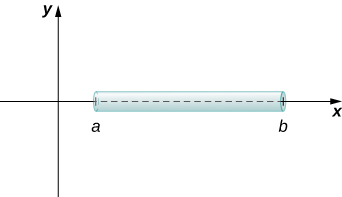
We can use integration to develop a formula for calculating mass based on a density function. First we consider a thin rod or wire. Orient the rod so it aligns with the with the left end of the rod at and the right end of the rod at (Figure 6.48). Note that although we depict the rod with some thickness in the figures, for mathematical purposes we assume the rod is thin enough to be treated as a one-dimensional object.
英語のヒント
積分を使うと、密度を表す関数から質量を求める公式を導ける。まず、細い棒や針金を考えよう。図6.48のように、棒をに沿って置き、左端を、右端をとする。図では太さを付けて描いているが、数学的には1次元の物体として扱えるほど細いものとする。
OpenStax, Rice University; Calculus Volume 1. · CC BY-NC-SA 4.0
Figure 6.48図 6.48
We can calculate the mass of a thin rod oriented along the by integrating its density function.
に沿って置いた細い棒の質量は、密度を表す関数を積分して求められる。
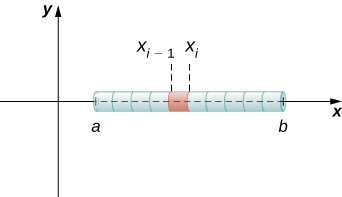
If the rod has constant density given in terms of mass per unit length, then the mass of the rod is just the product of the density and the length of the rod: If the density of the rod is not constant, however, the problem becomes a little more challenging. When the density of the rod varies from point to point, we use a linear density function, to denote the density of the rod at any point, Let be an integrable linear density function. Now, for let be a regular partition of the interval and for choose an arbitrary point Figure 6.49 shows a representative segment of the rod.
英語のヒント
単位長さあたりの質量で表した密度が一定なら、棒の質量は密度と長さの積である。しかし、密度が一定でない場合は少し工夫が必要になる。位置によって密度が変わるとき、任意の位置の密度を表す関数を、線密度関数という。は積分可能とする。として、を区間の等分割とする。について、任意の点を選ぶ。棒を分けてできる代表的な小部分を、図6.49に示す。
OpenStax, Rice University; Calculus Volume 1. · CC BY-NC-SA 4.0
Figure 6.49図 6.49
A representative segment of the rod.
棒の代表的な小部分。
The mass of the segment of the rod from to is approximated by
からまでの棒の部分の質量は、次式で近似できる。
Adding the masses of all the segments gives us an approximation for the mass of the entire rod:
すべての小部分の質量を足すと、棒全体の質量の近似値を得る。
This is a Riemann sum. Taking the limit as we get an expression for the exact mass of the rod:
これはリーマン和である。の極限をとれば、棒の正確な質量を表す式が得られる。
We state this result in the following theorem.
この結果を、次の定理にまとめる。
We apply this theorem in the next example.
次の例題で、この定理を使う。
Example 6.23例題 6.23
Calculating Mass from Linear Density線密度から質量を求める
Consider a thin rod oriented on the x-axis over the interval If the density of the rod is given by what is the mass of the rod?
x 軸上の区間 に沿って置かれた細い棒を考える。棒の線密度が で与えられるとき、棒の質量はいくらか。
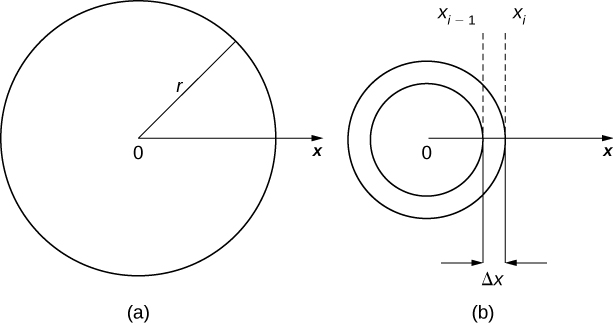
We now extend this concept to find the mass of a two-dimensional disk of radius As with the rod we looked at in the one-dimensional case, here we assume the disk is thin enough that, for mathematical purposes, we can treat it as a two-dimensional object. We assume the density is given in terms of mass per unit area (called area density), and further assume the density varies only along the disk’s radius (called radial density). We orient the disk in the with the center at the origin. Then, the density of the disk can be treated as a function of denoted We assume is integrable. Because density is a function of we partition the interval from along the For let be a regular partition of the interval and for choose an arbitrary point Now, use the partition to break up the disk into thin (two-dimensional) washers. A disk and a representative washer are depicted in the following figure.
英語のヒント
次に、この考え方を広げて、半径の薄い円板の質量を求める。1次元の棒と同じように、ここでは円板が十分薄く、2次元の物体として扱えるとする。単位面積あたりの質量を面密度といい、今回はそれが中心からの距離だけによって変わるとする。これを半径方向の密度という。円板をに置き、中心を原点に合わせる。このとき中心からの距離の関数として密度を扱い、と書く。は積分可能とする。密度がの関数なので、上の区間を分割する。として、を区間の等分割とする。について、任意の点を選ぶ。この分割で円板を幅の狭い円環に分ける。円板と代表的な円環を次の図に示す。
OpenStax, Rice University; Calculus Volume 1. · CC BY-NC-SA 4.0
Figure 6.50図 6.50
(a) A thin disk in the xy-plane. (b) A representative washer.
(a) xy 平面内の薄い円板。(b) 代表的な円環。
We now approximate the density and area of the washer to calculate an approximate mass, Note that the area of the washer is given by
円環の密度と面積を近似して、質量の近似値を求める。円環の面積は次のようになる。
You may recall that we had an expression similar to this when we were computing volumes by shells. As we did there, we use to approximate the average radius of the washer. We obtain
円筒殻法で体積を求めたときにも、似た式が現れた。そのときと同じように、円環の平均半径をで近似すると、次式を得る。
Using to approximate the density of the washer, we approximate the mass of the washer by
円環の密度をで近似すれば、その質量は次式で近似できる。
Adding up the masses of the washers, we see the mass of the entire disk is approximated by
各円環の質量を足すと、円板全体の質量の近似値は次式となる。
We again recognize this as a Riemann sum, and take the limit as This gives us
これもリーマン和である。の極限をとると、次式を得る。
We summarize these findings in the following theorem.
以上の結果を、次の定理にまとめる。
Example 6.24例題 6.24
Calculating Mass from Radial Density半径方向の密度から質量を求める
Let represent the radial density of a disk. Calculate the mass of a disk of radius 4.
円板の半径方向の密度をとする。半径4の円板の質量を求めよ。
Solution解き方
Applying the formula, we find
公式を使うと、次のようになる。