第6章積分の応用
Exponential Decay Model指数的減少のモデル
Exponential functions can also be used to model populations that shrink (from disease, for example), or chemical compounds that break down over time. We say that such systems exhibit exponential decay, rather than exponential growth. The model is nearly the same, except there is a negative sign in the exponent. Thus, for some positive constant we have
英語のヒント
指数関数は、病気などで減少する個体数や、時間とともに分解する化合物の量にも使える。このような変化を指数的減少という。指数的増加のモデルとほぼ同じだが、指数に負号が付く。つまり、正の定数を使ってと表す。
As with exponential growth, there is a differential equation associated with exponential decay. We have
指数的増加と同じように、指数的減少にも対応する微分方程式がある。
The following figure shows a graph of a representative exponential decay function.
代表的な指数的減少の関数のグラフを、次の図に示す。
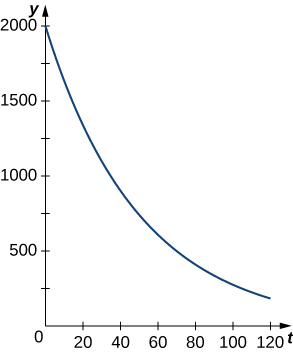
OpenStax, Rice University; Calculus Volume 1. · CC BY-NC-SA 4.0
Figure 6.80図 6.80
An example of exponential decay.
指数的減少の例。
Let’s look at a physical application of exponential decay. Newton’s law of cooling says that an object cools at a rate proportional to the difference between the temperature of the object and the temperature of the surroundings. In other words, if represents the temperature of the object and represents the ambient temperature in a room, then
英語のヒント
指数的減少の物理への応用を見よう。ニュートンの冷却の法則によれば、物体が冷える速さは、物体と周囲の温度差に比例する。物体の温度を、一定の室温をとすれば、次式が成り立つ。
Note that this is not quite the right model for exponential decay. We want the derivative to be proportional to the function, and this expression has the additional term. Fortunately, we can make a change of variables that resolves this issue. Let Then and our equation becomes
英語のヒント
このままでは、指数的減少の形と少し違う。導関数を元の関数に比例させたいが、余分なの項がある。そこで、変数をと置き換える。するととなり、方程式は次の形になる。
From our previous work, we know this relationship between y and its derivative leads to exponential decay. Thus,
このような y とその導関数の関係から、指数的減少が得られることはすでに学んだ。したがって、次式となる。
and we see that
よって、次式を得る。
where represents the initial temperature. Let’s apply this formula in the following example.
は初めの温度である。次の例で公式を使ってみよう。
Example 6.45例題 6.45
Newton’s Law of Coolingニュートンの冷却の法則
According to experienced baristas, the optimal temperature to serve coffee is between and Suppose coffee is poured at a temperature of and after minutes in a room it has cooled to When is the coffee first cool enough to serve? When is the coffee too cold to serve? Round answers to the nearest half minute.
コーヒーを提供するのに適した温度を、からの間とする。で注いだコーヒーを室温の部屋に置くと、分後にまで冷えた。提供できる温度に初めて達するのはいつか。また、この範囲より冷たくなるのはいつか。最も近い0.5分単位に丸めて答えよ。
Solution解き方
We have
次の式が得られる。
Then, the model is
したがって、モデルは次のようになる。
The coffee reaches when
コーヒーがになる時刻は、次のように求められる。
The coffee can be served about minutes after it is poured. The coffee reaches at
注いでから約分後に、提供できる温度になる。になる時刻は、次のように求められる。
The coffee is too cold to be served about minutes after it is poured.
注いでから約分後には、指定した提供温度の範囲より冷たくなる。
Just as systems exhibiting exponential growth have a constant doubling time, systems exhibiting exponential decay have a constant half-life. To calculate the half-life, we want to know when the quantity reaches half its original size. Therefore, we have
指数的増加で倍加時間が一定であるのと同じように、指数的減少では半減期が一定である。半減期を求めるには、量が初期値の半分になる時刻を求めればよい。
Note: This is the same expression we came up with for doubling time.
これは、倍加時間で得られたものと同じ形の式である。
Example 6.46例題 6.46
Radiocarbon Dating放射性炭素による年代測定
One of the most common applications of an exponential decay model is carbon dating. decays (emits a radioactive particle) at a regular and consistent exponential rate. Therefore, if we know how much carbon was originally present in an object and how much carbon remains, we can determine the age of the object. The half-life of is approximately years—meaning, after that many years, half the material has converted from the original to the new nonradioactive If we have g today, how much is left in years? If an artifact that originally contained g of carbon now contains g of carbon, how old is it? Round the answer to the nearest hundred years.
英語のヒント
指数的減少の代表的な応用に、放射性炭素による年代測定がある。は放射性崩壊し、その残存量は一定の減衰定数で指数的に減少する。したがって、初めの量と現在の残存量が分かれば、経過時間を求められる。の半減期は約年である。この時間がたつと、初めにあったの半分が、放射性ではないに変わる。今日、が g あるなら、年後には何 g 残るか。また、初めに g の炭素14を含んでいた試料に、現在は g しか残っていない場合、何年前のものと推定されるか。年代は最も近い100年単位に丸めよ。
Solution解き方
We have
次の式が得られる。
So, the model says
したがって、モデルは次のようになる。
In years, we have
年後の量は、次のように求められる。
Therefore, in years, g of remains.
年後には、が g 残る。
To determine the age of the artifact, we must solve
試料の年代を求めるには、次の方程式を解く。
The artifact is about years old.
試料は約年前のものと推定される。