第6章積分の応用
Center of Mass of Thin Plates薄い板の重心
So far we have looked at systems of point masses on a line and in a plane. Now, instead of having the mass of a system concentrated at discrete points, we want to look at systems in which the mass of the system is distributed continuously across a thin sheet of material. For our purposes, we assume the sheet is thin enough that it can be treated as if it is two-dimensional. Such a sheet is called a lamina. Next we develop techniques to find the center of mass of a lamina. In this section, we also assume the density of the lamina is constant.
英語のヒント
これまでは、直線上や平面上の質点系を考えた。次は、質量が離れた点に集中しているのではなく、薄い板の全体に連続的に分布している場合を扱う。板は十分薄く、2次元の物体として扱えるとする。このような薄板を lamina という。薄板の重心を求める方法を導こう。この節では、板の面密度は一定とする。
Laminas are often represented by a two-dimensional region in a plane. The geometric center of such a region is called its centroid. Since we have assumed the density of the lamina is constant, the center of mass of the lamina depends only on the shape of the corresponding region in the plane; it does not depend on the density. In this case, the center of mass of the lamina corresponds to the centroid of the delineated region in the plane. As with systems of point masses, we need to find the total mass of the lamina, as well as the moments of the lamina with respect to the x- and y-axes.
英語のヒント
薄板は、平面内の2次元の領域で表せる。その領域の幾何学的な中心を図心という。板の密度は一定と仮定しているので、重心は密度の値には依存せず、領域の形だけで決まる。この場合、板の重心は領域の図心に一致する。質点系と同じように、薄板全体の質量と、x 軸・y 軸に関するモーメントを求める必要がある。
We first consider a lamina in the shape of a rectangle. Recall that the center of mass of a lamina is the point where the lamina balances. For a rectangle, that point is both the horizontal and vertical center of the rectangle. Based on this understanding, it is clear that the center of mass of a rectangular lamina is the point where the diagonals intersect, which is a result of the symmetry principle, and it is stated here without proof.
英語のヒント
まず、長方形の薄板を考える。重心は、そこで支えると板が釣り合う点である。長方形なら、縦にも横にも中央にある点、すなわち対角線の交点が重心となる。これは、次の対称性の原理の一例である。ここでは証明せずに述べる。
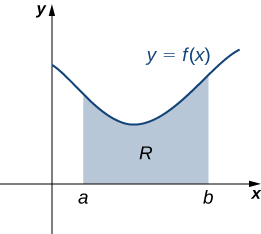
Let’s turn to more general laminas. Suppose we have a lamina bounded above by the graph of a continuous function below by the x-axis, and on the left and right by the lines and respectively, as shown in the following figure.
もっと一般的な薄板を考えよう。次の図のように、上を連続関数のグラフ、下を x 軸、左を直線、右を直線で囲まれた薄板を考える。
OpenStax, Rice University; Calculus Volume 1. · CC BY-NC-SA 4.0
Figure 6.65図 6.65
A region in the plane representing a lamina.
薄板を表す平面領域。
As with systems of point masses, to find the center of mass of the lamina, we need to find the total mass of the lamina, as well as the moments of the lamina with respect to the x- and y-axes. As we have done many times before, we approximate these quantities by partitioning the interval and constructing rectangles.
質点系と同じく、重心を求めるには、薄板全体の質量と、x 軸・y 軸に関するモーメントが必要である。これまでと同じように区間を分割し、長方形を使ってこれらの量を近似する。
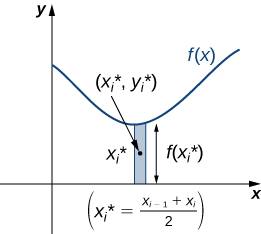
For let be a regular partition of Recall that we can choose any point within the interval as our In this case, we want to be the x-coordinate of the centroid of our rectangles. Thus, for we select such that is the midpoint of the interval. That is, Now, for construct a rectangle of height on The center of mass of this rectangle is as shown in the following figure.
として、を区間の等分割とする。には、区間内のどの点を選んでもよかった。今回は、を長方形の図心の x 座標にしたい。そこでについて、が区間の中点になるようにを選ぶ。すなわちである。について、区間の上に高さの長方形を作る。その重心は、次の図のようにとなる。
OpenStax, Rice University; Calculus Volume 1. · CC BY-NC-SA 4.0
Figure 6.66図 6.66
A representative rectangle of the lamina.
薄板を近似する代表的な長方形。
Next, we need to find the total mass of the rectangle. Let represent the density of the lamina (note that is a constant). In this case, is expressed in terms of mass per unit area. Thus, to find the total mass of the rectangle, we multiply the area of the rectangle by Then, the mass of the rectangle is given by
次に、この長方形の質量を求める。薄板の面密度をとする。は定数であり、の単位は単位面積あたりの質量である。長方形の面積にを掛ければ、質量を得る。
To get the approximate mass of the lamina, we add the masses of all the rectangles to get
すべての長方形の質量を足すと、薄板の質量の近似値を得る。
This is a Riemann sum. Taking the limit as gives the exact mass of the lamina:
これはリーマン和である。の極限をとれば、薄板の正確な質量が得られる。
Next, we calculate the moment of the lamina with respect to the x-axis. Returning to the representative rectangle, recall its center of mass is Recall also that treating the rectangle as if it is a point mass located at the center of mass does not change the moment. Thus, the moment of the rectangle with respect to the x-axis is given by the mass of the rectangle, multiplied by the distance from the center of mass to the x-axis: Therefore, the moment with respect to the x-axis of the rectangle is Adding the moments of the rectangles and taking the limit of the resulting Riemann sum, we see that the moment of the lamina with respect to the x-axis is
次に、x 軸に関するモーメントを求める。代表的な長方形の重心はであった。長方形の質量をすべて重心に集めた質点として扱っても、モーメントは変わらない。したがって、質量に、重心から x 軸までの距離を掛ければよい。長方形のモーメントはとなる。各長方形のモーメントを足し、得られたリーマン和の極限をとると、薄板の x 軸に関するモーメントは次式になる。
We derive the moment with respect to the y-axis similarly, noting that the distance from the center of mass of the rectangle to the y-axis is Then the moment of the lamina with respect to the y-axis is given by
y 軸に関するモーメントも同じように求められる。長方形の重心の y 軸からの符号付きの距離はであるため、次式を得る。
We find the coordinates of the center of mass by dividing the moments by the total mass to give If we look closely at the expressions for we notice that the constant cancels out when and are calculated.
モーメントを全質量で割れば、重心の座標を得る。の式をよく見ると、、を計算する際に、定数が約分されて消えることが分かる。
We summarize these findings in the following theorem.
以上の結果を、次の定理にまとめる。
In the next example, we use this theorem to find the center of mass of a lamina.
次の例題では、この定理を使って薄板の重心を求める。
Example 6.31例題 6.31
Finding the Center of Mass of a Lamina薄板の重心を求める
Let R be the region bounded above by the graph of the function and below by the x-axis over the interval Find the centroid of the region.
区間 上で、上を関数 のグラフ、下を x 軸に囲まれた領域を R とする。この領域の図心を求めよ。
Solution解き方
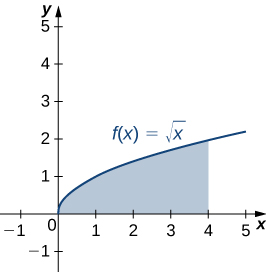
The region is depicted in the following figure.
この領域を次の図に示す。
OpenStax, Rice University; Calculus Volume 1. · CC BY-NC-SA 4.0
Figure 6.67図 6.67
Finding the center of mass of a lamina.
薄板の重心を求める。
Since we are only asked for the centroid of the region, rather than the mass or moments of the associated lamina, we know the density constant cancels out of the calculations eventually. Therefore, for the sake of convenience, let’s assume
英語のヒント
求めたいのは領域の図心であって、薄板の質量やモーメントではない。密度の定数は最後に消えるので、計算を簡単にするためとしてよい。
First, we need to calculate the total mass:
まず、全質量を計算する。
Next, we compute the moments:
次に、モーメントを計算する。
and
および
Thus, we have
したがって、次の式が得られる。
The centroid of the region is
この領域の図心は である。
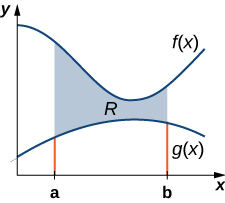
We can adapt this approach to find centroids of more complex regions as well. Suppose our region is bounded above by the graph of a continuous function as before, but now, instead of having the lower bound for the region be the x-axis, suppose the region is bounded below by the graph of a second continuous function, as shown in the following figure.
この方法は、もっと複雑な領域の図心にも使える。上側の境界は先ほどと同じく連続関数のグラフとし、下側の境界を x 軸ではなく、別の連続関数のグラフとする。次の図を見よう。
OpenStax, Rice University; Calculus Volume 1. · CC BY-NC-SA 4.0
Figure 6.68図 6.68
A region between two functions.
2つの関数のグラフの間にある領域。
Again, we partition the interval and construct rectangles. A representative rectangle is shown in the following figure.
今回も区間を分割し、長方形を作る。代表的な長方形を次の図に示す。
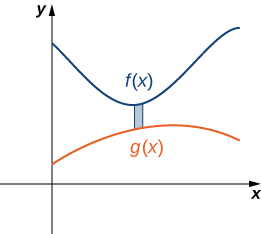
OpenStax, Rice University; Calculus Volume 1. · CC BY-NC-SA 4.0
Figure 6.69図 6.69
A representative rectangle of the region between two functions.
2曲線間の領域を近似する代表的な長方形。
Note that the centroid of this rectangle is We won’t go through all the details of the Riemann sum development, but let’s look at some of the key steps. In the development of the formulas for the mass of the lamina and the moment with respect to the y-axis, the height of each rectangle is given by which leads to the expression in the integrands.
この長方形の図心はである。リーマン和を用いる導出の細部は省き、要点を見よう。質量と y 軸に関するモーメントの式では、長方形の高さがになるため、被積分関数にが現れる。
In the development of the formula for the moment with respect to the x-axis, the moment of each rectangle is found by multiplying the area of the rectangle, by the distance of the centroid from the x-axis, which gives Summarizing these findings, we arrive at the following theorem.
x 軸に関するモーメントは、長方形の質量に、図心の x 軸からの符号付きの距離を掛けて求める。その結果はとなる。これらをまとめると、次の定理を得る。
We illustrate this theorem in the following example.
次の例題で、この定理を使う。
Example 6.32例題 6.32
Finding the Centroid of a Region Bounded by Two Functions2つの関数で囲まれた領域の図心を求める
Let R be the region bounded above by the graph of the function and below by the graph of the function Find the centroid of the region.
上を関数 のグラフ、下を関数 のグラフで囲まれた領域を R とする。この領域の図心を求めよ。
Solution解き方
The region is depicted in the following figure.
この領域を次の図に示す。
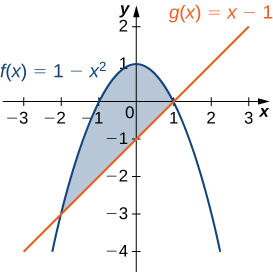
OpenStax, Rice University; Calculus Volume 1. · CC BY-NC-SA 4.0
Figure 6.70図 6.70
Finding the centroid of a region between two curves.
2曲線間の領域の図心を求める。
The graphs of the functions intersect at and so we integrate from −2 to 1. Once again, for the sake of convenience, assume
2つのグラフはとで交わるので、−2 から1まで積分する。今回も、計算を簡単にするためとする。
First, we need to calculate the total mass:
まず、全質量を計算する。
Next, we compute the moments:
次に、モーメントを計算する。
and
および
Therefore, we have
したがって、次の結果を得る。
The centroid of the region is
この領域の図心は である。