第6章積分の応用
6.8 Exponential Growth and Decay6.8 指数的増加と指数的減少
Learning Objectives学習目標
- Use the exponential growth model in applications, including population growth and compound interest.個体数の増加や複利などに、指数的増加のモデルを使う。
- Explain the concept of doubling time.倍加時間を説明する。
- Use the exponential decay model in applications, including radioactive decay and Newton’s law of cooling.放射性崩壊やニュートンの冷却の法則などに、指数的減少のモデルを使う。
- Explain the concept of half-life.半減期を説明する。
One of the most prevalent applications of exponential functions involves growth and decay models. Exponential growth and decay show up in a host of natural applications. From population growth and continuously compounded interest to radioactive decay and Newton’s law of cooling, exponential functions are ubiquitous in nature. In this section, we examine exponential growth and decay in the context of some of these applications.
英語のヒント
指数関数の代表的な応用に、増加と減少のモデルがある。人口増加、連続複利、放射性崩壊、ニュートンの冷却の法則など、さまざまな現象に指数関数が現れる。この節では、そのいくつかを通して指数的増加・減少を調べる。
Exponential Growth Model指数的増加のモデル
Many systems exhibit exponential growth. These systems follow a model of the form where represents the initial state of the system and is a positive constant, called the growth constant. Notice that in an exponential growth model, we have
指数的に増加する量は多く、という形のモデルに従う。は初期値、は増加定数と呼ばれる正の定数である。このモデルでは、次式が成り立つ。
That is, the rate of growth is proportional to the current function value. This is a key feature of exponential growth. Equation 6.27 involves derivatives and is called a differential equation. We learn more about differential equations in Introduction to Differential Equations.
Population growth is a common example of exponential growth. Consider a population of bacteria, for instance. It seems plausible that the rate of population growth would be proportional to the size of the population. After all, the more bacteria there are to reproduce, the faster the population grows. Figure 6.79 and Table 6.1 represent the growth of a population of bacteria with an initial population of bacteria and a growth constant of Notice that after only hours minutes), the population is times its original size!
英語のヒント
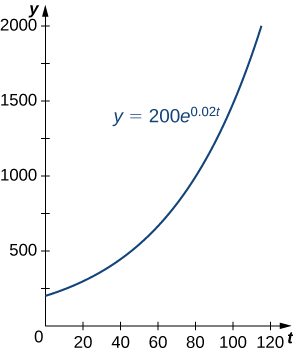
OpenStax, Rice University; Calculus Volume 1. · CC BY-NC-SA 4.0
Figure 6.79図 6.79
An example of exponential growth for bacteria.
細菌の個体数が指数的に増加する例。
Time (min) 時間(分) |
Population Size (no. of bacteria) 細菌の個体数 |
|---|---|
Note that we are using a continuous function to model what is inherently discrete behavior. At any given time, the real-world population contains a whole number of bacteria, although the model takes on noninteger values. When using exponential growth models, we must always be careful to interpret the function values in the context of the phenomenon we are modeling.
英語のヒント
本来は離散的な個体数を、連続関数で近似していることに注意しよう。実際の細菌の個体数は常に整数だが、モデルの値は整数とは限らない。指数的増加のモデルを使うときは、対象とする現象に合わせて関数の値を解釈する必要がある。
Example 6.42例題 6.42
Population Growth個体数の増加
Consider the population of bacteria described earlier. This population grows according to the function where t is measured in minutes. How many bacteria are present in the population after hours minutes)? When does the population reach bacteria?
先ほどの細菌の個体数を考える。に従って増加し、t の単位は分とする。時間分)後の個体数はいくらか。また、に達するのはいつか。
Solution解き方
We have Then
なので、次のようになる。
There are bacteria in the population after hours.
時間後の細菌の個体数はである。
To find when the population reaches bacteria, we solve the equation
に達する時刻を求めるには、次の方程式を解けばよい。
The population reaches bacteria after minutes.
分後に、細菌の個体数はに達する。
Let’s now turn our attention to a financial application: compound interest. Interest that is not compounded is called simple interest. Simple interest is paid once, at the end of the specified time period (usually year). So, if we put in a savings account earning simple interest per year, then at the end of the year we have
次に、金融への応用として複利を考える。利息にさらに利息を付けない計算方法を単利という。ここでは、指定期間(通常は年)の終わりに利息を1回受け取る場合を考える。年利の単利でを預けると、1年後には次の金額になる。
Compound interest is paid multiple times per year, depending on the compounding period. Therefore, if the bank compounds the interest every months, it credits half of the year’s interest to the account after months. During the second half of the year, the account earns interest not only on the initial but also on the interest earned during the first half of the year. Mathematically speaking, at the end of the year, we have
英語のヒント
複利では、決められた間隔で利息を元金に加え、その合計に次の利息を付ける。たとえばか月ごとに利息を加える場合、か月後に年利の半分の利息を受け取る。後半の半年では、最初のだけでなく、前半の利息にも利息が付く。1年後の金額は次のようになる。
Similarly, if the interest is compounded every months, we have
同様に、か月ごとに利息を加えると、次のようになる。
and if the interest is compounded daily times per year), we have If we extend this concept, so that the interest is compounded continuously, after years we have
毎日、すなわち年回)利息を加えると、1年後にはとなる。この間隔を限りなく短くした連続複利では、年後の金額は次式となる。
Now let’s manipulate this expression so that we have an exponential growth function. Recall that the number can be expressed as a limit:
この式を変形し、指数的増加の関数に書き直そう。数は、次の極限で表せる。
Based on this, we want the expression inside the parentheses to have the form Let Note that as as well. Then we get
そこで、括弧の中をの形にしたい。と置く。ならでもあるので、次のようになる。
We recognize the limit inside the brackets as the number So, the balance in our bank account after years is given by Generalizing this concept, we see that if a bank account with an initial balance of earns interest at a rate of compounded continuously, then the balance of the account after years is
角括弧内の極限はである。したがって、年後の口座残高はとなる。一般に、初めの残高がで、小数で表した年利(たとえば2%なら0.02)の連続複利なら、年後の残高は次式で表される。
Example 6.43例題 6.43
Compound Interest複利
A 25-year-old student is offered an opportunity to invest some money in a retirement account that pays annual interest compounded continuously. How much does the student need to invest today to have million when she retires at age What if she could earn annual interest compounded continuously instead?
英語のヒント
25歳の学生が、年利の連続複利で増える退職準備用の口座への投資を考えている。歳で退職するときに百万ドルを得るには、今いくら投資すればよいか。年利の連続複利なら、いくら必要か。
Solution解き方
We have
次の式が得られる。
She must invest at interest.
年利では、を投資する必要がある。
If, instead, she is able to earn then the equation becomes
代わりに年利を得られる場合、方程式は次のようになる。
In this case, she needs to invest only This is roughly two-thirds the amount she needs to invest at The fact that the interest is compounded continuously greatly magnifies the effect of the increase in interest rate.
英語のヒント
この場合、必要な投資額はである。年利の場合のおよそ3分の2で済む。利率のポイントの差も、長期間にわたる複利では大きな差になる。
If a quantity grows exponentially, the time it takes for the quantity to double remains constant. In other words, it takes the same amount of time for a population of bacteria to grow from to bacteria as it does to grow from to bacteria. This time is called the doubling time. To calculate the doubling time, we want to know when the quantity reaches twice its original size. So we have
英語のヒント
指数的に増加する量では、2倍になるまでの時間は一定である。たとえば細菌の個体数がからに増える時間と、からに増える時間は等しい。この時間を倍加時間という。倍加時間を求めるには、量が初期値の2倍になる時刻を求めればよい。
Example 6.44例題 6.44
Using the Doubling Time倍加時間を使う
Assume a population of fish grows exponentially. A pond is stocked initially with fish. After months, there are fish in the pond. The owner will allow his friends and neighbors to fish on his pond after the fish population reaches When will the owner’s friends be allowed to fish?
池の魚の個体数が指数的に増えるとする。初めに匹を放流したところ、か月後には匹になった。所有者は魚が匹になったら、友人や近所の人に釣りを許可するつもりである。いつから釣りができるか。
Solution解き方
We know it takes the population of fish months to double in size. So, if t represents time in months, by the doubling-time formula, we have Then, Thus, the population is given by To figure out when the population reaches fish, we must solve the following equation:
魚の個体数が2倍になるまでにか月かかる。時間 t の単位を月にとると、倍加時間の公式からであり、を得る。したがって、個体数はで表される。匹に達する時刻を求めるには、次の方程式を解く。
The owner’s friends have to wait months (a little more than years) to fish in the pond.
釣りができるまで、か月、すなわち年あまり待つ必要がある。