第6章積分の応用
6.3 Volumes of Revolution: Cylindrical Shells6.3 回転体の体積:円筒殻法
Learning Objectives学習目標
- Calculate the volume of a solid of revolution by using the method of cylindrical shells.円筒殻法を使って回転体の体積を求める。
- Compare the different methods for calculating a volume of revolution.回転体の体積を求める各方法を比較する。
In this section, we examine the method of cylindrical shells, the final method for finding the volume of a solid of revolution. We can use this method on the same kinds of solids as the disk method or the washer method; however, with the disk and washer methods, we integrate along the coordinate axis parallel to the axis of revolution. With the method of cylindrical shells, we integrate along the coordinate axis perpendicular to the axis of revolution. The ability to choose which variable of integration we want to use can be a significant advantage with more complicated functions. Also, the specific geometry of the solid sometimes makes the method of using cylindrical shells more appealing than using the washer method. In the last part of this section, we review all the methods for finding volume that we have studied and lay out some guidelines to help you determine which method to use in a given situation.
英語のヒント
この節では、回転体の体積を求める最後の方法として、円筒殻法を学ぶ。円板法や円環法で扱った立体にも使える方法だが、積分する方向が異なる。円板法・円環法では回転軸に平行な座標軸に沿って積分するのに対し、円筒殻法では回転軸に垂直な座標軸に沿って積分する。積分変数を選べることは、複雑な関数を扱う際に大きな利点となる。また、立体の形によっては円環法より円筒殻法が使いやすい。この節の最後では、これまでの体積の求め方を振り返り、状況に応じて方法を選ぶための指針をまとめる。
The Method of Cylindrical Shells円筒殻法
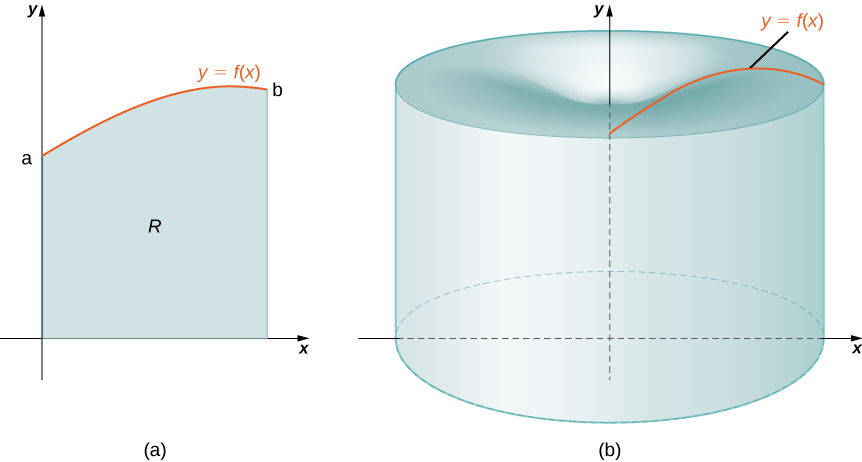
Again, we are working with a solid of revolution. As before, we define a region bounded above by the graph of a function below by the and on the left and right by the lines and respectively, as shown in Figure 6.25(a). We then revolve this region around the y-axis, as shown in Figure 6.25(b). Note that this is different from what we have done before. Previously, regions defined in terms of functions of were revolved around the or a line parallel to it.
OpenStax, Rice University; Calculus Volume 1. · CC BY-NC-SA 4.0
Figure 6.25図 6.25
(a) A region bounded by the graph of a function of (b) The solid of revolution formed when the region is revolved around the
(a) の関数のグラフで囲まれた領域。(b) この領域をの周りに回転させてできる回転体。
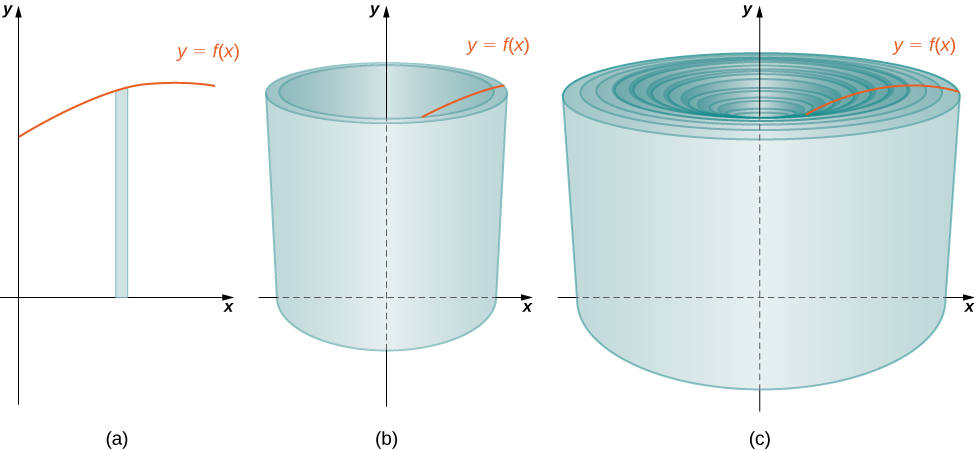
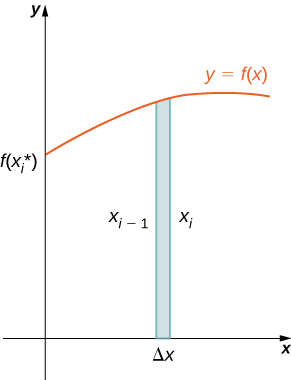
As we have done many times before, partition the interval using a regular partition, and, for choose a point Then, construct a rectangle over the interval of height and width A representative rectangle is shown in Figure 6.26(a). When that rectangle is revolved around the y-axis, instead of a disk or a washer, we get a cylindrical shell, as shown in the following figure.
これまでと同じように、区間を等分する分割をとり、について点を選ぶ。区間の上に、高さ、幅の長方形を作る。代表的な長方形を図6.26(a)に示す。これを y 軸の周りに回転させると、円板や円環ではなく、次の図のような薄い円筒の殻ができる。
OpenStax, Rice University; Calculus Volume 1. · CC BY-NC-SA 4.0
Figure 6.26図 6.26
(a) A representative rectangle. (b) When this rectangle is revolved around the the result is a cylindrical shell. (c) When we put all the shells together, we get an approximation of the original solid.
(a) 代表的な長方形。(b) この長方形をの周りに回転させると、円筒殻ができる。(c) すべての殻を合わせると、もとの立体を近似できる。
To calculate the volume of this shell, consider Figure 6.27.
この殻の体積を求めるために、図6.27を見よう。
OpenStax, Rice University; Calculus Volume 1. · CC BY-NC-SA 4.0
Figure 6.27図 6.27
Calculating the volume of the shell.
円筒殻の体積を求める。
The shell is a cylinder, so its volume is the cross-sectional area multiplied by the height of the cylinder. The cross-sections are annuli (ring-shaped regions—essentially, circles with a hole in the center), with outer radius and inner radius Thus, the cross-sectional area is The height of the cylinder is Then the volume of the shell is
英語のヒント
円筒殻の体積は、底面の面積に高さを掛ければ求められる。底面は外半径、内半径の円環、すなわち中心に穴のある円である。その面積はとなる。高さはなので、殻の体積は次のようになる。
Note that so we have
であることに注意すると、次式を得る。
Furthermore, is both the midpoint of the interval and the average radius of the shell, and we can approximate this by We then have
さらに、は区間の中点であり、殻の平均半径でもある。これをで近似すれば、次のようになる。
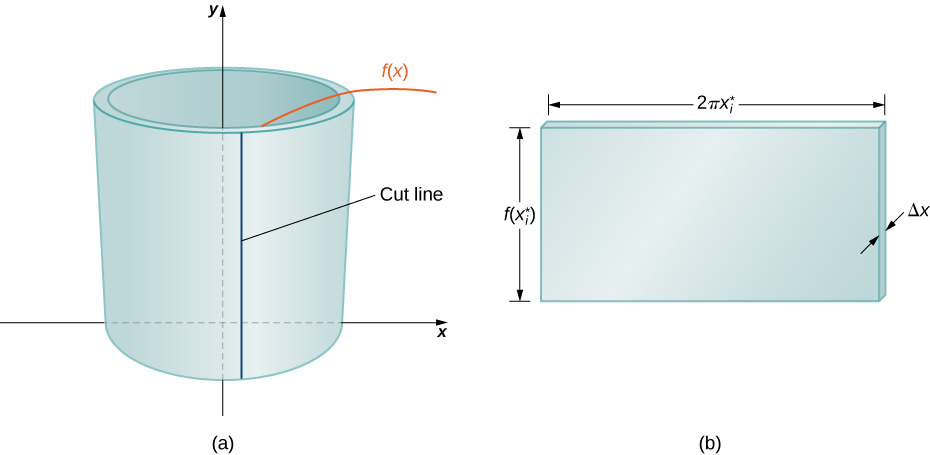
Another way to think of this is to think of making a vertical cut in the shell and then opening it up to form a flat plate (Figure 6.28).
英語のヒント
別の見方として、殻を縦に切り、平らな板になるように開くことを考えよう(図6.28)。
OpenStax, Rice University; Calculus Volume 1. · CC BY-NC-SA 4.0
Figure 6.28図 6.28
(a) Make a vertical cut in a representative shell. (b) Open the shell up to form a flat plate.
(a) 代表的な殻を縦に切る。(b) 殻を開いて平らな板にする。
In reality, the outer radius of the shell is greater than the inner radius, and hence the back edge of the plate would be slightly longer than the front edge of the plate. However, we can approximate the flattened shell by a flat plate of height width and thickness (Figure 6.28). The volume of the shell, then, is approximately the volume of the flat plate. Multiplying the height, width, and depth of the plate, we get
英語のヒント
実際には外半径の方が内半径より大きいため、板の奥側の辺は手前の辺より少し長くなる。それでも、高さ、幅、厚さの平らな板で近似できる(図6.28)。殻の体積は、この板の体積にほぼ等しい。高さ・幅・厚さを掛け合わせると、次の式を得る。
which is the same formula we had before.
これは先ほどと同じ式である。
To calculate the volume of the entire solid, we then add the volumes of all the shells and obtain
立体全体の体積を求めるために、すべての殻の体積を足し合わせる。
Here we have another Riemann sum, this time for the function Taking the limit as gives us
ここにもリーマン和が現れた。今回は関数のリーマン和である。の極限をとると、次のようになる。
This leads to the following rule for the method of cylindrical shells.
こうして、円筒殻法の公式が得られる。
Now let’s consider an example.
例題を見てみよう。
Example 6.12例題 6.12
The Method of Cylindrical Shells 1円筒殻法 1
Define as the region bounded above by the graph of and below by the over the interval Find the volume of the solid of revolution formed by revolving around the
区間 上で、上を のグラフ、下を で囲まれた領域を とする。 を のまわりに回転させてできる回転体の体積を求めよ。
Solution解き方
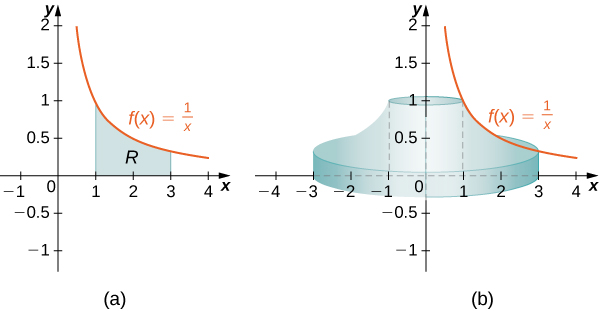
First we must graph the region and the associated solid of revolution, as shown in the following figure.
まず、領域と、それを回転させてできる立体を図に描く。
OpenStax, Rice University; Calculus Volume 1. · CC BY-NC-SA 4.0
Figure 6.29図 6.29
(a) The region under the graph of over the interval (b) The solid of revolution generated by revolving about the
(a) 区間で、のグラフの下にある領域。(b) をの周りに回転させてできる回転体。
Then the volume of the solid is given by
すると、立体の体積は次の式で与えられる。
Example 6.13例題 6.13
The Method of Cylindrical Shells 2円筒殻法 2
Define R as the region bounded above by the graph of and below by the over the interval Find the volume of the solid of revolution formed by revolving around the
区間で、上をのグラフ、下をで囲まれた領域を R とする。をの周りに回転させてできる立体の体積を求めよ。
Solution解き方
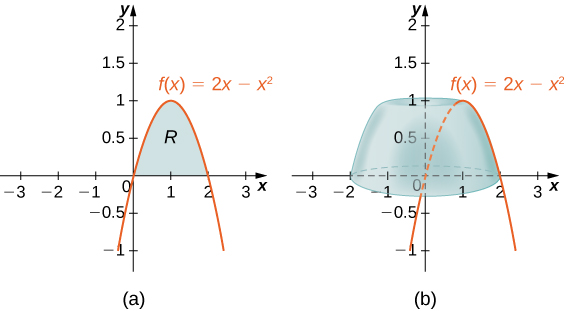
First graph the region and the associated solid of revolution, as shown in the following figure.
まず、領域と、それを回転させてできる立体を次の図のように描く。
OpenStax, Rice University; Calculus Volume 1. · CC BY-NC-SA 4.0
Figure 6.30図 6.30
(a) The region under the graph of over the interval (b) The volume of revolution obtained by revolving about the
(a) 区間で、のグラフの下にある領域。(b) をの周りに回転させてできる回転体。
Then the volume of the solid is given by
すると、立体の体積は次の式で与えられる。
As with the disk method and the washer method, we can use the method of cylindrical shells with solids of revolution, revolved around the when we want to integrate with respect to The analogous rule for this type of solid is given here.
英語のヒント
円板法・円環法と同様に、の周りの回転体にも円筒殻法を使える。その場合はについて積分する。対応する公式は次のとおりである。
Example 6.14例題 6.14
The Method of Cylindrical Shells for a Solid Revolved around the x-axisx 軸の周りの回転体を円筒殻法で求める
Define as the region bounded on the right by the graph of and on the left by the for Find the volume of the solid of revolution formed by revolving around the x-axis.
の範囲で、右をのグラフ、左をで囲まれた領域をとする。を x 軸の周りに回転させてできる立体の体積を求めよ。
Solution解き方
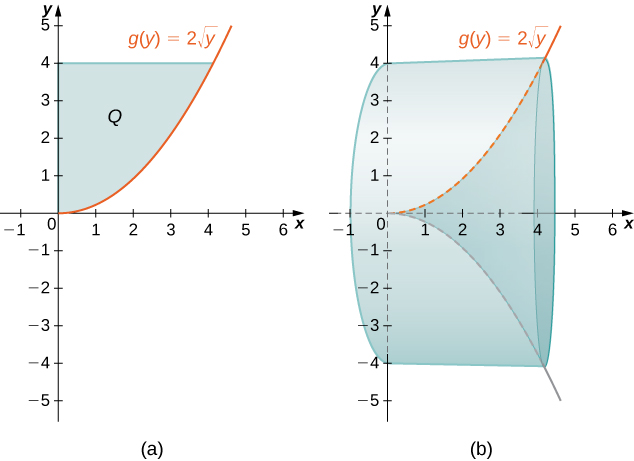
First, we need to graph the region and the associated solid of revolution, as shown in the following figure.
まず、領域と、それを回転させてできる立体を次の図のように描く。
OpenStax, Rice University; Calculus Volume 1. · CC BY-NC-SA 4.0
Figure 6.31図 6.31
(a) The region to the left of the function over the interval (b) The solid of revolution generated by revolving around the
(a) 区間で、関数のグラフの左側にある領域。(b) をの周りに回転させてできる回転体。
Label the shaded region Then the volume of the solid is given by
色を付けた領域をとする。立体の体積は次式で与えられる。
For the next example, we look at a solid of revolution for which the graph of a function is revolved around a line other than one of the two coordinate axes. To set this up, we need to revisit the development of the method of cylindrical shells. Recall that we found the volume of one of the shells to be given by
英語のヒント
次は、座標軸以外の直線の周りに領域を回転させる例を考える。その準備として、円筒殻法を導いた過程に戻ろう。1枚の殻の体積は、次の式で与えられた。
This was based on a shell with an outer radius of and an inner radius of If, however, we rotate the region around a line other than the we have a different outer and inner radius. Suppose, for example, that we rotate the region around the line where is some positive constant. Then, the outer radius of the shell is and the inner radius of the shell is Substituting these terms into the expression for volume, we see that when a plane region is rotated around the line the volume of a shell is given by
この式は外半径、内半径の殻から得たものである。しかし、以外の直線の周りに回転させれば、内外の半径は変わる。たとえば、正の定数に対して、直線の周りに回転させるとしよう。外半径は、内半径はとなる。これらを体積の式に代入すると、直線の周りに回転させた殻の体積は次式となる。
As before, we notice that is the midpoint of the interval and can be approximated by Then, the approximate volume of the shell is
先ほどと同じく、は区間の中点であり、で近似できる。したがって、殻の体積の近似値は次のようになる。
The remainder of the development proceeds as before, and we see that
あとは以前と同じ手順で、次式を得る。
We could also rotate the region around other horizontal or vertical lines, such as a vertical line in the right half plane. In each case, the volume formula must be adjusted accordingly. Specifically, the in the integral must be replaced with an expression representing the radius of a shell. To see how this works, consider the following example.
英語のヒント
右半平面にある鉛直線など、別の水平線や鉛直線の周りに回転させることもできる。どの場合も、回転軸に合わせて体積の公式を調整する必要がある。具体的には、積分のを、殻の半径を表す式に置き換える。次の例で確かめよう。
Example 6.15例題 6.15
A Region of Revolution Revolved around a Line座標軸以外の直線の周りに回転させる
Define as the region bounded above by the graph of and below by the over the interval Find the volume of the solid of revolution formed by revolving around the line
区間 上で、上を のグラフ、下を で囲まれた領域を とする。 を直線 のまわりに回転させてできる回転体の体積を求めよ。
Solution解き方
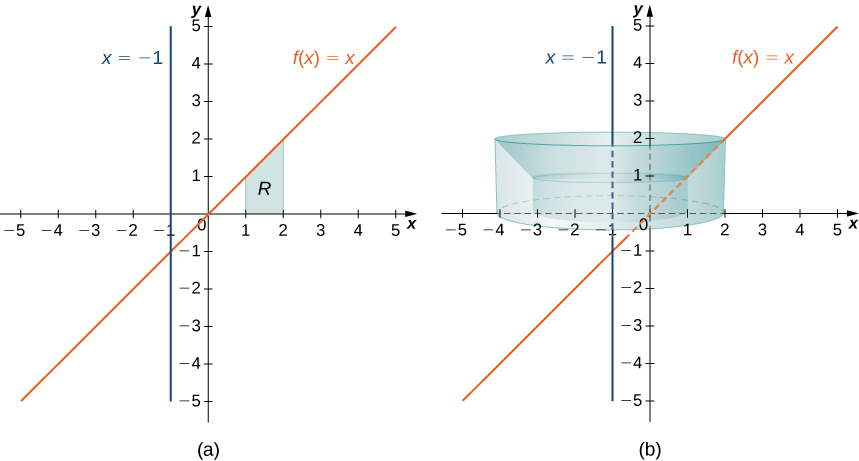
First, graph the region and the associated solid of revolution, as shown in the following figure.
まず、次の図のように、領域 と対応する回転体を描く。
OpenStax, Rice University; Calculus Volume 1. · CC BY-NC-SA 4.0
Figure 6.32図 6.32
(a) The region between the graph of and the over the interval (b) The solid of revolution generated by revolving around the line
(a) 区間で、のグラフとの間にある領域。(b) を直線の周りに回転させてできる回転体。
Note that the radius of a shell is given by Then the volume of the solid is given by
殻の半径はである。したがって、立体の体積は次式で与えられる。
For our final example in this section, let’s look at the volume of a solid of revolution for which the region of revolution is bounded by the graphs of two functions.
この節の最後の例では、2つの関数のグラフで囲まれた領域を回転させてできる立体の体積を求める。
Example 6.16例題 6.16
A Region of Revolution Bounded by the Graphs of Two Functions2つの関数のグラフで囲まれた領域の回転
Define as the region bounded above by the graph of the function and below by the graph of the function over the interval Find the volume of the solid of revolution generated by revolving around the
区間で、上を関数のグラフ、下を関数のグラフで囲まれた領域をとする。をの周りに回転させてできる立体の体積を求めよ。
Solution解き方
First, graph the region and the associated solid of revolution, as shown in the following figure.
まず、次の図のように、領域 と対応する回転体を描く。
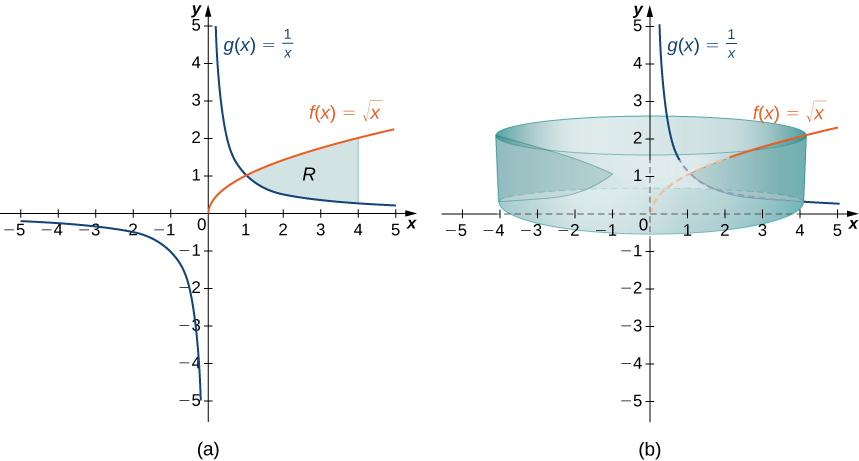
OpenStax, Rice University; Calculus Volume 1. · CC BY-NC-SA 4.0
Figure 6.33図 6.33
(a) The region between the graph of and the graph of over the interval (b) The solid of revolution generated by revolving around the
(a) 区間で、とのグラフの間にある領域。(b) をの周りに回転させてできる回転体。
Note that the axis of revolution is the so the radius of a shell is given simply by We don’t need to make any adjustments to the x-term of our integrand. The height of a shell, though, is given by so in this case we need to adjust the term of the integrand. Then the volume of the solid is given by
回転軸はなので、殻の半径はそのままとなる。被積分関数の x の部分を変える必要はない。一方、殻の高さはであるため、の部分は変更する。こうして、立体の体積は次式となる。