第6章積分の応用
6.7 Integrals, Exponential Functions, and Logarithms6.7 積分・指数関数・対数
Learning Objectives学習目標
- Write the definition of the natural logarithm as an integral.自然対数の定義を積分で書く。
- Recognize the derivative of the natural logarithm.自然対数の導関数を理解する。
- Integrate functions involving the natural logarithmic function.自然対数に関係する関数を積分する。
- Define the number through an integral.積分を使って数を定義する。
- Recognize the derivative and integral of the exponential function.指数関数の導関数と積分を理解する。
- Prove properties of logarithms and exponential functions using integrals.積分を用いて、対数と指数関数の性質を証明する。
- Express general logarithmic and exponential functions in terms of natural logarithms and exponentials.一般の対数関数と指数関数を、自然対数と自然指数関数で表す。
We already examined exponential functions and logarithms in earlier chapters. However, we glossed over some key details in the previous discussions. For example, we did not study how to treat exponential functions with exponents that are irrational. The definition of the number e is another area where the previous development was somewhat incomplete. We now have the tools to deal with these concepts in a more mathematically rigorous way, and we do so in this section.
英語のヒント
指数関数と対数は、すでに前の章で扱った。しかし、そのときは重要な細部をいくつか省いていた。たとえば、指数が無理数であるとき、指数関数をどう定義するかは扱っていない。数 e の定義も、十分厳密には導いていなかった。今は、これらを数学的に厳密に扱う道具がそろっている。この節では、そこを改めて確かめる。
For purposes of this section, assume we have not yet defined the natural logarithm, the number e, or any of the integration and differentiation formulas associated with these functions. By the end of the section, we will have studied these concepts in a mathematically rigorous way (and we will see they are consistent with the concepts we learned earlier).
英語のヒント
この節では、自然対数、数 e、および関連する微分・積分の公式を、まだ定義していないものとして議論を始める。節の終わりには、これらを数学的に厳密に構成し、以前に学んだ内容と一致することを確かめられる。
We begin the section by defining the natural logarithm in terms of an integral. This definition forms the foundation for the section. From this definition, we derive differentiation formulas, define the number and expand these concepts to logarithms and exponential functions of any base.
英語のヒント
まず、積分を使って自然対数を定義する。この定義が、節全体の土台となる。そこから微分公式を導き、数を定義し、さらに一般の底をもつ対数関数と指数関数へと広げる。
The Natural Logarithm as an Integral積分としての自然対数
Recall the power rule for integrals:
べき関数の積分公式を思い出そう。
Clearly, this does not work when as it would force us to divide by zero. So, what do we do with Recall from the Fundamental Theorem of Calculus that is an antiderivative of Therefore, we can make the following definition.
のときは、0で割ることになるので、この公式を使えない。それではをどう扱えばよいだろう。微積分の基本定理により、はの原始関数である。そこで、次のように定義する。
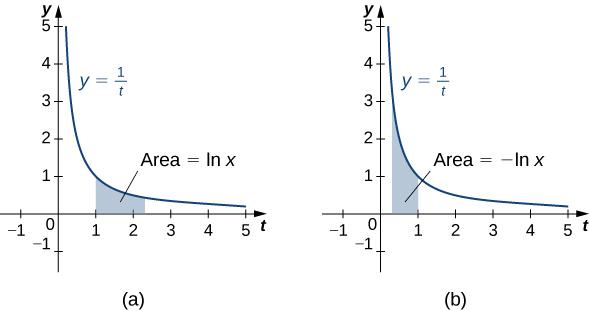
For this is just the area under the curve from to For we have so in this case it is the negative of the area under the curve from (see the following figure).
なら、これは曲線の下にある、からまでの面積である。正の x がを満たす場合はなので、までの曲線下の面積に、負号を付けた値となる。次の図を見よう。
OpenStax, Rice University; Calculus Volume 1. · CC BY-NC-SA 4.0
Figure 6.75図 6.75
(a) When the natural logarithm is the area under the curve from (b) When the natural logarithm is the negative of the area under the curve from to
(a) のとき、自然対数は曲線の下の、までの面積。(b) 正の x がを満たすときは、からまでの曲線下の面積の負の値。
Notice that Furthermore, the function for Therefore, by the properties of integrals, it is clear that is increasing for
まずである。また、の範囲に対応する正の t では、である。積分の性質から、はで増加することが分かる。
Properties of the Natural Logarithm自然対数の性質
Because of the way we defined the natural logarithm, the following differentiation formula falls out immediately as a result of to the Fundamental Theorem of Calculus.
英語のヒント
自然対数を積分で定義したので、微積分の基本定理から、次の微分公式が直ちに得られる。
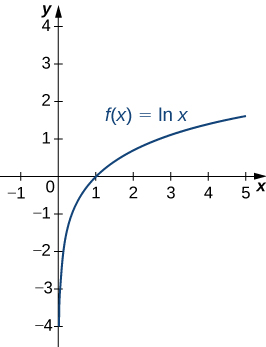
A graph of is shown in Figure 6.76. Notice that it is continuous throughout its domain of
のグラフを図6.76に示す。定義域全体で連続であることに注意しよう。
OpenStax, Rice University; Calculus Volume 1. · CC BY-NC-SA 4.0
Figure 6.76図 6.76
The graph of shows that it is a continuous function.
のグラフは、連続な関数であることを示している。
Example 6.35例題 6.35
Calculating Derivatives of Natural Logarithms自然対数を含む関数の導関数を求める
Calculate the following derivatives:
次の導関数を計算せよ。
Solution解き方
We need to apply the chain rule in both cases.
どちらの場合も連鎖律を使う。
Note that if we use the absolute value function and create a new function we can extend the domain of the natural logarithm to include Then This gives rise to the familiar integration formula.
英語のヒント
絶対値を使って新しい関数を作れば、も定義域に含められる。x≠0 でが成り立つため、よく知っている次の積分公式が得られる。
Example 6.36例題 6.36
Calculating Integrals Involving Natural Logarithms自然対数を用いる積分を求める
Calculate the integral
積分 を計算せよ。
Solution解き方
Using -substitution, let Then and we have
による置換を用い、 とおく。すると となり、次のようになる。
Although we have called our function a “logarithm,” we have not actually proved that any of the properties of logarithms hold for this function. We do so here.
英語のヒント
この関数を「対数」と呼んできたが、対数の性質が成り立つことはまだ証明していない。ここで確かめよう。
Proof証明
i. By definition,
i. 定義よりである。
ii. We have
ii. 次のように式を分けられる。
Use on the last integral in this expression. Let Then Furthermore, when and when So we get
この式の最後の積分にを使う。と置くとである。また、であり、となる。したがって、次式を得る。
iv. Note that
iv. まず、次式が成り立つ。
Furthermore,
また、次式も成り立つ。
Since the derivatives of these two functions are the same, by the Fundamental Theorem of Calculus, they must differ by a constant. So we have
2つの関数の導関数が同じなので、その差は定数である。したがって、次式が成り立つ。
for some constant Taking we get
ここでは定数である。を代入すると、次式を得る。
Thus and the proof is complete. Note that we can extend this property to irrational values of later in this section.
Part iii. follows from parts ii. and iv. and the proof is left to you.
よってとなり、証明が終わる。この節の後半では、が無理数の場合にも性質を広げる。iii は ii と iv から導けるので、各自で証明してみよう。
□
□
Example 6.37例題 6.37
Using Properties of Logarithms対数の性質を使う
Use properties of logarithms to simplify the following expression into a single logarithm:
対数の性質を使い、次の式を一つの対数で表せ。
Solution解き方
We have
次の式が得られる。