第6章積分の応用
Arc Length of the Curve x = g(y)曲線 x=g(y) の弧長
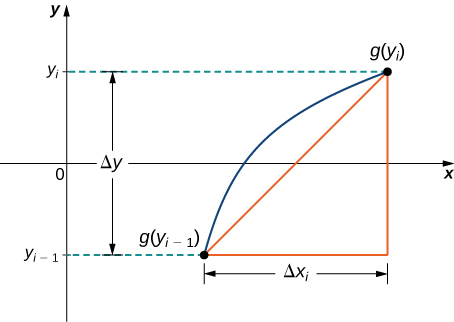
We have just seen how to approximate the length of a curve with line segments. If we want to find the arc length of the graph of a function of we can repeat the same process, except we partition the instead of the Figure 6.39 shows a representative line segment.
曲線を線分で近似して長さを求める方法を見た。の関数の弧長を求めるときも、の代わりにを分割すれば、同じ手順が使える。代表的な線分を図6.39に示す。
OpenStax, Rice University; Calculus Volume 1. · CC BY-NC-SA 4.0
Figure 6.39図 6.39
A representative line segment over the interval
区間に対応する代表的な線分。
Then the length of the line segment is which can also be written as If we now follow the same development we did earlier, we get a formula for arc length of a function
この線分の長さはであり、とも書ける。先ほどと同じように議論を進めると、関数の弧長の公式を得る。
Example 6.20例題 6.20
Calculating the Arc Length of a Function of yy の関数の弧長を求める
Let Calculate the arc length of the graph of over the interval
とする。区間 上の のグラフの弧長を求めよ。
Solution解き方
We have so Then the arc length is
なので、である。したがって弧長は、次式で与えられる。
Using a computer to approximate the value of this integral, we obtain
コンピューターでこの積分を近似計算すると、次の値を得る。
Area of a Surface of Revolution回転曲面の面積
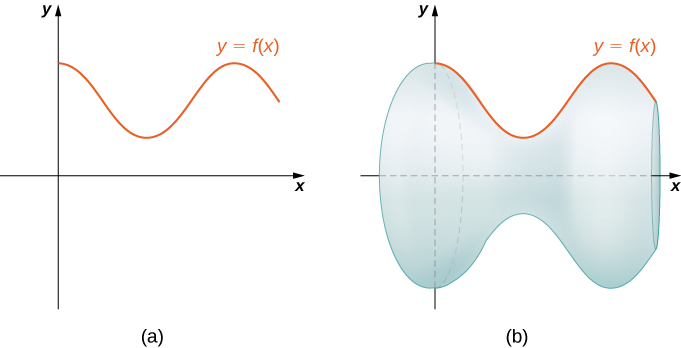
The concepts we used to find the arc length of a curve can be extended to find the surface area of a surface of revolution. Surface area is the total area of the outer layer of an object. For objects such as cubes or bricks, the surface area of the object is the sum of the areas of all of its faces. For curved surfaces, the situation is a little more complex. Let be a nonnegative smooth function over the interval We wish to find the surface area of the surface of revolution created by revolving the graph of around the as shown in the following figure.
弧長を求める考え方は、回転曲面の面積にも応用できる。表面積とは、物体の外側を覆う面の面積の合計である。立方体やれんがなら、すべての面の面積を足せばよい。曲面では、もう少し工夫が必要になる。区間上で非負の値をとる滑らかな関数を考える。次の図のように、のグラフをの周りに回転させてできる曲面の面積を求めよう。
OpenStax, Rice University; Calculus Volume 1. · CC BY-NC-SA 4.0
Figure 6.40図 6.40
(a) A curve representing the function (b) The surface of revolution formed by revolving the graph of around the
(a) 関数を表す曲線。(b) のグラフをの周りに回転させてできる回転曲面。
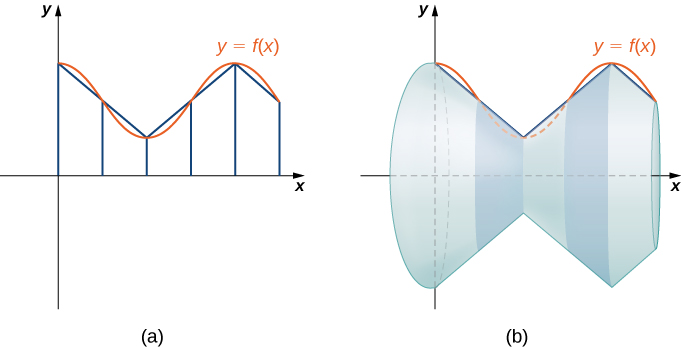
As we have done many times before, we are going to partition the interval and approximate the surface area by calculating the surface area of simpler shapes. We start by using line segments to approximate the curve, as we did earlier in this section. For let be a regular partition of Then, for construct a line segment from the point to the point Now, revolve these line segments around the to generate an approximation of the surface of revolution as shown in the following figure.
これまでと同じように、区間を分割し、簡単な図形の面積を足し合わせて曲面の面積を近似する。この節の前半で弧長を求めたときと同じく、まず曲線を線分で近似する。として、を区間の等分割とする。について、点と点を結ぶ線分を引く。これらをの周りに回転させると、次の図のように回転曲面を近似できる。
OpenStax, Rice University; Calculus Volume 1. · CC BY-NC-SA 4.0
Figure 6.41図 6.41
(a) Approximating with line segments. (b) The surface of revolution formed by revolving the line segments around the
(a) を線分で近似する。(b) その線分をの周りに回転させてできる曲面。
Notice that when each line segment is revolved around the axis, it produces a band. These bands are actually pieces of cones (think of an ice cream cone with the pointy end cut off). A piece of a cone like this is called a frustum of a cone.
英語のヒント
各線分を回転させると、帯状の面ができる。これらは円錐の一部である。アイスクリームのコーンの先端を切り落とした形を思い浮かべればよい。このような形を円錐台という。
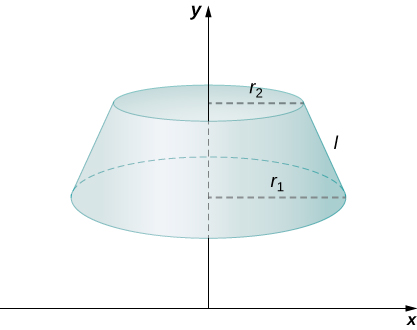
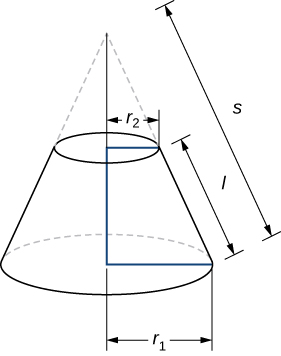
To find the surface area of the band, we need to find the lateral surface area, of the frustum (the area of just the slanted outside surface of the frustum, not including the areas of the top or bottom faces). Let and be the radii of the wide end and the narrow end of the frustum, respectively, and let be the slant height of the frustum as shown in the following figure.
英語のヒント
帯の面積は、円錐台の側面積である。上底・下底の面積は含めず、傾いた外側の面だけを数える。太い方と細い方の端の半径を、それぞれ、とし、斜めの辺の長さ、すなわち母線の長さをとする。次の図を見よう。
OpenStax, Rice University; Calculus Volume 1. · CC BY-NC-SA 4.0
Figure 6.42図 6.42
A frustum of a cone can approximate a small part of surface area.
曲面の小さな一部分を、円錐台の側面で近似できる。
We know the lateral surface area of a cone is given by
円錐の側面積は、次式で与えられる。
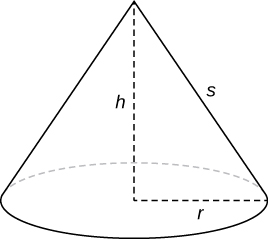
where is the radius of the base of the cone and is the slant height (see the following figure).
ここでは底面の半径、は母線の長さである。次の図を見よう。
OpenStax, Rice University; Calculus Volume 1. · CC BY-NC-SA 4.0
Figure 6.43図 6.43
The lateral surface area of the cone is given by
円錐の側面積はである。
Since a frustum can be thought of as a piece of a cone, the lateral surface area of the frustum is given by the lateral surface area of the whole cone less the lateral surface area of the smaller cone (the pointy tip) that was cut off (see the following figure).
英語のヒント
円錐台は円錐の一部分なので、大きな円錐全体の側面積から、切り落とした小さな円錐の側面積を引けばよい。次の図を見よう。
OpenStax, Rice University; Calculus Volume 1. · CC BY-NC-SA 4.0
Figure 6.44図 6.44
Calculating the lateral surface area of a frustum of a cone.
円錐台の側面積を求める。
The cross-sections of the small cone and the large cone are similar triangles, so we see that
小さな円錐と大きな円錐を軸に沿って切った断面は、相似な三角形である。したがって、次式が成り立つ。
Solving for we get
について解くと、次式を得る。
Then the lateral surface area (SA) of the frustum is
よって、円錐台の側面積 SA は次のようになる。
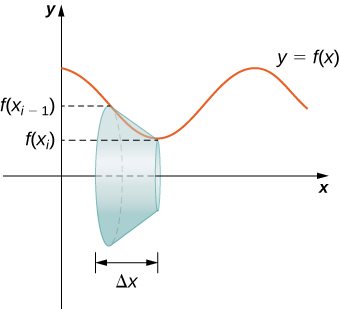
Let’s now use this formula to calculate the surface area of each of the bands formed by revolving the line segments around the A representative band is shown in the following figure.
この公式を使い、線分をの周りに回転させた各帯の面積を求めよう。代表的な帯を次の図に示す。
OpenStax, Rice University; Calculus Volume 1. · CC BY-NC-SA 4.0
Figure 6.45図 6.45
A representative band used for determining surface area.
曲面の面積を求めるために使う、代表的な帯。
Note that the slant height of this frustum is just the length of the line segment used to generate it. So, applying the surface area formula, we have
この円錐台の母線の長さは、回転させた線分の長さそのものである。側面積の公式を適用すると、次式になる。
Now, as we did in the development of the arc length formula, we apply the Mean Value Theorem to select such that This gives us
弧長の公式を導いたときと同じように、平均値の定理を使うと、を満たす点を選べる。したがって、次式を得る。
Furthermore, since is continuous, by the Intermediate Value Theorem, there is a point such that so we get
さらに、は連続なので、中間値の定理より、を満たす点が存在する。これを使うと、次のようになる。
Then the approximate surface area of the whole surface of revolution is given by
回転曲面全体の面積の近似値は、各帯の面積を足した次の式で与えられる。
This almost looks like a Riemann sum, except we have functions evaluated at two different points, and over the interval Although we do not examine the details here, it turns out that because is smooth, if we let the limit works the same as a Riemann sum even with the two different evaluation points. This makes sense intuitively. Both and are in the interval so it makes sense that as both and approach Those of you who are interested in the details should consult an advanced calculus text.
英語のヒント
リーマン和とほぼ同じ形だが、1つの区間の中で、関数を評価する点がとの2つに分かれている。詳しい証明は省くが、が滑らかなので、の極限では、この違いがあっても通常のリーマン和と同じ結果になる。直観的にも、とは同じ区間にある。として区間の幅を0に近づければ、との隔たりも0に近づき、積分では共通の変数で表せるようになる。詳しく知りたい場合は、より進んだ微積分の教科書を参照してほしい。
Taking the limit as we get
の極限をとると、次式を得る。
As with arc length, we can conduct a similar development for functions of to get a formula for the surface area of surfaces of revolution about the These findings are summarized in the following theorem.
弧長の場合と同じく、の関数にも同様の議論ができる。そこから、の周りの回転曲面の面積を求める公式が得られる。結果を次の定理にまとめる。
Example 6.21例題 6.21
Calculating the Surface Area of a Surface of Revolution 1回転曲面の面積を求める 1
Let over the interval Find the surface area of the surface generated by revolving the graph of around the Round the answer to three decimal places.
区間 上で とする。 のグラフを のまわりに回転させてできる曲面の表面積を求めよ。小数第4位を四捨五入して小数第3位まで答えよ。
Solution解き方
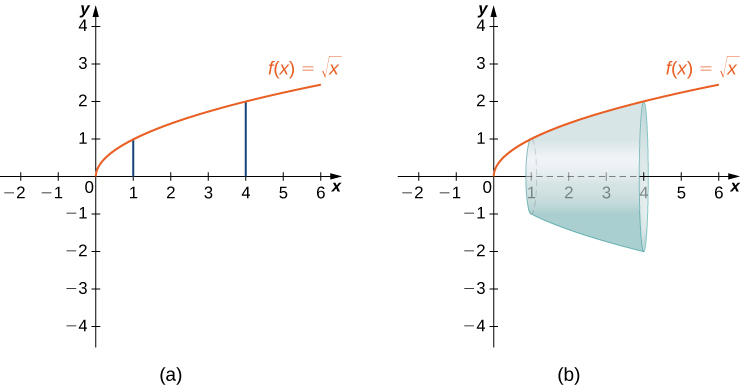
The graph of and the surface of rotation are shown in the following figure.
のグラフと、それを回転させてできる曲面を次の図に示す。
OpenStax, Rice University; Calculus Volume 1. · CC BY-NC-SA 4.0
Figure 6.46図 6.46
(a) The graph of (b) The surface of revolution.
(a) のグラフ。(b) 回転曲面。
We have Then, and Then,
だから、、である。したがって、次のようになる。
Let Then, When and when This gives us
と置くと、となる。のとき、のときである。よって、次式を得る。
Example 6.22例題 6.22
Calculating the Surface Area of a Surface of Revolution 2回転曲面の面積を求める 2
Let Consider the portion of the curve where Find the surface area of the surface generated by revolving the graph of around the
とする。曲線のうち、の部分を考える。のグラフをの周りに回転させてできる曲面の面積を求めよ。
Solution解き方
Notice that we are revolving the curve around the and the interval is in terms of so we want to rewrite the function as a function of y. We get The graph of and the surface of rotation are shown in the following figure.
回転軸はであり、区間もで指定されている。そこで、x を y の関数として表し直すと、となる。のグラフと回転曲面を次の図に示す。
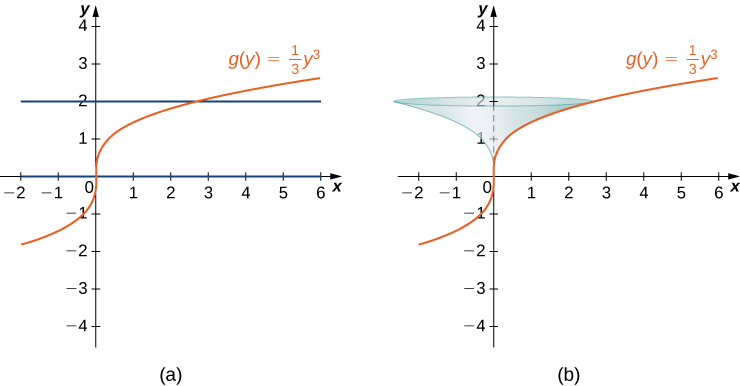
OpenStax, Rice University; Calculus Volume 1. · CC BY-NC-SA 4.0
Figure 6.47図 6.47
(a) The graph of (b) The surface of revolution.
(a) のグラフ。(b) 回転曲面。
We have so and Then
なので、、である。したがって、次のようになる。
Let Then When and when Then
と置くと、となる。のとき、のときである。よって、次式を得る。