第6章積分の応用
6.6 Moments and Centers of Mass6.6 モーメントと重心
Learning Objectives学習目標
- Find the center of mass of objects distributed along a line.一直線上に分布する物体の重心を求める。
- Locate the center of mass of a thin plate.薄板の重心を求める。
- Use symmetry to help locate the centroid of a thin plate.対称性を利用して薄板の図心を求める。
- Apply the theorem of Pappus for volume.体積に関するパップスの定理を使う。
In this section, we consider centers of mass (also called centroids, under certain conditions) and moments. The basic idea of the center of mass is the notion of a balancing point. Many of us have seen performers who spin plates on the ends of sticks. The performers try to keep several of them spinning without allowing any of them to drop. If we look at a single plate (without spinning it), there is a sweet spot on the plate where it balances perfectly on the stick. If we put the stick anywhere other than that sweet spot, the plate does not balance and it falls to the ground. (That is why performers spin the plates; the spin helps keep the plates from falling even if the stick is not exactly in the right place.) Mathematically, that sweet spot is called the center of mass of the plate.
英語のヒント
この節では、質量の中心、すなわち重心と、モーメントを考える。一定の条件のもとでは、重心は図形の幾何学的な中心である図心にも一致する。重心の基本的なイメージは、そこで支えると釣り合う点である。棒の先で皿を回す芸を見たことがあるだろう。芸人は何枚もの皿を、落とさずに回し続ける。1枚の皿を回さずに考えると、棒で支えたときにちょうど釣り合う位置がある。そこから外れると皿は傾いて落ちる。回転させるのは、支える位置が少しずれても落ちにくくするためである。数学的には、この釣り合いの位置が皿の重心に当たる。
In this section, we first examine these concepts in a one-dimensional context, then expand our development to consider centers of mass of two-dimensional regions and symmetry. Last, we use centroids to find the volume of certain solids by applying the theorem of Pappus.
まず1次元で重心とモーメントを調べ、それから2次元の領域へ広げて、対称性との関係を考える。最後に、パップスの定理を使い、図心から回転体の体積を求める。
Center of Mass and Moments重心とモーメント
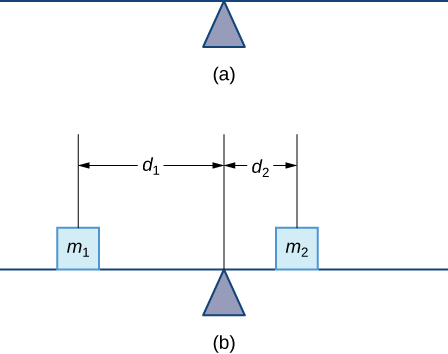
Let’s begin by looking at the center of mass in a one-dimensional context. Consider a long, thin wire or rod of negligible mass resting on a fulcrum, as shown in Figure 6.62(a). Now suppose we place objects having masses and at distances and from the fulcrum, respectively, as shown in Figure 6.62(b).
英語のヒント
OpenStax, Rice University; Calculus Volume 1. · CC BY-NC-SA 4.0
Figure 6.62図 6.62
(a) A thin rod rests on a fulcrum. (b) Masses are placed on the rod.
(a) 支点で支えた細い棒。(b) 棒の上に物体を置く。
The most common real-life example of a system like this is a playground seesaw, or teeter-totter, with children of different weights sitting at different distances from the center. On a seesaw, if one child sits at each end, the heavier child sinks down and the lighter child is lifted into the air. If the heavier child slides in toward the center, though, the seesaw balances. Applying this concept to the masses on the rod, we note that the masses balance each other if and only if
英語のヒント
身近な例は、体重の違う子どもが異なる位置に座るシーソーである。両端に1人ずつ座ると、重い子どもの側が下がり、軽い子どもの側が上がる。しかし、重い子どもが中央に近づけば釣り合う。棒の上の物体についても、釣り合うための必要十分条件はである。
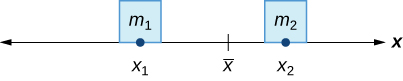
In the seesaw example, we balanced the system by moving the masses (children) with respect to the fulcrum. However, we are really interested in systems in which the masses are not allowed to move, and instead we balance the system by moving the fulcrum. Suppose we have two point masses, and located on a number line at points and respectively (Figure 6.63). The center of mass, is the point where the fulcrum should be placed to make the system balance.
英語のヒント
シーソーでは、支点を動かさず、子どもの位置を変えて釣り合わせた。しかし、これから考えたいのは、物体の位置が固定され、支点を動かして釣り合わせる場合である。数直線上の位置、に、質量、の質点があるとする(図6.63)。全体が釣り合う支点の位置を、この系の重心という。
OpenStax, Rice University; Calculus Volume 1. · CC BY-NC-SA 4.0
Figure 6.63図 6.63
The center of mass is the balance point of the system.
重心は、系が釣り合う点である。
Thus, we have
したがって、次の式が得られる。
The expression in the numerator, is called the first moment of the system with respect to the origin. If the context is clear, we often drop the word first and just refer to this expression as the moment of the system. The expression in the denominator, is the total mass of the system. Thus, the center of mass of the system is the point at which the total mass of the system could be concentrated without changing the moment.
英語のヒント
分子のを、原点に関する系の1次モーメントという。文脈から明らかな場合は、「1次」を省いて単にモーメントと呼ぶ。分母のは、系全体の質量である。したがって重心とは、すべての質量をそこに集めてもモーメントが変わらない点、と捉えることもできる。
This idea is not limited just to two point masses. In general, if n masses, are placed on a number line at points respectively, then the center of mass of the system is given by
この考え方は2つの質点に限らない。一般に、n 個の質点が数直線上の位置にそれぞれ置かれているなら、系の重心は次式で与えられる。
We apply this theorem in the following example.
次の例題で、この定理を使ってみよう。
Example 6.29例題 6.29
Finding the Center of Mass of Objects along a Line一直線上の質点系の重心を求める
Suppose four point masses are placed on a number line as follows:
四つの質点が数直線上に次のように置かれているとする。
Find the moment of the system with respect to the origin and find the center of mass of the system.
この質点系の原点に関するモーメントと、重心を求めよ。
Solution解き方
First, we need to calculate the moment of the system:
まず、系のモーメントを計算する。
Now, to find the center of mass, we need the total mass of the system:
重心を求めるには、系全体の質量も必要である。
Then we have
すると、次の式が得られる。
The center of mass is located 1/2 m to the left of the origin.
重心は、原点から左へ1/2 m の位置にある。
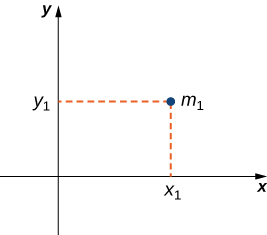
We can generalize this concept to find the center of mass of a system of point masses in a plane. Let be a point mass located at point in the plane. Then the moment of the mass with respect to the x-axis is given by Similarly, the moment with respect to the y-axis is given by Notice that the x-coordinate of the point is used to calculate the moment with respect to the y-axis, and vice versa. The reason is that the x-coordinate gives the distance from the point mass to the y-axis, and the y-coordinate gives the distance to the x-axis (see the following figure).
英語のヒント
この考え方を、平面上の質点系にも広げられる。質量の質点が点にあるとする。x 軸に関するモーメントは、y 軸に関するモーメントはで与えられる。y 軸に関するモーメントには x 座標を使い、x 軸に関するモーメントには y 座標を使うことに注意しよう。x 座標は y 軸からの符号付きの距離、y 座標は x 軸からの符号付きの距離を表すからである。次の図を見よう。
OpenStax, Rice University; Calculus Volume 1. · CC BY-NC-SA 4.0
Figure 6.64図 6.64
Point mass is located at point in the plane.
質量の質点が、平面上の点にある。
If we have several point masses in the xy-plane, we can use the moments with respect to the x- and y-axes to calculate the x- and y-coordinates of the center of mass of the system.
xy 平面上に複数の質点がある場合、x 軸・y 軸に関するモーメントを使って、系の重心の x 座標・y 座標を求められる。
The next example demonstrates how to apply this theorem.
次の例題で、この定理を使ってみよう。
Example 6.30例題 6.30
Finding the Center of Mass of Objects in a Plane平面上の質点系の重心を求める
Suppose three point masses are placed in the xy-plane as follows (assume coordinates are given in meters):
xy 平面上に、次の3つの質点を置く。座標の単位はメートルとする。
Find the center of mass of the system.
この質点系の重心を求めよ。
Solution解き方
First we calculate the total mass of the system:
まず、系全体の質量を計算する。
Next we find the moments with respect to the x- and y-axes:
次に、x 軸と y 軸に関するモーメントを求める。
Then we have
すると、次の式が得られる。
The center of mass of the system is in meters.
系の重心はである。座標の単位はメートル。