第6章積分の応用
Applications応用
One physical application of hyperbolic functions involves hanging cables. If a cable of uniform density is suspended between two supports without any load other than its own weight, the cable forms a curve called a catenary. High-voltage power lines, chains hanging between two posts, and strands of a spider’s web all form catenaries. The following figure shows chains hanging from a row of posts.
英語のヒント
双曲線関数の物理への応用に、つり下げたケーブルの形がある。密度が一様なケーブルを2点の間につり下げ、自重以外の荷重がないとき、ケーブルは懸垂線と呼ばれる曲線になる。送電線や支柱の間につり下げた鎖、糸などで見られる形である。次の図には、支柱の間につり下げた鎖を示す。
Image omitted because its reuse rights could not be verified.権利の確認ができないため画像を割愛。
Figure 6.83図 6.83
Chains between these posts take the shape of a catenary. (credit: modification of work by OKFoundryCompany, Flickr)
支柱の間の鎖は、懸垂線の形になる。(写真:OKFoundryCompany、Flickr の作品を加工)
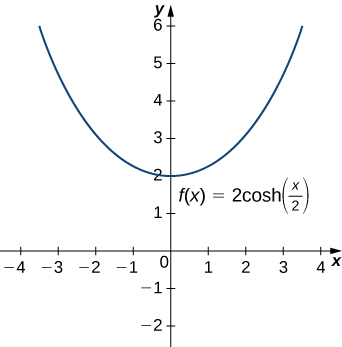
Hyperbolic functions can be used to model catenaries. Specifically, functions of the form are catenaries. Figure 6.84 shows the graph of
懸垂線は双曲線関数で表せる。具体的には、の形の関数が懸垂線となる。図6.84にのグラフを示す。
OpenStax, Rice University; Calculus Volume 1. · CC BY-NC-SA 4.0
Figure 6.84図 6.84
A hyperbolic cosine function forms the shape of a catenary.
双曲線余弦関数は、懸垂線の形を表す。
Example 6.51例題 6.51
Using a Catenary to Find the Length of a Cable懸垂線を使ってケーブルの長さを求める
Assume a hanging cable has the shape for where is measured in feet. Determine the length of the cable (in feet).
つり下げたケーブルが、での形をしているとする。の単位はフィートである。ケーブルの長さをフィート単位で求めよ。
Solution解き方
Recall from Section that the formula for arc length is
弧長を扱った節の公式を思い出そう。
We have so Then
なので、となる。したがって、次のようになる。
Now recall that so we have
を使うと、次式を得る。
Key Concepts重要な概念
- Hyperbolic functions are defined in terms of exponential functions.双曲線関数は、指数関数を使って定義される。
- Term-by-term differentiation yields differentiation formulas for the hyperbolic functions. These differentiation formulas give rise, in turn, to integration formulas.項ごとに微分すると、双曲線関数の微分公式が得られる。そこから積分公式も得られる。
- With appropriate range restrictions, the hyperbolic functions all have inverses.必要に応じて定義域を制限すれば、双曲線関数はどれも逆関数をもつ。
- Implicit differentiation yields differentiation formulas for the inverse hyperbolic functions, which in turn give rise to integration formulas.陰関数微分から逆双曲線関数の微分公式が得られ、さらに積分公式も得られる。
- The most common physical applications of hyperbolic functions are calculations involving catenaries.双曲線関数の代表的な物理への応用に、懸垂線に関する計算がある。
Exercises 377–384練習問題 377–384
Exercise 377問題 377
[T] Find expressions for and Use a calculator to graph these functions and ensure your expression is correct.
[T] とを簡単な式で表せ。計算機でグラフを描き、結果を確かめよ。
Solution解き方
Exercise 378問題 378
From the definitions of and find their antiderivatives.
との定義から、それぞれの原始関数を求めよ。
Exercise 379問題 379
Show that and satisfy
とがを満たすことを示せ。
Solution解き方
Answers may vary
答えは一通りとは限らない。
Exercise 380問題 380
Use the quotient rule to verify that
商の微分法を使い、を確かめよ。
Exercise 381問題 381
Derive from the definition.
定義からを導け。
Solution解き方
Answers may vary
答えは一通りとは限らない。
Exercise 382問題 382
Take the derivative of the previous expression to find an expression for
直前の式を微分し、 を表す式を求めよ。
Exercise 383問題 383
Prove by changing the expression to exponentials.
指数関数に書き換えることで、を証明せよ。
Solution解き方
Answers may vary
答えは一通りとは限らない。
Exercise 384問題 384
Take the derivative of the previous expression to find an expression for
直前の式を微分し、 を表す式を求めよ。
Exercises 385–394練習問題 385–394
For the following exercises, find the derivatives of the given functions and graph along with the function to ensure your answer is correct.
次の各問では、与えられた関数の導関数を求めよ。元の関数と導関数のグラフを描き、結果を確かめよ。
Exercise 385問題 385
[T]
[T]
Solution解き方
Exercise 386問題 386
[T]
[T]
Exercise 387問題 387
[T]
[T]
Solution解き方
Exercise 388問題 388
[T]
[T]
Exercise 389問題 389
[T]
[T]
Solution解き方
Exercise 390問題 390
[T]
[T]
Exercise 391問題 391
[T]
[T]
Solution解き方
Exercise 392問題 392
[T]
[T]
Exercise 393問題 393
[T]
[T]
Solution解き方
Exercise 394問題 394
[T]
[T]
Exercises 395–404練習問題 395–404
For the following exercises, find the antiderivatives for the given functions.
次の各問では、与えられた関数の原始関数を求めよ。
Exercise 395問題 395
Solution解き方
Exercise 396問題 396
Exercise 397問題 397
Solution解き方
Exercise 398問題 398
Exercise 399問題 399
Solution解き方
Exercise 400問題 400
Exercise 401問題 401
Solution解き方
Exercise 402問題 402
Exercise 403問題 403
Solution解き方
Exercise 404問題 404
Exercises 405–411練習問題 405–411
For the following exercises, find the derivatives for the functions.
次の各問では、与えられた関数の導関数を求めよ。
Exercise 405問題 405
Solution解き方
Exercise 406問題 406
Exercise 407問題 407
Solution解き方
Exercise 408問題 408
Exercise 409問題 409
Solution解き方
Exercise 410問題 410
Exercise 411問題 411
Solution解き方
Exercises 412–418練習問題 412–418
For the following exercises, find the antiderivatives for the functions.
次の各問では、与えられた関数の原始関数を求めよ。
Exercise 412問題 412
Exercise 413問題 413
Solution解き方
Exercise 414問題 414
Exercise 415問題 415
Solution解き方
Exercise 416問題 416
Exercise 417問題 417
Solution解き方
Exercise 418問題 418
Exercises 419–421練習問題 419–421
For the following exercises, use the fact that a falling body with friction equal to velocity squared obeys the equation
次の各問では、速度の2乗に比例する抵抗を受けて落下する物体が、単位と係数を適切にとるとに従うことを使う。
Exercise 419問題 419
Show that satisfies this equation.
がこの方程式を満たすことを示せ。
Solution解き方
Answers may vary
答えは一通りとは限らない。
Exercise 420問題 420
Derive the previous expression for by integrating
を積分して、前問のの式を導け。
Exercise 421問題 421
[T] Estimate how far a body has fallen in seconds by finding the area underneath the curve of
[T] のグラフの下の面積を求め、秒間に落下した距離を近似せよ。
Solution解き方
Exercises 422–424練習問題 422–424
For the following exercises, use this scenario: A cable hanging under its own weight has a slope that satisfies The constant is the ratio of cable density to tension.
英語のヒント
次の各問では、自重で垂れ下がったケーブルを考える。その傾きは、を満たす。定数は、ケーブルの単位長さあたりの重さと、張力の水平成分との比である。
Exercise 422問題 422
Show that satisfies this equation.
がこの方程式を満たすことを示せ。
Exercise 423問題 423
Integrate to find the cable height if
を積分し、を満たすケーブルの高さを求めよ。
Solution解き方
Exercise 424問題 424
Sketch the cable and determine how far down it sags at
ケーブルの概形を描き、でのたるみの深さを調べよ。
Exercises 425–434練習問題 425–434
For the following exercises, solve each problem.
次の各問を解け。
Exercise 425問題 425
[T] A chain hangs from two posts m apart to form a catenary described by the equation Find the slope of the catenary at the left fence post.
[T] m 離れた同じ高さの支柱の間に鎖をつり下げると、で表される懸垂線になった。左右の支柱を原点から等距離に置き、左の支柱での傾きを求めよ。
Solution解き方
Exercise 426問題 426
[T] A chain hangs from two posts four meters apart to form a catenary described by the equation Find the total length of the catenary (arc length).
[T] 4 m 離れた同じ高さの支柱の間につり下げた鎖が、で表される懸垂線になった。左右の支柱を原点から等距離に置き、鎖全体の長さを求めよ。
Exercise 427問題 427
[T] A high-voltage power line is a catenary described by Find the ratio of the area under the catenary to its arc length. What do you notice?
[T] 高圧送電線が、懸垂線で表される。ある区間の曲線下の面積と、同じ区間の弧長の比を求めよ。どのようなことが分かるか。
Solution解き方
Exercise 428問題 428
A telephone line is a catenary described by Find the ratio of the area under the catenary to its arc length. Does this confirm your answer for the previous question?
電話線が、懸垂線で表される。曲線下の面積と、同じ区間の弧長の比を求めよ。前問の結果を確かめられるか。
Exercise 429問題 429
Prove the formula for the derivative of by differentiating (Hint: Use hyperbolic trigonometric identities.)
を微分することで、 の導関数の公式を証明せよ。(ヒント:双曲線関数の恒等式を用いる。)
Exercise 430問題 430
Prove the formula for the derivative of by differentiating
を微分することで、の導関数の公式を証明せよ。
(Hint: Use hyperbolic trigonometric identities.)
ヒント:双曲線関数の恒等式を使う。
Exercise 431問題 431
Prove the formula for the derivative of by differentiating (Hint: Use hyperbolic trigonometric identities.)
を微分することで、 の導関数の公式を証明せよ。(ヒント:双曲線関数の恒等式を用いる。)
Exercise 432問題 432
Prove that
を証明せよ。
Exercise 433問題 433
Prove the expression for Multiply by and solve for Does your expression match the textbook?
の式を証明せよ。 に を掛け、 について解け。得られた式は教科書の式と一致するか。
Exercise 434問題 434
Prove the expression for Multiply by and solve for Does your expression match the textbook?
の式を証明せよ。 に を掛け、 について解け。得られた式は教科書の式と一致するか。