第6章積分の応用
Areas of Compound Regionsいくつかの部分に分かれる領域の面積
So far, we have required over the entire interval of interest, but what if we want to look at regions bounded by the graphs of functions that cross one another? In that case, we modify the process we just developed by using the absolute value function.
英語のヒント
ここまでは、対象区間の全体で を要求した。では、グラフ同士が交差する場合はどうすればよいだろうか。その場合は、絶対値を使ってこれまでの方法を調整する。
In practice, applying this theorem requires us to break up the interval and evaluate several integrals, depending on which of the function values is greater over a given part of the interval. We study this process in the following example.
英語のヒント
実際の計算では、区間 を、どちらの関数値が大きいかに応じて分け、いくつかの積分を求める。次の例題で、その手順を見よう。
Example 6.3例題 6.3
Finding the Area of a Region Bounded by Functions That Cross交差する関数に挟まれた面積を求める
If R is the region between the graphs of the functions and over the interval find the area of region
区間 上で関数 と のグラフの間にある領域を R とする。領域 の面積を求めよ。
Solution解き方
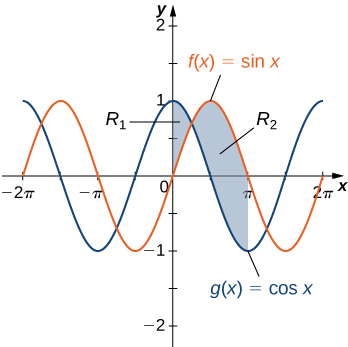
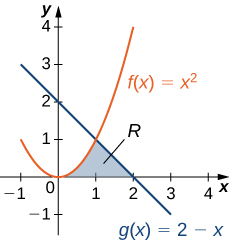
The region is depicted in the following figure.
この領域を次の図に示す。
OpenStax, Rice University; Calculus Volume 1. · CC BY-NC-SA 4.0
Figure 6.6図 6.6
The region between two curves can be broken into two sub-regions.
二つの曲線の間の領域を、二つの小領域に分けられる。
The graphs of the functions intersect at For so
グラフは で交わる。 では なので、
On the other hand, for so
一方、 では なので、
Then
すると、
The area of the region is units2.
この領域の面積は 単位2である。
Example 6.4例題 6.4
Finding the Area of a Complex Region複雑な領域の面積を求める
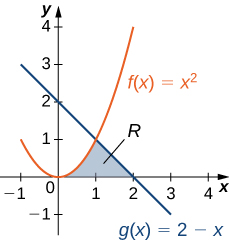
Consider the region depicted in Figure 6.7. Find the area of
図6.7の領域を考える。 の面積を求めよ。
OpenStax, Rice University; Calculus Volume 1. · CC BY-NC-SA 4.0
Figure 6.7図 6.7
Two integrals are required to calculate the area of this region.
この領域の面積を x について計算するには、二つの積分が必要になる。
Solution解き方
As with Example 6.3, we need to divide the interval into two pieces. The graphs of the functions intersect at (set and solve for x), so we evaluate two separate integrals: one over the interval and one over the interval
例題6.3と同様、区間を二つに分ける。 とおいて x を求めると、交点は である。そこで、区間 と の積分を別々に計算する。
Over the interval the region is bounded above by and below by the x-axis, so we have
区間 では、上側が 、下側が x 軸なので、
Over the interval the region is bounded above by and below by the so we have
区間 では、上側が 、下側が なので、
Adding these areas together, we obtain
この二つの面積を足すと、
The area of the region is units2.
この領域の面積は 単位2である。
Regions Defined with Respect to yy を使って表す領域
In Example 6.4, we had to evaluate two separate integrals to calculate the area of the region. However, there is another approach that requires only one integral. What if we treat the curves as functions of instead of as functions of Review Figure 6.7. Note that the left graph, shown in red, is represented by the function We could just as easily solve this for and represent the curve by the function (Note that is also a valid representation of the function as a function of However, based on the graph, it is clear we are interested in the positive square root.) Similarly, the right graph is represented by the function but could just as easily be represented by the function When the graphs are represented as functions of we see the region is bounded on the left by the graph of one function and on the right by the graph of the other function. Therefore, if we integrate with respect to we need to evaluate one integral only. Let’s develop a formula for this type of integration.
英語のヒント
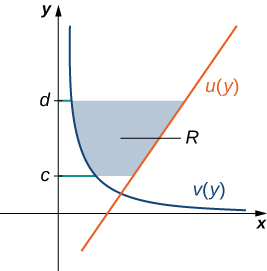
Let and be continuous functions over an interval such that for all We want to find the area between the graphs of the functions, as shown in the following figure.
と を区間 上の連続関数とし、すべての に対して とする。次の図のような、二つのグラフの間の面積を求める。
OpenStax, Rice University; Calculus Volume 1. · CC BY-NC-SA 4.0
Figure 6.8図 6.8
We can find the area between the graphs of two functions, and
二つの関数 と のグラフの間の面積を求める。
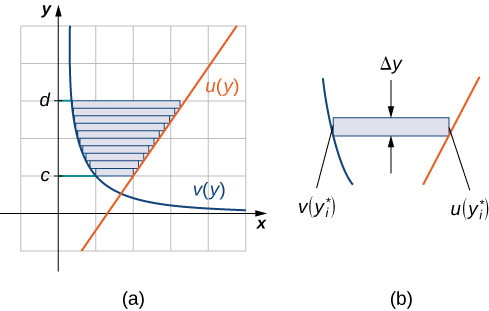
This time, we are going to partition the interval on the and use horizontal rectangles to approximate the area between the functions. So, for let be a regular partition of Then, for choose a point then over each interval construct a rectangle that extends horizontally from to Figure 6.9(a) shows the rectangles when is selected to be the lower endpoint of the interval and Figure 6.9(b) shows a representative rectangle in detail.
OpenStax, Rice University; Calculus Volume 1. · CC BY-NC-SA 4.0
Figure 6.9図 6.9
(a) Approximating the area between the graphs of two functions, and with rectangles. (b) The area of a typical rectangle.
(a) 関数 と の間の面積を長方形で近似する。(b) 一つの長方形の面積。
The height of each individual rectangle is and the width of each rectangle is Therefore, the area between the curves is approximately
長方形の高さは 、横幅は である。したがって、曲線の間の面積はおよそ、
This is a Riemann sum, so we take the limit as obtaining
これはリーマン和なので、 の極限をとると、
These findings are summarized in the following theorem.
以上の結果は、次の定理にまとめられる。
Example 6.5例題 6.5
Integrating with Respect to yy に関して積分する
Let’s revisit Example 6.4, only this time let’s integrate with respect to Let be the region depicted in Figure 6.10. Find the area of by integrating with respect to
OpenStax, Rice University; Calculus Volume 1. · CC BY-NC-SA 4.0
Figure 6.10図 6.10
The area of region can be calculated using one integral only when the curves are treated as functions of
曲線を の関数として扱うと、領域 の面積を一つの積分で求められる。
Solution解き方
We must first express the graphs as functions of As we saw at the beginning of this section, the curve on the left can be represented by the function and the curve on the right can be represented by the function
まずグラフを の関数として表す。この節の冒頭で見たように、左側の曲線は 、右側の曲線は で表せる。
Now we have to determine the limits of integration. The region is bounded below by the x-axis, so the lower limit of integration is The upper limit of integration is determined by the point where the two graphs intersect, which is the point so the upper limit of integration is Thus, we have
次に積分区間を決める。領域の下端は x 軸なので、積分の下端は である。上端は二つの曲線の交点 によって決まり、 となる。したがって、 である。
Calculating the area of the region, we get
面積を計算すると、
The area of the region is units2.
この領域の面積は 単位2である。