第6章積分の応用
Work Done by a Force力がする仕事
We now consider work. In physics, work is related to force, which is often intuitively defined as a push or pull on an object. When a force moves an object, we say the force does work on the object. In other words, work can be thought of as the amount of energy it takes to move an object. According to physics, when we have a constant force, work can be expressed as the product of force and distance.
英語のヒント
次に「仕事」を考える。物理では、物体を押したり引いたりする力と仕事が結び付いている。力が物体を動かすとき、その力は物体に仕事をしたという。仕事は、力によって物体へ移されるエネルギーと考えられる。一定の力が、その力と同じ向きに物体を動かす場合、仕事は力と移動距離の積で表される。
In the English system, the unit of force is the pound and the unit of distance is the foot, so work is given in foot-pounds. In the metric system, kilograms and meters are used. One newton is the force needed to accelerate kilogram of mass at the rate of m/sec2. Thus, the most common unit of work is the newton-meter. This same unit is also called the joule. Both are defined as kilograms times meters squared over seconds squared
ヤード・ポンド法では、力の単位にポンド、距離の単位にフィートを使うため、仕事の単位はフィート・ポンドとなる。メートル法ではキログラムやメートルを使う。質量キログラムの物体に m/s2の加速度を与える力が、1ニュートンである。したがって、仕事の単位にはニュートン・メートルを使う。これはジュールとも呼ばれ、どちらもに等しい。
When we have a constant force, things are pretty easy. It is rare, however, for a force to be constant. The work done to compress (or elongate) a spring, for example, varies depending on how far the spring has already been compressed (or stretched). We look at springs in more detail later in this section.
英語のヒント
力が一定なら、仕事の計算は簡単である。しかし、力が一定とは限らない。たとえば、ばねを縮めたり伸ばしたりするのに必要な力は、すでにどれだけ縮んだり伸びたりしているかによって変わる。ばねについては、この節で詳しく扱う。
Suppose we have a variable force that moves an object in a positive direction along the x-axis from point to point To calculate the work done, we partition the interval and estimate the work done over each subinterval. So, for let be a regular partition of the interval and for choose an arbitrary point To calculate the work done to move an object from point to point we assume the force is roughly constant over the interval, and use to approximate the force. The work done over the interval then, is given by
位置によって変わる力が、物体を x 軸の正の向きに点から点まで動かすとする。仕事を求めるため、区間を分割し、各小区間での仕事を見積もる。として、を区間の等分割とし、について任意の点を選ぶ。点から点まで動かす仕事は、小区間内で力がほぼ一定とみなし、で力を近似して求める。区間での仕事は、近似的に次のようになる。
Therefore, the work done over the interval is approximately
したがって、区間全体での仕事は、近似的に次式で与えられる。
Taking the limit of this expression as gives us the exact value for work:
の極限をとれば、仕事の正確な値を得る。
Thus, we can define work as follows.
こうして、仕事を次のように定義できる。
Note that if F is constant, the integral evaluates to which is the formula we stated at the beginning of this section.
F が一定なら積分はとなり、先ほど述べた公式に一致する。
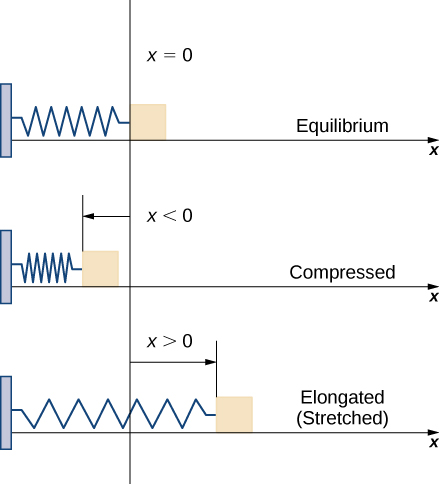
Now let’s look at the specific example of the work done to compress or elongate a spring. Consider a block attached to a horizontal spring. The block moves back and forth as the spring stretches and compresses. Although in the real world we would have to account for the force of friction between the block and the surface on which it is resting, we ignore friction here and assume the block is resting on a frictionless surface. When the spring is at its natural length (at rest), the system is said to be at equilibrium. In this state, the spring is neither elongated nor compressed, and in this equilibrium position the block does not move until some force is introduced. We orient the system such that corresponds to the equilibrium position (see the following figure).
英語のヒント
具体例として、ばねを縮めたり伸ばしたりする仕事を考える。水平なばねに物体が取り付けられているとしよう。ばねが伸び縮みすると、物体は前後に動く。現実には物体と接する面との摩擦を考える必要があるが、ここでは摩擦のない面を仮定する。ばねが自然長にあり、物体が静止している状態を平衡状態という。この状態では、ばねは伸びても縮んでもいない。外から力が加わらなければ物体は動かない。図のように、平衡位置をにとる。
OpenStax, Rice University; Calculus Volume 1. · CC BY-NC-SA 4.0
Figure 6.51図 6.51
A block attached to a horizontal spring at equilibrium, compressed, and elongated.
水平なばねにつながれた物体。上から、平衡状態、縮んだ状態、伸びた状態。
According to Hooke’s law, the force required to compress or stretch a spring from an equilibrium position is given by for some constant The value of depends on the physical characteristics of the spring. The constant is called the spring constant and is always positive. We can use this information to calculate the work done to compress or elongate a spring, as shown in the following example.
英語のヒント
フックの法則によれば、ばねを平衡位置からゆっくり縮めたり伸ばしたりするのに必要な外力は、ある定数を使ってと表される。の値はばねの性質によって決まる。この正の定数を、ばね定数という。これを使えば、次の例のようにばねを縮めたり伸ばしたりする仕事を求められる。
Example 6.25例題 6.25
The Work Required to Stretch or Compress a Springばねを伸ばす・縮めるための仕事
Suppose it takes a force of N (in the negative direction) to compress a spring m from the equilibrium position. How much work is done to stretch the spring m from the equilibrium position?
ばねを平衡位置から m 縮めるには、負の向きに N の力が必要だとする。このばねを平衡位置から m 伸ばすには、どれだけの仕事が必要か。
Solution解き方
First find the spring constant, When we know so
まず、ばね定数を求める。のときなので、次式が成り立つ。
and Then, to calculate work, we integrate the force function, obtaining
したがってである。力を表す関数を積分して、仕事を求める。
The work done to stretch the spring is J.
ばねを伸ばすのに必要な仕事は、 J である。