第6章積分の応用
Hydrostatic Force and Pressure静水圧と静水圧による力
In this last section, we look at the force and pressure exerted on an object submerged in a liquid. In the English system, force is measured in pounds. In the metric system, it is measured in newtons. Pressure is force per unit area, so in the English system we have pounds per square foot (or, perhaps more commonly, pounds per square inch, denoted psi). In the metric system we have newtons per square meter, also called pascals.
英語のヒント
この節の最後では、液体中の物体が受ける力と圧力を考える。力の単位は、ヤード・ポンド法ではポンド、メートル法ではニュートンである。圧力は単位面積あたりの力なので、前者ではポンド毎平方フィート、あるいは一般によく使われるポンド毎平方インチ(psi)で表す。後者ではニュートン毎平方メートルを使い、この単位をパスカルともいう。
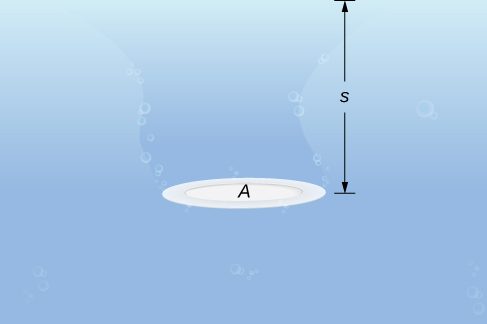
Let’s begin with the simple case of a plate of area submerged horizontally in water at a depth s (Figure 6.56). Then, the force exerted on the plate is simply the weight of the water above it, which is given by where is the weight density of water (weight per unit volume). To find the hydrostatic pressure—that is, the pressure exerted by water on a submerged object—we divide the force by the area. So the pressure is
まず、面積の板を水深 s の位置に水平に沈めた場合を考える(図6.56)。水が板に及ぼす力は、その上にある水の重さで与えられる。は、水の重量密度、すなわち単位体積あたりの重さである。静水圧は、静止した水が水中の物体に及ぼす圧力であり、力を面積で割れば求められる。したがってとなる。
OpenStax, Rice University; Calculus Volume 1. · CC BY-NC-SA 4.0
Figure 6.56図 6.56
A plate submerged horizontally in water.
水中に水平に沈めた板。
By Pascal’s principle, the pressure at a given depth is the same in all directions, so it does not matter if the plate is submerged horizontally or vertically. So, as long as we know the depth, we know the pressure. We can apply Pascal’s principle to find the force exerted on surfaces, such as dams, that are oriented vertically. We cannot apply the formula directly, because the depth varies from point to point on a vertically oriented surface. So, as we have done many times before, we form a partition, a Riemann sum, and, ultimately, a definite integral to calculate the force.
英語のヒント
静止した液体では、同じ深さの圧力はどの向きにも等しく働く。そのため、板が水平でも鉛直でも、ある点の圧力は深さから分かる。この性質を使えば、ダムの壁のような鉛直な面が受ける力を求められる。ただし、鉛直な面では場所によって深さが異なるため、を面全体にそのまま適用することはできない。そこで、これまでと同じように分割とリーマン和を使い、最終的に定積分で力を求める。
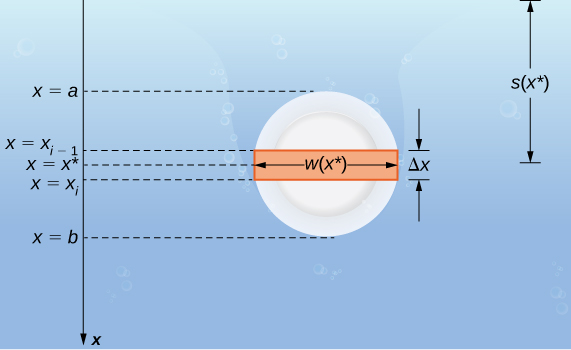
Suppose a thin plate is submerged in water. We choose our frame of reference such that the x-axis is oriented vertically, with the downward direction being positive, and point corresponding to a logical reference point. Let denote the depth at point x. Note we often let correspond to the surface of the water. In this case, depth at any point is simply given by However, in some cases we may want to select a different reference point for so we proceed with the development in the more general case. Last, let denote the width of the plate at the point
薄い板を水中に沈める。x 軸を鉛直に、下向きを正にとり、を使いやすい基準位置に合わせる。位置 x における水深をと書く。水面をに選ぶことが多く、その場合は単にとなる。ただし、を別の位置にとりたい場合もあるので、ここでは一般的に式を導く。さらに、位置での板の幅をとする。
Assume the top edge of the plate is at point and the bottom edge of the plate is at point Then, for let be a regular partition of the interval and for choose an arbitrary point The partition divides the plate into several thin, rectangular strips (see the following figure).
板の上端を、下端をとする。として、を区間の等分割とし、について任意の点を選ぶ。この分割によって、板は幅の狭い帯に分かれ、各帯を薄い長方形で近似できる。次の図を見よう。
OpenStax, Rice University; Calculus Volume 1. · CC BY-NC-SA 4.0
Figure 6.57図 6.57
A thin plate submerged vertically in water.
水中に鉛直に沈めた薄い板。
Let’s now estimate the force on a representative strip. If the strip is thin enough, we can treat it as if it is at a constant depth, We then have
代表的な帯が受ける力を見積もろう。帯が十分薄ければ、全体が一定の水深にあるものとして扱える。したがって、次のようになる。
Adding the forces, we get an estimate for the force on the plate:
各帯が受ける力を足すと、板全体が受ける力の近似値を得る。
This is a Riemann sum, so taking the limit gives us the exact force. We obtain
これはリーマン和なので、極限をとれば正確な力が得られる。
Evaluating this integral gives us the force on the plate. We summarize this in the following problem-solving strategy.
この積分を計算すれば、板が受ける力を求められる。手順を次にまとめる。
Example 6.27例題 6.27
Finding Hydrostatic Force静水圧による力を求める
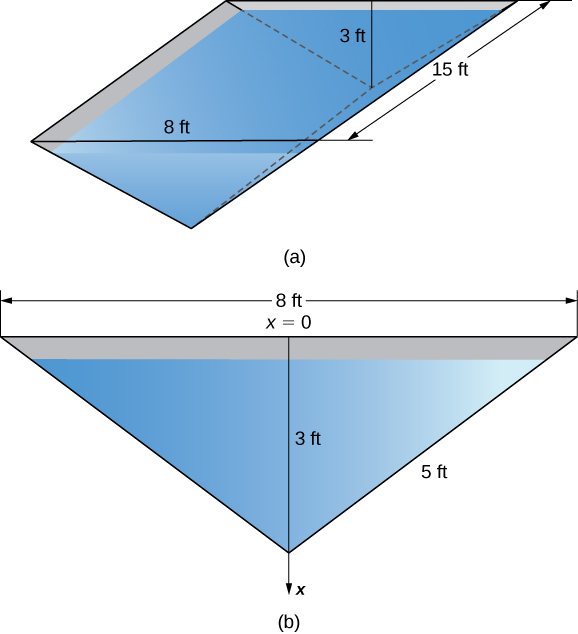
A water trough 15 ft long has ends shaped like inverted isosceles triangles, with base 8 ft and height 3 ft. Find the force on one end of the trough if the trough is full of water.
長さ15フィートの水槽の両端は、底辺8フィート、高さ3フィートの逆向きの二等辺三角形になっている。水槽が満水のとき、片方の端面が受ける力を求めよ。
Solution解き方
Figure 6.58 shows the trough and a more detailed view of one end.
水槽と、その片方の端面を詳しく描いた図を、図6.58に示す。
OpenStax, Rice University; Calculus Volume 1. · CC BY-NC-SA 4.0
Figure 6.58図 6.58
(a) A water trough with a triangular cross-section. (b) Dimensions of one end of the water trough.
(a) 三角形の断面をもつ水槽。(b) 片方の端面の寸法。
Select a frame of reference with the oriented vertically and the downward direction being positive. Select the top of the trough as the point corresponding to (step 1). The depth function, then, is Using similar triangles, we see that (step 2). Now, the weight density of water is lb/ft3 (step 3), so applying Equation 6.13, we obtain
を鉛直にとり、下向きを正にする。水槽の上端をにとる(手順1)。すると水深はとなる。三角形の相似から、幅はである(手順2)。水の重量密度は lb/ft3なので(手順3)、式6.13を使うと次のようになる。
The water exerts a force of 748.8 lb on the end of the trough (step 4).
水は水槽の端面に748.8ポンドの力を及ぼす(手順4)。
Example 6.28例題 6.28
Chapter Opener: Finding Hydrostatic Force章の導入問題:静水圧による力を求める
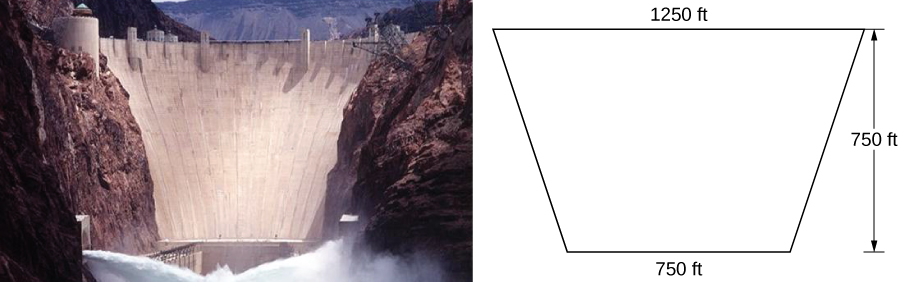
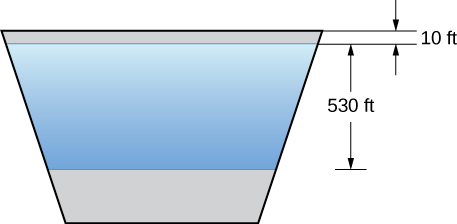
We now return our attention to the Hoover Dam, mentioned at the beginning of this chapter. The actual dam is arched, rather than flat, but we are going to make some simplifying assumptions to help us with the calculations. Assume the face of the Hoover Dam is shaped like an isosceles trapezoid with lower base ft, upper base ft, and height ft (see the following figure).
英語のヒント
章の冒頭で取り上げたフーバーダムに戻ろう。実物のダムは平面ではなくアーチ形だが、計算しやすくするため形を単純化する。正面を、下底フィート、上底フィート、高さフィートの等脚台形と仮定する。次の図を見よう。
OpenStax, Rice University; Calculus Volume 1. · CC BY-NC-SA 4.0
When the reservoir is full, Lake Mead’s maximum depth is about 530 ft, and the surface of the lake is about 10 ft below the top of the dam (see the following figure).
このモデルでは、満水時のミード湖の最大水深を約530フィート、水面の位置をダムの上端から約10フィート下とする。次の図を見よう。
OpenStax, Rice University; Calculus Volume 1. · CC BY-NC-SA 4.0
Figure 6.59図 6.59
A simplified model of the Hoover Dam with assumed dimensions.
寸法を仮定して単純化した、フーバーダムのモデル。
- Find the force on the face of the dam when the reservoir is full.貯水池が満水のとき、ダムの正面が受ける力を求めよ。
- The southwest United States has been experiencing a drought, and the surface of Lake Mead is about 125 ft below where it would be if the reservoir were full. What is the force on the face of the dam under these circumstances?
英語のヒント
米国南西部での干ばつを想定し、ミード湖の水面が満水時より約125フィート低い場合を考える。このとき、ダムの正面が受ける力はいくらか。
Solution解き方
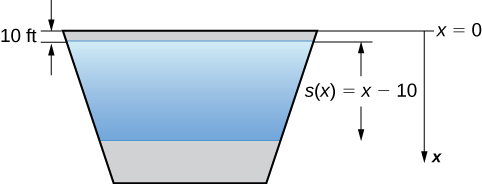
- We begin by establishing a frame of reference. As usual, we choose to orient the vertically, with the downward direction being positive. This time, however, we are going to let represent the top of the dam, rather than the surface of the water. When the reservoir is full, the surface of the water is ft below the top of the dam, so (see the following figure).まず座標系を決める。いつものようにを鉛直にとり、下向きを正にする。ただし今回は、水面ではなくダムの上端をとする。満水時の水面は上端からフィート下にあるので、となる。次の図を見よう。
OpenStax, Rice University; Calculus Volume 1. · CC BY-NC-SA 4.0
Figure 6.60図 6.60We first choose a frame of reference.まず座標系を選ぶ。
To find the width function, we again turn to similar triangles as shown in the figure below.幅を表す関数を求めるため、次の図の相似な三角形を使う。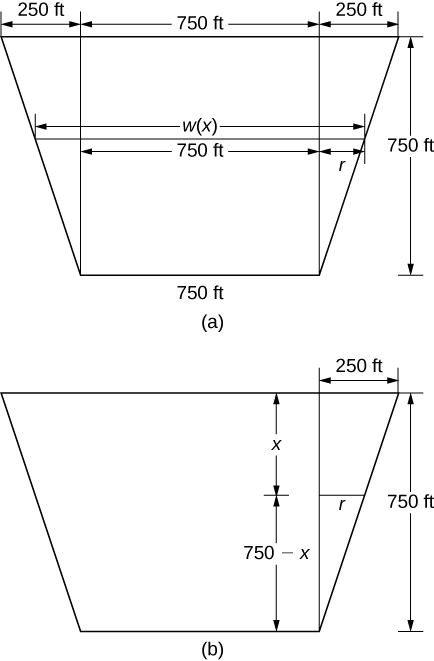
OpenStax, Rice University; Calculus Volume 1. · CC BY-NC-SA 4.0
Figure 6.61図 6.61We use similar triangles to determine a function for the width of the dam. (a) Assumed dimensions of the dam; (b) highlighting the similar triangles.三角形の相似を使って、ダムの幅を表す関数を求める。(a) 仮定した寸法。(b) 相似な三角形に注目した図。
From the figure, we see that Using properties of similar triangles, we get Thus,図よりである。三角形の相似からとなるため、次式を得る。重量密度 lb/ft3を用い(手順3)、式6.13を適用すると、次のようになる。Note the change from pounds to tons lb = ton) (step 4).最後に、ポンドから米トンへ換算している。換算関係は lb = 米トン)である(手順4)。 - Notice that the drought changes our depth function, and our limits of integration. We have The lower limit of integration is The upper limit remains Evaluating the integral, we get干ばつで水位が下がると、水深を表す関数と積分区間が変わる。今回はとなり、積分の下端は、上端は変わらずである。積分を計算すると、次のようになる。