第1章関数とグラフ
1.5 Exponential and Logarithmic Functions1.5 指数関数と対数関数
Learning Objectives学習目標
- Identify the form of an exponential function.指数関数の形を見分ける。
- Explain the difference between the graphs of andとのグラフの違いを説明する。
- Recognize the significance of the number数の意味と重要性を理解する。
- Identify the form of a logarithmic function.対数関数の形を見分ける。
- Explain the relationship between exponential and logarithmic functions.指数関数と対数関数の関係を説明する。
- Describe how to calculate a logarithm to a different base.異なる底の対数を計算する方法を説明する。
- Identify the hyperbolic functions, their graphs, and basic identities.双曲線関数、そのグラフ、基本的な恒等式を理解する。
In this section we examine exponential and logarithmic functions. We use the properties of these functions to solve equations involving exponential or logarithmic terms, and we study the meaning and importance of the number We also define hyperbolic and inverse hyperbolic functions, which involve combinations of exponential and logarithmic functions. (Note that we present alternative definitions of exponential and logarithmic functions in the chapter Applications of Integrations, and prove that the functions have the same properties with either definition.)
英語のヒント
この節では指数関数と対数関数を調べる。それらの性質を使って、指数や対数を含む方程式を解き、数の意味と重要性を学ぶ。また、指数関数と対数関数の組合せからなる双曲線関数と逆双曲線関数も定義する。「積分の応用」の章では、指数関数と対数関数の別の定義を示し、どちらの定義からも同じ性質が得られることを証明する。
Exponential Functions指数関数
Exponential functions arise in many applications. One common example is population growth.
指数関数は多くの応用に現れる。よくある例の1つが人口の増加である。
For example, if a population starts with individuals and then grows at an annual rate of its population after 1 year is
たとえば、初めの人口が人で、年にの割合で増えるなら、1年後の人口は次のようになる。
Its population after 2 years is
2年後の人口は、次のようになる。
In general, its population after years is
一般に、年後の人口は次のようになる。
which is an exponential function. More generally, any function of the form where is an exponential function with base and exponent x. Exponential functions have constant bases and variable exponents. Note that a function of the form for some constant is not an exponential function but a power function.
英語のヒント
これは指数関数である。より一般に、を満たすという形の関数を、底が、指数がxの指数関数という。指数関数では、底は定数で、指数が変数となる。定数に対するという形の関数は、指数関数ではなくべき関数であることに注意しよう。
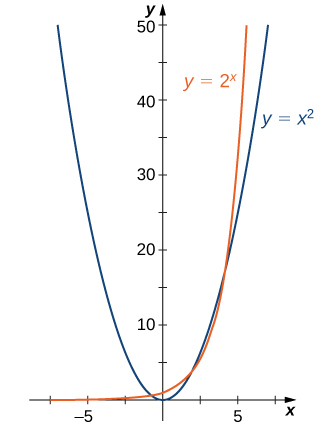
To see the difference between an exponential function and a power function, we compare the functions and In Table 1.10, we see that both and approach infinity as Eventually, however, becomes larger than and grows more rapidly as In the opposite direction, as whereas The line is a horizontal asymptote for
英語のヒント
指数関数とべき関数の違いを見るため、とを比較しよう。表1.10から、のとき、もも無限大に近づくことがわかる。しかし、十分先ではがを上回り、に向かうにつれてより速く増える。逆の向きでは、となる一方、となる。直線はの水平漸近線である。
In Figure 1.43, we graph both and to show how the graphs differ.
図1.43では、とを同じ座標上に描き、その違いを示す。
OpenStax, Rice University; Calculus Volume 1. · CC BY-NC-SA 4.0
Figure 1.43図 1.43
Both and approach infinity as but grows more rapidly than As whereas
のとき、もも無限大に近づくが、のほうがより速く増える。逆に、となる一方、となる。
Evaluating Exponential Functions指数関数の値を求める
Recall the properties of exponents: If is a positive integer, then we define (with factors of If is a negative integer, then for some positive integer and we define Also, is defined to be If is a rational number, then where and are integers and For example, However, how is defined if is an irrational number? For example, what do we mean by This is too complex a question for us to answer fully right now; however, we can make an approximation. In Table 1.11, we list some rational numbers approaching and the values of for each rational number are presented as well. We claim that if we choose rational numbers getting closer and closer to the values of get closer and closer to some number We define that number to be
英語のヒント
指数の性質を思い出そう。が正の整数なら、と定義する。つまり、を個掛け合わせる。が負の整数なら、正の整数を使ってと書き、と定義する。また、はと定義する。が有理数なら、整数、を使ってと書き、と定める。たとえばである。では、が無理数のとき、はどう定義するのだろうか。たとえば、にはどのような意味があるのだろうか。今の段階で完全に答えるには複雑すぎるが、近似はできる。表1.11には、に近づく有理数を並べ、各有理数に対するの値を示した。にますます近い有理数を選ぶと、の値はある数に近づく。この数を、と定義する。
Example 1.33例題 1.33
Bacterial Growth細菌の増殖
Suppose a particular population of bacteria is known to double in size every hours. If a culture starts with bacteria, the number of bacteria after hours is The number of bacteria after hours is In general, the number of bacteria after hours is Letting we see that the number of bacteria after hours is Find the number of bacteria after hours, hours, and hours.
英語のヒント
ある細菌の集団は、時間ごとに個数が2倍になることがわかっているとする。個から培養を始めると、時間後の個数はとなる。時間後はである。一般に、時間後の個数はとなる。とおけば、時間後の個数はとわかる。時間後、時間後、時間後の細菌の個数を求めよ。
Solution解き方
The number of bacteria after 6 hours is given by bacteria. The number of bacteria after hours is given by bacteria. The number of bacteria after hours is given by bacteria.
6時間後は個、時間後は個、時間後は個となる。