第1章関数とグラフ
Finding a Function’s Inverse逆関数を求める
We can now consider one-to-one functions and show how to find their inverses. Recall that a function maps elements in the domain of to elements in the range of The inverse function maps each element from the range of back to its corresponding element from the domain of Therefore, to find the inverse function of a one-to-one function given any in the range of we need to determine which in the domain of satisfies Since is one-to-one, there is exactly one such value We can find that value by solving the equation for Doing so, we are able to write as a function of where the domain of this function is the range of and the range of this new function is the domain of Consequently, this function is the inverse of and we write Since we typically use the variable to denote the independent variable and to denote the dependent variable, we often interchange the roles of and and write Representing the inverse function in this way is also helpful later when we graph a function and its inverse on the same axes.
英語のヒント
ここからは一対一の関数を扱い、その逆関数の求め方を示す。関数はの定義域の要素をの値域の要素へ対応させる。逆関数は、の値域の各要素を、の定義域の対応する要素へ戻す。したがって、一対一の関数の逆関数を求めるには、の値域から任意のをとり、の定義域のどのがを満たすかを調べる。は一対一なので、そのようなはちょうど1つ存在する。方程式をについて解けば、その値が求まる。これにより、の関数としてを表せる。この新しい関数の定義域はの値域、値域はの定義域である。したがって、この関数はの逆関数であり、と書く。通常は独立変数に、従属変数にを使うため、との役割を入れ替えてと書くことが多い。この表し方は、後で関数とその逆関数を同じ座標軸に描くときにも便利である。
Example 1.29例題 1.29
Finding an Inverse Function逆関数を求める
Find the inverse for the function State the domain and range of the inverse function. Verify that
関数の逆関数を求め、その定義域と値域を述べよ。また、を確かめよ。
Solution解き方
Follow the steps outlined in the strategy.
先ほどの手順に従う。
Step 1. If then and
手順1。なら、、したがってである。
Step 2. Rewrite as and let
手順2。と書き換え、とおく。
Therefore,
したがって、である。
Since the domain of is the range of is Since the range of is the domain of is
の定義域がなので、の値域はである。また、の値域がなので、の定義域はである。
You can verify that by writing
次の計算によって、を確かめられる。
Note that for to be the inverse of both and for all x in the domain of the inside function.
がの逆関数であるためには、との両方が、それぞれ内側の関数の定義域内のすべてのxで成り立つ必要がある。
Graphing Inverse Functions逆関数のグラフを描く
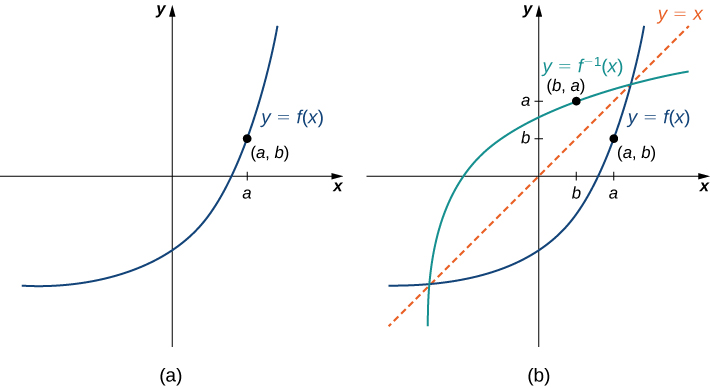
Let’s consider the relationship between the graph of a function and the graph of its inverse. Consider the graph of shown in Figure 1.39 and a point on the graph. Since then Therefore, when we graph the point is on the graph. As a result, the graph of is a reflection of the graph of about the line
関数のグラフと逆関数のグラフとの関係を考えよう。図1.39ののグラフ上に点をとる。なので、である。したがって、のグラフには点がある。この結果、のグラフはのグラフを直線について反転したものになる。
OpenStax, Rice University; Calculus Volume 1. · CC BY-NC-SA 4.0
Figure 1.39図 1.39
(a) The graph of this function shows point on the graph of (b) Since is on the graph of the point is on the graph of The graph of is a reflection of the graph of about the line
(a) 関数の図で、点はのグラフ上にある。(b) がのグラフ上にあるので、点はのグラフ上にある。のグラフはのグラフを直線について反転したものである。
Example 1.30例題 1.30
Sketching Graphs of Inverse Functions逆関数のグラフを対称性から描く
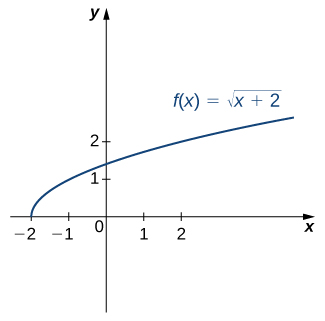
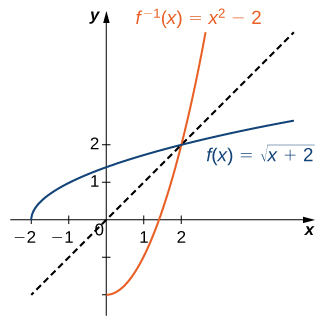
For the graph of in the following image, sketch a graph of by sketching the line and using symmetry. Identify the domain and range of
次ののグラフに対し、直線を引いて対称性を利用し、のグラフを描け。の定義域と値域も求めよ。
OpenStax, Rice University; Calculus Volume 1. · CC BY-NC-SA 4.0
Solution解き方
Reflect the graph about the line The domain of is The range of is By using the preceding strategy for finding inverse functions, we can verify that the inverse function is as shown in the graph.
グラフを直線について反転する。の定義域は、の値域はである。先ほどの逆関数を求める手順を使うと、図の逆関数はと確かめられる。
OpenStax, Rice University; Calculus Volume 1. · CC BY-NC-SA 4.0
Restricting Domains定義域を制限する
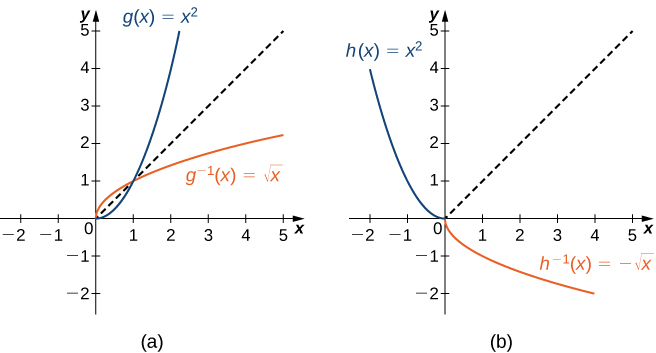
As we have seen, does not have an inverse function because it is not one-to-one. However, we can choose a subset of the domain of such that the function is one-to-one. This subset is called a restricted domain. By restricting the domain of we can define a new function such that the domain of is the restricted domain of and for all in the domain of Then we can define an inverse function for on that domain. For example, since is one-to-one on the interval we can define a new function such that the domain of is and for all in its domain. Since is a one-to-one function, it has an inverse function, given by the formula On the other hand, the function is also one-to-one on the domain Therefore, we could also define a new function such that the domain of is and for all in the domain of Then is a one-to-one function and must also have an inverse. Its inverse is given by the formula (Figure 1.40).
英語のヒント
これまで見たように、は一対一ではないため逆関数を持たない。しかし、の定義域の一部を選び、その範囲で一対一になるようにできる。この部分集合を、制限された定義域という。の定義域を制限して、新しい関数を定義する。の定義域を、の制限された定義域とし、の定義域内のすべてのでとなるようにする。すると、その範囲での逆関数を定義できる。たとえば、は区間で一対一なので、新しい関数を定義できる。の定義域をとし、その中のすべてのでとする。は一対一なので逆関数をもち、式はとなる。別の取り方として、は定義域でも一対一である。そこで、新しい関数を定義し、の定義域を、の定義域内のすべてのでとすることもできる。このも一対一なので逆関数をもち、その式はとなる(図1.40)。
OpenStax, Rice University; Calculus Volume 1. · CC BY-NC-SA 4.0
Figure 1.40図 1.40
(a) For restricted to (b) For restricted to
(a) の定義域をとなる。(b) の定義域をとなる。
Example 1.31例題 1.31
Restricting the Domain定義域を制限して逆関数を求める
Consider the function
関数を考えよ。
- Sketch the graph of and use the horizontal line test to show that is not one-to-one.のグラフを描き、水平線テストを使ってが一対一でないことを示せ。
- Show that is one-to-one on the restricted domain Determine the domain and range for the inverse of on this restricted domain and find a formula forが制限された定義域で一対一であることを示せ。この範囲に制限したの逆関数の定義域と値域を求め、の式を求めよ。
Solution解き方
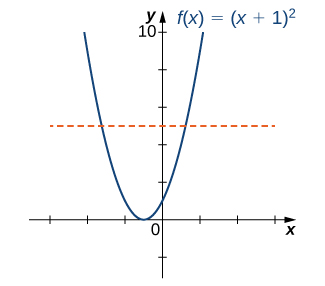
- The graph of is the graph of shifted left 1 unit. Since there exists a horizontal line intersecting the graph more than once, is not one-to-one.のグラフはのグラフを左へ1移したものである。グラフと2回以上交わる水平線が存在するので、は一対一ではない。
OpenStax, Rice University; Calculus Volume 1. · CC BY-NC-SA 4.0
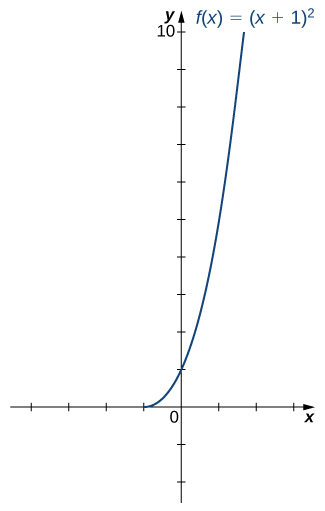
- On the interval is one-to-one.区間は一対一である。
OpenStax, Rice University; Calculus Volume 1. · CC BY-NC-SA 4.0
The domain and range of are given by the range and domain of respectively. Therefore, the domain of is and the range of is To find a formula for solve the equation for If then Since we are restricting the domain to the interval where we need Therefore, Interchanging and we write and conclude thatの定義域と値域は、それぞれの値域と定義域になる。したがって、の定義域は、の値域はである。の式を求めるには、方程式をについて解く。ならである。定義域をとなる区間に制限しているので、でなければならない。したがってを選ぶ。とを入れ替えてと書くと、が得られる。