第1章関数とグラフ
Transcendental Functions超越関数
Thus far, we have discussed algebraic functions. Some functions, however, cannot be described by basic algebraic operations. These functions are known as transcendental functions because they are said to “transcend,” or go beyond, algebra. The most common transcendental functions are trigonometric, exponential, and logarithmic functions. A trigonometric function relates the ratios of two sides of a right triangle. They are (We discuss trigonometric functions later in the chapter.) An exponential function is a function of the form where the base A logarithmic function is a function of the form for some constant where if and only if (We also discuss exponential and logarithmic functions later in the chapter.)
英語のヒント
ここまでは代数関数を扱った。しかし、基本的な代数演算では表せない関数もある。そのような関数は、代数を「超える」(transcend)ことから超越関数と呼ばれる。代表的なものは三角関数、指数関数、対数関数である。三角関数は直角三角形の2辺の長さの比に関わる関数で、がある。三角関数は、この章の後半で扱う。指数関数はという形の関数で、底はを満たす。対数関数は、定数に対してという形の関数であり、が成り立つこととが成り立つことは同値である。指数関数と対数関数も、この章の後半で扱う。
Example 1.18例題 1.18
Classifying Algebraic and Transcendental Functions代数関数と超越関数を分類する
Classify each of the following functions, a. through c., as algebraic or transcendental.
次のaからcの各関数を、代数関数または超越関数に分類せよ。
Solution解き方
- Since this function involves basic algebraic operations only, it is an algebraic function.基本的な代数演算だけを使っているので、これは代数関数である。
- This function cannot be written as a formula that involves only basic algebraic operations, so it is transcendental. (Note that algebraic functions can only have powers that are rational numbers.)基本的な代数演算だけの式では書けないため、この関数は超越関数である。代数関数として認められるべきの指数は、有理数に限られることに注意しよう。
- As in part b., this function cannot be written using a formula involving basic algebraic operations only; therefore, this function is transcendental.bと同じく、基本的な代数演算だけの式では書けないため、この関数は超越関数である。
Piecewise-Defined Functions区分的に定義された関数
Sometimes a function is defined by different formulas on different parts of its domain. A function with this property is known as a piecewise-defined function. The absolute value function is an example of a piecewise-defined function because the formula changes with the sign of
定義域の部分ごとに、異なる式で定義される関数がある。この性質を持つものを、区分的に定義された関数という。絶対値関数もその例であり、の符号によって式が次のように変わる。
Other piecewise-defined functions may be represented by completely different formulas, depending on the part of the domain in which a point falls. To graph a piecewise-defined function, we graph each part of the function in its respective domain, on the same coordinate system. If the formula for a function is different for and we need to pay special attention to what happens at when we graph the function. Sometimes the graph needs to include an open or closed circle to indicate the value of the function at We examine this in the next example.
英語のヒント
ほかにも、入力が定義域のどの部分に入るかによって、まったく異なる式を用いる区分的な関数がある。そのグラフを描くには、同じ座標系の上で、各部分の式をそれぞれに対応する定義域だけに描く。とで式が異なる場合、で何が起こるかに特に注意する必要がある。での関数の値を示すため、白丸や黒丸が必要になることもある。次の例題でこれを調べよう。
Example 1.19例題 1.19
Graphing a Piecewise-Defined Function区分的に定義された関数のグラフを描く
Sketch a graph of the following piecewise-defined function:
次の区分的に定義された関数のグラフを描け。
Solution解き方
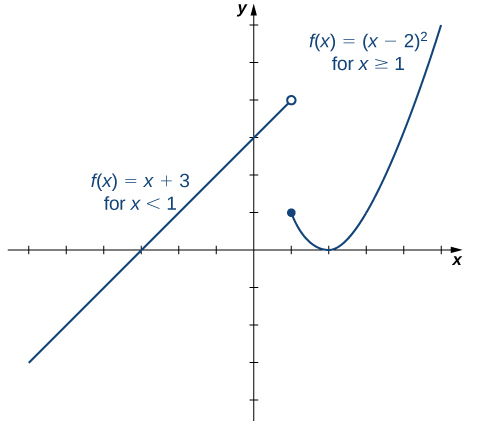
Graph the linear function on the interval and graph the quadratic function on the interval Since the value of the function at is given by the formula we see that To indicate this on the graph, we draw a closed circle at the point The value of the function is given by for all but not at To indicate this on the graph, we draw an open circle at
1次関数を区間に、2次関数を区間に描く。での値は式で与えられるので、となる。これを示すため、点には黒丸を描く。すべてのではで値が与えられるが、ではそうではない。したがって、点には白丸を描く。
OpenStax, Rice University; Calculus Volume 1. · CC BY-NC-SA 4.0
Figure 1.22図 1.22
This piecewise-defined function is linear for and quadratic for
この区分的に定義された関数は、では1次式、では2次式である。
Example 1.20例題 1.20
Parking Fees Described by a Piecewise-Defined Function区分的に定義された関数で駐車料金を表す
In a big city, drivers are charged variable rates for parking in a parking garage. They are charged $10 for the first hour or any part of the first hour and an additional $2 for each hour or part thereof up to a maximum of $30 for the day. The parking garage is open from 6 a.m. to 12 midnight.
英語のヒント
大都市のある立体駐車場では、駐車時間に応じて料金が変わる。最初の1時間は、1時間未満でも10ドル。その後は1時間ごとに2ドルが加わり、1時間未満の端数も1時間として数える。1日の上限は30ドルである。駐車場は午前6時から深夜0時まで営業している。
- Write a piecewise-defined function that describes the cost to park in the parking garage as a function of hours parked駐車時間を変数として、駐車料金を表す区分的に定義された関数を書け。
- Sketch a graph of this functionこの関数のグラフを描け。
Solution解き方
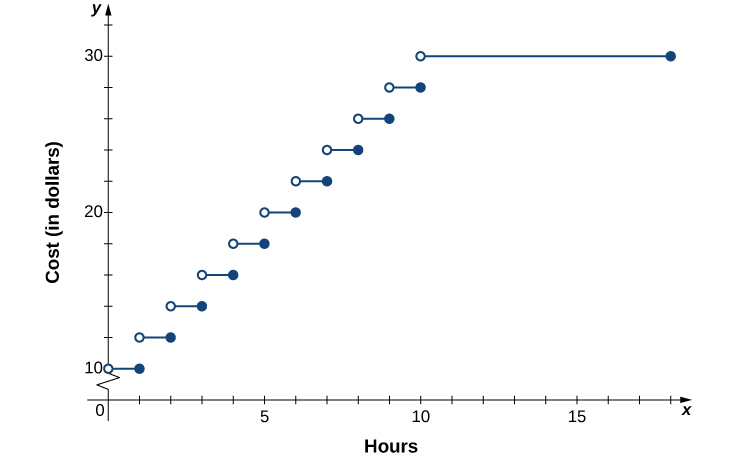
- Since the parking garage is open 18 hours each day, the domain for this function is The cost to park a car at this parking garage can be described piecewise by the function1日の営業時間は18時間なので、この関数の定義域はである。駐車料金は次の区分的な関数で表せる。
- The graph of the function consists of several horizontal line segments.この関数のグラフは、いくつかの水平な線分からなる。
OpenStax, Rice University; Calculus Volume 1. · CC BY-NC-SA 4.0