第1章関数とグラフ
Algebraic Functions代数関数
By allowing for quotients and fractional powers in polynomial functions, we create a larger class of functions. An algebraic function is one that involves addition, subtraction, multiplication, division, rational powers, and roots. Two types of algebraic functions are rational functions and root functions.
英語のヒント
多項式関数に、商や分数のべきも認めると、さらに広い種類の関数を作れる。代数関数とは、加法・減法・乗法・除法・有理数のべき・べき根を用いて表される関数である。有理関数とべき根の関数は、その2つの例である。
Just as rational numbers are quotients of integers, rational functions are quotients of polynomials. In particular, a rational function is any function of the form where and are polynomials. For example,
英語のヒント
有理数が整数どうしの商であるのと同じように、有理関数は多項式どうしの商である。具体的には、とを多項式としてという形で表される関数を、有理関数という。たとえば、次の関数がある。
are rational functions. A root function is a power function of the form where is a positive integer greater than one. For example, is the square-root function and is the cube-root function. By allowing for compositions of root functions and rational functions, we can create other algebraic functions. For example, is an algebraic function.
英語のヒント
これらは有理関数である。べき根の関数とは、1より大きい正の整数に対し、という形をとるべき関数である。たとえば、は平方根の関数、は立方根の関数である。べき根の関数と有理関数を合成すれば、別の代数関数も作れる。たとえば、は代数関数である。
Example 1.16例題 1.16
Finding Domain and Range for Algebraic Functions代数関数の定義域と値域を求める
For each of the following functions, find the domain and range.
次の各関数について、定義域と値域を求めよ。
Solution解き方
- It is not possible to divide by zero, so the domain is the set of real numbers such that To find the range, we need to find the values for which there exists a real number such that0で割ることはできないので、定義域はを満たす実数の集合である。値域を求めるには、次の式を満たす実数が存在するような、の値を求める。
When we multiply both sides of this equation by we see that must satisfy the equation両辺にを掛けると、は次の式を満たす必要がある。From this equation, we can see that must satisfyこの式から、は次の式を満たす必要があるとわかる。
If this equation has no solution. On the other hand, as long asなら、この方程式に解はない。一方、である限り、次の値が、
satisfies this equation. We can conclude that the range of isこの方程式を満たす。したがって、の値域はである。 - To find the domain of , we need to identify values of with . Note that when or . Solving is equivalent to solving . If this inequality is true, then both factors are positive or both are negative.の定義域を求めるには、を満たすの値を調べる。またはのとき、となる。を解くことは、を解くことと同じである。この不等式が成り立つとき、2つの因数は両方とも正、または両方とも負である。Case 1: Both factors are positive.場合1:2つの因数が両方とも正。So, the expression is positive for all values in the interval .したがって、式は区間のすべての値で正になる。Case 2: Both factors are negative.場合2:2つの因数が両方とも負。There is no value of that can satisfy both inequalities.この2つの不等式を同時に満たすの値は存在しない。The domain of the function is .この関数の定義域はである。To identify the range, note that if , then . Therefore, . The range of is .値域を求めるには、ならであることに注目する。したがってであり、の値域はとなる。
The root functions have defining characteristics depending on whether is odd or even. For all even integers the domain of is the interval For all odd integers the domain of is the set of all real numbers. Since for odd integers is an odd function if is odd. See the graphs of root functions for different values of in Figure 1.21.
べき根の関数の性質は、が奇数か偶数かで異なる。すべての偶数に対して、の定義域は区間である。すべての奇数に対して、の定義域は実数全体である。奇数の場合にはが成り立つ。したがって、が奇数の場合、整数は奇関数となる。図1.21で、の値が異なるべき根の関数のグラフを確認しよう。
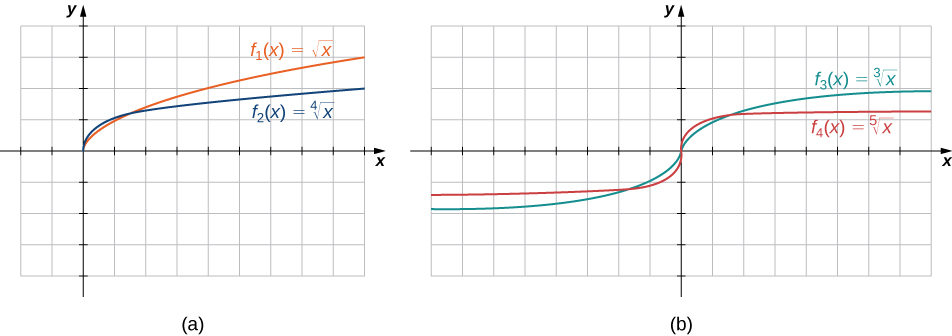
OpenStax, Rice University; Calculus Volume 1. · CC BY-NC-SA 4.0
Figure 1.21図 1.21
(a) If is even, the domain of is (b) If is odd, the domain of is and the function is an odd function.
(a) が偶数なら、の定義域はである。(b) が奇数なら、の定義域はであり、関数は奇関数である。
Example 1.17例題 1.17
Finding Domains for Algebraic Functions代数関数の定義域を求める
For each of the following functions, determine the domain of the function.
次の各関数の定義域を求めよ。
Solution解き方
- You cannot divide by zero, so the domain is the set of values such that Therefore, the domain is0で割ることはできないので、定義域はを満たすの集合である。したがって、定義域はとなる。
- You need to determine the values of for which the denominator is zero. Since for all real numbers the denominator is never zero. Therefore, the domain is分母が0になるの値を調べる。すべての実数に対してなので、分母は決して0にならない。したがって、定義域はである。
- Since the square root of a negative number is not a real number, the domain is the set of values for which Therefore, the domain is負の数の平方根は実数ではないので、定義域はを満たすの集合である。したがって、定義域はとなる。
- The cube root is defined for all real numbers, so the domain is the interval立方根はすべての実数に対して定義されるので、定義域は区間である。