The six basic trigonometric functions are periodic, and therefore they are not one-to-one. However, if we restrict the domain of a trigonometric function to an interval where it is one-to-one, we can define its inverse. Consider the sine function (Figure 1.34). The sine function is one-to-one on an infinite number of intervals, but the standard convention is to restrict the domain to the interval By doing so, we define the inverse sine function on the domain such that for any in the interval the inverse sine function tells us which angle in the interval satisfies Similarly, we can restrict the domains of the other trigonometric functions to define inverse trigonometric functions, which are functions that tell us which angle in a certain interval has a specified trigonometric value.
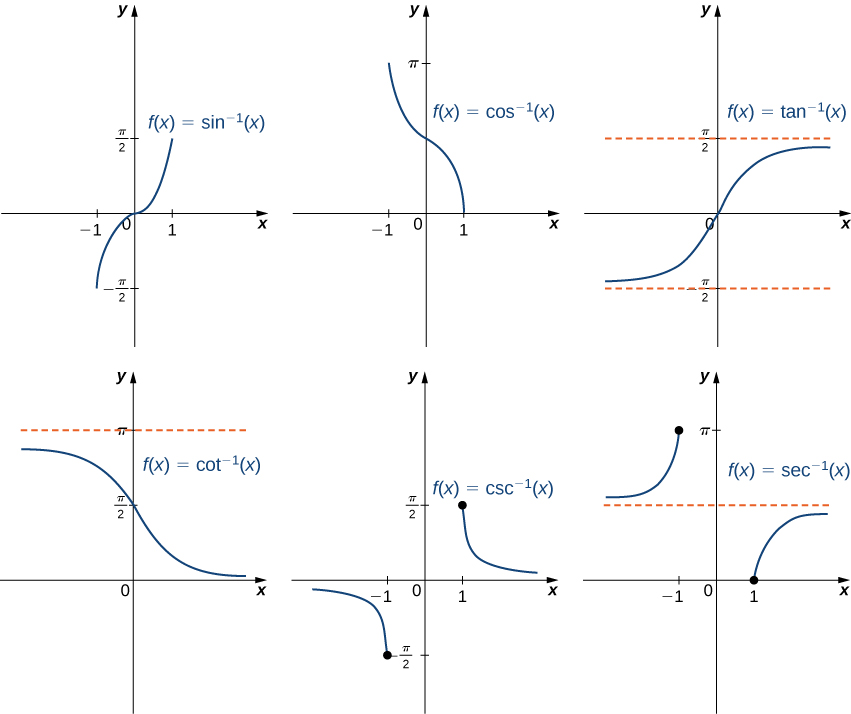
To graph the inverse trigonometric functions, we use the graphs of the trigonometric functions restricted to the domains defined earlier and reflect the graphs about the line (Figure 1.41).
OpenStax, Rice University; Calculus Volume 1. · CC BY-NC-SA 4.0
Figure 1.41図 1.41
The graph of each of the inverse trigonometric functions is a reflection about the line of the corresponding restricted trigonometric function.
逆三角関数のグラフは、対応する三角関数を定義域の指定区間に制限し、直線について反転したものである。
When evaluating an inverse trigonometric function, the output is an angle. For example, to evaluate we need to find an angle such that Clearly, many angles have this property. However, given the definition of we need the angle that not only solves this equation, but also lies in the interval We conclude that
We now consider a composition of a trigonometric function and its inverse. For example, consider the two expressions and For the first one, we simplify as follows:
The inverse function is supposed to “undo” the original function, so why isn’t Recalling our definition of inverse functions, a function and its inverse satisfy the conditions for all in the domain of and for all in the domain of so what happened here? The issue is that the inverse sine function, is the inverse of the restricted sine function defined on the domain Therefore, for in the interval it is true that However, for values of outside this interval, the equation does not hold, even though is defined for all real numbers
What about Does that have a similar issue? The answer is no. Since the domain of is the interval we conclude that if and the expression is not defined for other values of To summarize,