第1章関数とグラフ
Logarithmic Functions対数関数
Using our understanding of exponential functions, we can discuss their inverses, which are the logarithmic functions. These come in handy when we need to consider any phenomenon that varies over a wide range of values, such as pH in chemistry or decibels in sound levels.
英語のヒント
指数関数を理解したので、その逆関数である対数関数を考えよう。対数関数は、化学のpHや音の大きさを表すデシベルなど、値が広い範囲にわたって変わる現象を扱うときに役立つ。
The exponential function is one-to-one, with domain and range Therefore, it has an inverse function, called the logarithmic function with base For any the logarithmic function with base b, denoted has domain and range and satisfies
指数関数は、定義域、値域の一対一の関数である。したがって逆関数をもち、それを底の対数関数という。に対して、底bの対数関数をと表す。その定義域は、値域はであり、次の関係を満たす。
For example,
たとえば、次のようになる。
Furthermore, since and are inverse functions,
さらに、とは互いに逆関数なので、次の関係が成り立つ。
The most commonly used logarithmic function is the function Since this function uses natural as its base, it is called the natural logarithm. Here we use the notation or to mean For example,
特によく使われる対数関数はである。自然な底を使うため、自然対数と呼ばれる。本書では、をまたはと表す。たとえば、次の値が得られる。
Since the functions and are inverses of each other,
関数とは互いに逆関数なので、次の関係が成り立つ。
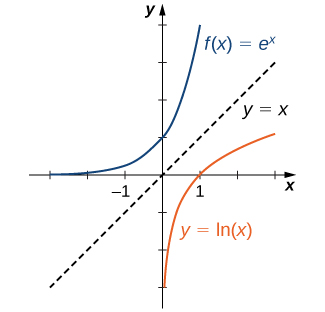
and their graphs are symmetric about the line (Figure 1.46).
また、そのグラフは直線について対称である(図1.46)。
OpenStax, Rice University; Calculus Volume 1. · CC BY-NC-SA 4.0
Figure 1.46図 1.46
The functions and are inverses of each other, so their graphs are symmetric about the line
とは互いに逆関数なので、そのグラフは直線について対称である。
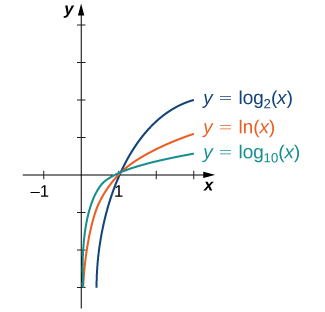
In general, for any base the function is symmetric about the line with the function Using this fact and the graphs of the exponential functions, we graph functions for several values of (Figure 1.47).
一般に、底に対する関数のグラフは、のグラフと直線について対称である。この性質と指数関数のグラフを利用し、いくつかのに対するのグラフを描く(図1.47)。
OpenStax, Rice University; Calculus Volume 1. · CC BY-NC-SA 4.0
Figure 1.47図 1.47
Graphs of are depicted for
についてののグラフ。
Before solving some equations involving exponential and logarithmic functions, let’s review the basic properties of logarithms.
指数関数や対数関数を含む方程式を解く前に、対数の基本的な性質を復習しよう。
Example 1.36例題 1.36
Solving Equations Involving Exponential Functions指数関数を含む方程式を解く
Solve each of the following equations for
次の各方程式をについて解け。
Solution解き方
- Applying the natural logarithm function to both sides of the equation, we have方程式の両辺の自然対数をとると、次のようになる。
Using the power property of logarithms,対数のべきの法則を使うと、
Therefore,したがって、である。 - Multiplying both sides of the equation by we arrive at the equation両辺にを掛けると、次の方程式になる。
Rewriting this equation asこの方程式を次のように書き直すと、
we can then rewrite it as a quadratic equation inについての2次方程式として書ける。
Now we can solve the quadratic equation. Factoring this equation, we obtainあとは2次方程式を解けばよい。因数分解すると、次の式を得る。
Therefore, the solutions satisfy and Taking the natural logarithm of both sides gives us the solutionsしたがって、解はまたはを満たす。両辺の自然対数をとると、解が得られる。
Example 1.37例題 1.37
Solving Equations Involving Logarithmic Functions対数関数を含む方程式を解く
Solve each of the following equations for
次の各方程式をについて解け。
Solution解き方
- By the definition of the natural logarithm function,自然対数の定義から、
Therefore, the solution isしたがって、解はである。 - Using the product and power properties of logarithmic functions, rewrite the left-hand side of the equation as対数の積の法則とべきの法則を使い、左辺を書き換える。
Therefore, the equation can be rewritten asしたがって、方程式は次のように書き換えられる。
The solution is解はである。 - Using the power property of logarithmic functions, we can rewrite the equation as
Using the quotient property, this becomes対数のべきの法則を使うと、方程式はと書ける。さらに商の法則を使うと、次のようになる。
Therefore, which implies We should then check for any extraneous solutions.したがって、であり、を得る。最後に、もとの方程式を満たさない余分な解がないか確認する。
When evaluating a logarithmic function with a calculator, you may have noticed that the only options are or log, called the common logarithm, or ln, which is the natural logarithm. However, exponential functions and logarithm functions can be expressed in terms of any desired base If you need to use a calculator to evaluate an expression with a different base, you can apply the change-of-base formulas first. Using this change of base, we typically write a given exponential or logarithmic function in terms of the natural exponential and natural logarithmic functions.
英語のヒント
電卓で対数を計算するとき、常用対数の(またはlog)と、自然対数のlnしかないことに気づいたかもしれない。しかし、指数関数も対数関数も、望む底で表すことができる。異なる底を持つ式を電卓で計算したい場合は、先に底の変換公式を適用すればよい。通常は、与えられた指数関数や対数関数を、自然指数関数と自然対数関数で表し直す。
Proof証明
For the first change-of-base formula, we begin by making use of the power property of logarithmic functions. We know that for any base Therefore,
第1の底の変換公式では、まず対数のべきの法則を使う。任意の底が成り立つ。したがって、
In addition, we know that and are inverse functions. Therefore,
また、とは互いに逆関数なので、
Combining these last two equalities, we conclude that
これら2つの等式を合わせると、を得る。
To prove the second property, we show that
第2の公式を証明するため、次の等式を示す。
Let and We will show that By the definition of logarithmic functions, we know that and From the previous equations, we see that
、とおき、を示す。対数の定義から、、である。これらより、次の関係を得る。
Therefore, Since exponential functions are one-to-one, we can conclude that
したがってである。指数関数は一対一なので、と結論できる。
□
□
Example 1.38例題 1.38
Changing Bases底を変える
Use a calculating utility to evaluate with the change-of-base formula presented earlier.
先ほどの底の変換公式と電卓などを使い、を計算せよ。
Solution解き方
Use the second equation with and
第2の公式で、とする。
Example 1.39例題 1.39
Chapter Opener: The Richter Scale for Earthquakes章の導入問題:地震のリヒタースケール
Robb Hannawacker, National Park Service; modified by OpenStax. · CC BY 2.0
Figure 1.48図 1.48
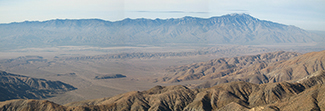
(credit: modification of work by Robb Hannawacker, NPS)
(写真提供:Robb Hannawacker、NPSの作品を改変)
In 1935, Charles Richter developed a scale (now known as the Richter scale) to measure the magnitude of an earthquake. The scale is a base-10 logarithmic scale, and it can be described as follows: Consider one earthquake with magnitude on the Richter scale and a second earthquake with magnitude on the Richter scale. Suppose which means the earthquake of magnitude is stronger, but how much stronger is it than the other earthquake? A way of measuring the intensity of an earthquake is by using a seismograph to measure the amplitude of the earthquake waves. If is the amplitude measured for the first earthquake and is the amplitude measured for the second earthquake, then the amplitudes and magnitudes of the two earthquakes satisfy the following equation:
英語のヒント
1935年、チャールズ・リヒターは地震の規模を測る尺度を開発した。現在リヒタースケールと呼ばれるこの尺度は、底10の対数目盛であり、次のように説明できる。リヒタースケールでマグニチュードの地震と、の地震を考える。なら、の地震のほうが大きい。しかし、どれだけ違うのだろうか。地震の強さを調べる方法の1つは、地震計で地震波の振幅を測ることである。第1の地震で測った振幅を、第2の地震で測った振幅をとすると、振幅とマグニチュードは次の関係を満たす。
Consider an earthquake that measures 8 on the Richter scale and an earthquake that measures 7 on the Richter scale. Then,
マグニチュード8の地震と7の地震を考える。このとき、
Therefore,
したがって、
which implies or Since is 10 times the size of we say that the first earthquake is 10 times as intense as the second earthquake. On the other hand, if one earthquake measures 8 on the Richter scale and another measures 6, then the relative intensity of the two earthquakes satisfies the equation
この式から、、すなわちとわかる。はの10倍なので、振幅で比較した強さは第1の地震が第2の地震の10倍である。一方、マグニチュード8と6の地震を比較すると、振幅による強さの比は次の方程式を満たす。
Therefore, That is, the first earthquake is 100 times more intense than the second earthquake.
したがって、である。つまり、振幅で比較すると、第1の地震は第2の地震の100倍の強さである。
How can we use logarithmic functions to compare the relative severity of the magnitude 9 earthquake in Japan in 2011 with the magnitude 7.3 earthquake in Haiti in 2010?
英語のヒント
この問題では、2011年の日本の地震のマグニチュードを9、2010年のハイチの地震を7.3として扱う。対数関数を使って、振幅による強さの比をどう求められるか。
Solution解き方
To compare the Japan and Haiti earthquakes, we can use an equation presented earlier:
両者を比較するには、先ほどの関係式を使う。
Therefore, and we conclude that the earthquake in Japan was approximately times more intense than the earthquake in Haiti.
したがって、となる。このモデルで振幅を比較すると、日本の地震はハイチの地震の約倍となる。