第1章関数とグラフ
Polynomials多項式
A linear function is a special type of a more general class of functions: polynomials. A polynomial function is any function that can be written in the form
英語のヒント
1次式の関数は、より広い関数の分類である多項式関数の特別な場合である。多項式関数とは、次の形で書ける関数をいう。
(1.7)
for some integer and constants where In the case when we allow for if the function is called the zero function. The value is called the degree of the polynomial; the constant is called the leading coefficient. A linear function of the form is a polynomial of degree 1 if and degree 0 if A polynomial of degree 0 is also called a constant function. A polynomial function of degree 2 is called a quadratic function. In particular, a quadratic function has the form where A polynomial function of degree is called a cubic function.
英語のヒント
ここで、は整数、は定数であり、とする。の場合にはも認め、であれば、関数を零関数という。を多項式の次数、定数を最高次の係数という。という関数は、なら次数1の多項式、なら定数多項式である。次数0の多項式は定数関数とも呼ばれる。次数2の多項式関数は2次関数と呼ばれ、具体的にはという形で、である。次数の多項式関数を3次関数という。
Power Functionsべき関数
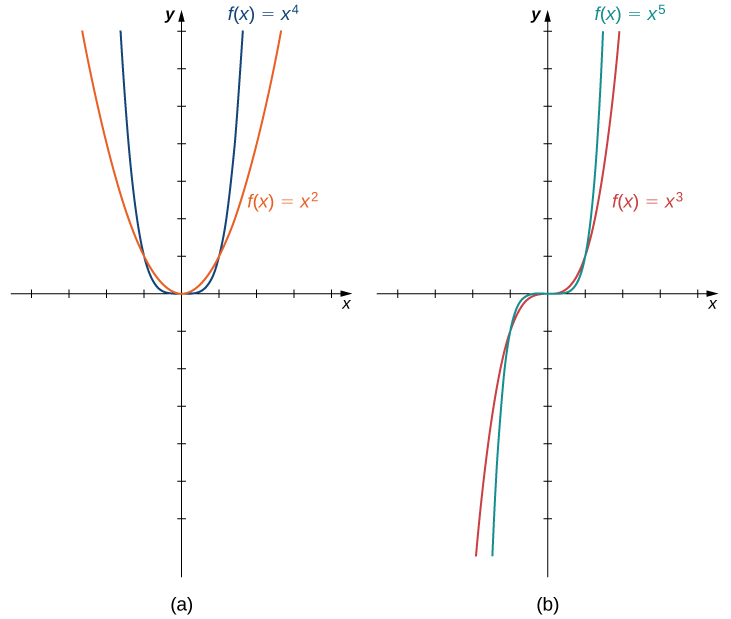
Some polynomial functions are power functions. A power function is any function of the form where and are any real numbers. The exponent in a power function can be any real number, but here we consider the case when the exponent is a positive integer. (We consider other cases later.) If the exponent is a positive integer, then is a polynomial. If is even, then is an even function because if is even. If is odd, then is an odd function because if is odd (Figure 1.18).
英語のヒント
多項式関数の中には、べき関数であるものもある。べき関数とはという形の関数であり、とは任意の実数である。べき関数の指数はどんな実数でもよいが、ここでは正の整数の場合を考える。その他の場合は後で扱う。指数が正の整数なら、は多項式である。が偶数なら、は偶関数になる。が偶数のときとなるからである。が奇数なら、は奇関数になる。が奇数のときとなるからである(図1.18)。
OpenStax, Rice University; Calculus Volume 1. · CC BY-NC-SA 4.0
Figure 1.18図 1.18
(a) For any even integer is an even function. (b) For any odd integer is an odd function.
(a) 任意の偶数の整数は偶関数である。(b) 任意の奇数の整数は奇関数である。
Behavior at Infinity無限遠での振る舞い
To determine the behavior of a function as the inputs approach infinity, we look at the values as the inputs, become larger. For some functions, the values of approach a finite number. For example, for the function the values become closer and closer to zero for all values of as they get larger and larger. For this function, we say approaches two as goes to infinity,” and we write as The line is a horizontal asymptote for the function because the graph of the function gets closer to the line as gets larger.
英語のヒント
入力が無限大に近づくときの関数の振る舞いを調べるには、入力を大きくしていったときの値に注目する。関数によっては、が有限の数に近づく。たとえば、関数では、を大きくするほどは0に近づく。このとき、が無限大に近づくとは2に近づくといい、のときと書く。を大きくするにつれて関数のグラフが直線に近づくので、この直線を関数の水平漸近線という。
For other functions, the values may not approach a finite number but instead may become larger for all values of as they get larger. In that case, we say approaches infinity as approaches infinity,” and we write as For example, for the function the outputs become larger as the inputs get larger. We can conclude that the function approaches infinity as approaches infinity, and we write as The behavior as and the meaning of as or can be defined similarly. We can describe what happens to the values of as and as as the end behavior of the function.
英語のヒント
一方、を大きくしていくと、関数値が有限の数に近づかず、際限なく大きくなる関数もある。この場合、が無限大に近づくとも無限大に近づくといい、のときと書く。たとえば関数では、入力が大きくなるにつれて出力も大きくなる。したがって、関数はが無限大に近づくと無限大に近づき、のときと書く。のときの振る舞いや、またはのときとなることの意味も、同じように定義できる。のとき、およびのときにの値がどうなるかを、その関数の無限遠での振る舞いという。
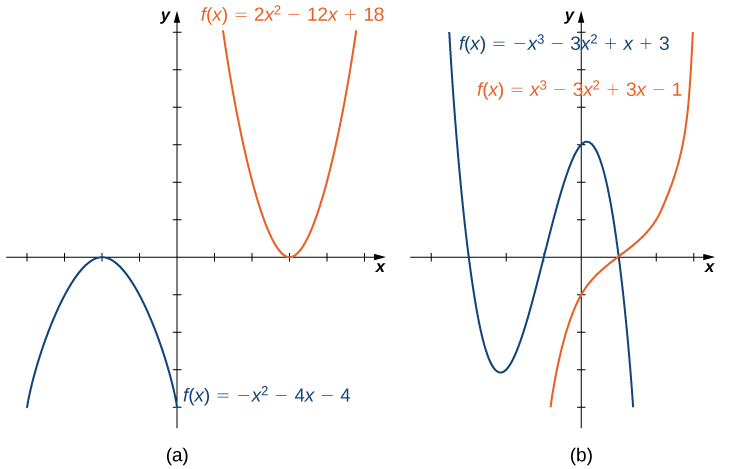
To understand the end behavior for polynomial functions, we can focus on quadratic and cubic functions. The behavior for higher-degree polynomials can be analyzed similarly. Consider a quadratic function If the values as If the values as Since the graph of a quadratic function is a parabola, the parabola opens upward if the parabola opens downward if (See Figure 1.19(a).)
多項式関数の無限遠での振る舞いを理解するため、2次関数と3次関数に注目しよう。より高い次数の多項式も同様に調べられる。2次関数を考える。なら、のときとなる。なら、のときとなる。2次関数のグラフは放物線なので、なら上向きに開き、なら下向きに開く(図1.19(a))。
Now consider a cubic function If then as and as If then as and as As we can see from both of these graphs, the leading term of the polynomial determines the end behavior. (See Figure 1.19(b).)
英語のヒント
次に3次関数を考える。なら、のときとなり、のときとなる。なら、のときとなり、のときとなる。両方のグラフからわかるように、多項式の最高次の項が無限遠での振る舞いを決める(図1.19(b))。
OpenStax, Rice University; Calculus Volume 1. · CC BY-NC-SA 4.0
Figure 1.19図 1.19
(a) For a quadratic function, if the leading coefficient the parabola opens upward. If the parabola opens downward. (b) For a cubic function if the leading coefficient the values as and the values as If the leading coefficient the opposite is true.
(a) 2次関数は、最高次の係数がなら上向きの放物線、なら下向きの放物線になる。(b) 3次関数の最高次の係数がなら、のとき、のときとなる。最高次の係数がなら、その逆である。