第1章関数とグラフ
Combining Functions関数を組み合わせる
Now that we have reviewed the basic characteristics of functions, we can see what happens to these properties when we combine functions in different ways, using basic mathematical operations to create new functions. For example, if the cost for a company to manufacture items is described by the function and the revenue created by the sale of items is described by the function then the profit on the manufacture and sale of items is defined as Using the difference between two functions, we created a new function.
英語のヒント
関数の基本的な特徴を復習したので、今度は基本的な数学の演算で関数をさまざまに組み合わせ、新しい関数を作ると、それらの性質がどうなるかを調べよう。たとえば、ある会社が品物を個製造する費用を関数、個販売したときの売上を関数で表すとする。このとき、個の製造と販売による利益は、と定義される。2つの関数の差を使って、新しい関数を作ったことになる。
Alternatively, we can create a new function by composing two functions. For example, given the functions and the composite function is defined such that
英語のヒント
別の方法として、2つの関数を合成して新しい関数を作ることもできる。たとえば、関数とが与えられたとき、合成関数を次のように定義する。
The composite function is defined such that
合成関数は、次のように定義する。
Note that these two new functions are different from each other.
この2つの新しい関数は互いに異なることに注意しよう。
Combining Functions with Mathematical Operators演算記号を使って関数を組み合わせる
To combine functions using mathematical operators, we simply write the functions with the operator and simplify. Given two functions and we can define four new functions:
英語のヒント
数学の演算を使って関数を組み合わせるには、関数の間に演算記号を書いて式を整理すればよい。2つの関数とが与えられると、次の4つの新しい関数を定義できる。
Example 1.6例題 1.6
Combining Functions Using Mathematical Operations数学の演算で関数を組み合わせる
Given the functions and find each of the following functions and state its domain.
関数とについて、次の各関数を求め、その定義域を示せ。
Solution解き方
- The domain of this function is the interval。この関数の定義域は区間である。
- The domain of this function is the interval。この関数の定義域は区間である。
- The domain of this function is the interval。この関数の定義域は区間である。
- The domain of this function is。この関数の定義域はである。
Function Composition関数の合成
When we compose functions, we take a function of a function. For example, suppose the temperature on a given day is described as a function of time (measured in hours after midnight) as in Table 1.1. Suppose the cost to heat or cool a building for 1 hour, can be described as a function of the temperature Combining these two functions, we can describe the cost of heating or cooling a building as a function of time by evaluating We have defined a new function, denoted which is defined such that for all in the domain of This new function is called a composite function. We note that since cost is a function of temperature and temperature is a function of time, it makes sense to define this new function It does not make sense to consider because temperature is not a function of cost.
英語のヒント
関数を合成するとは、ある関数の値に対して別の関数を適用することである。たとえば、表1.1のように、ある日の気温を、午前0時からの経過時間の関数として記述するとしよう。また、建物を1時間暖房・冷房する費用を、気温の関数として記述できるとする。この2つの関数を組み合わせてを計算すれば、建物の暖房・冷房費用を時刻の関数として表せる。この新しい関数をと表し、の定義域内のすべてのについてとなるように定義する。この新しい関数を合成関数という。費用は気温の関数で、気温は時刻の関数なので、この新しい関数を定義することには意味がある。気温は費用の関数ではないため、を考えることには、この場面では意味がない。
A composite function can be viewed in two steps. First, the function maps each input in the domain of to its output in the range of Second, since the range of is a subset of the domain of the output is an element in the domain of and therefore it is mapped to an output in the range of In Figure 1.12, we see a visual image of a composite function.
合成関数は2段階に分けて捉えられる。まず、関数が、の定義域内の各入力を、の値域内の出力へ対応させる。次に、の値域はの定義域の部分集合なので、その出力はの定義域の要素であり、の値域内の出力へ対応させられる。図1.12に、合成関数の見取り図を示す。
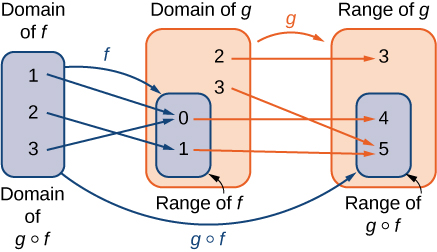
OpenStax, Rice University; Calculus Volume 1. · CC BY-NC-SA 4.0
Figure 1.12図 1.12
For the composite function we have and
合成関数について、およびとなる。
Example 1.7例題 1.7
Compositions of Functions Defined by Formulas式で定義された関数の合成
Consider the functions and
関数とを考えよ。
- Find and state its domain and range.を求め、その定義域と値域を示せ。
- Evaluateの値を求めよ。
- Find and state its domain and range.を求め、その定義域と値域を示せ。
- Evaluateの値を求めよ。
Solution解き方
- We can find the formula for in two different ways. We could writeの式は、2通りの方法で求められる。まず、次のように書ける。
Alternatively, we could write別の方法では、次のように書ける。
Since for all real numbers the domain of is the set of all real numbers. Since the range is, at most, the interval To show that the range is this entire interval, we let and solve this equation for to show that for all in the interval there exists a real number such that Solving this equation for we see that which implies thatすべての実数についてなので、の定義域は実数全体の集合である。なので、値域は少なくとも区間の外へは広がらない。この区間全体が値域であることを示すために、とおいてについて解く。それにより、区間内のすべてのに対して、となる実数が存在することを示す。この方程式をについて解くととなり、したがって、
If is in the interval the expression under the radical is nonnegative, and therefore there exists a real number such that We conclude that the range of is the interval英語のヒント
が区間にあれば、根号の中の式は0以上である。したがって、となる実数が存在する。よって、の値域は区間である。
- We can find a formula for in two ways. First, we could writeの式は2通りの方法で求められる。まず、次のように書ける。
Alternatively, we could write別の方法では、次のように書ける。
The domain of is the set of all real numbers such that To find the range of we need to find all values for which there exists a real number such thatの定義域は、を満たす実数すべての集合である。の値域を求めるため、次の条件を満たす実数が存在するようなの値をすべて求める。
Solving this equation for we see that we need to satisfyこの方程式をについて解くと、は次の条件を満たす必要がある。
which simplifies toこれを整理すると、
Finally, we obtain最終的に、次を得る。
Since is a real number if and only if the range of is the setが実数になるための必要十分条件はなので、の値域は集合である。
In Example 1.7, we can see that This tells us, in general terms, that the order in which we compose functions matters.
英語のヒント
例題1.7では、であることがわかる。一般に、関数を合成するときには、その順序が重要である。
Example 1.8例題 1.8
Composition of Functions Defined by Tables表で定義された関数の合成
0 |
1 |
2 |
3 |
4 |
||||
0 |
4 |
2 |
4 |
0 |
4 |
0 |
2 |
4 |
|||
1 |
0 |
3 |
0 |
5 |
- Evaluateの値を求めよ。
- State the domain and range ofの定義域と値域を示せ。
- Evaluateの値を求めよ。
- State the domain and range ofの定義域と値域を示せ。
Solution解き方
- The domain of is the set Since the range of is the set the range of is the setの定義域は集合である。の値域は集合なので、の値域は集合である。
- The domain of is the set Since the range of is the set the range of is the setの定義域は集合である。の値域は集合なので、の値域は集合である。
Example 1.9例題 1.9
Application Involving a Composite Function合成関数を使う応用例
A store is advertising a sale of off all merchandise. Caroline has a coupon that entitles her to an additional off any item, including sale merchandise. If Caroline decides to purchase an item with an original price of dollars, how much will she end up paying if she applies her coupon to the sale price? Solve this problem by using a composite function.
英語のヒント
ある店が、すべての商品を引きにするセールを宣伝している。キャロラインは、セール品を含むどの商品でも、さらに引きになるクーポンを持っている。元の価格がドルの商品を買い、セール価格にクーポンを適用すると、最終的にいくら支払うことになるか。合成関数を使って解け。
Solution解き方
Since the sale price is off the original price, if an item is dollars, its sale price is given by Since the coupon entitles an individual to off the price of any item, if an item is dollars, the price, after applying the coupon, is given by Therefore, if the price is originally dollars, its sale price will be and then its final price after the coupon will be
セール価格は元の価格の引きなので、ドルの商品なら、セール価格はで与えられる。クーポンを使うとどの商品も価格の引きになるので、ドルの商品なら、適用後の価格はで与えられる。したがって、元の価格がドルなら、セール価格は、さらにクーポン適用後の最終価格はとなる。