第1章関数とグラフ
1.4 Inverse Functions1.4 逆関数
Learning Objectives学習目標
- Determine the conditions for when a function has an inverse.関数が逆関数を持つための条件を判定する。
- Use the horizontal line test to recognize when a function is one-to-one.水平線テストを使って、関数が一対一かどうかを判定する。
- Find the inverse of a given function.与えられた関数の逆関数を求める。
- Draw the graph of an inverse function.逆関数のグラフを描く。
- Evaluate inverse trigonometric functions.逆三角関数の値を求める。
An inverse function reverses the operation done by a particular function. In other words, whatever a function does, the inverse function undoes it. In this section, we define an inverse function formally and state the necessary conditions for an inverse function to exist. We examine how to find an inverse function and study the relationship between the graph of a function and the graph of its inverse. Then we apply these ideas to define and discuss properties of the inverse trigonometric functions.
英語のヒント
逆関数は、もとの関数が行った操作を逆向きに行う。言い換えると、関数が何をしたとしても、それを元に戻すのが逆関数である。この節では逆関数を厳密に定義し、それが存在するために必要な条件を述べる。逆関数の求め方と、もとの関数のグラフとの関係を調べる。さらに、これらの考えを使って逆三角関数を定義し、その性質を考える。
Existence of an Inverse Function逆関数が存在する条件
We begin with an example. Given a function and an output we are often interested in finding what value or values were mapped to by For example, consider the function Since any output we can solve this equation for to find that the input is This equation defines as a function of Denoting this function as and writing we see that for any in the domain of Thus, this new function, “undid” what the original function did. A function with this property is called the inverse function of the original function.
英語のヒント
例から始めよう。関数と出力が与えられると、によってに対応づけられた入力がどれかを求めたいことがある。たとえば、関数を考える。出力はなので、これをについて解くと、入力はと求まる。この式は、の関数としてを定義する。この関数をと表し、と書くと、定義域内のすべてのについて、が成り立つ。つまり、新しい関数は、もとの関数が行ったことを元に戻している。この性質を持つ関数を、もとの関数の逆関数という。
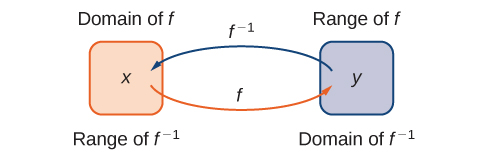
Note that is read as “f inverse.” Here, the is not used as an exponent and Figure 1.37 shows the relationship between the domain and range of f and the domain and range of
は「f inverse(エフ・インヴァース)」と読む。ここでは指数ではなく、である。図1.37に、fの定義域・値域と、の定義域・値域の関係を示す。
OpenStax, Rice University; Calculus Volume 1. · CC BY-NC-SA 4.0
Figure 1.37図 1.37
Given a function and its inverse if and only if The range of becomes the domain of and the domain of becomes the range of
関数と逆関数が成り立つことと、が成り立つことは同値である。の値域はの定義域に、の定義域はの値域になる。
Recall that a function has exactly one output for each input. Therefore, to define an inverse function, we need to map each input to exactly one output. For example, let’s try to find the inverse function for Solving the equation for we arrive at the equation This equation does not describe as a function of because there are two solutions to this equation for every The problem with trying to find an inverse function for is that two inputs are sent to the same output for each output The function discussed earlier did not have this problem. For that function, each input was sent to a different output. A function that sends each input to a different output is called a one-to-one function.
英語のヒント
関数は各入力に対して出力をちょうど1つ対応させることを思い出そう。逆関数を定義するときも、入力ごとに出力がちょうど1つに決まらなければならない。たとえば、の逆関数を求めてみよう。方程式をについて解くと、となる。この式は、の関数としてを定めていない。どのに対しても、解が2つあるためである。の逆関数を作ろうとすると問題になるのは、各出力に対して、同じ出力へ送られる入力が2つあることである。先ほどのには、この問題はなかった。その関数では、異なる入力は異なる出力に送られていた。このように、異なる入力を必ず異なる出力に対応させる関数を、一対一の関数という。
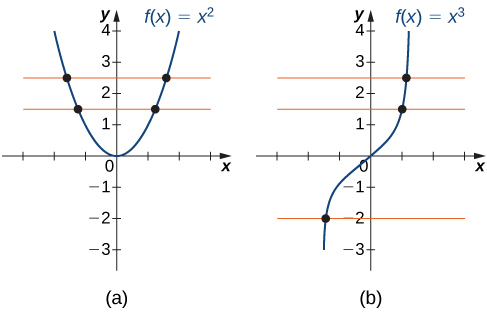
One way to determine whether a function is one-to-one is by looking at its graph. If a function is one-to-one, then no two inputs can be sent to the same output. Therefore, if we draw a horizontal line anywhere in the -plane, according to the horizontal line test, it cannot intersect the graph more than once. We note that the horizontal line test is different from the vertical line test. The vertical line test determines whether a graph is the graph of a function. The horizontal line test determines whether a function is one-to-one (Figure 1.38).
関数が一対一かどうかは、グラフからも判定できる。一対一の関数では、2つの異なる入力が同じ出力になることはない。したがって、平面のどこに水平線を引いても、グラフと2回以上交わることはない。これを利用するのが水平線テストである。水平線テストと垂直線テストは目的が異なる。垂直線テストは、あるグラフが関数のグラフかどうかを判定する。水平線テストは、その関数が一対一かどうかを判定する(図1.38)。
OpenStax, Rice University; Calculus Volume 1. · CC BY-NC-SA 4.0
Figure 1.38図 1.38
(a) The function is not one-to-one because it fails the horizontal line test. (b) The function is one-to-one because it passes the horizontal line test.
(a) は水平線テストを通らないため、一対一ではない。(b) は水平線テストを通るため、一対一である。
Example 1.28例題 1.28
Determining Whether a Function Is One-to-One関数が一対一かどうかを判定する
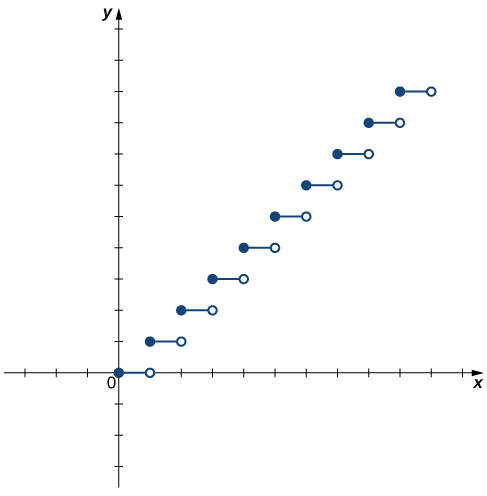
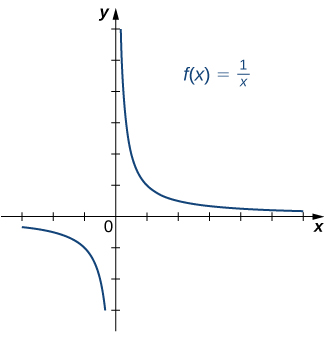
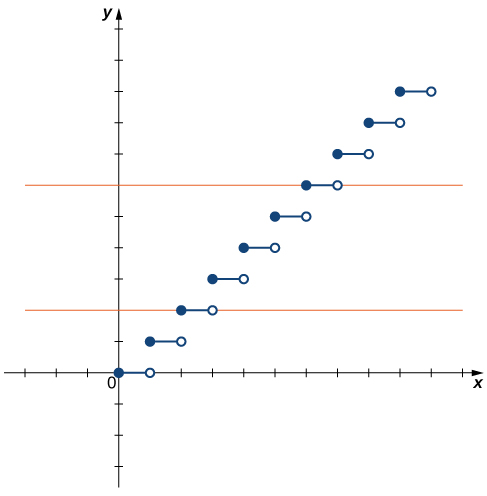
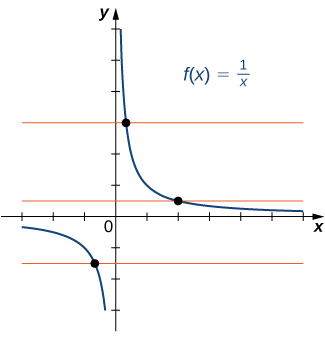
For each of the following functions, use the horizontal line test to determine whether it is one-to-one.
次の各関数について、水平線テストを使い、一対一かどうかを判定せよ。
OpenStax, Rice University; Calculus Volume 1. · CC BY-NC-SA 4.0
OpenStax, Rice University; Calculus Volume 1. · CC BY-NC-SA 4.0
Solution解き方
- Since the horizontal line for any integer intersects the graph more than once, this function is not one-to-one.整数に対する水平線は、グラフと複数の点で交わるので、この関数は一対一ではない。
OpenStax, Rice University; Calculus Volume 1. · CC BY-NC-SA 4.0
- Since every horizontal line intersects the graph once (at most), this function is one-to-one.どの水平線もグラフと高々1回しか交わらないため、この関数は一対一である。
OpenStax, Rice University; Calculus Volume 1. · CC BY-NC-SA 4.0