第1章関数とグラフ
Trigonometric Identities三角関数の恒等式
A trigonometric identity is an equation involving trigonometric functions that is true for all angles for which the functions are defined. We can use the identities to help us solve or simplify equations. The main trigonometric identities are listed next.
三角関数の恒等式とは、関数が定義されるすべての角について成り立つ、三角関数を含んだ等式である。恒等式は、方程式を解いたり、式を簡単にしたりするときに役立つ。主な恒等式を次に示す。
Example 1.25例題 1.25
Solving Trigonometric Equations三角方程式を解く
For each of the following equations, use a trigonometric identity to find all solutions.
次の各方程式について、三角関数の恒等式を使ってすべての解を求めよ。
Solution解き方
- Using the double-angle formula for we see that is a solution ofの倍角の公式を使うと、が次の方程式の解であることは、
if and only if次の式が成り立つことと同値である。
which is true if and only ifこれはさらに、次の式が成り立つことと同値である。
To solve this equation, it is important to note that we need to factor the left-hand side and not divide both sides of the equation by The problem with dividing by is that it is possible that is zero. In fact, if we did divide both sides of the equation by we would miss some of the solutions of the original equation. Factoring the left-hand side of the equation, we see that is a solution of this equation if and only if英語のヒント
この方程式を解くときは、左辺を因数分解することが重要で、両辺をで割ってはいけない。で割ると問題になるのは、が0である可能性があるためである。実際、両辺をで割ると、もとの方程式の解の一部を落としてしまう。左辺を因数分解すると、がこの方程式の解であることは、次の式が成り立つことと同値だとわかる。
Since whenとなるのは、次の場合である。
and whenまた、となるのは、次の場合である。
we conclude that the set of solutions to this equation isしたがって、この方程式の解の集合は次のようになる。 - Using the double-angle formula for and the reciprocal identity for the equation can be written asの倍角の公式との商の関係を使うと、方程式は次のように書ける。
To solve this equation, we multiply both sides by to eliminate the denominator, and say that if satisfies this equation, then satisfies the equation英語のヒント
この方程式を解くため、両辺にを掛けて分母を払う。がこの方程式を満たすなら、は次の方程式も満たす。
However, we need to be a little careful here. Even if satisfies this new equation, it may not satisfy the original equation because, to satisfy the original equation, we would need to be able to divide both sides of the equation by However, if we cannot divide both sides of the equation by Therefore, it is possible that we may arrive at extraneous solutions. So, at the end, it is important to check for extraneous solutions. Returning to the equation, it is important that we factor out of both terms on the left-hand side instead of dividing both sides of the equation by Factoring the left-hand side of the equation, we can rewrite this equation as英語のヒント
ただし、ここでは少し注意が必要である。が新しい方程式を満たしても、もとの方程式を満たすとは限らない。もとの方程式へ戻すには、両辺をで割れなければならない。しかし、の場合はで割れない。したがって、余分な解が入り込む可能性があり、最後にそれを確認することが重要である。計算に戻ろう。ここでも、両辺をで割るのではなく、左辺の両方の項からをくくり出すことが大切である。因数分解すると、次のように書き換えられる。
Therefore, the solutions are given by the angles such that or The solutions of the first equation are The solutions of the second equation are After checking for extraneous solutions, the set of solutions to the equation isしたがって、解の候補はまたはを満たす角である。第1の方程式の解は、第2の方程式の解はである。余分な解がないかを確認すると、この方程式の解の集合は次のようになる。
Example 1.26例題 1.26
Proving a Trigonometric Identity三角関数の恒等式を証明する
Prove the trigonometric identity
三角関数の恒等式を証明せよ。
Solution解き方
We start with the identity
次の恒等式から始める。
Dividing both sides of this equation by we obtain
両辺をで割ると、次の式を得る。
Since and we conclude that
、であるから、次の式が成り立つ。
Graphs and Periods of the Trigonometric Functions三角関数のグラフと周期
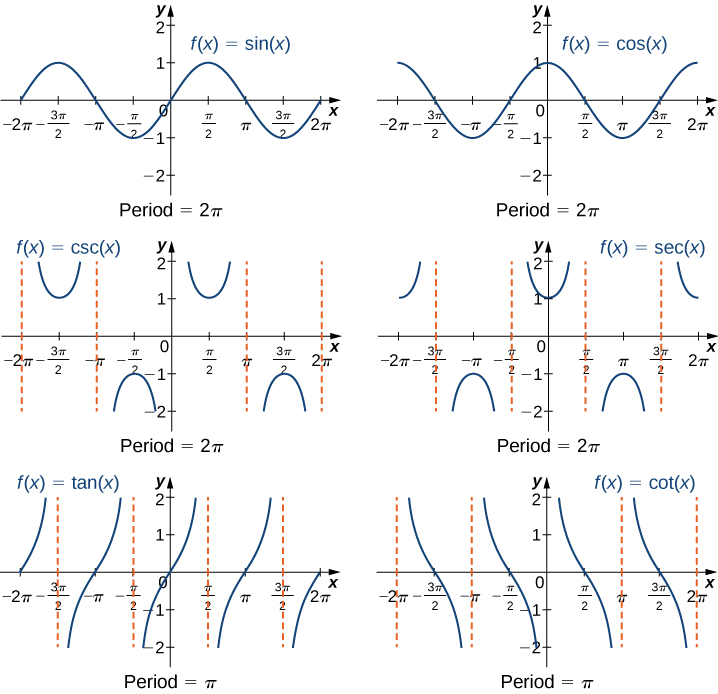
We have seen that as we travel around the unit circle, the values of the trigonometric functions repeat. We can see this pattern in the graphs of the functions. Let be a point on the unit circle and let be the corresponding angle Since the angle and correspond to the same point the values of the trigonometric functions at and at are the same. Consequently, the trigonometric functions are periodic functions. The period of a function is defined to be the smallest positive value such that for all values in the domain of The sine, cosine, secant, and cosecant functions have a period of Since the tangent and cotangent functions repeat on an interval of length their period is (Figure 1.34).
英語のヒント
単位円を一周していくと、三角関数の値は繰り返される。その様子は関数のグラフにも現れる。単位円上の点を、対応する角をとする。角とは同じ点に対応するので、とでの三角関数の値は等しい。したがって、三角関数は周期関数である。関数の周期とは、の定義域内のすべてのに対してとなる、最小の正の値である。正弦、余弦、正割、余割の周期はである。正接と余接は長さの区間ごとに繰り返すので、その周期はである(図1.34)。
OpenStax, Rice University; Calculus Volume 1. · CC BY-NC-SA 4.0
Figure 1.34図 1.34
The six trigonometric functions are periodic.
6つの三角関数はいずれも周期関数である。
Just as with algebraic functions, we can apply transformations to trigonometric functions. In particular, consider the following function:
代数関数と同じように、三角関数にも変換を施せる。具体的に、次の関数を考えよう。
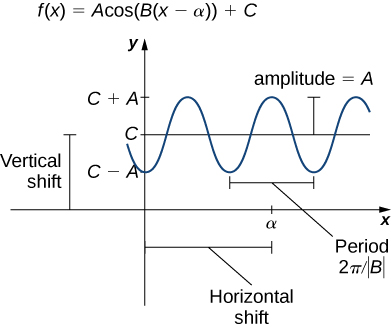
In Figure 1.35, the constant causes a horizontal or phase shift. The factor changes the period. This transformed sine function will have a period The factor results in a vertical stretch by a factor of We say is the “amplitude of ” The constant causes a vertical shift.
英語のヒント
図1.35では、定数が水平方向の移動、すなわち位相の移動をもたらす。係数は周期を変え、このように変換された正弦関数の周期はとなる。係数によって、垂直方向に倍される。を「の振幅」という。定数は垂直方向の移動をもたらす。
OpenStax, Rice University; Calculus Volume 1. · CC BY-NC-SA 4.0
Figure 1.35図 1.35
A graph of a general cosine function.
一般の余弦関数のグラフ。
Notice in Figure 1.34 that the graph of is the graph of shifted to the left units. Therefore, we can write Similarly, we can view the graph of as the graph of shifted right units, and state that
図1.34で、のグラフはのグラフを左へだけ移したものであることに注目しよう。したがって、と書ける。同様に、のグラフはのグラフを右へだけ移したものと考えられ、と書ける。
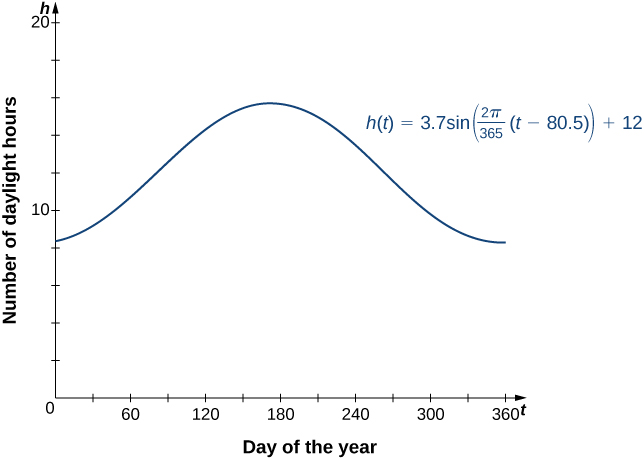
A shifted sine curve arises naturally when graphing the number of hours of daylight in a given location as a function of the day of the year. For example, suppose a city reports that June 21 is the longest day of the year with hours and December 21 is the shortest day of the year with hours. It can be shown that the function
ある場所の日照時間を、その年の何日目かを表す変数の関数として描くと、平行移動した正弦曲線が自然に現れる。たとえば、ある都市では6月21日が最も昼の長い日で時間、12月21日が最も短い日で時間だとする。このとき、次の関数が、
is a model for the number of hours of daylight as a function of day of the year (Figure 1.36).
その年の何日目かを表すに対して、日照時間を表すモデルになる(図1.36)。
OpenStax, Rice University; Calculus Volume 1. · CC BY-NC-SA 4.0
Figure 1.36図 1.36
The hours of daylight as a function of day of the year can be modeled by a shifted sine curve.
1年の中での日照時間の変化は、平行移動した正弦曲線でモデル化できる。
Example 1.27例題 1.27
Sketching the Graph of a Transformed Sine Curve変換した正弦曲線のグラフを描く
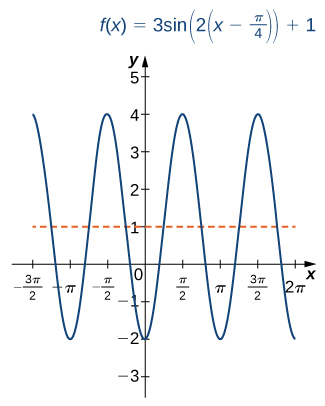
Sketch a graph of
のグラフを描け。
Solution解き方
This graph is a horizontal compression by a factor of 2, a phase shift to the right by π/4 units, followed by a vertical stretch by a factor of 3, and then a vertical shift by 1 unit. The period of is
正弦曲線を水平方向に1/2に縮め、右へπ/4だけ位相を移し、垂直方向に3倍に伸ばし、最後に上へ1だけ移す。の周期はである。
OpenStax, Rice University; Calculus Volume 1. · CC BY-NC-SA 4.0