第1章関数とグラフ
Graphing Exponential Functions指数関数のグラフを描く
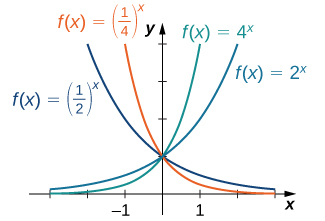
For any base the exponential function is defined for all real numbers and Therefore, the domain of is and the range is To graph we note that for is increasing on and as whereas as On the other hand, if is decreasing on and as whereas as (Figure 1.44).
底に対する指数関数は、すべての実数について定義され、である。したがって、の定義域は、値域はである。のグラフを描くには、はで増加することに注目する。のときとなり、のときとなる。一方、はで減少し、のとき、のときとなる(図1.44)。
OpenStax, Rice University; Calculus Volume 1. · CC BY-NC-SA 4.0
Figure 1.44図 1.44
If then is increasing on If then is decreasing on
なら、はで増加する。なら、はで減少する。
Note that exponential functions satisfy the general laws of exponents. To remind you of these laws, we state them as rules.
指数関数も、一般の指数法則を満たす。復習のため、その法則をまとめる。
Example 1.34例題 1.34
Using the Laws of Exponents指数法則を使う
Use the laws of exponents to simplify each of the following expressions.
指数法則を使って、次の各式を簡単にせよ。
Solution解き方
- We can simplify as follows:次のように簡単にできる。
- We can simplify as follows:次のように簡単にできる。
The Number e数e
A special type of exponential function appears frequently in real-world applications. To describe it, consider the following example of exponential growth, which arises from compounding interest in a savings account. Suppose a person invests dollars in a savings account with an annual interest rate compounded annually. The amount of money after 1 year is
英語のヒント
現実への応用では、ある特別な指数関数が頻繁に現れる。それを説明するため、預金の複利計算から生じる指数的な増加を考えよう。年利の口座にドルを預け、年に1回利息を元金に組み入れるとする。1年後の金額は次のようになる。
The amount of money after years is
年後の金額は、次のようになる。
More generally, the amount after years is
一般に、年後の金額は次のようになる。
If the money is compounded 2 times per year, the amount of money after half a year is
年に2回利息を組み入れるなら、半年後の金額は次のようになる。
The amount of money after year is
年後の金額は、次のようになる。
After years, the amount of money in the account is
年後の口座残高は、次のようになる。
More generally, if the money is compounded times per year, the amount of money in the account after years is given by the function
一般に、年に回利息を組み入れるなら、年後の口座残高は次の関数で与えられる。
What happens as To answer this question, we let and write
とすると、何が起こるだろうか。これを調べるため、とおいて、次のように書く。
and examine the behavior of as using a table of values (Table 1.12).
そして、のときのの振る舞いを、数値の表(表1.12)で調べる。
Looking at this table, it appears that is approaching a number between and as In fact, does approach some number as We call this number . To six decimal places of accuracy,
表を見ると、のとき、はとの間の数へ近づくように見える。実際、のときはある数に近づく。この数をと呼ぶ。小数第6位まで表すと、次の値である。
The letter was first used to represent this number by the Swiss mathematician Leonhard Euler during the 1720s. Although Euler did not discover the number, he showed many important connections between and logarithmic functions. We still use the notation today to honor Euler’s work because it appears in many areas of mathematics and because we can use it in many practical applications.
この数を記号で表した最初の人物は、1720年代のスイスの数学者レオンハルト・オイラーである。オイラー自身がこの数を発見したわけではないが、と対数関数との重要な関係を数多く示した。この数は数学の多くの分野に現れ、実用的な応用も多いため、現在もオイラーの業績にちなんで記号を使っている。
Returning to our savings account example, we can conclude that if a person puts dollars in an account at an annual interest rate compounded continuously, then This function may be familiar. Since functions involving base arise often in applications, we call the function the natural exponential function. Not only is this function interesting because of the definition of the number but also, as discussed next, its graph has an important property.
英語のヒント
預金の例に戻ろう。年利の口座にドルを預け、連続複利で運用するなら、となる。この関数には見覚えがあるかもしれない。底がの関数は応用によく現れるため、を自然指数関数と呼ぶ。この関数は数の定義による面白さだけでなく、次に述べるように、そのグラフにも重要な性質がある。
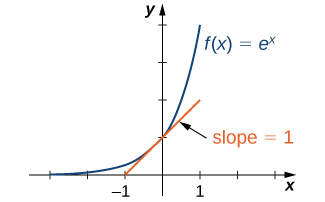
Since we know is increasing on In Figure 1.45, we show a graph of along with a tangent line to the graph of at We give a precise definition of tangent line in the next chapter; but, informally, we say a tangent line to a graph of at is a line that passes through the point and has the same “slope” as at that point The function is the only exponential function with tangent line at that has a slope of 1. As we see later in the text, having this property makes the natural exponential function the most simple exponential function to use in many instances.
英語のヒント
なので、はで増加する。図1.45には、のグラフとでの接線を示した。接線の厳密な定義は次の章で与えるが、大まかには、でののグラフへの接線とは、点を通り、その点でのと同じ「傾き」を持つ直線である。関数は、での接線の傾きが1となる唯一の指数関数である。後で見るように、この性質のため、自然指数関数は多くの場面で最も扱いやすい指数関数となる。
OpenStax, Rice University; Calculus Volume 1. · CC BY-NC-SA 4.0
Figure 1.45図 1.45
The graph of has a tangent line with slope at
のグラフでは、での接線の傾きがである。
Example 1.35例題 1.35
Compounding Interest複利計算
Suppose is invested in an account at an annual interest rate of compounded continuously.
を年利の口座に預け、連続複利で運用するとする。
- Let denote the number of years after the initial investment and denote the amount of money in the account at time Find a formula for預け入れてからの経過年数を、時刻での口座残高をとする。の式を求めよ。
- Find the amount of money in the account after years and after years.年後と年後の口座残高を求めよ。
Solution解き方
- If dollars are invested in an account at an annual interest rate compounded continuously, then Here and Therefore,年利の口座にドルを預けて連続複利で運用すると、となる。ここでは、なので、である。
- After years, the amount of money in the account is年後の口座残高は、次のとおりである。
After years, the amount of money in the account is年後の口座残高は、次のとおりである。